We’re building more than payment infrastructure at Upflam.
Today, we’re proud to release: Upflam Super Scan
A public dashboard for Super Validator health, performance, infrastructure, regions, and historical data.
→ https://t.co/pO7L9Z3Qfh
.@upflamhq is preparing a privacy pool for Canton payments, designed to make the link between a payment's sender and recipient harder to trace.
The team has opened its Groth16 key ceremony to participants ahead of launch.
https://t.co/IFrd52vVN4
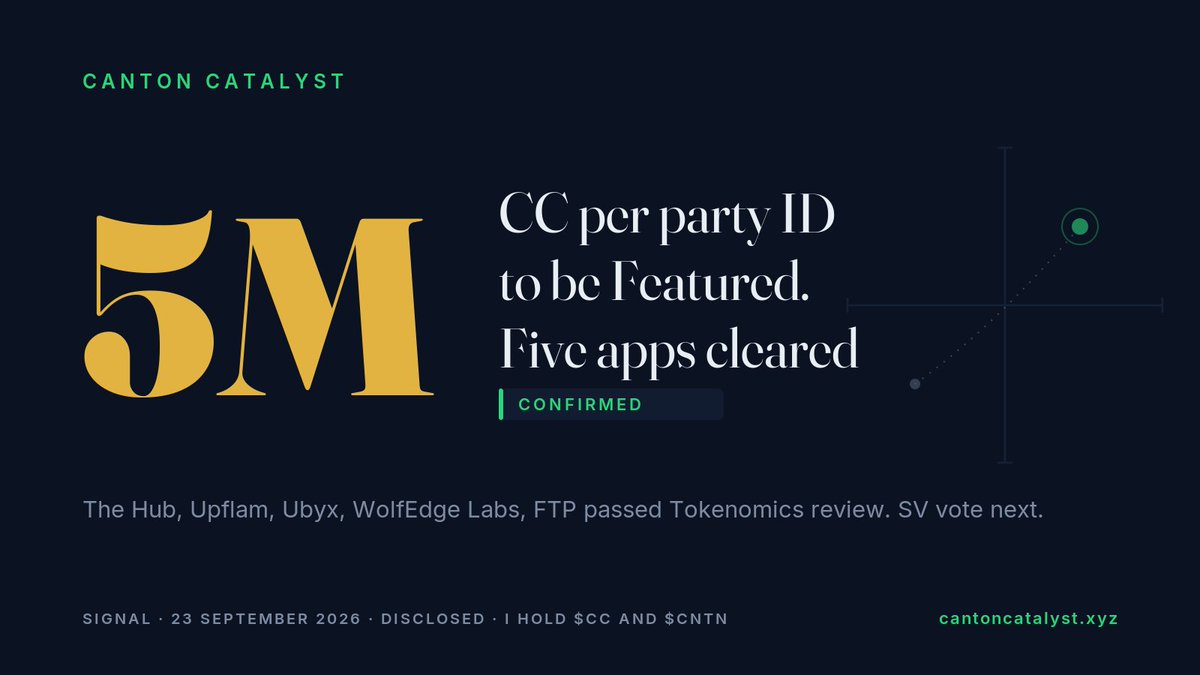
Five more apps cleared Canton's Tokenomics review for Featured App status on 21 September. @TheHub, @upflamhq and FTP go to a Super Validator on-chain vote sponsored by Canton Foundation, and @Ubyx_ and @WolfEdgeLabs go sponsored by @DigitalAsset. It's on the Foundation's own tokenomics list, so the committee step is confirmed. Featured status itself isn't, until the operators vote it on chain.
What Featured costs is set by CIP-0116, active since May. A non-issuer app has to lock 5,000,000 CC per party ID and an asset issuer 25,000,000, in a segregated, identifiable party the Foundation is told about, and the on-chain vote is gated on proof that the lock exists. Unlocking vests over 60 days at one sixtieth a day. If the locked amount ever drops below the threshold the status goes, and operators have to respond to an unfeature proposal within 30 minutes. The notice lists a locking party for each of the five, which turns a logo into a balance.
For a CC holder the mechanism is simple enough. Every app that wants the app reward allocation has to take CC off the market for as long as it wants the status, and the notice says plainly that approval is not an endorsement by the Foundation. Circle's USYC went through the same door earlier this month. That's six approvals in a fortnight, each one a party that has to lock 5 million or more to hold the status.
I hold $CC and $CNTN.
Of the five, which one do you actually expect to generate traffic on @CantonNetwork rather than just a locked balance?
@FiveNorthHQ@canton_loop We’re building @upflamhq around a simple idea: Canton assets should be useful beyond the ecosystem itself. With @canton_loop, we’re making it possible to use CC and supported CIP-56 tokens for everyday purchases through a privacy focus payment experience. This is just the start🚀
We’re building more than payment infrastructure at Upflam.
Today, we’re proud to release: Upflam Super Scan
A public dashboard for Super Validator health, performance, infrastructure, regions, and historical data.
→ https://t.co/pO7L9Z3Qfh
The brutal truth about crypto is that most networks are valued on speculation.
Their valuations are built around what people hope they might become, rather than the economic activity they are producing today. Many chains reached multibillion-dollar valuations before proving they had real users, sustainable demand or a genuine reason to exist.
Canton is taking a different path.
It is not completely free from speculation, but its long-term value has a much clearer connection to execution. More institutions, assets, applications and transactions mean more network activity, more fees and stronger fundamentals.
Canton is already building, attracting institutional participation and showing measurable results. As that activity grows, the network’s valuation has a stronger foundation to grow with it.
Most chains were valued first and expected to deliver later.
Canton is delivering first and allowing the value to follow.
Less hopium. More execution, usage and results.
An issuer on Canton chooses their own validators, determining who sees trade and participation details.
That means the same rights an issuer has on Ethereum, with the added benefit of privacy and determinism.
@Wesarn_real discusses with @Santiag78758327 on @RealVision