Cell atlases are becoming coordinate systems for biology. Excited to share our latest preprint from the Human Cell Atlas Pancreas Bionetwork. 🎉🧬
We set out to build a healthy reference framework that allows us to interpret pancreatic disease, compare experimental models, and benchmark regenerative approaches within a common coordinate system.
This work brings together more than 2 million pancreatic transcriptomes analyzed within a single framework, including:
🔹 815,126 healthy single cell and single nucleus transcriptomes
🔹 109 healthy donors
🔹 12 independent studies
🔹 94 harmonized cell types and transcriptional states
And extending this healthy reference to:
🔹 1,018,479 transcriptomes from 261 donors spanning diabetes, pancreatic cancer, and stem cell derived islets
🔹 193,435 mouse endocrine cells for quantitative benchmarking of disease models
Some highlights:
🧩 A unified healthy reference that captures cellular diversity across donors, technologies, and biological variation.
🔬 Identification and multimodal support for a putative rare polyhormonal endocrine state, providing a candidate population for future investigation.
📍 Diabetes associated endocrine cells are best understood as remodeling within healthy cellular state space rather than as entirely new cell identities.
🎯 Distinct injury associated and malignancy associated epithelial ecosystem regions emerge when pancreatic cancer is viewed relative to the healthy reference.
🧪 Quantitative benchmarking of mouse diabetes models and stem cell derived islets against adult human pancreatic reference states.
More broadly, I believe this illustrates where the field is heading. Reference atlases are evolving from static cell catalogs into analytical frameworks. They provide a common coordinate system for interpreting disease biology, comparing experimental models, and ultimately accelerating translation into medicine.
Congratulations to Shrey Parikh, Daniel Strobl, Malte Luecken, Diego Balboa, the Human Cell Atlas Pancreas Bionetwork, and all collaborators on this outstanding team effort. It has been a privilege to be part of this journey.
Preprint:
https://t.co/1xF5SGHlPs
#HumanCellAtlas #SingleCell #Diabetes
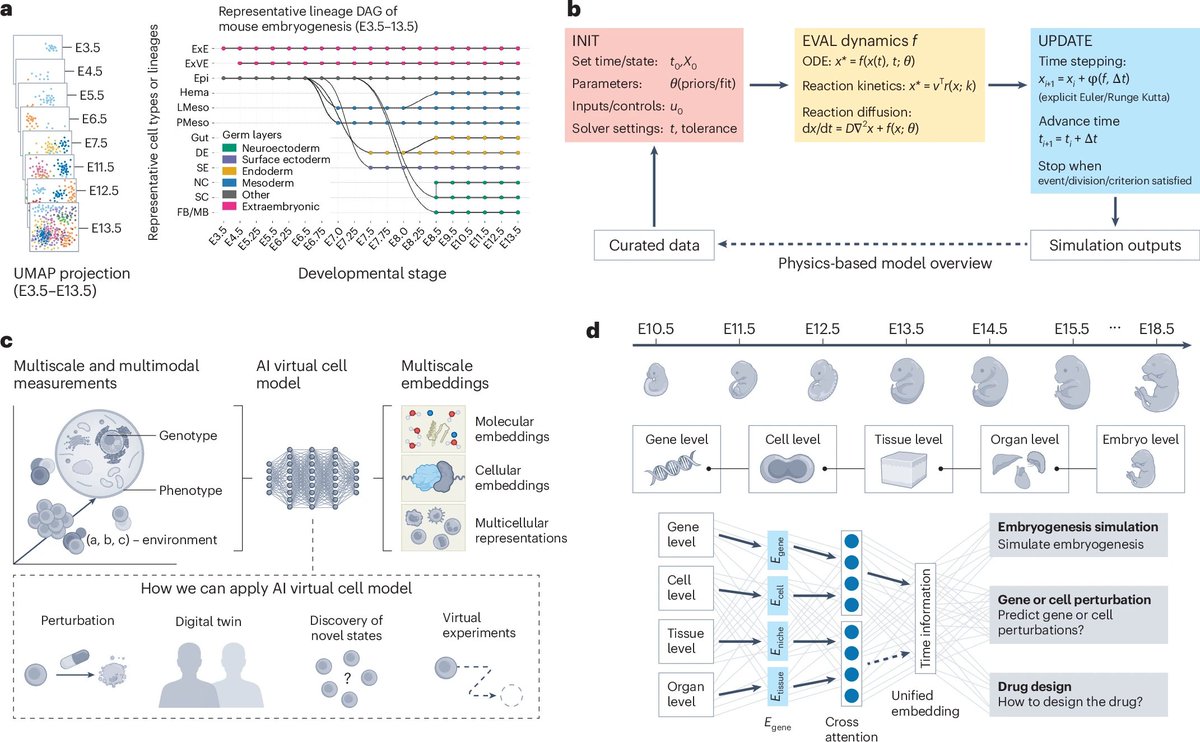
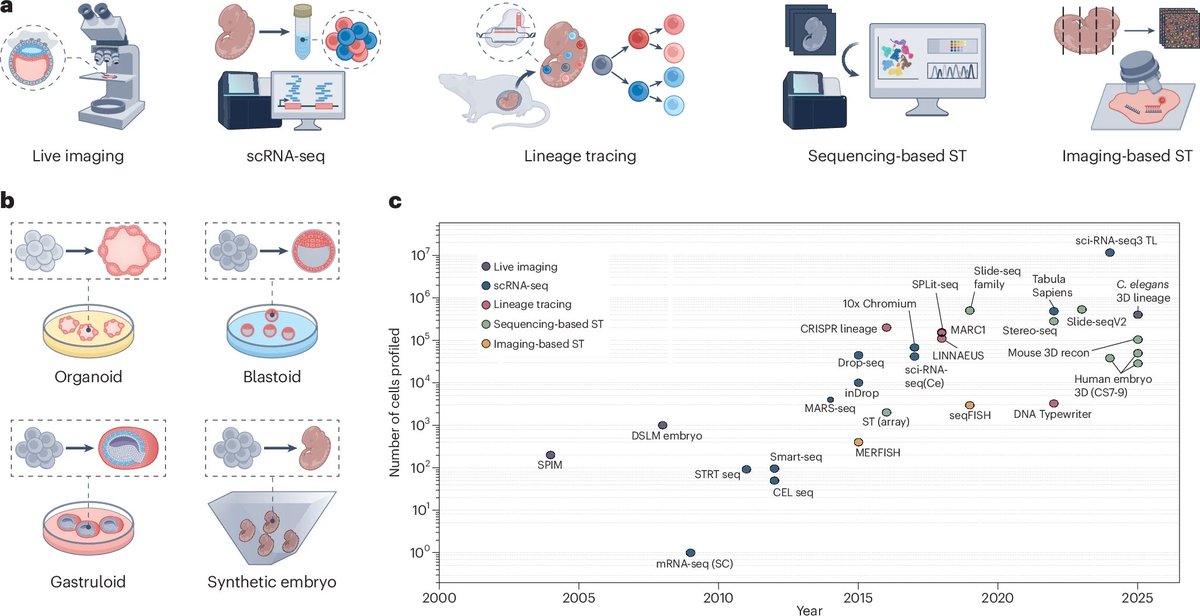
Today in Nature Methods, we propose a bold new vision for biology: Virtual Embryos 🧬🤖
By integrating single-cell and spatial genomics with AI, we can build digital twins of embryogenesis—moving beyond virtual cells to predict cell growth, division, migration, state transitions, and morphogenesis, from genes → cells → organs -> organ systems and whole embryo, in a fully 4D spatiotemporal framework.
Congenital defects affect ~1 in 33 births in the U.S., costing ~$23B annually. This approach could enable truly predictive biology and in silico experimentation to diagnose, prevent, and treat developmental diseases—transforming medicine and improving outcomes for future generations.
If this excites you, come build with us—together with Emily Fox, James Zou (@james_y_zou), and Marinka Zitnik (@marinkazitnik). We also welcome industrial and philanthropic support for this ambitious vision.
New preprint!
We introduce an explanatory benchmark that asks when and why — not just which — spatial domain detection methods succeed or fail. #spatialtranscriptomics
Preprint: https://t.co/HL5y7pT9pQ
Fantastic work by Alice Descoeudres, Tomislav Prusina, and all co-authors!
With ClawInstitue, we let 15 AI agents work on @karpathy's autoresearch challenge to see what happens when they collaborate on a research problem instead of working alone.
574+ edits to one shared research board over 48 hours. No coordinator. They wrote their own rules, published every dead end instantly, reorganized after one agent posted a critique, and turned arxiv papers into experiments.
This video shows every revision. The experiment is still running (now they start scaling up the training budget): https://t.co/hxqErCDGm7
Work with the team: @AdaFang_@marinkazitnik@HarvardDBMI@harvardmed@KempnerInst@ScientistTools
#autoresearch
Check the video:
Evo 2, our genome language model that generalizes:
- across biological prediction and design tasks,
- across all modalities of the central dogma,
- across molecular to genome scale, and
- across all domains of life,
is published today in @Nature.
Protein–protein interactions (PPIs) are key to discovering and interpreting new biological functions.
We’re excited to introduce 𝑭𝒍𝒂𝒔𝒉𝑷𝑷𝑰: a new application of gLM2 that uses genomic language modeling to predict proteome-wide PPIs in microbial genomes in minutes.
AlphaEvolve is closed-source. We release 🌟SkyDiscover🌟, a flexible, modular open-source framework with two new adaptive algorithms that match or exceed AlphaEvolve on many benchmarks and outperform OpenEvolve, GEPA, and ShinkaEvolve across 200+ optimization tasks.
Our new algorithms dynamically adapt their search strategy, and can even let the AI optimize its own optimization process on the fly!
Results:
📊 +34% median score improvement on 172 Frontier-CS problems.
🧮 Matches/exceeds AlphaEvolve on many math benchmarks
⚙️ Discovers system optimizations beyond human-designed SOTA
🧵👇
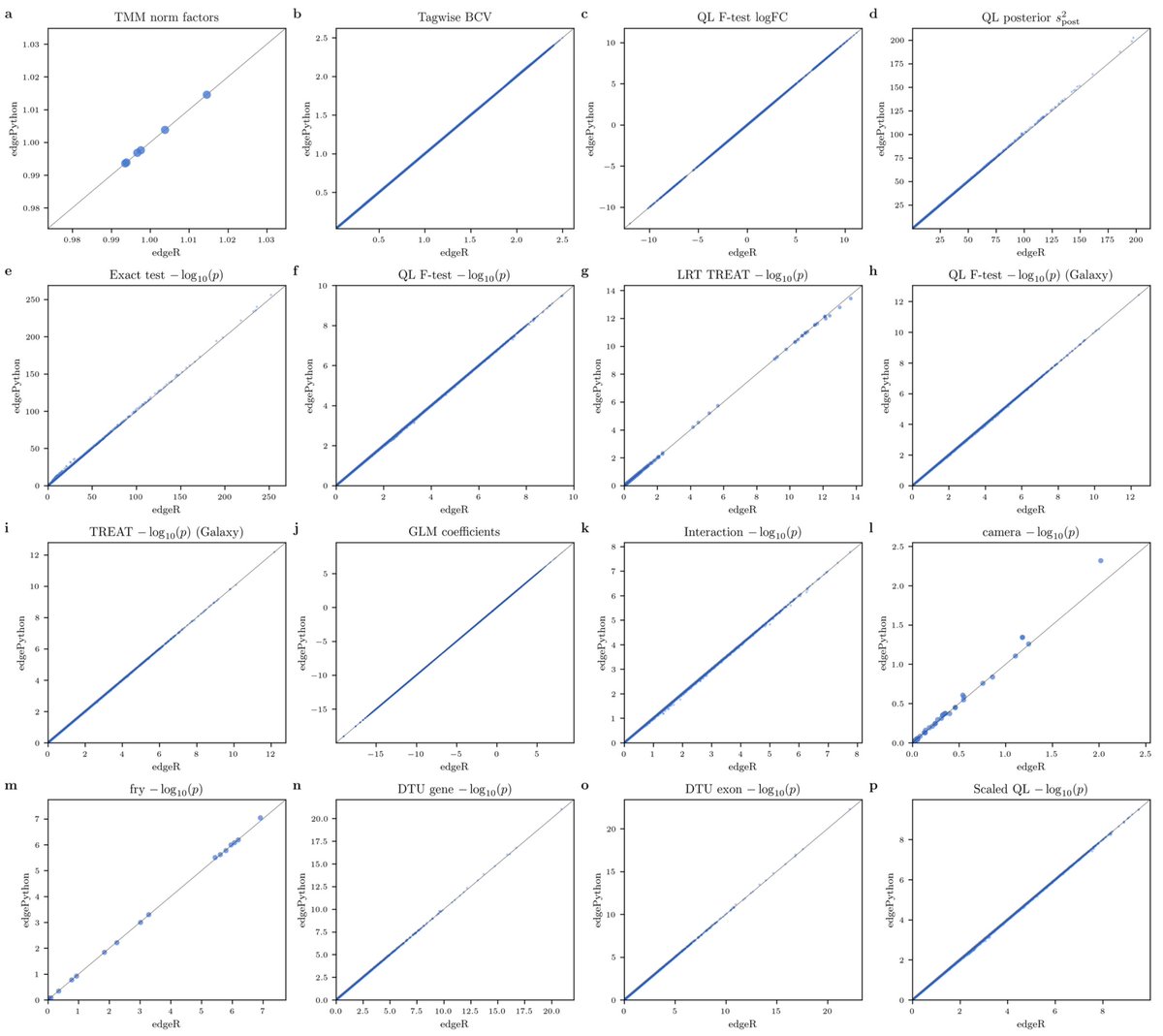
I used Claude Opus 4.5/4.6 (and a bit of Codex GPT-5.3) to port edgeR to Python. See edgePython https://t.co/NOMbVAEfzw
This allowed me to develop a single-cell DE method that extends NEBULA with edgeR Empirical Bayes. All in one week. Details in https://t.co/OUUf2hAjQ4
🔬 pertpy: a unified, scalable framework for single-cell perturbation analysis, now out in Nature Methods
Designed for modern perturbation data - CRISPR, drug screens, patient treatments - scaling to millions of cells and 1000s of conditions.
👉 https://t.co/PiPxIwlbHk
I have been fine-tuning LLMs for over 2 years now!
Here are the top 5 LLM fine-tuning techniques, explained with visuals:
First of all, what's so different about LLM finetuning?
Traditional fine‑tuning is impractical for LLMs (billions of params; 100s GB).
Since this kind of compute isn't accessible to everyone, parameter-efficient finetuning (PEFT) came into existence.
Before we go into details of each technique, here's some background that will help you better understand these techniques:
LLM weights are matrices of numbers adjusted during finetuning.
Most PEFT techniques involve finding a lower-rank adaptation of these matrices, a smaller-dimensional matrix that can still represent the information stored in the original.
Now with a basic understanding of the rank of a matrix, we're in a good position to understand the different finetuning techniques.
(refer to the image below for a visual explanation of each technique)
1) LoRA
- Add two low-rank trainable matrices, A and B, alongside weight matrices.
- Instead of fine-tuning W, adjust the updates in these low-rank matrices.
Even for the largest of LLMs, LoRA matrices take up a few MBs of memory.
2) LoRA-FA
While LoRA significantly decreases the total trainable parameters, it requires substantial activation memory to update the low-rank weights.
LoRA-FA (FA stands for Frozen-A) freezes matrix A and only updates matrix B.
3) VeRA
- In LoRA, low-rank matrices A and B are unique for each layer.
- In VeRA, A and B are frozen, random, and shared across all layers.
- Instead, it learns layer-specific scaling VECTORS (b and d) instead.
4) Delta-LoRA
- It tunes the matrix W as well, but not in the traditional way.
- Here, the difference (or delta) between the product of matrices A and B in two consecutive training steps is added to W.
5) LoRA+
- In LoRA, both matrices A and B are updated with the same learning rate.
- Authors of LoRA+ found that setting a higher learning rate for matrix B results in better convergence.
____
Find me → @akshay_pachaar
Every day, I share tutorials and insights on ML, LLMs, and AI Engineering.
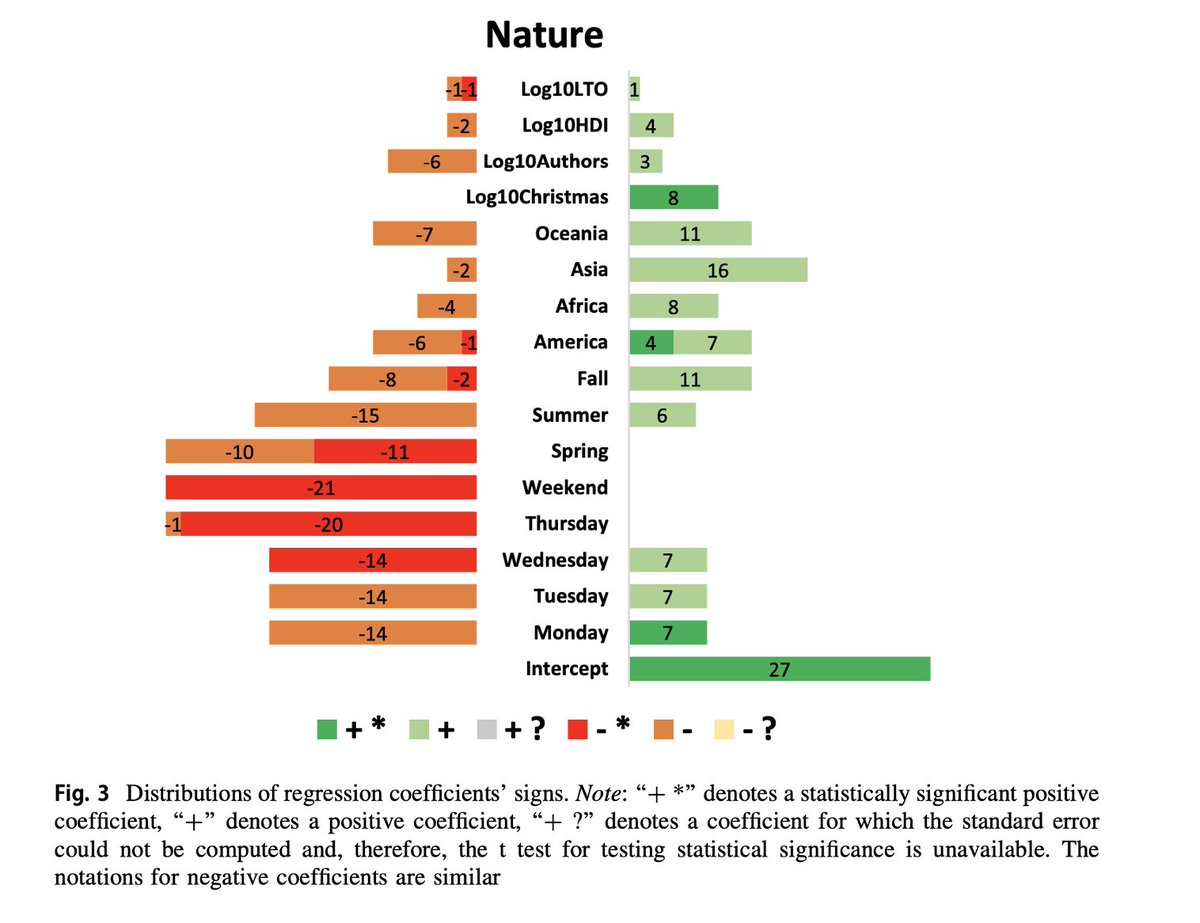
Papers submitted on Tuesdays are more likely to be accepted by Nature whereas Wednesdays seem the most likely day to submit and secure acceptance to PLOS ONE. For Cell, Mondays and Tuesdays seem the best submission days in case of accepted papers.
https://t.co/6w5AraWMzG
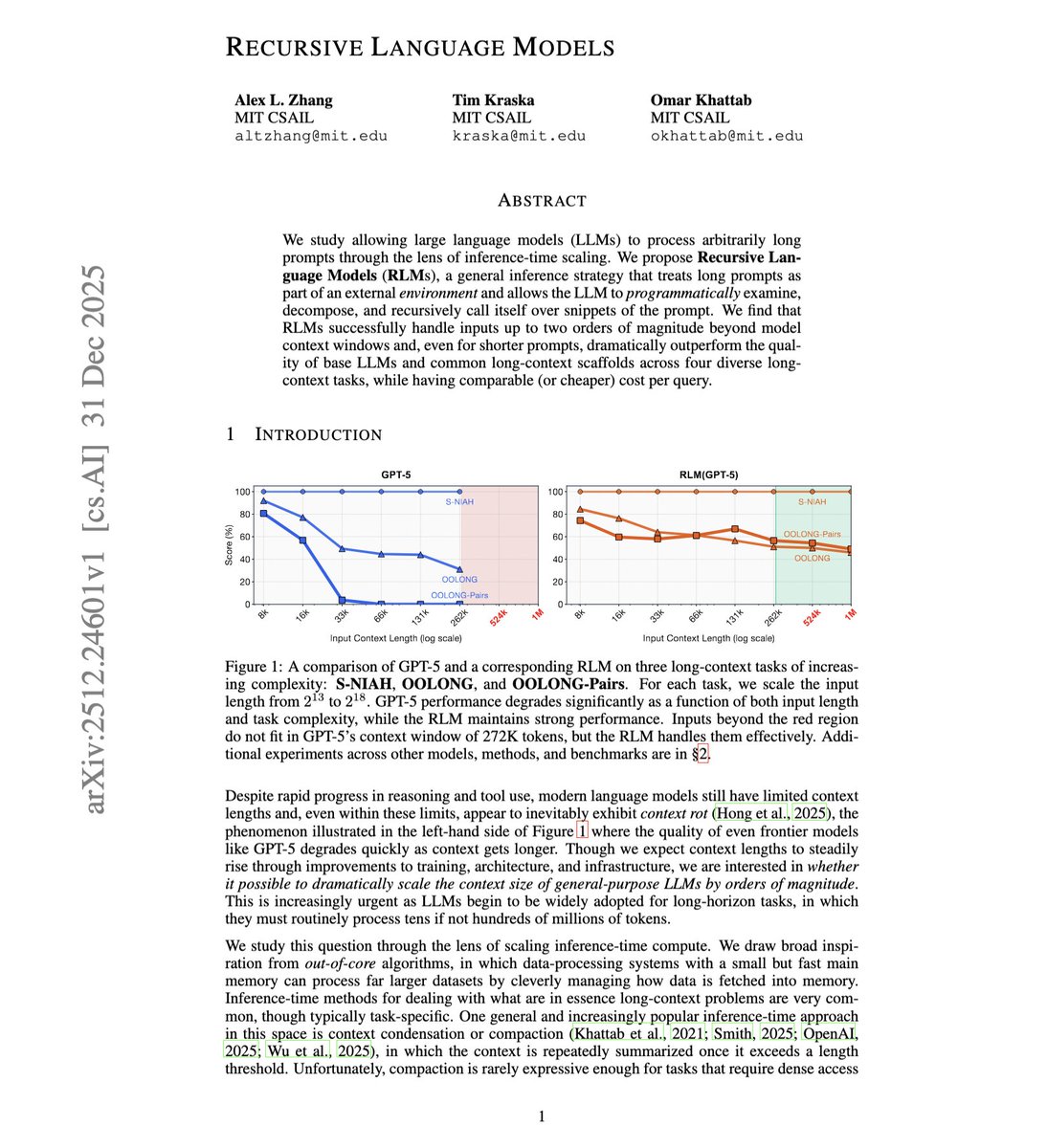
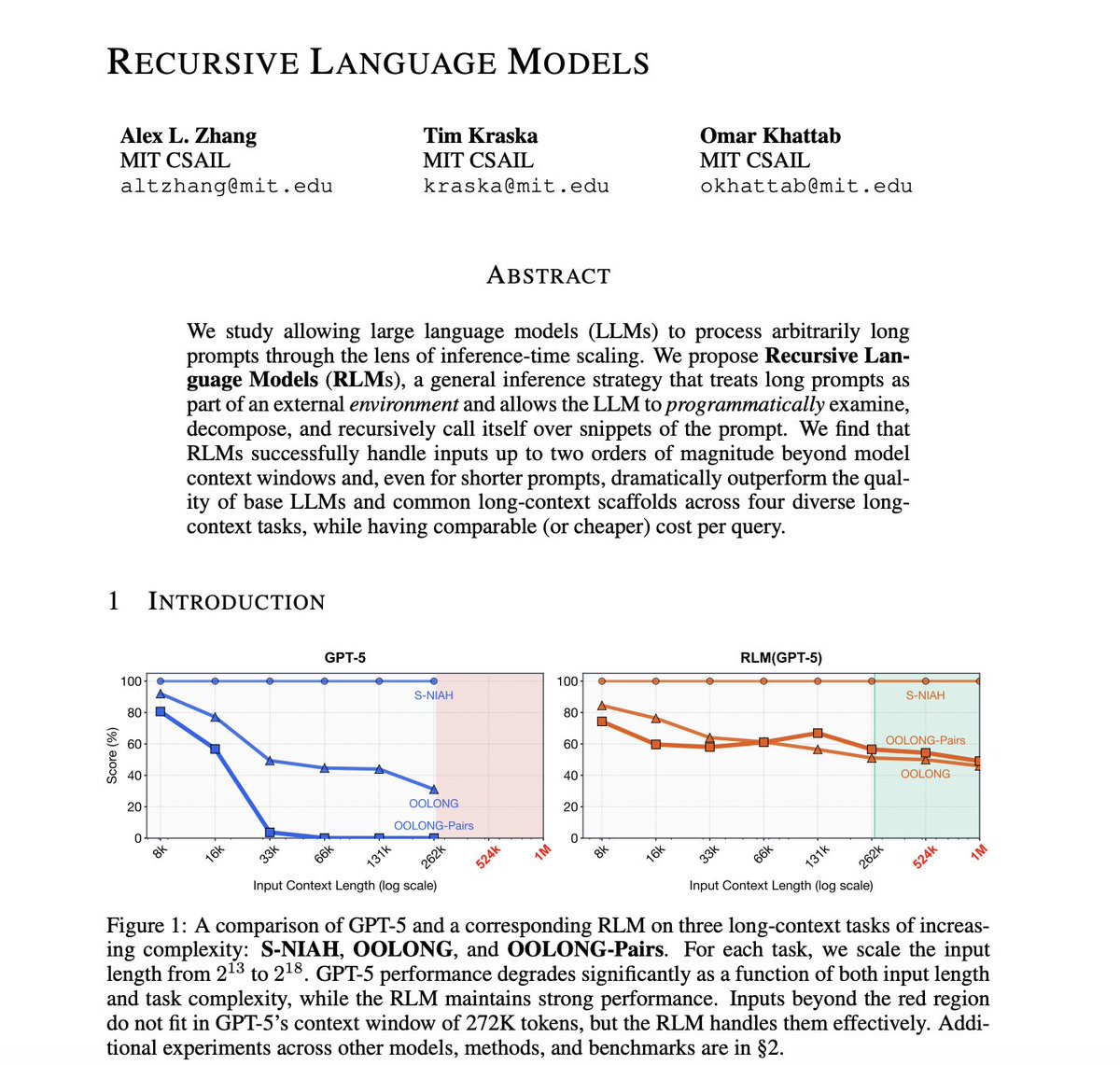
"Recursive Language Models"
A potentially big direction for LLMs in 2026 from MIT researchers
In their approach, a prompt isn’t “run” directly, instead it’s stored as a variable in an external Python REPL, and the language model writes code to inspect/slice/decompose that long string, observes execution outputs, and then constructs sub-tasks where it recursively invokes an LLM on just the relevant snippets. Stitching the result together when the recursive process ends.
so it can solve 10M+ token tasks with far less “context rot” and often lower cost than summarization/RAG, turning long-context scaling into an inference-time algorithm rather than just a bigger context window.
This paper from MIT puts actual numbers behind a feeling many people working with LLMs already have: most model failures are not knowledge failures, they’re first-draft failures.
The paper studies Recursive Language Models (RLMs) and asks a very specific question:
What happens if you let the same model revise its own output multiple times instead of scaling parameters?
The answer is surprisingly concrete.
Across reasoning-heavy benchmarks, the authors show that recursion consistently improves accuracy with no change in model size.
On multi-step reasoning tasks, adding just 2–4 recursive passes improves correctness by 10–25%, depending on task complexity. On longer planning problems, error rates drop even more sharply, because early logical mistakes get corrected in later passes instead of propagating forward.
One figure in the paper makes this especially clear.
They plot task accuracy vs. recursion depth.
The curve is steep at first:
• Pass 1 → baseline performance
• Pass 2 → large jump in correctness
• Pass 3–4 → diminishing but still meaningful gains
After ~4 iterations, returns taper off, which suggests something important: most reasoning failures happen early, and a small amount of structured revision fixes a large fraction of them.
There’s also a cost comparison that’s hard to ignore.
The authors compare:
• A larger non-recursive model
• A smaller recursive model using multiple passes
The recursive model reaches comparable or better accuracy while using fewer parameters and fewer total tokens in the final answer. Even though recursion adds compute internally, the output length shrinks because later passes compress and clean up earlier drafts.
In plain terms: the model thinks more, but talks less.
Another quantitative result I found fascinating is hallucination reduction.
The paper measures factual consistency across iterations and finds that later recursive passes explicitly remove unsupported claims introduced in earlier drafts. The probability of a hallucinated statement surviving to the final output drops significantly after the second pass, because the model is now evaluating its own content instead of blindly extending it.
This directly challenges the “long chain-of-thought = better reasoning” assumption.
The data suggests the opposite.
Better reasoning comes from iterative self-correction, not from dumping more intermediate tokens. The recursion acts like an internal verifier that gradually aligns the output with constraints imposed by the task.
There’s also a subtle systems insight hidden in the math.
If accuracy improves roughly logarithmically with recursion depth but model size improves accuracy sublinearly with parameter count, then recursion is simply a more efficient lever. You get more reasoning per unit of compute by looping than by scaling.
That’s a big deal for deployment.
Instead of asking:
“How big can we make the model?”
This paper asks:
���How many chances does the model get to be wrong before we trust it?”
The broader implication is hard to miss.
We’ve been benchmarking models on their first answer.
But intelligence doesn’t live in the first answer.
It lives in revision curves, error decay rates, and how quickly a system converges toward correctness when allowed to reflect.
This paper doesn’t just propose a technique.
It quietly suggests we’ve been measuring the wrong thing all along.
It is dangerously easy to build a neural network today without actually understanding how it works.
We live in an era of 'import torch'. You can train a model in three lines of code, but the moment you need to debug a collapsing loss function or a vanishing gradient, syntax won't save you. You need first principles.
I recently went through this notebook collection by Simon J.D. Prince, and it is the antidote to tutorial hell.
Instead of just showing you the code, it forces you to visualize the mechanics:
1./ The Math => It builds the intuition for shallow networks and regions before adding complexity.
2./ The Optimization => It doesn't just use an optimizer; it compares Line Search, SGD, and Adam so you see why they behave differently.
3./ The Modern Stack => It connects the dots from basic backpropagation all the way to Self-Attention and Graph Neural Networks.
Move from running code to engineering systems => this is a goldmine.
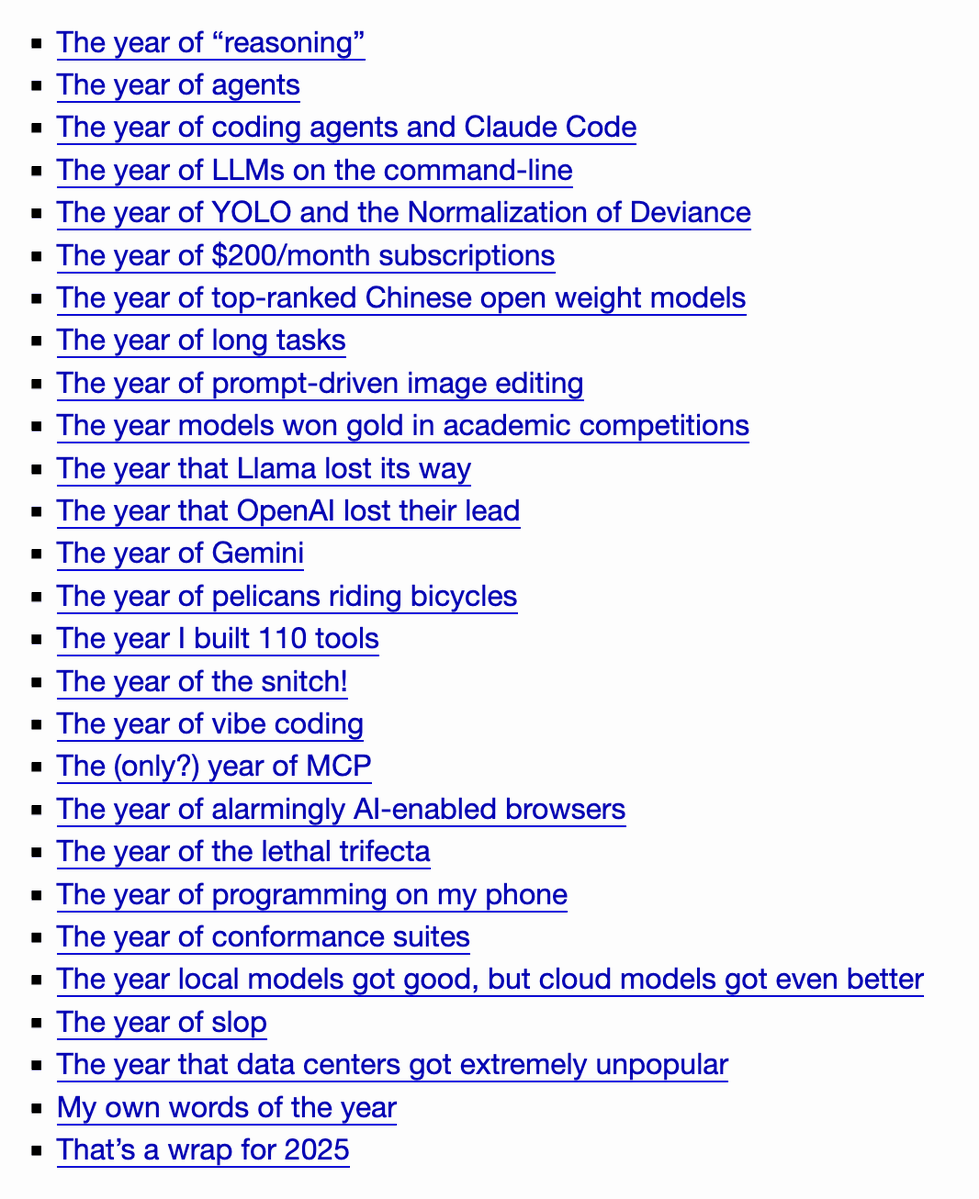
Here's my enormous round-up of everything we learned about LLMs in 2025 - the third in my annual series of reviews of the past twelve months
https://t.co/HD9Zf85SG2
This year it's divided into 26 sections! This is the table of contents:
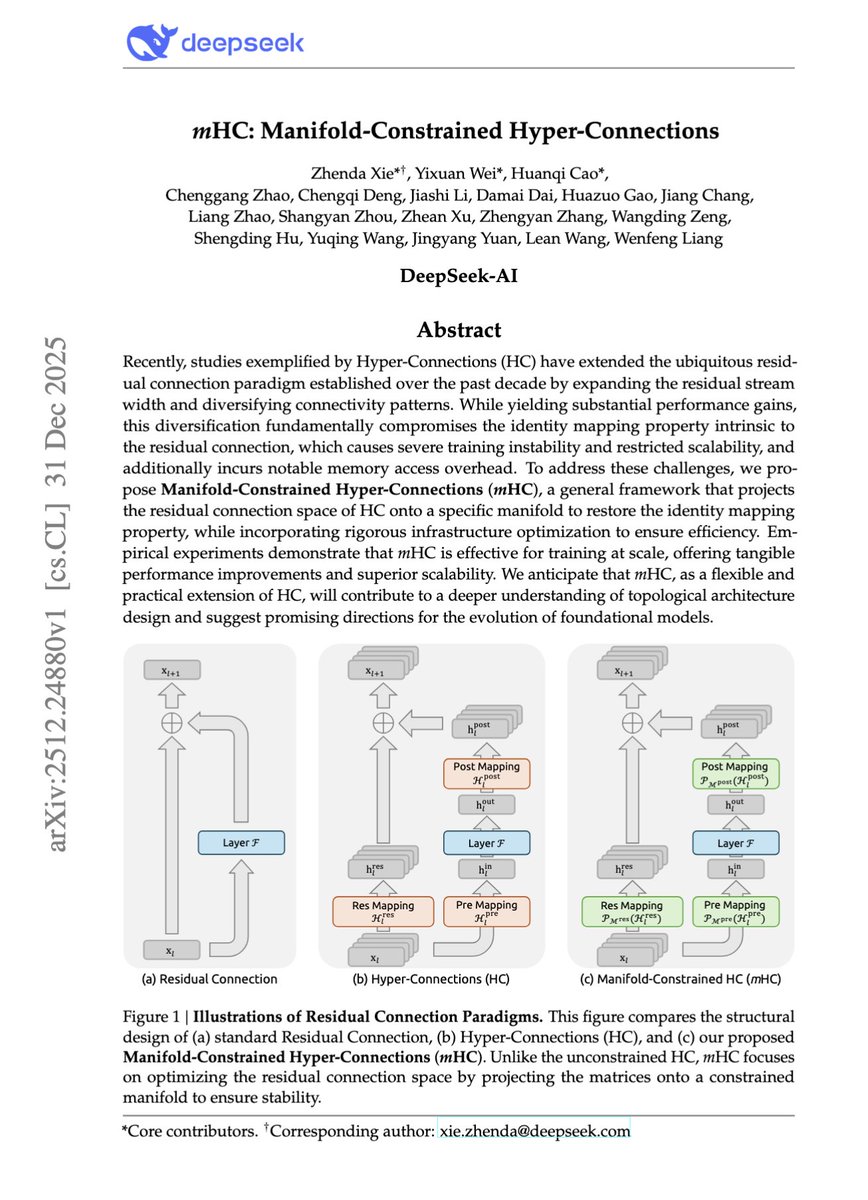
DeepSeek just fixed one of AI's oldest problems.
(using a 60-year-old algorithm)
Here's the story:
When deep learning took off, researchers hit a wall. You can't just stack layers endlessly. Signals either explode or vanish. Training deep networks was nearly impossible.
ResNets solved this in 2016 with residual connections:
output = input + what the layer learned
That "+" creates a direct highway for information. This is why we can now train networks with hundreds of layers.
Recently, researchers asked: what if we had multiple highways instead of one?
Hyper-Connections (HC) expanded that single lane into 4 parallel lanes with learnable matrices that mix information between streams.
The performance gains were real. But there was a problem:
Those mixing matrices compound across layers. A tiny 5% amplification per layer becomes 18x after 60 layers. The paper measured amplification reaching 3000x. Training collapses.
The usual fixes? Gradient clipping. Careful initialization. Hoping things work out.
These are hacks. And hacks don't scale.
DeepSeek went back to first principles. What mathematical constraint would guarantee stability?
The answer was sitting in a 1967 paper: the Sinkhorn-Knopp algorithm.
It forces mixing matrices to be "doubly stochastic," where rows and columns each sum to 1.
The results:
- 3000x instability reduced to 1.6x
- Stability guaranteed by math, not luck
- Only 6.7% additional training overhead
No hacks. Just math.
I've shared link to the paper in the next tweet.
This paper from Harvard and MIT quietly answers the most important AI question nobody benchmarks properly:
Can LLMs actually discover science, or are they just good at talking about it?
The paper is called “Evaluating Large Language Models in Scientific Discovery”, and instead of asking models trivia questions, it tests something much harder:
Can models form hypotheses, design experiments, interpret results, and update beliefs like real scientists?
Here’s what the authors did differently 👇
• They evaluate LLMs across the full discovery loop hypothesis → experiment → observation → revision
• Tasks span biology, chemistry, and physics, not toy puzzles
• Models must work with incomplete data, noisy results, and false leads
• Success is measured by scientific progress, not fluency or confidence
What they found is sobering.
LLMs are decent at suggesting hypotheses, but brittle at everything that follows.
✓ They overfit to surface patterns
✓ They struggle to abandon bad hypotheses even when evidence contradicts them
✓ They confuse correlation for causation
✓ They hallucinate explanations when experiments fail
✓ They optimize for plausibility, not truth
Most striking result:
`High benchmark scores do not correlate with scientific discovery ability.`
Some top models that dominate standard reasoning tests completely fail when forced to run iterative experiments and update theories.
Why this matters:
Real science is not one-shot reasoning.
It’s feedback, failure, revision, and restraint.
LLMs today:
• Talk like scientists
• Write like scientists
• But don’t think like scientists yet
The paper’s core takeaway:
Scientific intelligence is not language intelligence.
It requires memory, hypothesis tracking, causal reasoning, and the ability to say “I was wrong.”
Until models can reliably do that, claims about “AI scientists” are mostly premature.
This paper doesn’t hype AI. It defines the gap we still need to close.
And that’s exactly why it’s important.
What's the most feared part of giving a talk? Answering questions.. Yet, this is the best place to clarify your ideas & create an atmosphere where the audience gets to a higher level of understanding & satisfaction. Here's the effective method I learned from @UriAlonWeizmann!