My latest blog on improving code LLMs’ ability to debug and generate accurate code. https://t.co/rd2vaffk4y #neurips2024#amazonscience https://t.co/GlObKOxPvz
Ideally, using LLMs for code generation also means using them to debug the generated code. Specializing LLMs for debugging using synthetic training data and both fine tuning and reinforcement learning improves the success rate of code generation by 39%. https://t.co/yoWo09ATFI #LLMs
Early lectures on LLMs leaned heavily on brain and neuron analogies. I believe future lectures will instead emphasize compression as the primary motivation: these models are, at their core, compression machines. Extraordinarily efficient ones.
my paper won an award at icml 😁
some thoughts:
• this work was rejected from NeurIPS. i cleaned it up a small amount and it got great reviews from ICML! don't give up
• ICML received 24k submissions and only gives out 7 awards, which is crazy. feeling grateful
• i distinctly remember sitting at my desk two winters ago wondering if i would ever finish this project. most of all this is the product of sitting down and forcing myself to keep working for several months straight. the results emerged from running the experiments over and over and fixing a long sequence of tiny details. eventually, the curves looked like that 👇
• also happy that the insights in this paper are becoming more widely accepted: 3.3 bits/param, thinking about capacity "LLM as flashdrive" mentality
• the method here is used successfully for selecting midtraining data at least one frontier lab, which is cool!
• i am grateful to my collaborators, but Meta is no longer a great place for academic research imo and this almost never got published for a number of reasons. i shall not elaborate further
• for future work, i think analyzing the implications of on-policy algorithms on capacity, as well as LoRA and things like it, are fruitful potential research directions
• sadly i'm not in Korea but am following the conference online from california and happy to chat!
a nice end to one phase of my research career :)
@juliarturc And not just that, it's like saying it to professional photographers (akin to professional developers here who have years of domain experience).
@BrendanFoody Given a good base like GLM 5.2 (or a future much better base), big enterprises should pursue RL/ Continual learning. Sooner or later, they will realize the IP risk with just calling API for intelligence.
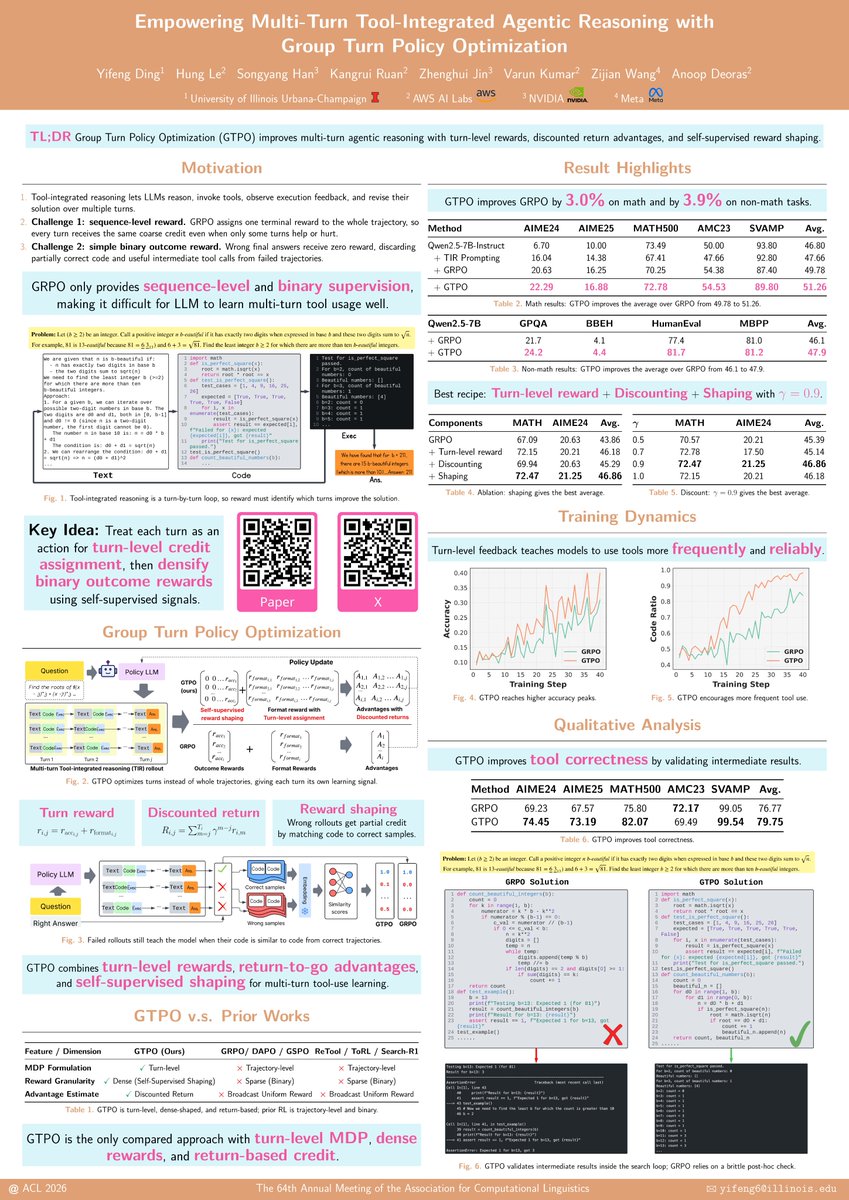
I will be attending #ACL2026 7/5-7/7, presenting GTPO!
I've also been working on: (1) building code agents to operate more efficiently (https://t.co/sCAhxlKM2o) and write more secure code; (2) stabilizing large-scale RL training for code.
DM me if you want to chat!
Many smart people/AI insiders are saying GLM-5.2 is the first Chinese AI model to match and often beat the American big lab public AI models with no compromises. Incredible timing given current events.
PPO had a second wave in the LLM era for reasons unanticipated by the original paper
- the importance-ratio objective fixes biases from numeric error, async training, and forward pass noise
- the clipping objective affects entropy through a mechanism that we didn't know about at the time of publication (DAPO, https://t.co/sBo9DeFS5Y)
📱Kiro is now on iOS.
Native app built for real engineering work that gives developers a new surface to kick off, monitor, steer, and interact with their Kiro sessions directly from their phone.
Check in while you’re grabbing coffee. Come back to a PR.
Available in preview for Pro, Pro+, Pro Max, and Power customers. iOS 26+ required.
Request early access → https://t.co/yxgPAESfjy
I get that we love asking WHY for everything but why not?
Enterprises building on open-source with their own RL environments are real business opportunities. Tinker, Together, Fireworks are all proof. Better base models only accelerate it.
Standard benchmarks are largely recognized by every frontier model. Real evals = real-world simulated distributions. A very nice study from OpenAI, great breakdown of agentic task simulation.
When asked directly, the evaluation detector classified 98.9–100% of trajectories from every traditional-evaluation category as evaluations, compared with 5.38% of production conversations
So TL will be all enterprise RL this week :) Honestly, as OSS base models improve, RL on enterprise tools/harness with their own data, will deliver huge efficiency gains.
Most RL frameworks are moving from “engine mode” to “server mode”.
slime goes one step further: the RL job does not need to own the rollout servers at all.
Bring your own SGLang fleet, already deployed and managed by your serving system. slime connects to it, registers it with the router, generates rollouts, and syncs updated actor weights via NCCL or disk-based full/delta transport.
This is the deployment shape we believe large-scale agentic RL is moving toward: training and inference as independently managed systems, connected by a clean rollout + weight-sync contract.