My latest blog on improving code LLMs’ ability to debug and generate accurate code. https://t.co/rd2vaffk4y #neurips2024#amazonscience https://t.co/GlObKOxPvz
Ideally, using LLMs for code generation also means using them to debug the generated code. Specializing LLMs for debugging using synthetic training data and both fine tuning and reinforcement learning improves the success rate of code generation by 39%. https://t.co/yoWo09ATFI #LLMs
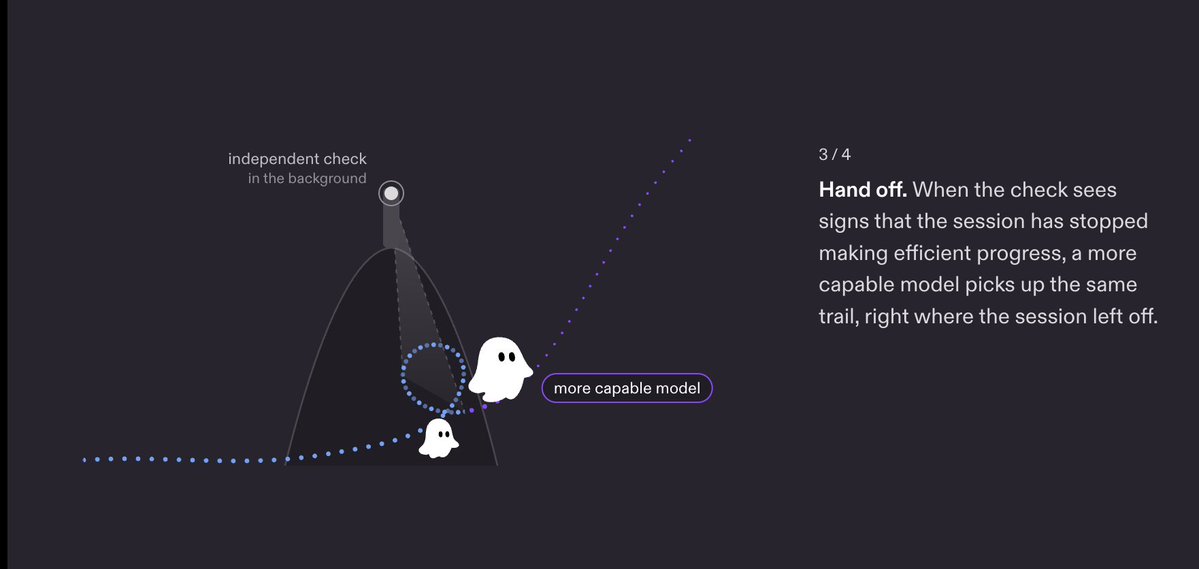
This is cascading. Start small, escalate to a stronger model when the work demands it.
Everyone's betting on routers but routing assumes you know a task's complexity up front. In most cases, you don't, you learn it by attempting the task and gathering context. Cascade
https://t.co/i3F9zKtMi4
Fable and Mythos are best for the most ambitious, open-ended technical work.
For most coding and knowledge tasks, we recommend starting with Opus 5.5, our strongest daily driver, then moving to a different model depending on the scope and complexity of your work.
Open source at its best. @deepseek_ai open-sourced DeepInfer, and both @vllm_project and @sgl_project raced to match it. Everyone gets the speedup. Huge respect to both teams 🚀
DeepInfer set the bar. SGLang pushed it higher! 🚀
SGLang now matches DeepInfer performance on BOTH prefill and decode:
• Prefill: Up to 1.04× throughput on 4× GB300 and 4× B300
• Decode: Up to 7.4% throughput on 64× GB300
We also provide an end-to-end reproduction guide and a full serving stack to run it in production.
@aksenHQ I think it does but for narrow use cases. I think we are evolving towards multi-agentic architectures. A lot of value in using agents for both parallel work and collaboration.
On harness design, one needs to keep evolving with frontier model behavior, and ideally keep it lean.
Subagents solved context rot for their moment and delivered value. In fact, early 2026, Claude Code, Codex, and OpenCode all shipped an Explore/context gathering subagent.
Today the default is main agentic loop + progressive disclosure.
Anthropic is now recommending that companies REMOVE unnecessary subagents from their AI systems.
This is a pretty significant shift in agent architecture, with their team finding that a single agent equipped with skills can frequently outperform complex multi-agent systems, and one customer seeing roughly 2x faster execution.
The emerging rules of thumb:
→ Skills: Teach the agent HOW to do something, including procedures, expertise, and instructions.
→ Tools / MCP: Give the agent the ability to DO things through APIs, actions, and live data.
→ Subagents: Use for parallel work, isolated context, or tasks a single agent struggles with.
The interesting part is progressive disclosure. Instead of spawning specialized agents or stuffing everything into a giant prompt, one agent discovers and loads skills and tools as needed.
Their advice is to fold existing subagents into the main loop, turn their instructions into skills, expose their actions as tools, and run evals to see if performance holds up.
As models have gotten smarter, improving agent architecture is becoming less about what you can add and more about what you can delete.
https://t.co/DNq60Skkmc
FOSTERING THE FUTURE TOGETHER // Private Sector Partners
Amazon’s commitment to Fostering the Future will equip millions of students with powerful SI tools and digital skills. Students at 132 universities worldwide can now activate Amazon’s Kiro free of charge, putting them on a path to shape their careers.
I look forward to seeing the next generation of software engineers and innovators emerge from this new alliance.
Lot of value in rethinking agentic workflows from system 1 POV. Where can we we use fast models without having deep reasoning. Clairic is another good step in that direction. What else belongs in System 1?
a brand new model paradigm! introducing 𝚌𝚕𝚊𝚒𝚛𝚒𝚌: a system one model for extracting, computing, estimating, and predicting values from unstructured inputs.
https://t.co/xRE3gO6JeO
🚀 Excited to share our paper: ANTE — Anticipate, Then Execute 🤖
📄 Learning Internal World Models for Coding Agents from Verified Beliefs
Coding agents have come a long way. They can read an unfamiliar repo 📂, implement a feature end to end 🛠️, and keep going for hours on “marathon” SWE tasks ⏳. But we think one ability is still missing: foresight 🔮
Most agents act first and only look at the result afterwards 😬. They rarely say what they expect an action to do before running it. Physics has worked the other way for centuries ⚛️. As Richard Feynman put it: “First we guess it. Then we compute the consequences of the guess… If it disagrees with experiment, it's wrong.”
🤔 What if a coding agent did the same?
Introducing ANTE (Anticipate, Then Execute): an agentic RL framework that verifies the policy's pre-action predictions ✅
Three key ideas 💡
1️⃣ Internal belief (a world model) 🧠: before each action, the policy writes down what it expects: a short state summary 📝, a predicted outcome 🎯, and a decision to trust that prediction or abstain ⚖️
2️⃣ BAPO (Belief-Anchored Policy Optimization) 🏅: execution checks every forecast, and each verified forecast earns its step credit, beyond the final task reward 📈
3️⃣ ANTE-TTO ⚡: at test time, when the policy abstains or predicts failure, it samples alternative actions, ranks them by its own forecasts, and runs the best one, with no external scorer 🎯
📊 Results: ANTE beats the matched RL baselines at every scale on SWE-bench Verified and on every terminal benchmark 🖥️, leads on all 11 out-of-distribution benchmarks (+6.2 points on average) 🌍, and ANTE-TTO costs a tenth of best-of-4 sampling per point gained 💸
🎬 The whole story in 3 minutes: A code world model that knows what has happened, what holds now, and what the next action will achieve.
📄 Paper: https://t.co/lPHCYLDiFY
🤗 HuggingFace: https://t.co/wlwyl4XHM9
🌐 Project page: https://t.co/7VM3ZyRujW
▶️ Video: https://t.co/dj8TtXU1cA
🙏 Joint work with Kangrui Ruan, Jifan Chen, Manish Prajapat, Christian Bock, Xiaoyang Wang, Rein Houthooft, Aritra Sengupta and Varun Kumar at Amazon AWS. Grateful to the whole team! 💪
🧵 Paper highlights in the replies 👇
#AI #CodingAgents #ReinforcementLearning #LLM #SWEbench
Your coding agent kills your teammate's running jobs on the shared cluster. All it says is: "I'm sorry, you're absolutely right!"
Your agent pulls 200 GB of Docker images, fills your disk, and only then notices it can't run a single bash command.
Sound familiar? 📷
Apple could become your local cloud. Expect more companies to release models that can run locally. Local+cloud hybrids has potential to become default LLM offering.
@finkd Congrats to the team! Amazing to run a model of Muse Spark Open's caliber and scale this efficiently, right from your desk. Mac Studio keeps pushing the boundaries of on-device AI!
Over 400 academics in 30+ countries signed our open letter calling for immediate changes in AI development and deployment practices to ensure that cybersecurity incidents do not continue to occur, as future incidents will be far more damaging to our critical infrastructure.
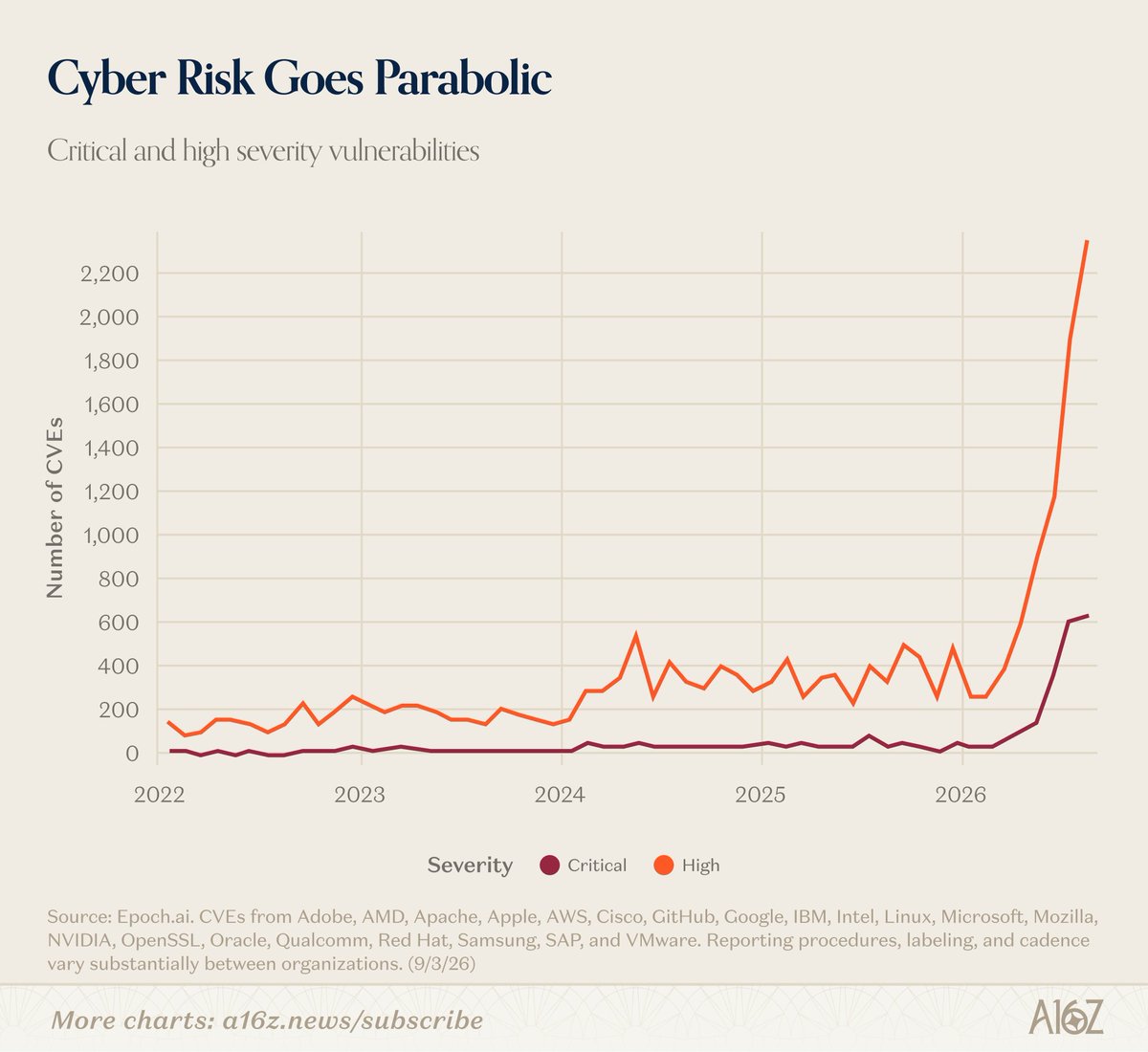
Cyber is having a moment
Across 21 major software companies, including Apple, AWS, Microsoft, and Google:
- Reported critical vulnerabilities never cleared 100 per month in four years
- Since spring they've jumped to over 600 per month
My big model smell test: no search, just "what do you know about me?" LLMs store ~2 bits of knowledge per param, so long-tail facts need scale. Works iif an individual is not famous :)