@transcend_io is now a @spacexai Launch Partner.
Enterprises using Grok Build and Grok Bot can add Transcend Rails Agent Controls: allow, deny, or require approval for every tool call and model request before the agent acts.
https://t.co/fdFDguBGZa
Text/chat are the command line for AI, and Nuance is betting on what's next: expressiveness, realism, deep engagement. This is research-blended-with-product at its finest, the demo is mind-blowing. Their AI persona is the interface for personal agents we're all craving.
@nuance_ai@fangchangma bravo on our launch!
The first AI persona you’ll actually want to meet face-to-face.
Most AI personas stare blankly while you talk. Emma reacts while you’re still speaking.
After 18 months of research at @nuance_ai, this is Emma, built on Nuplex, our full-duplex audiovisual foundation model.
Noodling on some key themes over here after reading a lot of "AI diffusion" bear cases as of late. They aren't wrong -- but does capture the hard work ahead.
1/ If code is the modality that drives AI into more categories, how do we pull these non-technical domains up into a coding domain? Seems it’s two problems: one, "transpile" the subject matter into something machines can reason about (hard), then two, deliver a trusted verdict (harder). Said differently we might need to bring vertical domains to the code, as opposed to wedging code into the vertical domains.
2/ The applied AI companies doing both appear advantaged in the long run. But rollouts are slower for sure, i.e. lots of integration work, building context, then re-modeling internal operations around a new capability. But once a customer runs its operations against your spec, switching costs go way up. You become an internal standard, and eventually an industry standard. This was Veeva, Guidewire, Avalara pre-AI (and maybe it's them post AI...)
3/ The pattern I'm liking is a split: a spec some domain expert can audit but can be executed and checked by AI. Catala does this for tax. Tax experts/lawyers can review the encoding line by line against whatever statute, then a compiler handles the rest. Cadence/Synopsys is effectively this in in chip-design, and why they're such a standard. Vanta, Drata for verification in the digital domain. Where are others?
4/ Frontier models will be strong judges over time. But high-stakes domains need the verdict as close to "human-auditable" as possible. And there are many domains where the verdicts exist in an external authority (think FDA, automotive safety, robotics/consumer electronics standards, construction permitting). We mostly got there on SOC2/ISO27000, but there's a long catalog of standards in these physical domains. Tuesday's election only strengthens those gates I'd guess.
AI diffusion has a ways to go. But big rewards in solving the above in large, complex domains.
Some thought-provoking framing in the Apollo report on AI's diffusion (or lack thereof), though I think there are clear reasons for why the stats look the way they do. If you're on the credit side of the AI infra build I can appreciate the need for a clear schedule of AI's impact, but my gut is we'll be underwriting qualitative signals for a while...
For one, the path from AI lift to revenue is MUCH shorter in tech than non-tech. AI/code-gen --> more software --> more gross profit dollars with fewer engineers. We've seen this across both mag7 and privates. In non-tech, those gains have a much more complex reality to navigate: supply chains, manufacturing, equipment, operations. The current state in the "S&P 493" seems to be more AI-curious, enjoying modest AI-assistance, but nothing as transformative as AI writing code. The diffusion in non-tech could take years and applied AI companies will have to patiently chop said wood before we see the ROI.
Also begs the question: will AI ever show up there as "productivity" in the economic sense? The salaried employee who works 9-5 may just get their job done in a shorter window and consume the extra time as leisure. Not everyone strives for tokenmaxx'd output -- there's a more gentle, steady reality outside SF (*hand raise* .... grew up in Georgia), where you don't rush to use those extra hours to "do more". And wages aren't elastic enough to reward the employee who willingly directs their extra time to extra output. Instead...the efficiency may show up as welfare and happiness, which isn't as directly measurable. Still a great outcome, but won't fit neatly in the spreadsheet, which may not be satisfying...
NEW: A week ago, Apollo Global Management's chief economist Torsten Slok warned that “productivity returns for firms on their AI investments are either arriving far slower than projected or failing to materialize at all.” For good measure, he added on Saturday that AI has delivered “zero financial payoff” to corporate America outside Big Tech, citing new data.
Forty-eight hours later, Apollo announced it was leading a $40 billion chip-financing commitment for SpaceX. And that wasn’t even the day’s largest AI investment news: Blackstone and a group of banks unveiled a $63 billion package for Anthropic to purchase chips from Broadcom.
The juxtaposition of Slok’s words against Apollo’s actions captures a growing tension on Wall Street: doubts about AI’s economic payoff are mounting, even as private-capital giants continue to commit tens of billions of dollars to the infrastructure powering the boom.
Read my latest in @forbes unpacking private equity's growing AI portfolio👇
https://t.co/wss6jRLHWz
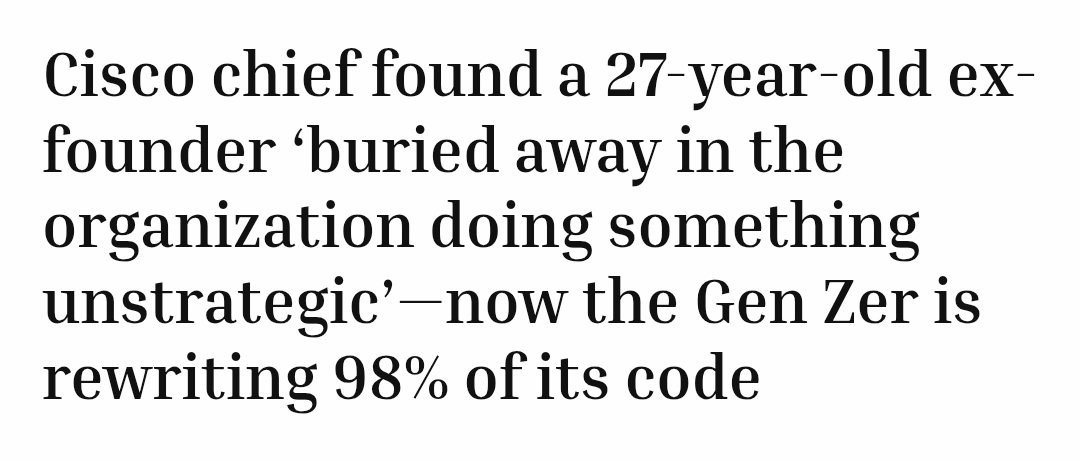
This is INSANE. Cisco’s president Jeetu Patel has given a 27-year-old engineer unlimited AI tokens to try to rewrite 98% of the company’s legacy code within 24 months, Fortune reports.
Padmanabhan Krishnamurthy thinks he can do it with a two-person team. He has just four weeks to prove the approach.
Love this campaign. Had the privilege of sitting with @ElenaVerna of @Lovable talking about brand and storytelling at the @claudeai event a few weeks ago and this illustrates a lot of what we talked about.
When AI flattens more of the world, when switching costs lower and there are tons of substitutes -- the defensible asset resolves to brand. A great product alone won't help you become a category default. You have to pierce the psychology of your customer and deeply associate your service with the needs they feel.
Lovable works hard to tunnel into the intrinsic ambition + agency its customers feel. They're (equal parts) giving you a tool to build with and the belief that you're a builder.
For generations, we’ve had DIY: do it yourself.
Don’t like what’s available? Do it yourself.
But software has never been a part of this.
We buy and use software that doesn’t fit right.
And for a long time, there wasn’t another option.
Today, there is.
With Lovable, you can MIY.
Make it yourself.
The future of enterprise software is everyone being able to build, without compromising on security.
Today, we're making that possible with new @Lovable Enterprise capabilities:
→ Companies can deploy apps in their own AWS or Azure cloud
→ Keep AI inference within the EU
→ Manage access, security, and approvals centrally
→ Give IT full visibility and control
The goal is simple: give everyone the freedom to build, while giving enterprises the control they need to ship.
Read in full: https://t.co/SdDd1SAlNl
Org context is indispensible when deploying agents. You don't just want "plausible" actions, you want actions grounded in your team's meetings, convos, and past decisions. We led the first round of @withscuba to wrangle this temperamental but super valuable data to support all kinds of agent workflows across product, engineering, design and GTM.
With founders (and great humans, @noah_weiss, @dolapo) who've lived the problem from their early days @SlackHQ
The framework biases us to default optimism which is why I love it.
Duration: keep trying, mind your burn….give yourself lotssss of time to witness upside. How many startups saw a better opportunity b/c they stayed in the game long enough for AI to show up? Sure - opposite can be true as well, duration can move against you. But usually not at Seed … still nimble enough to adjust to new forces.
Btw, investors who anchor a bridge round to extend said window, give us more time — that’s optimism in practice.
Positive volatility: think ambitiously about the unique and durable value we offer the world (volatility that spikes positively) and how it can quickly spread. Bold risk-taking ftw. Great products well distributed. Nuff said.
It’s a way of showing up.
At the risk of shoving my nose in where it doesn't belong....I'm sadly known at Accel as a big fan of call option thinking. It's not meant to reduce a Seed check to a lottery ticket we stick in a drawer -- to the contrary we treat each Seed like a Series A, highly engaged.
But a "call option" is a clean way to mathematically represent what's happening at Seed. Which is to say, you'll see more value with longer duration (maintain runway, run lots of experiments, see lots of data), volatility (the types of experiments you run allow you to spike asymmetrically to the upside), and ideally an entry price that reflects the risk of the stage. Big ups to my homies Black and Scholes.
None of that makes it a passive lottery ticket. Convexity and duration are things we try to underwrite, and what makes the work so involved -- gotta think big and long term, and gotta stay in the game.
Gamma saw AI flattening creativity into a mess of undifferentiated output and said, game on.
Gamma 5. There’s no pacing the frontier of one’s imagination, and Gamma will be there every step of the way.
@GammaApp@thisisgrantlee
Everyone is sick of generic AI, including us.
Gamma was the first AI presentation platform to reach real scale. But now that AI tools are everywhere, everything looks the same.
Earlier this summer, we came to an uncomfortable conclusion: without a step change in visual variety, Gamma’s output would look and feel too similar to all the other AI tools. The entire point of a presentation is to help someone "get" your idea, to see it as unique and do something with it.
We started over. Today we're shipping Gamma 5, the biggest product overhaul in our company's history.
We rebuilt Gamma to create presentations that actually look like you and your brand. Your teams can design anything they dream up, following your brand's aesthetic or something entirely new, with every frontier and image model under the hood. And the same goes for your docs, social assets, and graphics.
We revamped our agent, design tools, editing, import, export, connectors, and more.
Get your ideas out there.
Very excited to be chatting with the incredible @ElenaVerna on all things growth, branding and marketing @Lovable -- and the importance of branding and storytelling at the earliest stages. A topic near and dear to my heart. Join us on Thursday in SF at the @claudeai Founder House! @AnthropicAI@Accel.
Claude Founder House is coming to SF Tech Week (Oct 6–8) and Stockholm (Oct 14).
Come for talks, workshops, and office hours with our team, plus time to meet others building with Claude. Whether you're a founder, a CEO, or a builder, there's a session for you.
Sometimes you build the infrastructure for a certain app and the "real" app surprises you. Transcend powered through the policy/privacy law/regulatory infrastructure for years. Now agents are a voracious consumer of that truth....what data can an agent access, how is it used -- solved singularly in a clean and scalable abstraction.
Introducing Transcend Rails - agent policy as code. We're inflecting .... again! Come join us!
Your agents have access. Now they need permission to act.
Today, we announce the launch of Transcend Rails, an agent policy-as-code platform that decides and enforces what every AI agent is allowed to do at runtime.
Identity tells you who an agent is. Gateways tell you what it can reach. Governance tools document what it should do.
Rails governs the action, answering the question: Can my agent do this, for this purpose, right now?
Rails applies policy before the action happens. Every action resolves to allow, deny, or escalate. Every decision is logged with an owner, reason, and policy version.
Rails runs on the same policy foundation Transcend has used to make 203 billion automated data decisions for Fortune 500 brands, and it's already live with customers across media, consumer, and healthcare.
https://t.co/9vGr7MsTV4
#AI #AIGovernance #AgenticAI #DataGovernance #AIInfrastructure
Finding the signal I most closely watch these days is a company's metabolic rate. How a company takes in data about its market and customers, and how it converts it into product/positioning. The amazing thing is what agents can do to orchestrate and drive each.
Brand & story are the SUPER critical outer loop -- a great one will expand your reach, and get you more shots on goal with customers, partners, talent. Great brand means tons of intake.
Product is the critical inner loop that turns the aforementioned reach into feedback --> tickets --> shipped value.
Fascinating to watch agents autonomously run (if not accelerate) each loop, and the best of the best are finding the highest leverage points to inject human judgement.
This new "agent era" reminds us of the stickiness & value of existing systems of record, complex UI/UX notwithstanding. Customers get fast outcomes along with the provenance of the record underneath -- business teams get speed, compliance gets its audit trail. Why vibecode new software when agents work with what you already have...
See it firsthand in a bunch of our fastest growing companies:
@linear is accelerating as the record behind all work-in-process software development. Everyone builds more software -- agents read from and write to Linear's source of truth.
@useagave agents operate across the ERP stack (Oracle, Sage, ViewPoint, Autodesk) that sits behind critical real world projects No one rips out years of cost codes/project history ... but they gladly welcome our agents to operate atop what they have. (FYI - hiring!)
https://t.co/W3ksc05fn5 is growing fast as the post-RPA solution for brittle, complex workflows across healthcare, HR, compliance, insurance, etc. -- things with low error tolerance. We see negligible rip-and-replace from customers...just a deep need to operate what they have better and more deterministically.
@usekernel, @modal etc. are all growing so quickly offering the core primitive (VMs/environments) for agents and software to interact.
Maybeeeee all this software sticks around after all....
Agents don't "visit" a site, they load the data into their own context window and make their own decision, immune to whatever conversion path the UX was built to drive. Agents mediating the web def moves rents up a layer and that's a big re-ordering of the web's value chain. Bit easier to name the businesses that lose rents -- starting to see it in the traffic-dependent public names. Trying to find the long side of the trade though outside the obvious names....
Lovable’s agent infrastructure records ~500M events on a typical weekday.
Today we’re launching Chats, built on that foundation.
Getting agents to work together means more than handing off a task. What happens when the receiving agent is already busy? Which history should it see? How do results get back to the conversation that started the work?
Our approach separates an agent’s history, its incoming messages, and the machinery that runs it.
Chats uses that foundation to send work to the agents building your apps and bring their progress back into one conversation.
We’ve shared the architecture and tradeoffs for anyone building agents that need to work together.
Full breakdown: https://t.co/dBEaRHBptF
If AI flattens everything else, speaking extemporaneously is maybe the last unassisted/unmediated read on any counter-party. Big win for those of us who love large words but generally have little to say...I'll take it!