Biostatistician at Memorial Sloan Kettering Cancer Center. Special interest in prostate cancer, risk prediction, patient-reported outcomes, decision-making.
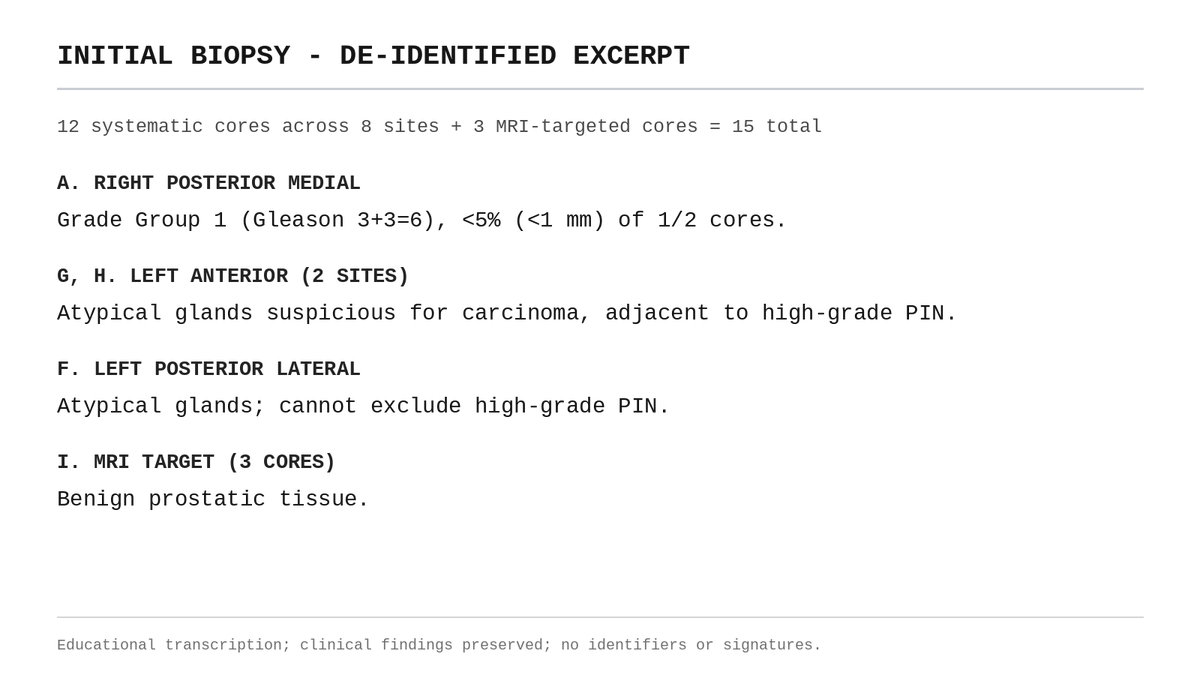
We had a patient with 3 negative MRIs and 3 negative biopsies rapidly progress to metastatic disease. Should we have told this patient his biopsies were positive?
1/8 🧵 A small prostate. Systematic + MRI-targeted biopsy. Less than 1 mm of GG1 cancer. Decipher 0.17.
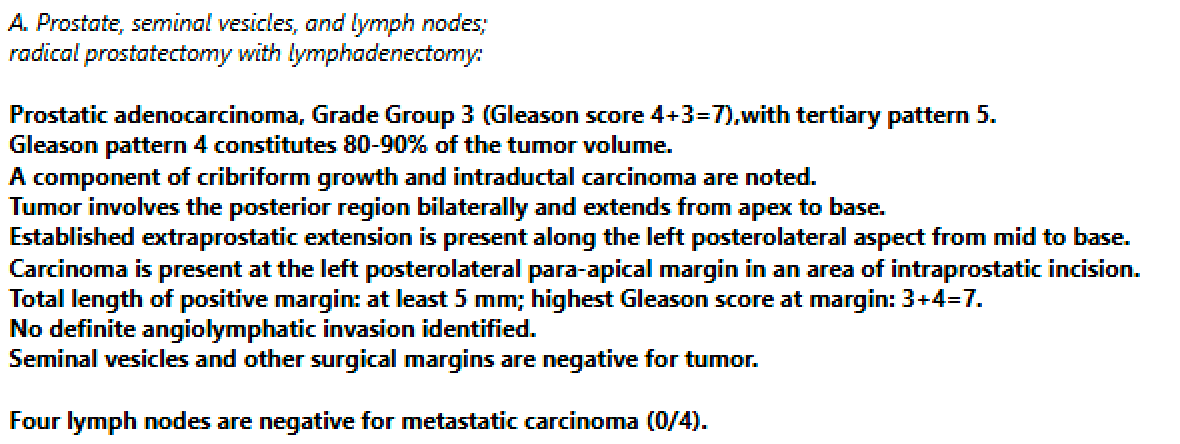
Eleven months later: GG4 on repeat biopsy, followed by EPE and a positive margin at prostatectomy.
Did we miss aggressive cancer—or did it progress this quickly?
We are debating whether GG1 should even be called “cancer.” 🧵 @PCF_Science@PCFnews@urotoday@AmericanCancer@AmerUrological
https://t.co/fqeYijir8W
@jimhumd@samsimsal@UMichUrology@UrologyMSK Counterpoint: biopsy benign tissue only does not equal only benign tissue in the whole gland. Tests with sensitivity <100% are routine in medicine but we don't say "this patient with a negative test has disease because we might have missed disease"
Much commentary on American Cancer Society switching from shared decision-making to general recommendation for PSA. But there was never evidence PSA screening is preference-sensitive (was asserted, not demonstrated). Best evidence: not preference sensitive https://t.co/sGXd2E4qPr
@uretericbud Turns out there are some very hard core statistical issues here because of induced correlations between event times. see https://t.co/L85UDcSm64
Lymphocele cited as major reason in guidelines to avoid LND in prostate cancer. Here we show most almost all lymphoceles (42/43) come from Cloquet's node, which should not be removed during LND. https://t.co/OOxRWivkXy
mm pattern 4 on biopsy far superior predictor of prostate cancer outcome than stage, grade, PSA, cores. We show using mm criteria rather than "favorable intermediate risk" would increase the number of US men eligible for active surveillance by >50,000. https://t.co/twt6InibQ2
@rewcastle_john@wheatbuster@DongNguyeb Phew! someone brave enough to admit data is questionable in the biopsy setting. We are actively looking at this issue. My guess is that most folks with cribriform also have a high pattern 4 burden
@5_utr it sounded like you were against it! The dichotomization here is to make a general point about risk stratification. In practice, I'd recommend it turned into a continuous risk to allow for individualization.
"When we tell a patient they have prostate cancer, we mean the pathologist has looked at prostate biopsy cores under a microscope and saw areas without a basal cell layer; what the patient hears, however, is something entirely different" https://t.co/QU8ET8EOtX
Join us next week for two days focused on the latest advances, evolving treatment strategies, and key clinical questions in #ProstateCancer care.
Through tumor boards, panel discussions, and head-to-head debates, multidisciplinary experts from @MSKCancerCenter and guest speakers, @Chris_Barbieri1 and @mishabeltran, will explore the full continuum of care — from screening, biomarkers, and advanced imaging to active surveillance, focal therapy, high-risk and metastatic disease, PSMA PET, radioligand therapy, PARP inhibition, and precision treatment strategies.
We hope to see you in New York or virtually, October 8–9. Learn more and register: https://t.co/1vsTDMSrgt
#MSKprostateCME