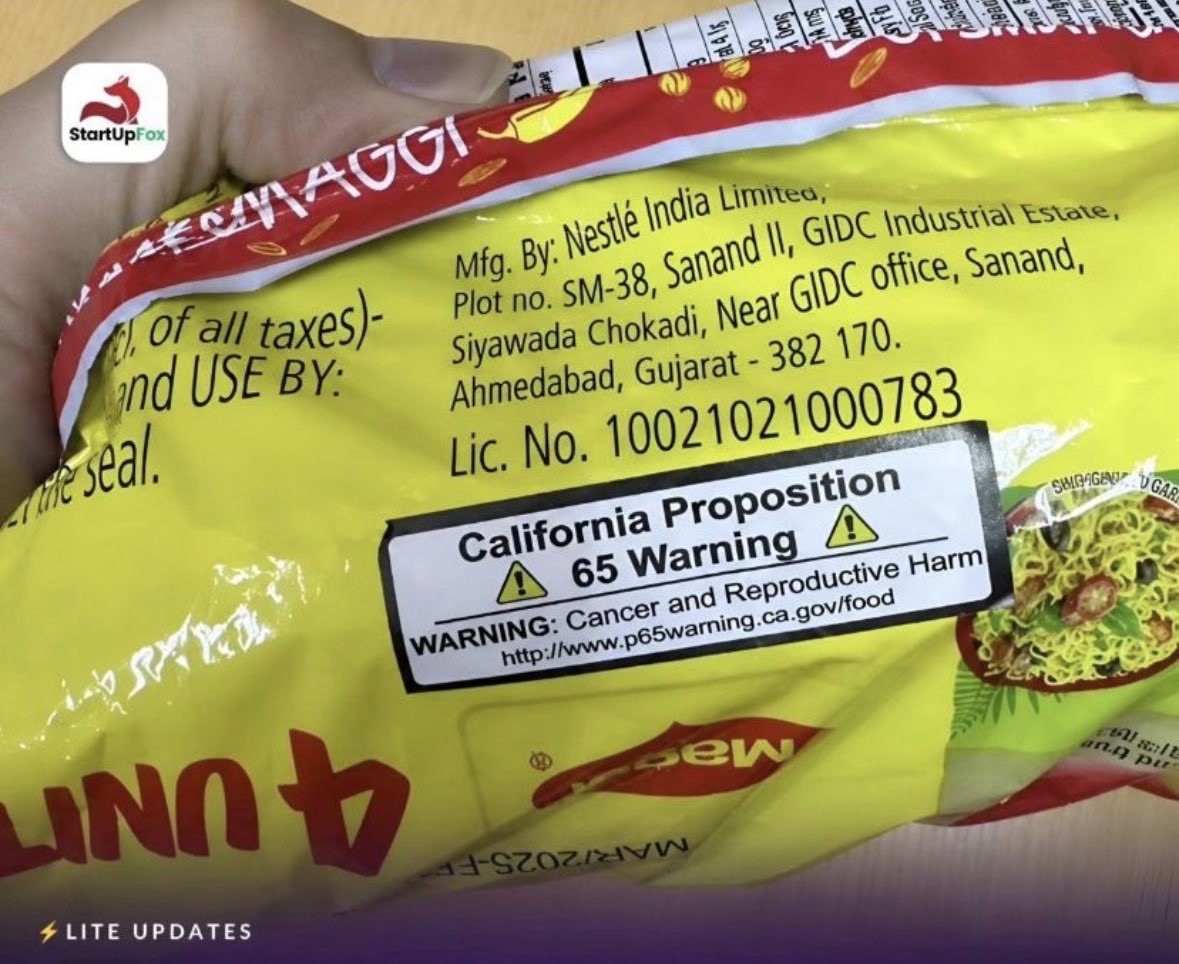
Shouldn’t Maggi say “Instant Cancer.”
When Maggi sells the same Noodles in California they carry a Cancer warning label.
India is the dumping ground for chemical food. When US banned DDT, US companies dumped all their stock in India—Indian govt called it “Green Revolution.”
A US berry company taught China to grow blueberries, and China ate its market. Everyone is sharing that story this week. Here is the original version of that story and the teacher was us (We Indians). 🙏🙏
I really wonder why we do not make it a part of our curriculum...Anyway..Let us hear this story..
On Christmas Day in 1722, it became a crime to wear one fabric in Britain.
Printed cotton from India....
The cloth was chintz. Hand-painted and block-printed cotton from Masulipatnam, Ahmedabad, Sironj, Burhanpur.
Wash it, and the colours came out brighter than before. European dyers simply could not do this. Their reds ran. Their blues faded.
English wool and silk weavers panicked. In June 1719, mobs of weavers roamed London streets, tore calico gowns off women, threw ink and acid at others. "Down with the callicoes," they shouted.
Parliament listened....
1st, in 1700: every piece of printed or dyed calico from India had to be locked in a customs warehouse for re-export.
Sell it in England and pay a 200 pound fine. Then, on 23 March 1721, a harder law. From 25 December 1722, anyone caught wearing printed, painted, stained / dyed calico paid 5 pounds per offence.
A curtain / a cushion cover in the same cloth cost 20. The fine money went to whoever informed on you.
Now the interesting part...
While England banned the cloth, France sent men to learn how it was made.
Georges Roques, a French East India Company agent, reached Surat in 1676. He wrote a 333 page manual (1678) recording, step by step, how the printers of Ahmedabad worked.
3 wooden blocks: one for the outline, one for the ground, one for the details. A sesame oil bath for the cloth. And the full shopping list of an Indian dye-house: a root for the red, alum, iron rust, gall-nuts, pomegranate rind, turmeric, indigo, sour wheat flour, tree gum, wax.
His own opening line is honest: it can only be a good thing to know how these people apply colours that do not fade in the wash, but come out more beautiful than before.
Then Antoine de Beaulieu, a Company lieutenant at Pondicherry. Around 1734 he wrote a 2nd manual, and pinned an actual sample of cloth at every stage of the process. French printers used it as a recipe book.
Then a Jesuit, Pere Coeurdoux, also in Pondicherry. He watched the dyers, took lessons from 2 Indian craftsmen, and mailed the whole process home in letters (1742 and 1747) that were printed and passed around in France.
Step by step, Europe learnt the Indian method. Then it mechanized it.
What happened to the teacher?
India exported about 4.5M pieces of cotton cloth a year in the 1790s. By the 1830s, under half a million. Around 1830 India became a net importer of cloth. By 1880-81, by one estimate, ~58% of the cloth worn in India was made in Britain.
Roques' manual sat forgotten in a Paris archive until 1966.
Even today, almost everything we know of how our own dyers worked comes from what the Frenchmen wrote down. The dyers left no book of their own.
How much else did we know, and never write down?
P.S. The real secret was the mordant: a chemical fixer (alum, iron) applied to the cloth before dyeing, so the dye bites into the fibre and never washes out. The words still carry the address: chintz comes from the Hindi chheent (spotted), calico from Calicut.
Sources: Giorgio Riello, "Asian knowledge and the development of calico printing in Europe", Journal of Global History (2010); G.B. Souza, in "How India Clothed the World" (Brill, 2009); B. Gupta, "Cotton Textiles and the Great Divergence" (Univ. of Warwick); Old Bailey trial record, July 1719; London Gazette, April 1721.
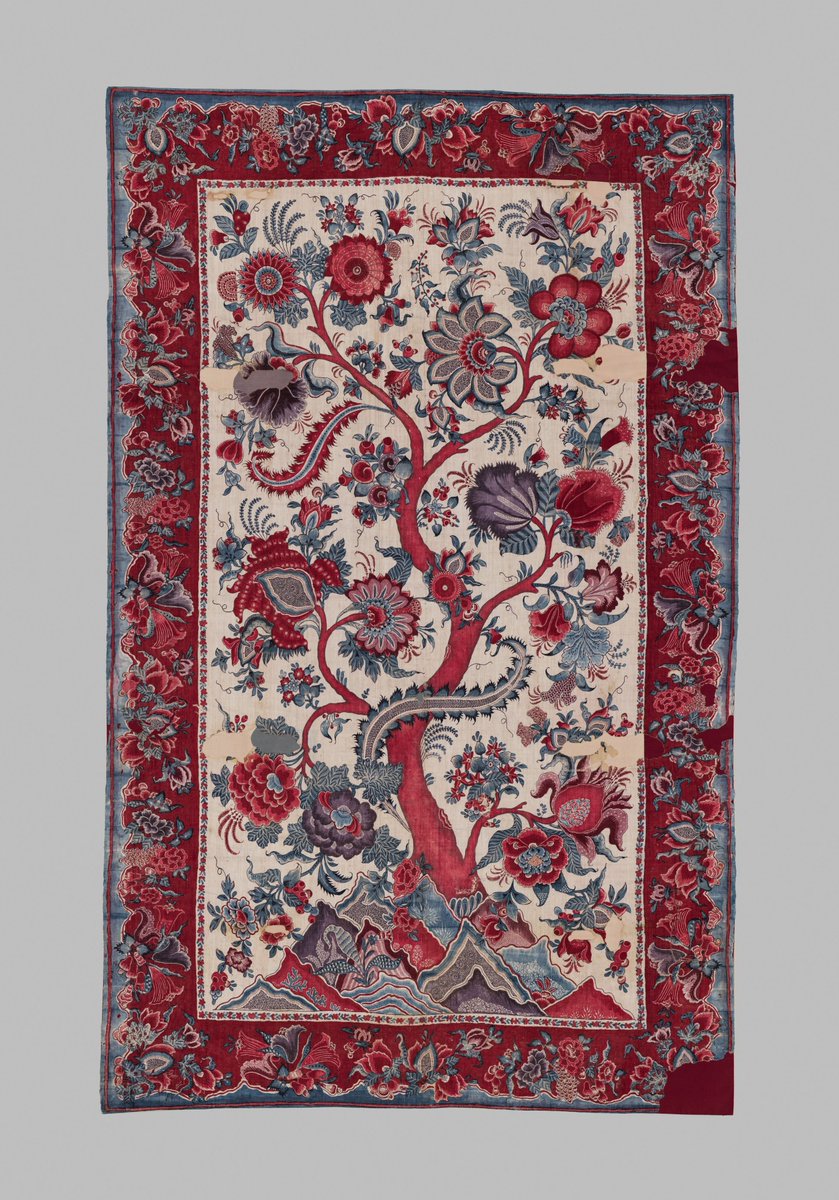
Photo: Coromandel Coast palampore, painted resist and mordant, the exact technique in the post.
This is the story of a french astronomer, stranded after missing the Venus transit, watches a Tamil Brahmin compute the December 1768 lunar eclipse in < 45 mins with cowries and palm-leaf booklets, matching the Paris ephemerides.
In 1768, a man named Nana Moutou walked into a French astronomer's house in Pondicherry and offered to compute an eclipse in front of him.
The astronomer was Guillaume Le Gentil of the Royal Academy of Sciences, Paris. He had come to India for the 1761 transit of Venus and was stuck at sea on the day.
He waited 8 years for the next one. On 3 June 1769, a single cloud covered the Sun at the exact moment. Nearly 10,000 leagues, he wrote, just to be "spectator of a fatal cloud".
Hidden inside the same book is a story nobody tells...
Le Gentil had been in Pondicherry barely 8 days when Nana Moutou came with an interpreter. Le Gentil asked for the total lunar eclipse of December 1768.
Next morning the man returned with a packet of palm leaves and a bag of cowrie shells. He sat on the floor, moved the shells with a singular speed, kept consulting his little booklet, and gave all the phases of the eclipse in less than three quarters of an hour.
Le Gentil checked the numbers against the French Ephemerides. They matched. He gave him more eclipses. Same result.
No pen. No paper. The shells were the counters, laid out on the ground.
The rules were verses recited from memory while working, the way Europeans use formulas. Once a step was done it was wiped away. And they rarely made mistakes, he writes.
Nana Moutou agreed to teach him, under strict secrecy. 4 months of hard work, he said, if the Frenchman had the aptitude.
Lessons at 4.30 every evening. Le Gentil changed interpreters 3x and got nowhere. In the end it took him more than a month, an hour a day, to compute a lunar eclipse.
His verdict: for lunar eclipses, the error in several he calculated never went > 25 minutes.
Sources: Le Gentil, Voyage dans les mers de l'Inde, Tome 1 (1779), pp. 40, 210-211
Photos: pages 210, 211 and 40 of the same 1779 edition, Imprimerie royale, scan via Internet Archive (Getty Research Institute copy), key lines highlighted
Tuvakara. A Sanskrit word for a Chaulmoogra tree. Ayurveda used its oil against leprosy for centuries.
Frederic Mouat, a British prof. at Bengal Medical College, heard of it from Indian vaidyas and the headmaster of Hindu College. Tried at Calcutta's Leper Asylum, it worked. In 1854 Mouat wrote the 1st Western paper on chaulmoogra.
Drinking it was the hard part. Many patients said they would rather have leprosy than take one more dose.
Calcutta fixed that....
Leonard Rogers and chemistry prof. Chuni Lal Bose made a soluble salt of the oil, and on 31 July 1915 it went into patients for the 1st time.
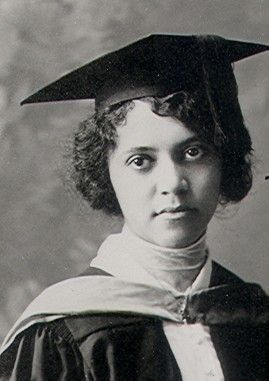
Then Hawaii. A 23-year-old chemist there, Alice Ball, converted the oil into injectable esters.
They became the standard leprosy treatment worldwide until the 1940s. Ball died at 24, before she could publish. So her department head published the work under his own name. In 1922 a colleague finally said it was hers, and called it Ball's Method.
The tree was ours. The chemistry that made it usable was ours. And we do not remember any of it.
Sources: "Chaulmoogra Oil and the Treatment of Leprosy", John Parascandola, U.S. National Library of Medicine
Photo: Alice Ball's 1915 portrait, University of Hawaii, via Wikimedia Commons (public domain)
Another way the current administration is trapped in the ZERO-SUM FALLACY: The H-1B visa situation.
+ You are NOT taking a job from a citizen, rather creating jobs by increasing overal economic output. Plus these people (even vegetarians) SPEND locally.
+ The US has long been benefiting from other countries' brain drain; without it its edge wd collapse. Tesla, Von Braun, von Neumann, Fermi & Einstein did NOT each take the job of a citizen.
+ It the problem is anti-Indian racism, say it, don't play games.
IT DIDN’T HAVE TO GET TO THIS POINT.
On October 14, we learned that on October 11, 19-year-old Alexandros Paporakis attempted a mass shooting at Sri Venkateswara Swami Temple in Aurora, Illinois. According to prosecutors, he tried to fire his assault rifle at someone, but the weapon jammed. He told a coworker about his plan, who then reported it to the police.
I keep thinking about how close this came to becoming an unimaginable tragedy. Hindu Americans had gathered at their temple for Navaratri celebrations, and their lives could have been taken in an instant.
According to prosecutors, the suspect had spent approximately two months targeting this Hindu temple. His manifesto reportedly expressed hatred toward Indians, Jews, and Black people, and he identified with white supremacist ideology. He told a coworker he “couldn't wait to kill Indian people.”
It’s important to be precise about what we know. His expressed hatred was racial and religious, and the institution he chose to attack was a Hindu place of worship.
Both facts matter.
We don't need to establish that he hated Hindu theology specifically to recognize the significance of his target.
What almost happened in Illinois is particularly horrifying because of the scale of violence that was intended. I'm glad the attempted shooting is receiving serious media coverage, but I wish the broader pattern of hostility toward Hindu institutions received the same attention.
Over the past several years, Hindu temples across the United States have been repeatedly vandalized and the hostility has not come exclusively from white supremacists. These are very different acts from an attempted mass shooting, and I don't want to conflate them. But we should be able to recognize and take seriously hostility toward Hindu places of worship, regardless of where it comes from.
For years, many of us have been trying to have thoughtful conversations about Hinduphobia. We've raised concerns about the portrayal of Hinduism, the stereotypes that circulate about Hindus, and the assumptions people make about our traditions and communities.
What's been particularly troubling is that some of the most persistent and categorical dismissal of these concerns has come from academics, activists, and organizations on the political left, including those who claim to champion Hindu human rights, religious freedom, and inclusion.
I don't expect everyone to agree with every concern we raise. But intellectually rigorous disagreement requires engaging with evidence, not dismissing it.
Instead, we've been told that Hinduphobia doesn't exist, that it's a political invention, or that raising concerns about anti-Hindu prejudice is simply an attempt to silence criticism of Hindu nationalism.
Consider the 2021 Dismantling Global Hindutva conference, supported by departments and centers at more than 50 universities and defended by over 1,100 progressive scholars. One speaker described Hinduism as an enemy of democracy; another singled out Hindu surnames and associated them with violence.
When Hindu Americans raised concerns, we were accused of threatening academic freedom, even as the discourse about Hinduism and Hindus in these spaces remains overwhelmingly critical, with remarkably little viewpoint diversity.
Rather than engaging with the substance of what we're saying, our critics question our motives and use those presumed motives to justify dismissing our concerns. We are dismissed as unreliable narrators of our own experiences, and our concerns are treated as evidence of a political agenda.
Words shape how we see one another. When false assumptions are repeated often enough, they can begin to seem like ordinary descriptions rather than expressions of prejudice. When people who challenge those stereotypes are routinely dismissed, the underlying assumptions remain unexamined.
Paporakis reportedly identified as a white supremacist, and that matters. I'm not suggesting that rhetoric from the political left caused this attempted shooting. But prejudice against Hindus isn't confined to one political ideology, and neither is the willingness to dismiss it.
We shouldn't have to wait until prejudice manifests as the threat of violence before we're willing to take seriously the ways it operates in everyday language, institutions, and public discourse.
This is part of the reason I wrote *Hindu at Heart*. I wanted to examine the centuries-old narratives that continue to shape how Hinduism and Hindus are understood, and to create space for a more informed, honest, and generous conversation. These narratives didn't begin with Donald Trump or contemporary debates about Hindu nationalism. They are much older, and they transcend our current political divisions and landscapes.
Even in the responses to this attempted mass shooting, I've been struck by how quickly some folks on the political left have redirected the conversation. I've seen it described as rising hatred against “South Asians”, without acknowledging that a Hindu temple was deliberately targeted and that the shooter specifically named Indians, not South Asians. I've also seen responses suggesting that perhaps this will “finally” prompt Hindus to show solidarity with Muslims who have experienced hatred and violence (which presumes we haven’t already done so).
There is nothing wrong with recognizing shared experiences of prejudice or standing in solidarity with other communities. But Hindu Americans should not have to demonstrate their solidarity with others before the hostility directed toward them can be acknowledged on its own terms. We should not have to accept the erasure of our Hindu faith or endure reprimands for perceived political failings in order to be considered worthy of empathy.
We should be able to recognize what is happening to the Hindu American community, and allow everyone to understand and process it, without immediately turning it into a referendum on something else—and especially not a referendum on us.
It would have been far better if we had been willing to take Hinduphobia seriously before a young man attempted to murder hundreds of people at a Hindu temple. But here we are. The temple was deliberately targeted, reportedly over months. The significance of that choice is impossible to ignore.
To my fellow Americans: use your discernment. When commentators cannot bring themselves to name what is right in front of us, we should be willing to question their analysis rather than defer to their claims of moral authority.
There are millions of Americans, across faiths, races, and political affiliations, who recognize prejudice without first demanding that its targets pass a political test. Let us move together with love, compassion, and courage.
#Hinduphobia #HinduAmerican #ReligiousFreedom #Navaratri #StopHate
.@CongressmanRaja breaks down recounting the events from past Sunday.
“I don't know how the shooter's gun jammed. I don't know how my family & others escaped. I don't know how I happened to be there, but I believe that one purpose was so I could be here and I could speak out about hate, and that has become one of my life's missions.” 💔
More than 120 hours since authorities thwarted an alleged mass shooting plot targeting a Hindu temple in Illinois. Several Members of Congress from both sides of the aisle have spoken out in support of Hindu Americans.
With all due respect, Mr. @VP, why have you remained silent? Are you afraid to speak up for Hindu Americans whose safety is now at stake?
Given your wife’s Hindu heritage, we hope you will publicly condemn this hatred and reaffirm that every American deserves to worship without fear.
Hindu Americans deserve to know that their safety matters, too.
A tribal farmer from Wayanad died this week at 74. In his old mud house, he kept more than 60 traditional rice varieties alive.
His name was Cheruvayal Raman. People called him Ramettan.
He belonged to the Kurichya tribe in Wayanad, Kerala. When he was 17, his uncle died, and the family's traditional rice seeds came to him.
Wayanad once had around 160 native rice varieties. Most of them have disappeared.
He grew each old variety in its own small plot. Every year he harvested it, dried the seeds, and stored them in his mud house for the next season.
He stopped using chemical fertiliser in 1978. He said the earthworms came back after that.
It cost him around Rs 70,000 a year. Some years, his family lived on ration rice.
When other farmers came asking, mostly tribal families, he gave them seeds without taking money.
In 2023, he got the Padma Shri. Kerala Agricultural University made him a professor of practice.
He once said, "Don't call me a hero. Make sure the seeds survive. That is enough."
Musk said it at a YC interview in June 2025. The 6-12 months he promised ran out in June. Neuralink has published no human vision implant.
This clip is circulating again now, so ofc people will start benchmarking the time window from now. Science is brutal.
Meanwhile an Indian has been doing something different with blind kids, and it is worth a look till the Neuralink implant solves it.
Pawan Sinha, IIT Delhi alum, now teaches neuroscience at MIT. 2002, Delhi. He meets two blind siblings on the street. Cataracts. Treatable, nobody treated.
Two years later Project Prakash starts. Villages screened, kids operated free at Dr. Shroff's Charity Eye Hospital. 500+ surgeries so far.
Sounds like an NGO story, right?
But surgery fixes only the eye. A child blind since birth never learned to see, so what then? Sinha's lab tests and scans every child afterwards.
Do they recognise faces? Does the brain rewire? Textbooks said no, not after early childhood. Yet teenagers blind from birth gained real vision, and scans showed white matter changing.
One more thing. Right after the operation a child cannot match what s/he sees with what s/he feels by touch. Takes about a week to link up.
Ofc this is not cortex-writing like Blindsight. These kids had working retinas. It only shows a brain with no early vision can still learn to see.
Commendable job by Pawan Sinha and team. 🙏🙏
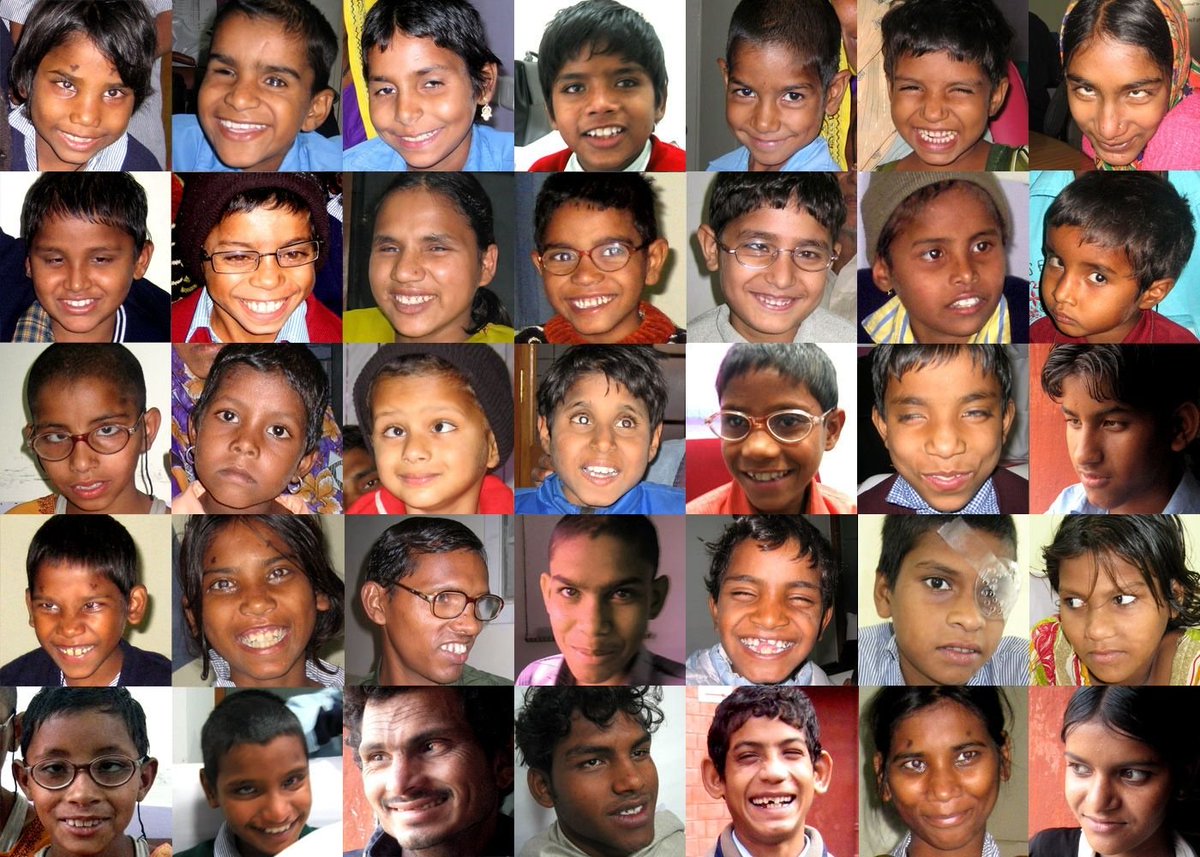
Photo 1: Pawan Sinha (seated left, white shirt) testing a child on a laptop in a village, early Project Prakash fieldwork.
Photo 2: Collage of Prakash children, some with glasses after surgery. Pairs with the 500+ surgeries line.
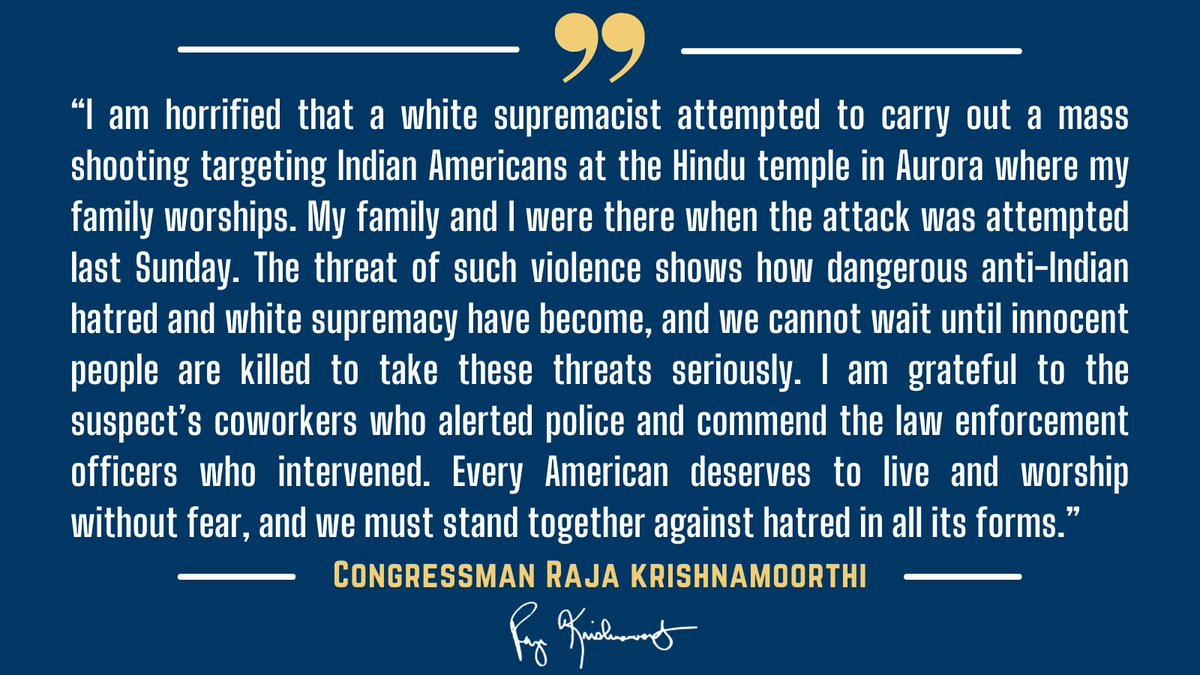
My family and I were worshipping at our Hindu temple in Aurora on Sunday when a white supremacist attempted a mass shooting targeting Indian Americans. I'm grateful to those who helped prevent a tragedy, but we must come together to confront the hatred that put so many innocent lives at risk.
Why the fuck are Indians hated so much? What have they done to deserve this level of hatred?
Have Indians promoted terrorism? Have they colonized your countries? Enslaved your people? Stolen your homes? Taken away your families? Kidnapped your children? What exactly have millions of ordinary Indians done to deserve this much racism and hostility?
Is it because they're educated, intelligent, ambitious, hardworking, and competing for the same jobs as you? Since when did intelligence and ambition become crimes? Since when did working hard to build a better life become a reason to be hated?
If your problem is job displacement, then why aren't you directing the same anger toward artificial intelligence?
Why not question AI? Why not question ChatGPT, Claude, Grok, Anthropic, OpenAI?
AI has the potential to displace far more jobs than Indian immigrants ever could. Yet somehow, the Indian engineer, the Indian student, the Indian doctor, and the Indian worker become your enemies.
Why? Because it's easier to target a human being with a different skin colour or accent than to confront the actual economic forces changing your world?
And understand one thing clearly.
If an Indian refuses to engage with your racism, if they ignore your insults, if they choose not to respond to your hatred, it doesn't mean they lack a spine.
It means your hatred isn't worth their time.
Indians don't owe you an apology for being educated, ambitious, hardworking, successful, or simply existing.
Being Indian is not a crime. Being successful is not a crime. And your insecurity is not a justification for racism.
With the recent reports of a thwarted mass shooting plot targeting a Hindu place of worship in Illinois and an attack on a Hindu temple in Ohio just two weeks ago, temple safety and security are more urgent than ever.
Every Hindu should be able to worship without fear. While we are grateful to law enforcement for responding to threats, protecting our mandirs also requires awareness, preparedness, and community vigilance.
HAF’s Temple Safety and Security Guide offers practical steps to help Hindu temples strengthen security and prepare for potential threats.
Please share this resource with your local mandir leadership and community. Preparedness matters, and every temple deserves to be a safe place of worship.
🔗 Read and share HAF’s Temple Safety and Security Guide 👉https://t.co/DJkk5aOkyX
According to the latest reporting, the heavily armed gunman was already at the Hindu temple and attempted to start shooting, but the gun jammed.
The man described himself as a "sociopathic white supremacist Neo-Nazi filled with hatred, fantasizing about mass murder nearly every day."
Very disturbing details here:
https://t.co/G2aN90yTu8
🚨 A MASS SHOOTING AT A HINDU TEMPLE NEAR CHICAGO WAS BEING PLANNED BY A WHITE SUPREMACIST.
THIS SHOULD TERRIFY EVERY AMERICAN.
19 year old Alexandros Paporakis allegedly planned to massacre Hindu worshippers. Police recovered a rifle, loaded magazines, HUNDREDS of rounds of ammunition, body armor, and a manifesto expressing HATRED toward Indians.
Imagine taking your children to a temple on a Sunday morning, completely unaware that someone may be preparing to SLAUGHTER your family simply because of your ethnicity or religion.
THIS IS HOW DEADLY RACIAL HATRED CAN BECOME.
For YEARS, HATE INFLUENCERS have turned demonizing Indians into a PROFITABLE BUSINESS.
Millions of impressions. Endless dehumanization. Racism disguised as political commentary.
ONLINE HATE DOES NOT STAY ONLINE.
IT CAN and HAS TURNED INTO REAL-WORLD TERRORISM.
We must HOLD these hate influencers ACCOUNTABLE for the hatred they push and normalize.
DO WE REALLY HAVE TO WAIT UNTIL INNOCENT INDIAN AMERICAN FAMILIES ARE MASSACRED BEFORE THIS COUNTRY TAKES ANTI-INDIAN HATRED SERIOUSLY?
ENOUGH IS ENOUGH.
SAUDI ARABIA WANTS TO EXECUTE A 24-YEAR-OLD HINDU MAN OVER A FACEBOOK COMMENT.
Read that again. A FACEBOOK COMMENT.
His name is Sivarasa Anojan, a young Sri Lankan Tamil engineer who went to Saudi Arabia to earn a living and build a future.
During a religious argument, he posted a comment deemed insulting to Islam.
He DELETED it. He APOLOGIZED.
But someone took a screenshot and reported him to his employer in Saudi Arabia.
He was arrested.
First, he was sentenced to FIVE YEARS in prison and an $800,000 fine.
Apparently, even that wasn't enough. Saudi prosecutors pursued a harsher punishment.
NOW THIS 24-YEAR-OLD FACES EXECUTION.
A young man with an entire life ahead of him. A mother waiting for her son to come home. A family begging for mercy. All over words written on a screen.
WHAT KIND OF JUSTICE SYSTEM CONSIDERS A FACEBOOK COMMENT WORTHY OF DEATH?
You cannot claim to be a modernizing nation while threatening to execute someone for offending religious beliefs.
Religious freedom means NOTHING if the penalty for offending a religion is DEATH.
The United States, India, Sri Lanka and the international community MUST demand that Saudi Arabia overturn this sentence.
SAUDI ARABIA MUST RELEASE SIVARASA ANOJAN.
His life is worth more than a religious insult.