When your repo/skill becomes your brand
@mvanhorn /last30days
@morluto /reverse engineer anything
@mattpocock /skills
@affaan /Everything claude code (ECC)
@obra /superpowers
@garrytan /gstack
Any more?
@hnshah I find that if the project is in a new area(new courses for me), then reviewing agent outputs gets more difficult over time, as I have not built expertise by building the artifacts myself.
The era of System One Vision Model is here! Introducing VFlash: parsing the visual world in parallel at unmatched speeds for Physical AI.
Most embodied prediction tasks like object localization, robot trajectory planning, and dense 3D motion are fixed-length float vectors. For example, a bounding box is always 6 tokens, a 10-waypoint robot arm trajectory is 54: we know these beforehand. Instead of decoding one token at a time, we can output the entire geometric shape in one go.
VFlash enables up to 12x faster action decoding and a 5.1x overall robot inference speedup on edge GPUs like the Jetson Thor and DGX Spark. What’s surprising is that it ends up even more accurate than the VLM backbone, with up to 61% lower 3D trajectory error. The intuition is that VFlash avoids the cascading errors of autoregressive decoding, where every coordinate is written in ink and every later point loses the chance to backspace.
Everything that moves will be autonomous, and everything autonomous will need to think on its own chip. The next inference revolution is physical reasoning at the speed of reflex.
And as always, it’s open paper, open source! Link in thread:
So one of our ambassadors @divagr1925 has been working on something cool
He found a way to use Qwen's Gated DeltaNet state as memory, and built a 32-bit RISC-V CPU directly into the model's weights. So instead of relying on predicting the answer to a calculation, the model can execute instructions internally. It can also run C and MicroPython programs.
He calls it Qwenputer, love the name btw. The results so far are pretty impressive. On one arithmetic benchmark, accuracy jumped from 48.6% to 100%.
Pretty cool to see developers experimenting with Qwen's architecture. Great work, my friend!
Surprise 1: Anthropic acquired a one-person biotech
.
.
.
Surprise 2: that person is me
Surprise 3: I’m here to tell you all about it
Yes, this is what you think it is; after 6 yrs of increasingly loose anonymity: the Professor Oak reveal post
…and yes, it has gotten so boring around here that I’m literally doxxing myself to spice up the timeline
-------
Ok, allow me to introduce myself. My name is Cody Tranbarger. I mostly tweet, but occasionally find time to dabble in drug dev & starting/building biotechs. My past lives span the VC, crossover, startup continuum; Prof Oak has been my way of keeping a digital foot in those worlds, despite having my physical feet planted elsewhere.
The past 18 mo, ‘elsewhere’ was Mithril Medicine, a co. I founded to develop bsAbs for LAMA2-CMD & other ECM-related genetic diseases.
Mithril was born out of hands-on building with @MikeNGladstone, @JasonPaulRhodes, @LifeSciVC, & team @atlasventure. Somehow, I made enough half-decent calls along the way (even a broken clock is right twice a day, eh?) to convince them Mithril/I warranted a small seed. While I can hardly rationalize such an outrageously cavalier bet, I’m grateful for it, & I'd partner with Atlas again in a heartbeat.
In typical AV fashion, Mithril’s primordial form was virtual, decentralized, & ultra-lean. This stage tends to be short-lived, but for Mithril, it worked surprisingly well, for surprisingly long, thanks in part to the rapid maturation of the AI tools I used liberally.
Eventually, Mithril became a bit of an experiment itself - to find the upper bound of how far it could scale as a single operator + a bunch of Claude (+ a stellar bench of part-time consultants).
In parallel, I started spending time with @nc_frey, @an1lam, & @CoefficientBio team; and promptly experienced, for the 1st time, AI at the frontier. Soon thereafter, Mithril stopped looking like an experiment, & started looking like a preview of an entirely new operating model.
From that spark came “Pipeline-in-a-Person.” The idea immediately resonated when we shared it here back in April; and it was central to the shared vision that led to Anthropic’s acquisition of Mithril, & my joining the team.
Why join Anthropic? Three reasons.
(1) For Mithril, the programs continue, with more resources & infrastructure behind them, and as much Claude as I can put to work.
(2) For me, the chance to start several more programs, & find out how many one person can actually run in parallel - an almost unprecedented luxury for a curious drug hunter.
(3) For our mission, a path to institutionalize & scale this new way of working, then put it in the hands of all of biopharma, all over the world - which, candidly, I find the most energizing.
Will AI x Bio cure diseases? Unequivocally yes, imo… but not by the route that gets the most airtime. Rather than timeline acceleration & compression, I see orchestration & parallelization as today's low-hanging fruit.
Most drug hunters see a handful of go/no-go calls in a career, & spend entirely too much of the rest trading emails (my inbox can attest).
Give them the bandwidth to run several programs at once, and the time to focus on scientific judgment, and I’m willing to bet they’ll make better calls. And at scale, better calls translate to more drugs, higher hit rates, broader patient impact, & likely, a disease or 10 or 100 cured. I couldn't be more excited to build toward that future @AnthropicAI.
Finally, a heartfelt thank you to BioTwitter/X. The end of anonymity is bittersweet, but if anyone’s earned a proper introduction, you all have.
It’s difficult to overstate how much this app has done for me: a decade of education, plenty of friends, many job opportunities, several mentors, a few investors, even a co-founder (fmr). It was the generosity of this community that inspired me to start posting 6 years ago, after just as many years lurking. I hope I’ve been able to pay it forward, in my own small way.
But, to be clear, Prof Oak isn’t going anywhere. Same beat, same themes, and now, a front-row seat to drug development at the frontier. Stay tuned for dispatches from the trenches; and remember...
Gotta Cure 'Em All
When your repo/skill becomes your brand
@mvanhorn /last30days
@morluto /reverse engineer anything
@mattpocock /skills
@affaan /Everything claude code (ECC)
@obra /superpowers
@garrytan /gstack
Any more?
@call_me_indiana not sure. the models are getting better each day so i am seeing more people just go direct instead of using MCP's, though it might have a life as a managed server.
New workflow
Read about some new technique/skill/model on X
Click the Grok button on the post, and have a conversation in context, supported by some secondary research and/or 'vibes' search on x (done by Grok) and develop some filtered opinion.
Have Grok hand it off to 'Dope' my Chief of Staff which can review and hand off that for consideration to one or more inboxes for my multiple agents, one for each repo(research, teaching, code subgroups). This is a commit to a repo on main, as each folder is a repo.
Once in the agent inbox, my local fleet of agents take over (Opus and Codex/Codex Edu)
Opus is the orchestrator(control), and it farms out tasks on the cloned copies of those repo's. Each repo might run models from Claude, Codex, Devin , Opencode based on the fleet protocol. Usually, I prefer Opus to be the driver and Codex as the main executor.
Each repo starts with a /start-session skill and closes with a /wrap-up-session skill which does a bunch of stuff, including checking inbox items, besides being the main interface for direct work by me.
All changes are commits, new/bif changes are branches, and every agent is forced to signoff on the commits, issues, comments with their signature and protocols are in place to prevent step on each others toes.
I can get updates on the go with voice interaction with Jev(ChatGpt Dot) or Dope(Grok bot) on the phone and/or Ara(Grok agent in the Tesla).
All im missing is a duplex voice agent in the claude ios app. Once that is done, I am golden.
Next steps. Move all the local execution to a protected cloud instance and every interface becomes a client. A private VPS or perhaps an always on M2 Max at home.
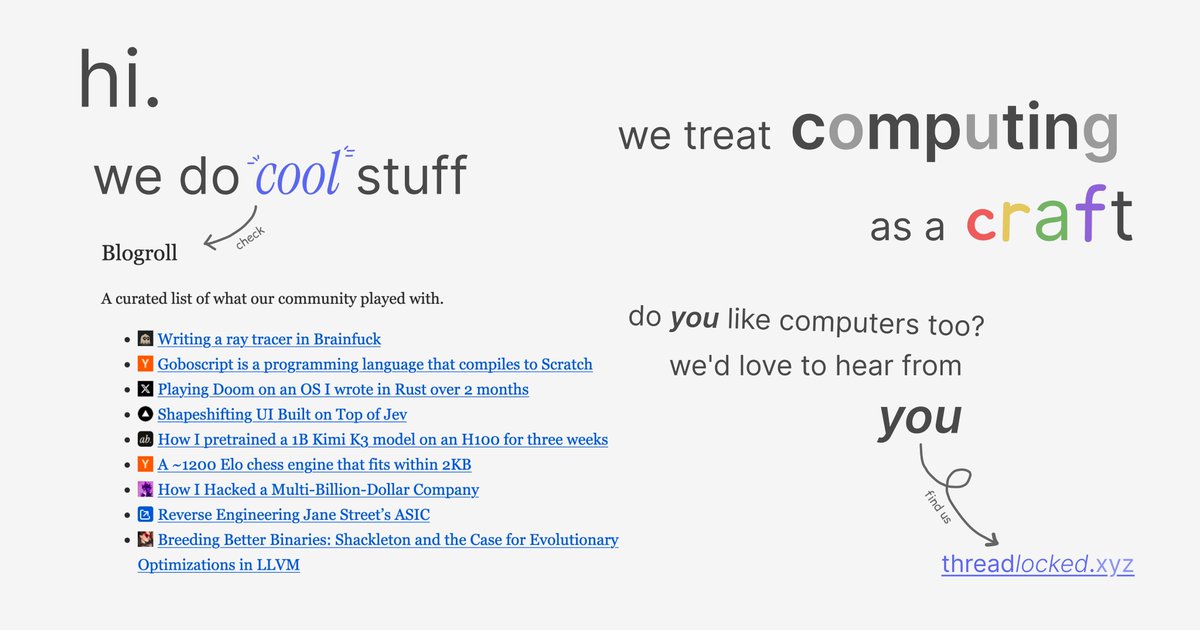
Hi, we're Threadlocked, a small collective of young researchers and hackers scattered across India and APAC.
We're sick of watching an entire generation mistake salary packages and credentials for the pursuit of computer science itself.
We're looking for curious hackers and researchers who still dare to take the road less traveled by treating computing as a craft.
We grew up in obscure corners of the Internet and learnt from strangers who encouraged our curiosity, shared their knowledge and even helped us access resources we couldn't afford. Somewhere along the way, we found our people. Now that we're in a position to do the same for others, we'd like to return the favor.
If any of these feel familiar we’d love to hear from you.
Jensen closed his GTC Berlin 2026 keynote with this Hermes Agent demo as the finale.
He introduced it by saying the way to build an agent is to ask an agent to build it for you, so he installed and set up a customized Hermes in one prompt.
Then he used Hermes, running on @nvidia RTX Spark, to create a simulated training environment for the @huggingface Microduck. Hermes planned an obstacle course with Nemotron and had GPT-6 Astra build it using FreeCAD, Omniverse libraries, Blender, Newton, and Isaac Lab. Hermes trained thousands of simulated ducks on that course until the validated policy was ready to run on the real robot in the physical world.
At Nous, we believe open source is a practical tool as much as a philosophical ideal. It gives users the ability to build powerful, complex workflows chaining numerous local+cloud models, devices, and tools themselves instead of waiting for a company to enable them.