Published!
New paper by myself, @volcanoLoz@volcanofile Peter Haynes, Rolando Garcia and Thomas Birner. We investigate why the QBO changes in response to a large volcanic eruption.
Delighted to announce that our new Volc2Clim webtool is available at https://t.co/Le1FtU3fWD 🎉 We hope it will be of broad interest for research, teaching and outreach purposes for volcanologists, atmospheric scientists, climate modellers and many other! 🌋🌦️ (1/n)
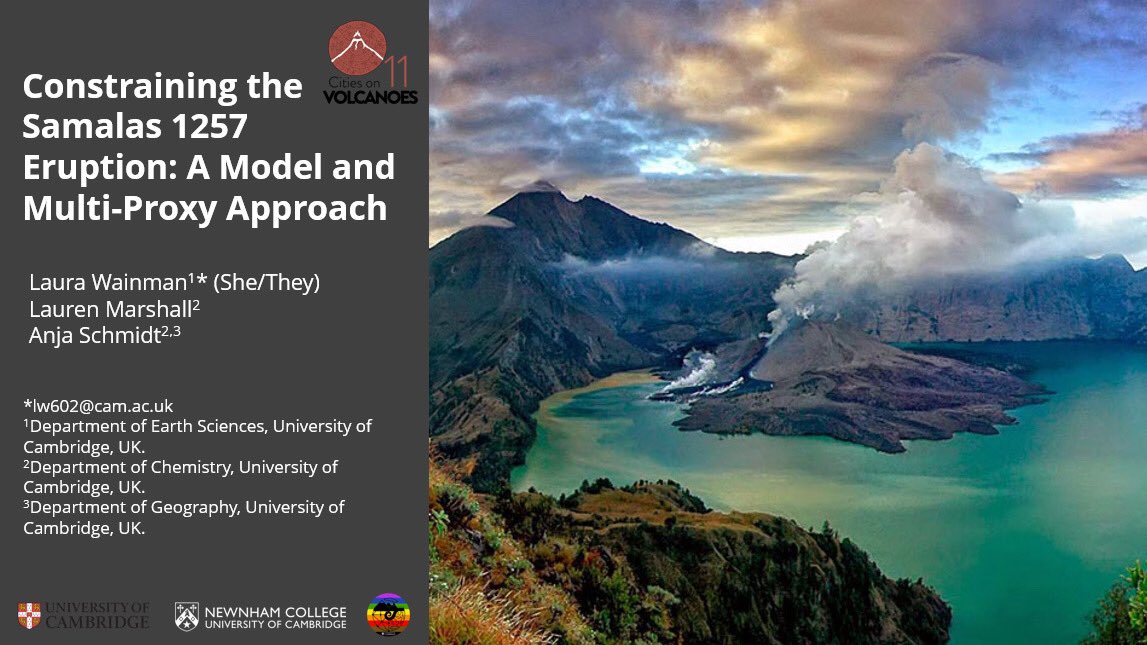
Don’t miss our Laura Wainman’s talk at @CoV11Crete on the Samalas 1257 eruption, today 12pm (S2.13) 🌋
@WainmanLaura will speak about their Masters research: bringing together tree rings, stalagmites and medieval chronicles to date the eruption #COV11@volcanoLoz@volcanofile
As expected there will be very little surface #cooling (change of -0.006 K averaged across the globe) due to the #HungaTonga#eruption! Calculated using a simple climate model developed by @chrisroadmap in synergy with data from @ThomasJAubry
https://t.co/SXSY5ck0ht
Here is a first estimate of the stratospheric aerosol optical depth (SAOD) evolution following the #HungaTongaHungaHaapai#eruption, using the EVA_H model. I used @simoncarn 0.4Tg SO2 estimates and a 25km height based on the 20-30km range seen from @andyprata and others. (1/n)
Volcanoes have always helped cool global temperatures, but as #ClimateChange continues to accelerate, the way volcanic gases interact with the atmosphere could change dramatically: https://t.co/mCCcB1f6VN
New research from @ThomasJAubry@volcanofile#Volcanoes
#volcanic eruptions impact climate, but how does climate change affect volcanic processes? 🌋🌦️🏭 Our new @NatureComms paper shows that climate change could alter the lifecycle and radiative forcing of volcanic sulfate aerosols from tropical eruptions (1/n)
Our results also suggest that high latitude eruptions could be responsible for bipolar deposition signals. An online tool where the emulated radiative forcing can be explored for a range in ice-sheet deposition is available here: https://t.co/55JdIqufDl👩💻3/3
Very happy to share our paper on the uncertainty in volcanic radiative forcing reconstructions caused by unknown eruption source parameters. We use aerosol-climate sims & statistical emulation to find eruptions that match bipolar deposition signals 🌋🧊1/3 https://t.co/WudSXdb3KO
Plausible eruptions have a wide range in sulfur dioxide emissions and latitudes, and consequently, a large range in radiative forcing. This leads to uncertainties in the global mean surface cooling on the order of 1°C for the largest unidentified historical eruptions🌎🌡️ 2/3
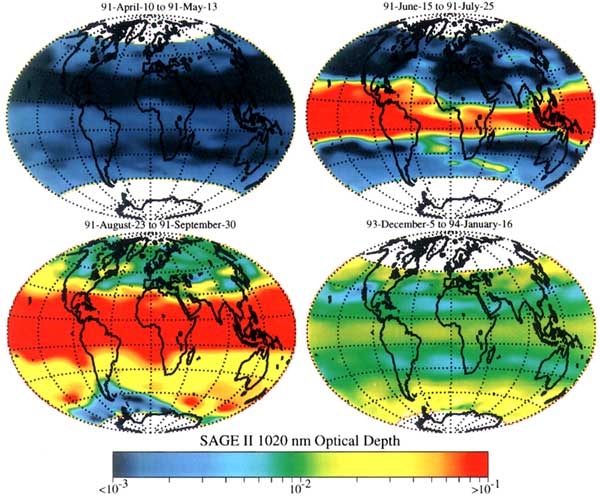
30 years ago today, the cataclysmic phase of the 1991 Mount #Pinatubo#eruption started. This eruption spawned research across many scientific disciplines, and is a good example of successful #hazard management.
Nice summary of the atmospheric effects:
https://t.co/d1h2mRc2YE
#UKCA simulations suggest that halogen emissions amplify the forcing of #volcanic sulfate aerosols. Fantastic work by my officemate Johnny Staunton-Sykes and his first PhD paper! Congrats Johnny 🥳
@volcanofile@aTarchie@volcanoLoz@Atmos_Pem
Join our #StepWide initiative and submit your profile to the site. We want to create a database of female #postdocs, experts in their fields, and improve our representation in the media.
#WomenInSTEM
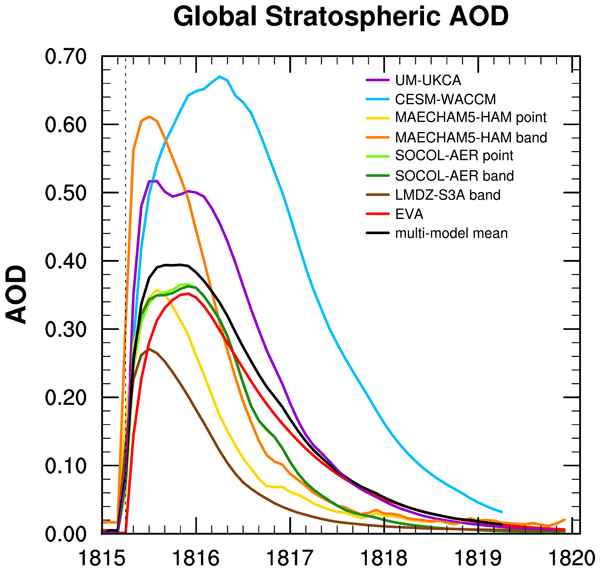
New #EGUhighlights: Model physics and chemistry causing intermodel disagreement within the VolMIP-Tambora Interactive Stratospheric Aerosol ensemble https://t.co/K6o9oFkjkO
Less than a week to go! On #IWD2021 (8th March) we’ll be joined by six amazing scientists to explore what it means to be a scientist within the context of broader life experiences.
Sign up now to join the discussion!
#WomenInSTEM
https://t.co/aTSSIQdzvw