« Intelligence artificielle : en 2026, le ciel nous tombe sur la tête. » Pour le mathématicien Cédric Villani, jusqu’en 2025 ses pairs voyaient dans l’IA un « super assistant ». En 2026, l'assistant est devenu un "remplaçant"... Retrouvez l’intégralité de l’émission sur https://t.co/2HOx7UMykb.
This @NewYorker story is so good, and so important for everyone to understand. Through the lens of semiconductor manufacturing, it highlights the interconnectedness of today’s world and puts to shame anyone who thinks that we can go back to a world shaped only by national rivalries rather than international cooperation and trade. “The semiconductor supply chain is a planetary superorganism with its own ecology…. Globalization has become tainted in our eyes, as if it necessarily constitutes a zero-sum enterprise. And its mercenary form—which is also its most common form—has indeed inflicted harm. But the global semiconductor supply chain reflects an alternative pathway. It has united its participants in the pursuit of something profoundly difficult that could not have been achieved in the absence of intercontinental solidarity.” https://t.co/IbZsJozH6l
My friend makes $1.2 million a year as an Anthropic engineer.
I asked him how he learned prompting so well. He sent me a video that was never supposed to get out. Their core team's prompting playbook.
You won’t find anything better about prompting than this 30 minutes video.
I watched it last night. Halfway through, I realized I've been using Claude completely wrong for two years.
Watch it, then read the article below.
Ben Affleck says AI is simply matrix multiplication, linear algebra and floating point calculations, and however convincingly it sounds like a person, it has nothing to do with thought, humanity or feeling
“Nor do I believe, and I think it’s important to draw the distinction between what AI does, which is simply predict the next token or the next word in a sentence, then add that word on, run it back to the machine, do a lot of computation and pick the next word."
"That is a very different thing than sentience or thought. And I think we need to be really clear about that because it can be convincingly, in an illusory way, sound like thought or like a person."
"But let’s be real clear. This is matrix multiplication. This is linear algebra. These are floating point calculations. It has nothing to do with thought, humanity, or feeling.”
Eric Schmidt's (ex-Google CEO) advice to college students: Use AI to scale your own work, whatever that work is.
"If you're a non-technical person, you should figure out how to use these tools to make your dreams and your realities extraordinarily scaled.
You want to be a global star, a global influencer, a global impactor, a global discoverer, a global singer, you want to use these tools, whatever it is that you want.
Figure out a way to use them to amplify you and what you care about and your innate goodness.
If you're a technical person, use the same tools to invent stuff and to invent stuff that changes the world. I've never seen the cost of entry to be so low and the availability of these ideas so great.
The only thing that limits you is your curiosity, your willingness to take risks and so forth. So, get over it. And say, I want to dream, I want to use these tools to have this enormous impact, right?"
----
From "Blackstone and Eric Schmidt" YouTube channel, (link in comment)
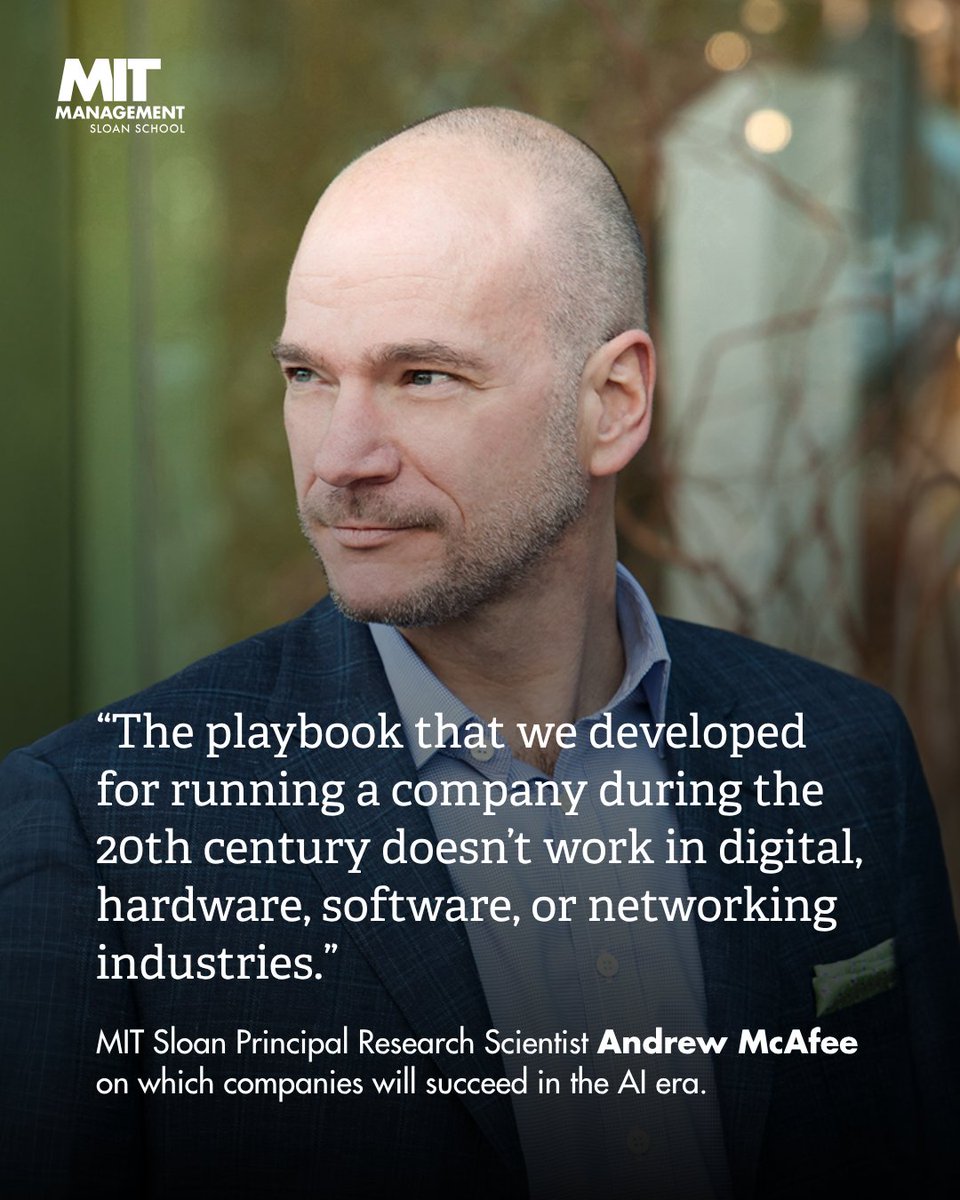
Organizations that succeed in the 21st century are agile and innovate quickly. According to MIT Sloan’s @amcafee, the future of tech-driven companies is young U.S. firms on the West Coast.
Learn more: https://t.co/siubN72WNK
Whatever book you pick up, it’s likely to make you feel better—maybe even a whole lot better. “In a secular age, I suspect that reading fiction is one of the few remaining paths to transcendence, that elusive state in which the distance between the self and the universe shrinks,” Ceridwen Dovey writes, in “Can Reading Make You Happier?,” which was published in 2015. Dive into the research behind the therapeutic effect of books: https://t.co/H94aQp3jtK
Economist and professor @TylerCowen chats with Megan McArdle (@asymmetricinfo) about how AI could transform talent, human capital and competition: https://t.co/s8ozD6rrVv
Job seekers in the U.S. and many other nations face a tough environment. At the same time, fears of AI-caused job loss have — so far — been overblown. However, the demand for AI skills is starting to cause shifts in the job market. I’d like to share what I’m seeing on the ground.
First, many tech companies have laid off workers over the past year. While some CEOs cited AI as the reason — that AI is doing the work, so people are no longer needed — the reality is AI just doesn’t work that well yet. Many of the layoffs have been corrections for overhiring during the pandemic or general cost-cutting and reorganization that occasionally happened even before modern AI. Outside of a handful of roles, few layoffs have resulted from jobs being automated by AI.
Granted, this may grow in the future. People who are currently in some professions that are highly exposed to AI automation, such as call-center operators, translators, and voice actors, are likely to struggle to find jobs and/or see declining salaries. But widespread job losses have been overhyped.
Instead, a common refrain applies: AI won’t replace workers, but workers who use AI will replace workers who don’t. For instance, because AI coding tools make developers much more efficient, developers who know how to use them are increasingly in-demand. (If you want to be one of these people, please take our short courses on Claude Code, Gemini CLI, and Agentic Skills!)
So AI is leading to job losses, but in a subtle way. Some businesses are letting go of employees who are not adapting to AI and replacing them with people who are. This trend is already obvious in software development. Further, in many startups’ hiring patterns, I am seeing early signs of this type of personnel replacement in roles that traditionally are considered non-technical. Marketers, recruiters, and analysts who know how to code with AI are more productive than those who don’t, so some businesses are slowly parting ways with employees that aren’t able to adapt. I expect this will accelerate.
At the same time, when companies build new teams that are AI native, sometimes the new teams are smaller than the ones they replace. AI makes individuals more effective, and this makes it possible to shrink team sizes. For example, as AI has made building software easier, the bottleneck is shifting to deciding what to build — this is the Product Management (PM) bottleneck. A project that used to be assigned to 8 engineers and 1 PM might now be assigned to 2 engineers and 1 PM, or perhaps even to a single person with a mix of engineering and product skills.
The good news for employees is that most businesses have a lot of work to do and not enough people to do it. People with the right AI skills are often given opportunities to step up and do more, and maybe tackle the long backlog of ideas that couldn’t be executed before AI made the work go more quickly. I’m seeing many employees in many businesses step up to build new things that help their business. Opportunities abound!
I know these changes are stressful. My heart goes out to every family that has been affected by a layoff, to every job seeker struggling to find the role they want, and to the far larger number of people who are worried about their future job prospects. Fortunately, there’s still time to learn and position yourself well for where the job market is going. When it comes to AI, the vast majority of people, technical or nontechnical, are at the starting line, or they were recently. So this remains a great time to keep learning and keep building, and the opportunities for those who do are numerous!
[Original text; https://t.co/zbIhZHfCC0 ]
I completely agree with Sam Altman; within 2 to 3 years, most knowledge work won’t be about doing the work anymore. It will be about directing AI agents.
The real skill will shift from execution to orchestration.
Knowing what to ask. Structuring problems clearly. Making high-leverage decisions while fleets of agents handle the heavy lifting.
Managers of intelligence instead of producers of output.
Elon Musk thinks coding dies this year.
Not evolves. Dies.
By December, AI won’t need programming languages. It generates machine code directly. Binary optimized beyond anything human logic could produce. No translation. No compilation. Just pure execution.
Musk: “You don’t even bother doing coding.”
Code was never the point. It was friction. A tax we paid because machines didn’t speak human. AI just learned fluent human. The tax is gone.
Now plug that into Neuralink. No syntax. No keyboard. No screen.
Musk: “Imagination-to-software.”
Thought becomes executable. You imagine an outcome, the system architects and compiles it into reality instantly.
We’re not automating programming. We’re erasing it from existence.
The entire profession collapses into a thought. Decades of training reduced to irrelevance. The gap between idea and instantiation hits zero.
You don’t build anymore. You imagine, and it materializes.
Not incremental progress. Total phase shift. The way humans have created things for ten thousand years just became obsolete.
Welcome to a world where the limiting factor isn’t skill, resources, or time. It’s whether you can picture what you want clearly enough for a machine to birth it into existence.