For the last three years, a startup in Bangalore has been obsessed with a pursuit that typically invites raised eyebrows, naked skepticism, and accusations of stealing from sci-fi:
@dognosis is training dogs to detect cancer.
And until you've spent time at their facility - a former pomegranate farm in the outskirts of Bangalore - perhaps skepticism is the rational response.
But Dognosis isn't betting on some pie-in-the-sky idea or some charming novelty act, they're betting on evolution.
@akadogluk and @Itamar_Bitan based their company on the fact that the dog's nose - a product of fifteen millennia of co-evolution with humans - can detect the faint chemical trace of cancer in your breath at a resolution that our machines, algorithms, and laboratory tests have never come close to matching.
We've known this fact for decades. We've consistently failed to do anything meaningful with that knowledge.
The missing link has been figuring out what the dog's nose knows, and applying it in a standardised, scalable, and clinically validated way.
Dognosis is building this missing piece of the equation i.e. the translation layer that allows the dog's nose to speak a language medicine can understand, enabling us to harness an ancient biological intelligence and plug it into our modern medical infrastructure.
Maybe you've read the paragraphs above and retained your skepticism. That's fair. But this past Friday, the Journal of Clinical Oncology - the world's most influential cancer journal - opted to make life much harder for the skeptics.
On Friday, the JCO published Dognosis' landmark study on breath-based multi-cancer detection - the largest of its kind ever conducted - showing that a team of trained dogs, equipped with sensors and AI, could detect multiple cancers from breath alone at 90%+ accuracy - including at Stage I, when it matters most - for $2 a test.
According to Akash, it proved "that everything we’ve known about the dogs is true".
Needless to say, it's a genuine milestone for Indian healthcare, health-tech, deep-tech, and, uh, dog-tech, that deserves far more attention than it's gotten so far.
To help change that, we were lucky to have Akash stop by the Tigerfeathers editorial desk this past week to unpack the Dognosis journey - helping us understand what they're building, how they're doing it, why it matters, and what comes next.
From where we're sitting, Dognosis is an n-of-1 Indian startup with an n-of-1 story that everyone in the Indian tech ecosystem should be aware of. If you've been intrigued by what you've read so far and you're keen to go deeper, dive into our piece here👇
https://t.co/limlGrgxJ1
Our canine-powered bayesian model achieved 90%+ sensitivity and specificity (AUC of 0.962) in a n=1502 trial, with sensitivity stable across cancer types and at Stage 1/2. Largest study of its kind published today in the world's leading cancer journal - JCO
hosting a meetup in bangalore on building your exocortex
if you're in bangalore and have opinions about local LLMs / obsidian vaults / second brains / what you should and shouldn't delegate to AI
come! https://t.co/sIklVOp15I
Stripe CEO Patrick Collison: "Software should be like pizza… cooked right then and there at the moment of use."
"You don’t want mass-produced industrial scale software. You want bespoke custom software made for you, that moment."
"Up until now, the economics of software have been conceived as fixed cost and then infinitely monetized."
"Once there are inference costs and custom creation involved, it really shifts. It’s kind of the non-Walrasian software regime."
@patrickc with @collision on @tbpn
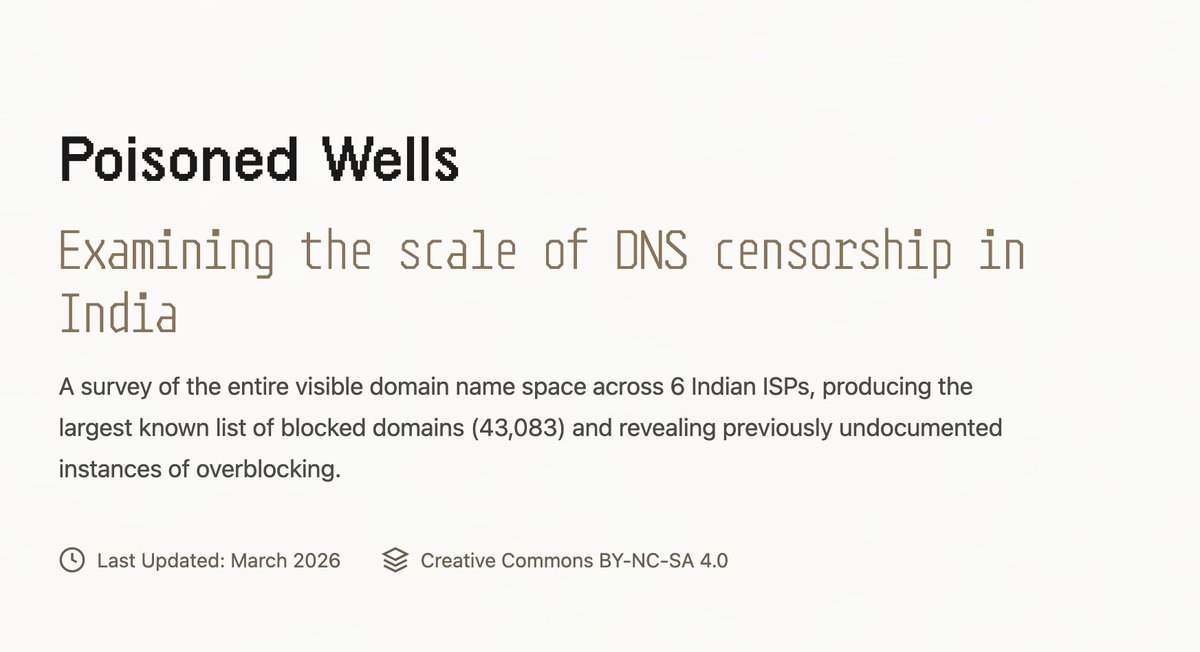
Excited to share “Poisoned Wells,” which presents the largest point-in-time study of website blocking in India to date. I tested the blocking of 294 million apex domains across six Indian ISPs, sending 1.76 billion DNS queries in total.
Last one on this topic, and I have been holding this in myself for a while.
For centuries, class divides kept the labor of the poor invisible to the rich. Factory workers toiled behind walls, farmers in distant fields, domestic help in backrooms. The wealthy consumed the fruits of that labor without ever seeing the faces or the fatigue behind it. No direct encounter, no personal guilt.
The gig economy shattered that invisibility, at unprecedented scale.
Suddenly, the poor aren't hidden away. They're at your doorstep: the delivery partner handing over your ₹1000+ biryani, late-night groceries, or quick-commerce essentials. You see them in the rain, heat, traffic, often on borrowed bikes, working 8–10 hours for earnings that give them sustenance. You see their exhaustion, their polite smile masking frustration with life in general.
This is the first time in history at this scale that the working class and consuming class interact face-to-face, transaction after transaction. And that discomfort with our own selves is why we are uncomfortable about the gig economy. We want these people to look our part, so that the guilt we feel while taking orders from them feels less.
We aren't just debating economics. We are confronting guilt. That ₹800 order might equal their entire day's earnings after fuel, bike rent, and app cuts. We tip awkwardly, or avoid eye contact, because the inequality is no longer abstract. It's personal.
Pre-gig era, the rich could enjoy luxury without moral discomfort. Labor was out of sight. Now, every doorbell ring is a reminder of systemic inequality. That's why debates explode. It's not just policy. It's emotional reckoning. Some defend the system (“they choose it”), others demand change (“this isn't progress, its exploitation”).
And here’s the uncomfortable twist: the unsaid ask of clumsy ‘solutions’ isn’t dignity. It is about returning to invisibility.
Ban gig work and you don’t solve inequality. You remove livelihoods. These jobs don’t magically reappear as formal, protected employment the next day. They disappear, or they get pushed back into the informal economy where there are even fewer protections and even less accountability. Over-regulate it until the model breaks, and you achieve the same outcome through paperwork instead of slogans: the work evaporates, prices rise, demand collapses, and the people we claim to protect are the first to lose income.
And then what happens?
The rich get their old comfort back. Convenience returns without faces. Guilt dissolves. We go back to clean abstractions and moral posturing from a distance. The poor don’t become safer, they become invisible again: back in cash economies, back in backrooms, back in shadows where regulation rarely reaches and dignity isn’t even debated.
The gig economy just exposed the reality of inequality to the people who previously had the luxury of not seeing it. The doorbell is not the problem. The question is what we do after opening the door.
Visibility is the price of progress. We can either use this discomfort to build something better (which we keep doing continuously as delivery partners are our backbone), or we can ban and over-regulate our way back into ignorance. One of those choices improves lives. The other simply helps the consuming class feel virtuous in the dark.