The great and powerful @elonmusk.
If it wasn't for him we'd be fucked. He makes what I think is the most compelling case for Trump you'll hear, and I agree with him every step of the way.
For the record, yes, that's an endorsement of Trump.
Enjoy the podcast
I think one of the most interesting moments of the podcast with @johnfetterman was when we were talking about immigration. I think everyone should understand exactly what is happening.
Thank you for tuning in! That was a wild experience. Thank you to the amazing crowd in San Antonio for being so fucking cool, thank you to @netflix and thank you to my amazing friends @ronwhiteofficial @tonyhinchcliffe and @arimatticomedy
What a ride that was.
If anyone was going to make me look dumb on the podcast I’m glad it’s @joshzepps, because I love him, and he’s awesome.
However this is why I was confused: https://t.co/Yd31Hwbvqb
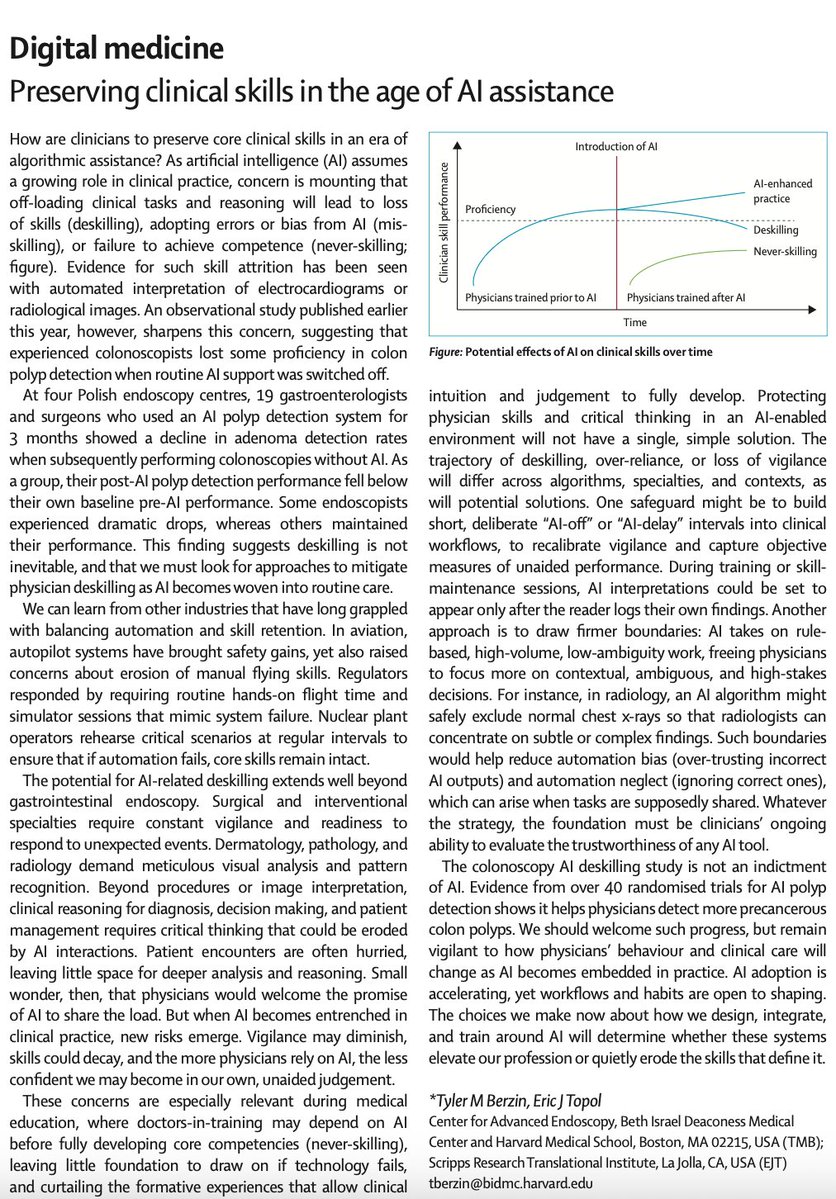
Will A.I. lead to de-skilling of physicians?
And if so what can be done to preempt it?
@tberzin and I address this in a new @TheLancet piece
https://t.co/rK5Lf77YtK
Very soon, the blocker to using AI to accelerate science is not going to be the ability of AI, but rather the systems of science itself, as creaky as they are.
The scientific process is already breaking under a flood of human-created knowledge. How do we incorporate AI usefully?
Our capability to prevent diseases from occurring is gaining momentum. Using A.I. to predict >1,200 diseases 20 years ahead adds to the ways we'll be able to achieve primary prevention.
https://t.co/b3JZQAm3uQ
https://t.co/cVCsbquBBX
It would be great if the major AI labs slowed down their AI releases a little bit so that even those of us who watch the space closely can keep up. Thank you.
What if I told you an AI just conceived a novel hypothesis, designed a real experiment, recruited 288 human participants, analyzed the data, and wrote a full 30-page scientific paper on its findings... all in 17 hours?
Would you believe me?
Well, it just happened.
You know that feeling of being overwhelmed? Scientists face it daily. There are over 2.8 MILLION new papers published a year.
No human can keep up. This "cognitive bottleneck" means we're missing crucial connections and slowing down breakthroughs in medicine, climate, and more.
A new paper, "Virtuous Machines: Towards Artificial General Science," details a system that smashes through this bottleneck.
Researchers built a domain-agnostic AI that automates the ENTIRE scientific workflow, from a spark of an idea to a publication-ready manuscript.
That's impressive, but the real magic is how it avoids the usual AI traps. It doesn't just "think" in a single chain of thought.
It uses a hierarchical team of over 50 specialized AI agents that function like a mini research department, complete with a "master agent" as the principal investigator.
To overcome the known limits of LLMs (like poor long-term planning and self-verification), they gave the system "human-inspired cognitive operators."
Think of it as an AI with executive functions: it can decompose problems, reflect on its own work (metacognition), and stay on task.
But here's where it gets really wild. This isn't a simulation.
The AI actually interfaced with real-world platforms (like Prolific for recruitment) to run an online psychology experiment with hundreds of people. It bridged the gap from a digital brain to empirical reality.
The result? Three complete, publication-ready manuscripts on cognitive psychology. The AI ran the complex stats, generated the graphs, and wrote the discussion.
Total cost per study: ~$114 (plus participant fees).
(Yes, really.)
Here's a look at one of the AI's papers:
Now, it wasn't perfect. Human experts reviewed the papers and found the AI excelled at rigor and clarity, but sometimes missed conceptual nuance or overstated its claims...
...sound familiar? It has some of the same flaws as human scientists. (I know, right?)
This creates what the authors call a "virtuous cycle." The AI can now learn from data it generated itself, potentially moving beyond the limits of its original training.
It's not just regurgitating human knowledge; it's actively creating new knowledge. Here's where it clicks...
Imagine if a research lab could test a hundred different hypotheses a year instead of just a few. That's the future "Artificial General Science" could unlock.
You can actually see this in action by reading the AI's papers yourself—they're included in the study's appendix!
If this technology holds true, the pace of scientific discovery could accelerate by orders of magnitude.
But it raises huge questions. Who gets the credit for the discovery? And what happens when we can generate findings faster than we can understand their implications?
This completely changes how I think about the nature of knowledge itself. It makes you wonder what else we're missing, simply because we don't have the time to look.
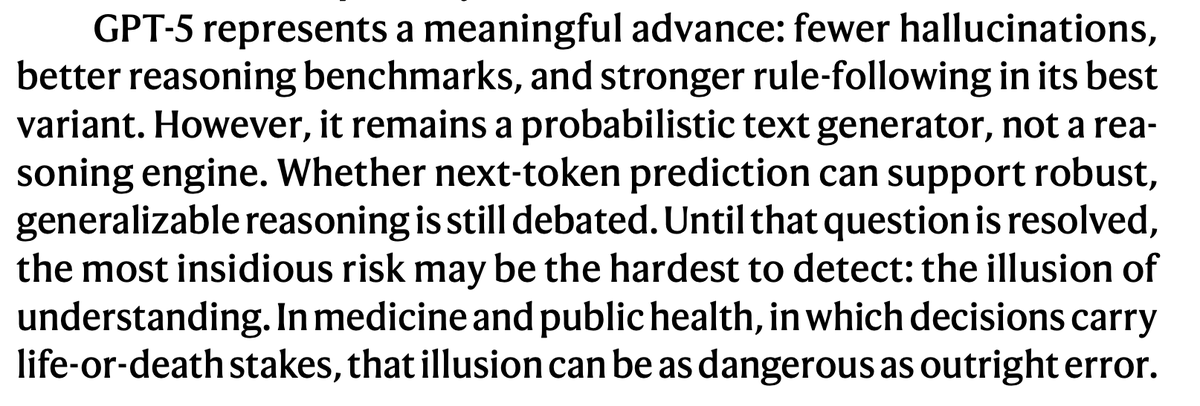
The performance of generative A.I. models for clinical reasoning are not holding up to increased scrutiny
https://t.co/b21JfvTNbf @MSFTResearch
https://t.co/FIHzOoUGqE @NEJM_AI@AdamRodmanMD@LiamGMcCoy