Kontrollstudier har bekräftat att de temperaturtrender som GISS, NCDC och CRU beräknat för mätstationer världen över som regel avviker från vad rådata visar, alltid visat i riktning mot starkare uppvärmning. Vidare har av instituten rapporterade historiska temperaturdata ändrats upprepade gånger utan någon förklaring, alltid i riktning mot starkare uppvärmning.
Före 1980 fanns det mer än 6000 mätstationer, idag ca 3000. Bortfallet av mätstationer har främst berört de kallare delarna av världen. Och bortfallet av kalla mätstationer leder självfallet till en skenbar höjning av den framräknade globala temperaturen.
Större delen av 1990-talets beräknade globala uppvärmning kan vara skenbar och i själva verket återspegla bortfallet av rapporter från kalla orter.
NIPCC har kritiserat GISS, NCDC och CRU för att deras beräkningsmetoder inte tar hänsyn av tätortseffekten.
Granskning har visat att 80% av de beaktade amerikanska mätstioner har en olämplig placering i närheten av artificiella värmekällor.
Den korrekta globala temperaturutvecklingen skulle kunna vara snarlik den man observerat i Arktis, Norden och USA:s glesbygd: En temperaturtopp 1940, följt av avkylning till ca 1970 och sedan ny uppvärmning mot 1940-års nivå.
New study:
Human CO2 emissions are responsible for 1.57% of the global T change since 1750; 98.43% of climate forcing is natural.
CO2 provides 0.0058% of surface energy.
There is a negative correlation (r = -0.19) between CO2 and T over the last 425 My.
https://t.co/kVOzXItBG4
Cloud data from a 2025 study show flat trends in shortwave (SW) radiation, longwave (LW) radiation, and radiation balance over the global ocean since 1970 despite a 100 ppm CO2 rise.
Trends in the subtropics (15-40°N, 45-65°W) indicate a +1 W/m²/decade increase in both SW radiation and radiation balance over the 120-year period, resulting in 13 W/m² in overall heat gains.
In contrast, SW radiation fluxes over mid-latitude oceans (40-50°N, 10-30°W) indicate -0.5 W/m²/decade decreasing trends since 1900, and even a slight decline in radiation balance (-0.18 W/m²/decade) during this period.
None of the radiation data suggest there is a link between linearly-rising CO2 and ocean heat change.
https://t.co/RIA7LJkMxa
@UN@WHO So the obvious communication from the @UN should be to advice people to stay inside and turn on their air conditioning. No? I guess the UN was never about *solutions*
@JanKEliasson@NurGugger@UNRWA@UN@X ”To compare” a @UN organisation to: [insert whatever you want] should lead to ”mass blocking” (?) You can’t be serious! when did ”comparing” become a hate crime?
Breaking - Scientists have discovered a technology that turns plants into highly nutritious protein without the need for factories, synthetic chemicals, or seed oils.
Thomas Sowell is 96 years old, and the man has spent seven of those decades teaching the same lesson the political class refuses to learn: there are no solutions, only trade-offs.
He started as a Marxist. Worked in the federal government in 1960, studying minimum wage policy in Puerto Rico. The data told him what the textbooks would not: when you raise the price of labor by law, you price the least-skilled workers out of a job. His government colleagues cared more about protecting the program than protecting the workers. That killed his faith in central planning faster than any theory.
Read "Knowledge and Decisions" (1980) and you get the whole architecture of his thought. Prices carry information. No planner in Washington, however credentialed, can gather what millions of buyers and sellers signal every second through their bids and refusals. Hayek made this point in his 1945 paper on the use of knowledge in society. Sowell took it and built an entire method around it, applying it to housing, education, race, crime, and the endless parade of "compassionate" schemes that reliably wreck the people they claim to rescue. Rent control empties buildings. Occupational licensing locks the poor out of trades. Sowell documented every one of these disasters with numbers, not slogans.
You want the sharpest example? Look at his work on race and economics. He showed that black Americans made faster gains in employment and income in the decades before the great expansion of the welfare state than after it. The programs sold as help became a ceiling. He said it plainly when saying it plainly cost him invitations to every respectable dinner party in the country. He never flinched. He wrote another column instead and another book, well into his nineties.
This man never mistook good intentions for good results. Go read him. You will emerge harder to fool.
125,000 years ago, the Thames was full of hippos.
2,000 years ago, the Romans grew grapes on the Scottish border.
Today, British councils force people to rip out their aircon because of "unprecedented climate change".
https://t.co/DhOjKIDFxN
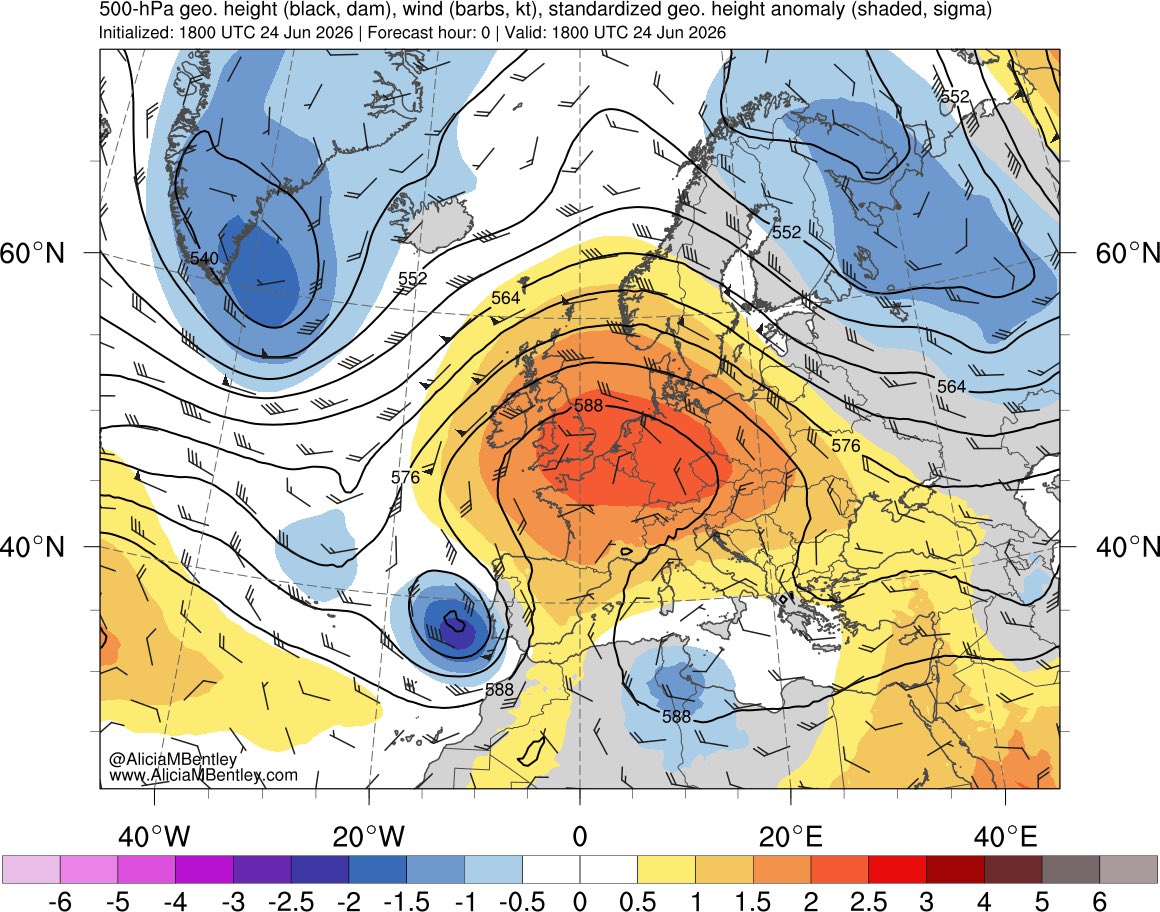
Why is it hot in Europe this week?
Well, it has to do with the “omega block” in the jet stream. Omega blocks get their name because they resemble the Greek uppercase letter omega, Ω.
You can see that in the synoptic setup. The map below on the left shows the 500 mb geopotential height anomaly at 18z. The contour lines resemble the Ω shape due to an enormous high-pressure ridge in the mid-troposphere that is sandwiched between two low-pressure systems to its east and west.
Hot Saharan air has been advected—that is, horizontally transported—northward into western Europe due to anticyclonic (clockwise) airflow, and as that air mass moves north, it is compressed adiabatically beneath the ridge where air is sinking.
This process is natural and has nothing whatsoever to do with climate change or greenhouse gas emissions. In fact, there are quite a few studies suggesting that reduced latitudinal baroclinicity (north-to-south temperature gradient) caused by Arctic amplification could reduce the frequency of mid- and high-latitude blocking events (e.g., Hassanzadeh et al., 2014; Woollings et al., 2018).
🔗 https://t.co/NGsFsRKpEt
🔗 https://t.co/M7h3vg232H
There is, however, debate about this.
Europe has seen an unusual amount of these extreme heat events since 2019, but most other areas of the globe have not. The notable exception was the June–July 2021 Pacific Northwest heatwave in North America, but even that wasn’t as rare as previously thought.
🔗 https://t.co/rNRFfJohs4
The most likely explanation for this boils down to a combination of two things:
1️⃣ Undiagnosed changes in atmospheric circulation patterns.
2️⃣ Increased absorbed solar radiation at the surface due to reduced stratiform low- and mid-level cloud cover (increased sunniness), some of which is likely due to reduced atmospheric aerosol concentrations from the EU’s strict pollution regulations.
The overall increase in the “global mean temperature” (which mostly affects overnight lows) has very little to do with this event. Even in a “pre-industrialized” climate, a record-breaking heatwave would still be happening. Heck, the “global mean temperature” fell today despite the heat cranking up in Europe.
This is mostly weather systems moving around. When you have a chaotic system with two turbulent fluids interacting with each other (the atmosphere and ocean), wild things can happen.
Get your weather information from real meteorologists, not sensationalistic clickbait news outlets like BBC News or the Daily Mail.
This is local weather during one (1) summer! When skeptics to the hypothesis of CO2 causing warming, point out that vikings had crops and cattle on Greenland, during the medieval warm period, alarmist brush it off claiming the phenomenon was ”local”. Now, 42C in Nantes suddenly is evidence of ”global warming”?
@cunninghamjeff@BjornLomborg The Nobel Prize for ”peace” is and has always been a joke. That’s what Gore got. The same price they gave Anwar Sadat and Begin in 78 for ”peace” in the middle east.
20 years ago, An Inconvenient Truth put climate change at the center of global debate, shaping politics, influencing leaders, and inspiring a generation of activists.
Two decades later, we can assess not just its impact, but its accuracy. Many of the film’s most alarming predictions did not materialize, while many of the policies it inspired have proven costly and ineffective.
The lesson? Panic is a poor guide for public policy. Focusing on innovation, adaptation, and economic development can do far more to help both people and the climate—at a fraction of the cost.
https://t.co/EIJyuNeFU1
https://t.co/PTSyFXF4vt
@AdelDahdal @jonsson_henrik@drdanielschatz Varför invektiv och personliga påhopp? Om du själv fått liknande kommentarer, vad hade sagt då? Att de var ett ”ett hot mot demokratin” ?
A supposedly smart ECB board member claims climate disasters are worsening
Media bias makes it feel that way — more dramatic coverage
Reality: Weather-related deaths and costs dropping for decades bc adaptation, wealth, and resilience
Stop scaring people and do your job
https://t.co/aCy89N1MEB
So let me get this straight...
When climate reconstructions show a Medieval Warm Period, we're told it was only regional and doesn't challenge the climate crisis narrative.
But when Europe has a heatwave, suddenly a few hot weeks in one region are proof of a global climate emergency.
Interesting how "regional doesn't matter" only seems to apply when it's inconvenient.