@hcapinvesting Given US regulatory landscape turning “from a savannah into a jungle” is a major bull case for HAYPP, and if zyns were to face regulatory headwinds in US then it may be a thesis breaker.
@hcapinvesting Do you see increased risk given the Dems swept midterms? As Dems are less pro-Zyn on avg compared to republicans. Could this be a small part of the sell-off too?
@HiddenGemsInves The co has very high operating leverage & EBIT + rev growth has been very lumpy historically. (11%/4.4%/7% EBIT margin FY24/25/26). What gives you conviction that now is a good time in the rev contracting cycle to invest, given quarterly lumpiness from the live events segment?
@Larryjamieson_ As someone who knows the guy you’re talking about personally, he was very grateful for the experience and learnt a lot under the fund + the person you’re talking about ultimately opened the door for him to get into a top-tier fund afterwards. So wouldn’t judge a book by its cover
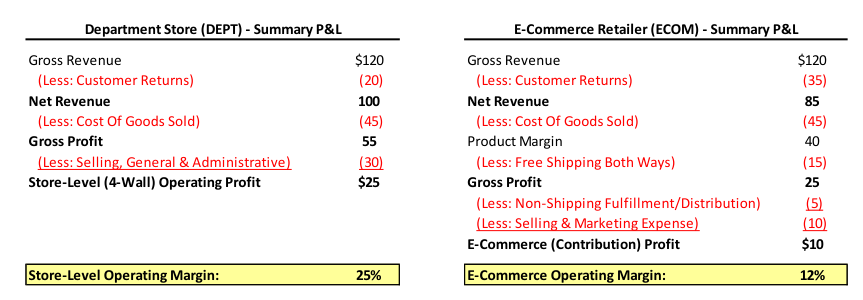
on retail/ecom unit economics -- margin impact of dollars shifting offline to online
this was 7-8 years ago but I can't see the #'s having changed meaningfully
1/4
ecom = higher % of variable costs
in-store = higher % fixed
ecom's free shipping + returns, those line items will never scale.
whether u sell 1 item or a billion, postman is gonna stick u for $6 bucks or whatever, each way, on that t-shirt
avg return rates are somewhere in the 20-30% range, but in apparel, ur looking at 40%
hence that post from earlier "ecommerce literally makes it fucking impossible to generate ebitda."
bc in a fixed cost model (think Macy's 20 years ago), as u scale, ur keeping 40 cents of each revenue dollar (40% GM%) and then spreading those gross profit dollars on a heavy fixed cost base
I think the photo below says 50% but those #'s are oversimplified, 40% GM% is avg
2/4
then SG&A should lever on say 3% SSS% or better, and ur ebit margins will scale with ur volumes.
ballpark 25-30% 4-wall ebit margin for a traditional retail box with no e-com
now, compare to ecom margin profile
u usually have the same product margin (ie t shirt cogs), although ecom gets used for promos/discounting/clearance, so that doesnt always hold
fixed costs, lower in ecom, less sq footage... say 10% of sales vs 25-30% in brick and mortar
but, u have higher variable per-unit cogs
returns and shipping, there is no escape.
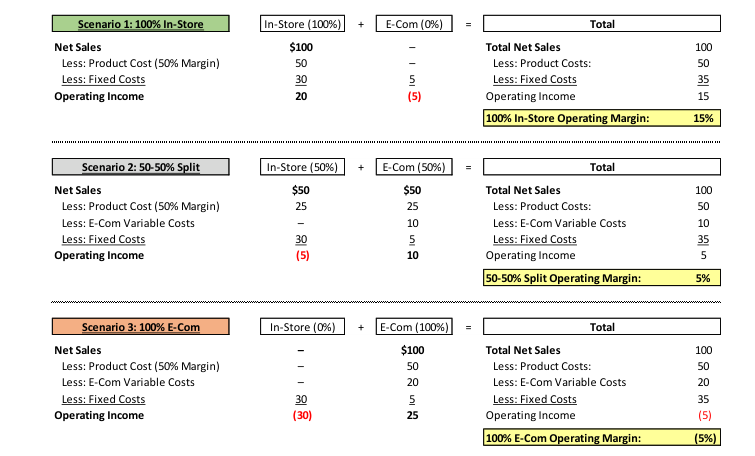
and then the major issue, which that 2nd photo is meant to illustrate, is what happens as dollars shift from physical to ecom
3/4
ppl come try shit on in store, go home, order 5x what they actually need, and return 90% of it
meanwhile, those heavy fixed costs from brick and mortar, those ain't going nowhere, ur rent, ur labor
that store isnt selling shit, no units, u basically have a showroom
again, think of a Macy's, these are just massive fucking boxes on a sq ft basis
so each dollar that exits brick and mortar, and arrives at ecom instead....u run into issues very quickly because of operating de-leverage.
ur swapping a 40% GM% dollar in-store, for say 30% online with all the variable COGS attached, so ur already working with a poop dollar
4/4
then, lets say ur generously at 0% SSS% in-store, which means fixed cost deleverage (ur opex is growing faster than ur sales)
and from there it gets exponentially worse, like a down (5%) comp in-store...that box is hemmorrhaging cash, like a negative (25%) contribution margin or something stupid
even if comps are flattish, having dollars shift from 100% in-store, to 50-50% ecom/in-store, is enough for ur brick & mortar operating margins to swing into the red.
thats why ecommerce is a dogshit business, even if ur digitally native, u arent above breakeven until volumes go exponential, and these early sales are driven by inflated ads, discounting, etc, because "CAC is the new rent"
no one knows u exist, u have no physical presence
so something like 90% of ecom launches fail within 4 months, its a ridiculous number
they can't escape from the variable cogs buzzsaw, they cant generate full-price sales w/o pumping sales & marketing, ads, discounting, promos
and so u just operate below breakeven the whole time, blow thru all ur VC cash, and u shut down.
END
has much changed since these #'s were laid out, like, yes and no
most concepts have prob shuttered unproductive sq ft, dumped $ into ecom fixed costs/distro to get some sort of scale, gotten smarter on omnichannel
but at the same time, now u have these all these fucking chinese shopping apps, just flooding the channel with dirt-cheap shit being sold below breakeven
I'm not even sure if temu and shein are profitable standalone yet
again, these are the iron laws of shitty ecom unit economics
u wanna ship someone a t-shirt from china, free both ways, free returns?
and the t shirt costs $4 fucking dollars?
that math is never gonna math homeboy, ever
--
hopefully this was useful
once u have looked at 200-300 names in the same sector, over a decade, this all becomes just mental math
which allows u to be much more effective on pattern recognition in generating short ideas
like a new IPO says they're going to generate 15% EBITDA margins selling couches over the internet
and ur just laughing like, bro the book of base rates has u at 0.00%, even fucking Amazon hasn't figured out a way to turn a profit mailing u some nasty ass chinese child-labor pleather sectional.
u have what I call a "structurally unprofitable business model," there is no level of scale where this enterprise is profitable on a per unit basis
and until that happens u are just selling dollars for 50 cents
but this is why everything is unit economics, this is why everything is operating leverage, and its why u spend the best years of ur life staring at cogs and opex
because u can both have the same revenue estimate, but even a small delta in fixed costs, suddenly u have a 10-20% variance to the other guy on earnings, u knife him on the print, snatch his bps, dump the body and keep it moving
laughing, because u know what the guy is thinking:
"since when does Fossil Watches move 40% on a fucking print???"
ur in shitco paradise now homeboy...come back tomorrow, I'll stab u for another 30% in Boot Barn
just another day in trench warfare lollapalooza 🗡️
good luck trading
@Aksel465 Hypothetical Q - why invest in both if CEO trustworthiness is an issue, is that not a red flag? Why not just invest in DBOX only? What risks do you see in DBOX that stop you from making it an even larger position?
Loved the DBOX writeup FYI, just curious abt your thought process