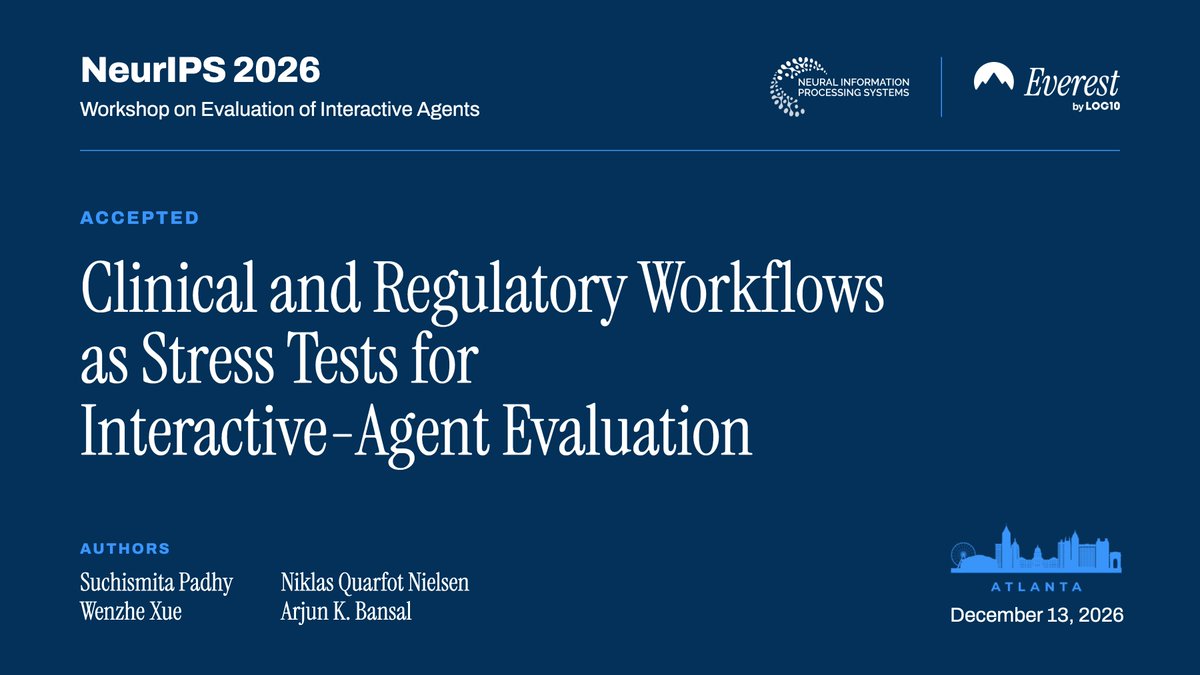
🎉 Our applied AI research team had a paper accepted at the NeurIPS 2026 Workshop on Evaluation of Interactive Agents. Our work focuses on evaluating agents in clinical and regulatory work. 🧵👇
btw Claude Code lets you configure your own output style!
drop instructions in ~/.claude/output-styles, then run /config → Output style
this is the one I like to use after a long day lol. honestly helps so much
Open-weight models match the frontier on benchmarks. But can they be trusted with regulatory and clinical-trial work?
We built ClinReg to find out — and ran 19 leading models through it. 🧵
@DrMakaryFDA @US_FDA Real-time data deserves real-time analysis and documentation — and that works for sponsors and regulators. Excited to see clinical trials catch up to the speed of the science.
This is the moment we've been building Everest for.
Nobody tells you this: Dopamine from information gathering is a dangerous drug. It’s the dopamine from reading, planning, or learning, but never doing. Stop looking for more information and start acting on the information you already have. Get your dopamine from action.
Voice mode is rolling out now in Claude Code. It’s live for ~5% of users today, and will be ramping through the coming weeks.
You'll see a note on the welcome screen once you have access. /voice to toggle it on!
It is hard to communicate how much programming has changed due to AI in the last 2 months: not gradually and over time in the "progress as usual" way, but specifically this last December. There are a number of asterisks but imo coding agents basically didn’t work before December and basically work since - the models have significantly higher quality, long-term coherence and tenacity and they can power through large and long tasks, well past enough that it is extremely disruptive to the default programming workflow.
Just to give an example, over the weekend I was building a local video analysis dashboard for the cameras of my home so I wrote: “Here is the local IP and username/password of my DGX Spark. Log in, set up ssh keys, set up vLLM, download and bench Qwen3-VL, set up a server endpoint to inference videos, a basic web ui dashboard, test everything, set it up with systemd, record memory notes for yourself and write up a markdown report for me”. The agent went off for ~30 minutes, ran into multiple issues, researched solutions online, resolved them one by one, wrote the code, tested it, debugged it, set up the services, and came back with the report and it was just done. I didn’t touch anything. All of this could easily have been a weekend project just 3 months ago but today it’s something you kick off and forget about for 30 minutes.
As a result, programming is becoming unrecognizable. You’re not typing computer code into an editor like the way things were since computers were invented, that era is over. You're spinning up AI agents, giving them tasks *in English* and managing and reviewing their work in parallel. The biggest prize is in figuring out how you can keep ascending the layers of abstraction to set up long-running orchestrator Claws with all of the right tools, memory and instructions that productively manage multiple parallel Code instances for you. The leverage achievable via top tier "agentic engineering" feels very high right now.
It’s not perfect, it needs high-level direction, judgement, taste, oversight, iteration and hints and ideas. It works a lot better in some scenarios than others (e.g. especially for tasks that are well-specified and where you can verify/test functionality). The key is to build intuition to decompose the task just right to hand off the parts that work and help out around the edges. But imo, this is nowhere near "business as usual" time in software.
🚀 Introducing Everest: AI-powered medical writing for life sciences!
Our new platform helps medical device, pharma & diagnostic companies (and their CROs) bring products to market faster with: