Stop wasting hours trying to learn AI. 📘📚
I have already done it for you.
With one list. Zero confusion. And no fluff
📹 Videos:
1. LLM Introduction: https://t.co/OBfDwz7W0O
2. LLMs from Scratch: https://t.co/oeOci6NERy
3. Agentic AI Overview (Stanford): https://t.co/5POKytu6ID
4. Building and Evaluating Agents: https://t.co/E5FFlGUDAy
5. Building Effective Agents: https://t.co/kusHO3dLyf
6. Building Agents with MCP: https://t.co/cCEsddKbou
7. Building an Agent from Scratch: https://t.co/8xWp3CmFch
8. Philo Agents: https://t.co/D4CENugUBX
🗂️ Repos
1. GenAI Agents: https://t.co/4KZ9sJmLCs
2. Microsoft's AI Agents for Beginners: https://t.co/vPvgZwjrED
3. Prompt Engineering Guide: https://t.co/ZJPx57nwFP
4. Hands-On Large Language Models: https://t.co/awbIDVAhWe
5. AI Agents for Beginners: https://t.co/vPvgZwjrED
6. GenAI Agentshttps://lnkd.in/dEt72MEy
7. Made with ML: https://t.co/rvYry8ZDvF
8. Hands-On AI Engineering:https://t.co/HjMTW5nvW1
9. Awesome Generative AI Guide: https://t.co/qGocn6df1V
10. Designing Machine Learning Systems: https://t.co/zZC31InA1q
11. Machine Learning for Beginners from Microsoft: https://t.co/SBVf1FPH6f
12. LLM Course: https://t.co/OCAvim3jah
🗺️ Guides
1. Google's Agent Whitepaper: https://t.co/VYeTNLRPE9
2. Google's Agent Companion: https://t.co/4gy8NGQe53
3. Building Effective Agents by Anthropic: https://t.co/WcMyxPSiN0.
4. Claude Code Best Agentic Coding practices: https://t.co/d01rxIEmrH
5. OpenAI's Practical Guide to Building Agents: https://t.co/fsQrbj1QUQ
📚Books:
1. Understanding Deep Learning: https://t.co/zf0RZ1gaO4
2. Building an LLM from Scratch: https://t.co/rCEkYCd7ei
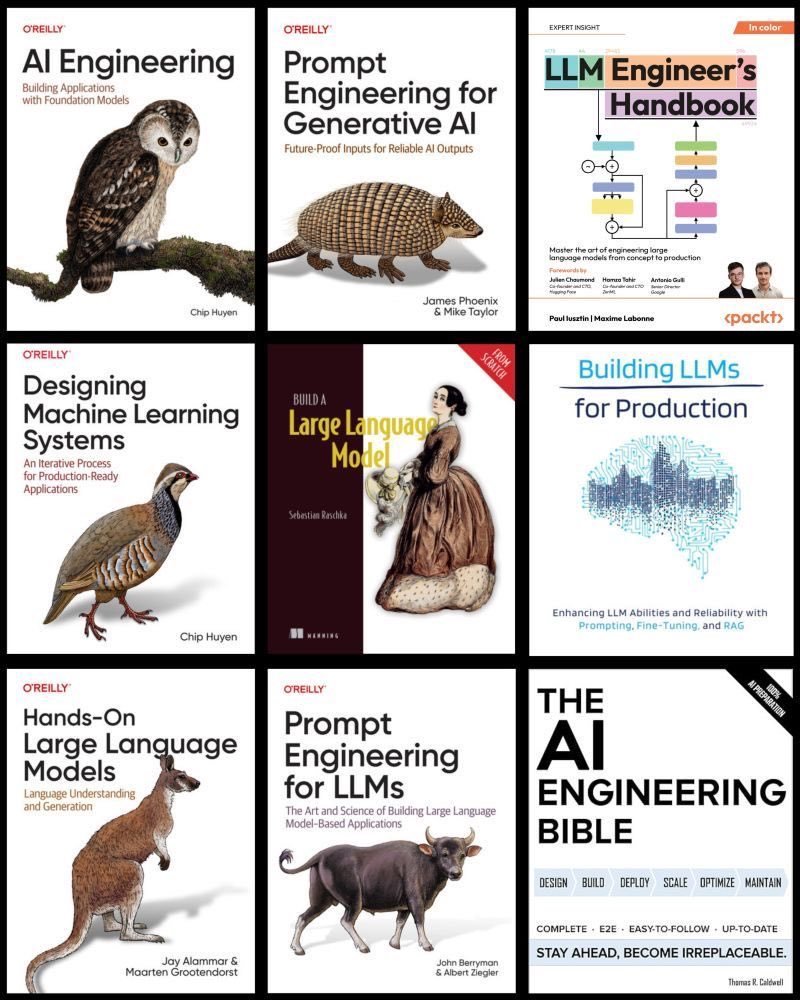
3. The LLM Engineering Handbook: https://t.co/cHxt9qbfnL
4. AI Agents: The Definitive Guide - Nicole Koenigstein: https://t.co/No7GopeCi9
5. Building Applications with AI Agents - Michael Albada: https://t.co/KxDWj7p8Dm
6. AI Agents with MCP - Kyle Stratis: https://t.co/Pdaw6hnlNh
7. AI Engineering: https://t.co/kqEMbAXVDO
📜 Papers
1. ReAct: https://t.co/gU23m8z2Iw
2. Generative Agents: https://t.co/5CCFoHUMT3.
3. Toolformer: https://t.co/ux2vgBLQJW
4. Chain-of-Thought Prompting: https://t.co/v6iOKX28QT.
🧑🏫 Courses:
1. HuggingFace's Agent Course: https://t.co/njL6khzCWz
2. MCP with Anthropic: https://t.co/TWp2H7ltsz
3. Building Vector Databases with Pinecone: https://t.co/bPCar16QJu
4. Vector Databases from Embeddings to Apps: https://t.co/6AwTQ3Y0nf
5. Agent Memory: https://t.co/EZSaCFaHDE
Repost for your network ♻️
Read this to get started learning ML infra.
This is an excellent high-level overview of important considerations in ML training from CMU. It touches on:
- hardware
- memory
- the ML experimentation process
https://t.co/RTWm0Ecni1
As an AI Engineer. Please learn:
Harness engineering, not just prompt engineering
Context engineering, not just long prompts
Prompt caching vs. semantic caching tradeoffs
KV cache management, eviction, reuse, and memory pressure at scale
Prefill vs. decode latency and why they optimize differently
Continuous batching, paged attention, and throughput optimization
Speculative decoding vs. quantization vs. distillation tradeoffs
INT8, INT4, FP8, AWQ, GPTQ, and when quantization hurts quality
Structured output failures, schema validation, repair loops, and fallback chains
Function calling reliability, tool contracts, argument validation, and idempotency
Agent guardrails, loop budgets, tool budgets, and termination conditions
Model routing, graceful fallback logic, and degraded-mode UX
RAG architecture: chunking, embeddings, hybrid search, reranking, and freshness
Retrieval evals: recall, precision, grounding, attribution, and citation quality
Evals: golden sets, regression tests, adversarial tests, LLM-as-judge, and human evals
LLM observability as a first-class discipline: traces, spans, tokens, latency, errors, and drift
Cost attribution per feature, workflow, tenant, and user journey not just per model
Safety engineering: prompt injection defense, data leakage prevention, and permission boundaries
Multi-tenant isolation, cache safety, and cross-user context contamination prevention
Fine-tuning vs. in-context learning vs. RAG vs. distillation and when each is the wrong tool
Latency, quality, cost, and reliability tradeoffs across the full inference stack
Production failure modes: hallucinated tool calls, malformed JSON, stale retrieval, runaway agents, and silent eval regressions
Shipping LLM systems as reliable infrastructure, not demos wrapped around prompts
https://t.co/OhK9MK04ld
Step-By-Step LLM Engineering Projects Roadmap
- Build a tokenizer
- Learn embeddings
- Implement RoPE / ALiBi
- Hand-wire attention
- Build MHA
- Build a Transformer block
- Train a mini-former
- Compare objectives
- Build sampling
- Speculative decoding
- KV cache
- MQA / GQA / MLA
- Long context
- FlashAttention
- Hardware budgets
- Toy MoE
- Sparse model trade-offs
- State-space / linear attention
- Diffusion language models
- Data pipelines
- Synthetic data
- Scaling laws
- SFT / DPO / RLHF / GRPO
- Quantization
- Serving stacks
- Eval harnesses
- RAG
- Tool use / agents
- Vision-language adapters
- Interpretability
- Red-team suite
- Full capstone model system
One request:
Choose an Opensource AI lab when you make it
Opensource is where humanity gets to keep the tools
DM me when you've made it ;)
Research papers you must read for AI Engineer interviews:
1. Attention is all you need (Transformers)
2. LoRA (Low rank adaption)
3. PEFT ( Parameter Efficient Fine Tuning)
4. VIT (Vision Transformers) 5. VAE (Variational Auto Encoder)
6. GANs ( Generative Adversarial Networks)
7. BERT ( Bidirectional Encoder Representation from Transformers)
8. Diffusion Models (Stable Diffusion)
9. RAG (Retrieval Augment Generation)
10. GPT (Generative Pre-trained Transformers)
11. MoE (Mixture of Experts)
12. RLHF (Reinforcement Learning from Human Feedback)
13. LLaMA (Large Language Model Meta AI)
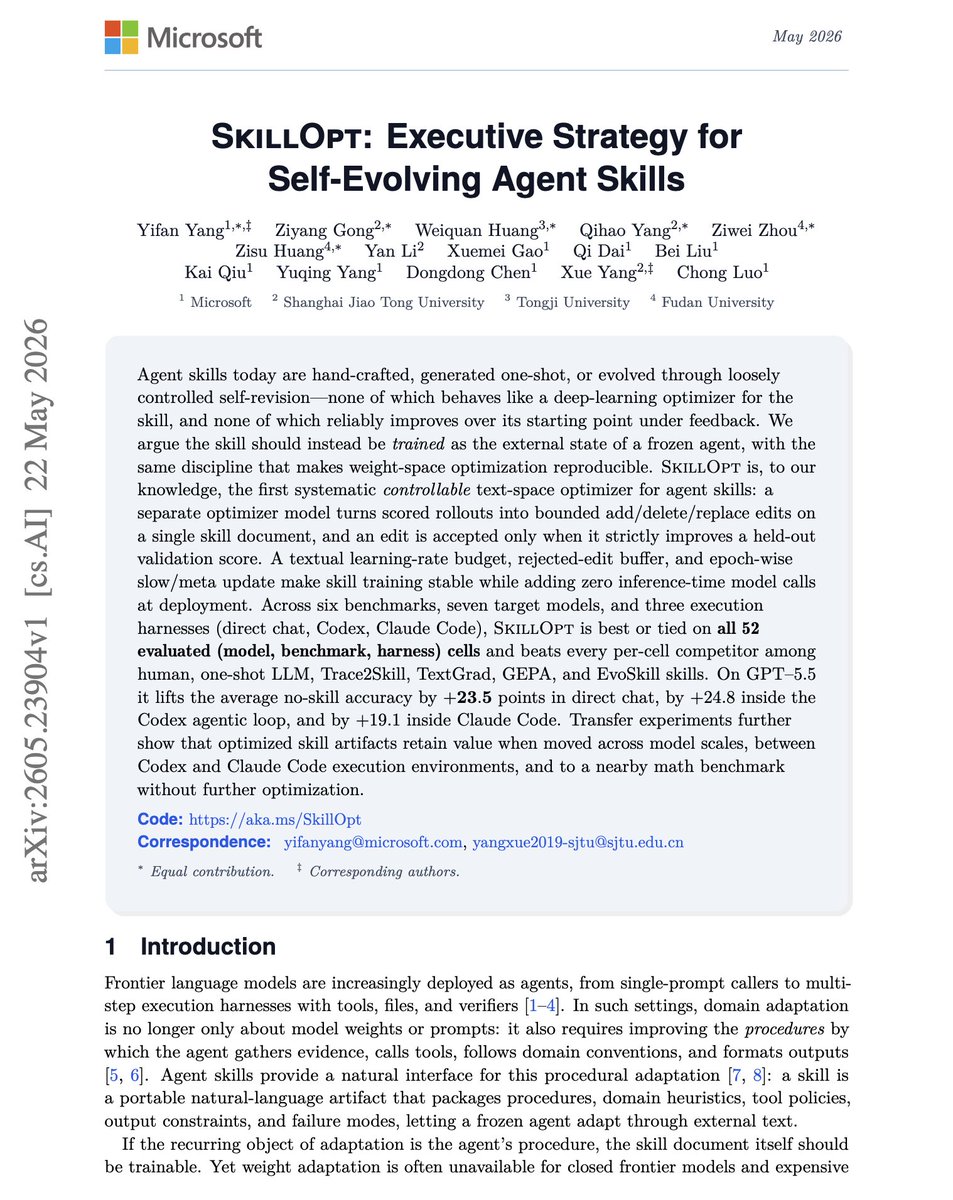
New research from Microsoft Research
I see a lot of AI engineers handwriting agent skill docs and hope they generalize.
Probably not optimal. This works show why.
It treats the skill doc as a trainable external state of a frozen agent instead.
It introduces SkillOpt, where an optimizer model makes validation-gated edits to the skill file. It adds, deletes, or replaces instructions, with a textual learning rate that controls how aggressively each round rewrites the doc. The agent itself never changes.
SkillOpt is best or tied on all 52 (model, benchmark, harness) cells.
On GPT-5.5 it adds 23.5 points in direct chat, 24.8 with Codex, and 19.1 with Claude Code over no skill. It beats human-written skills, TextGrad, GEPA, and EvoSkill, carries zero extra inference-time cost, and the learned skills transfer across models and harnesses.
Paper: https://t.co/mNgTmmT32U
Learn to build effective AI agents in our academy: https://t.co/1e8RZKs4uX
The full AI engineering curriculum is now free.
It's called AI Engineering from Scratch. 20 phases, 428 lessons, roughly 320 hours end to end. Free. MIT license. Runs on your own laptop.
The design principle that makes it different from everything else => every algorithm gets built from raw math before a single framework loads. Backprop by hand. Tokenizer by hand. Attention by hand. Agent loop by hand. Then you implement the same thing in PyTorch or sklearn. By the time the production library appears, you already know what it's doing underneath.
Every lesson ends with something you keep:
→ Prompt templates for any AI assistant
→ Skill files for Claude, Cursor, Codex, OpenClaw, Hermes
→ Agent definitions you wrote the loop for yourself
→ MCP servers built from scratch in Phase 13
428 lessons means 428 artifacts by the end. Tools you built and actually understand.
The full 20 phases:
→ Phase 0 - Setup & Tooling (12 lessons)
→ Phase 1 - Math Foundations (22 lessons)
→ Phase 2 - ML Fundamentals (18 lessons)
→ Phase 3 - Deep Learning Core (13 lessons)
→ Phase 4 - Computer Vision (28 lessons)
→ Phase 5 - NLP (29 lessons)
→ Phase 6 - Speech & Audio (17 lessons)
→ Phase 7 - Transformers Deep Dive (14 lessons)
→ Phase 8 - Generative AI (14 lessons)
→ Phase 9 - Reinforcement Learning (12 lessons)
→ Phase 10 - LLMs from Scratch (22 lessons)
→ Phase 11 - LLM Engineering (15 lessons)
→ Phase 12 - Multimodal AI (25 lessons)
→ Phase 13 - Tools & Protocols (23 lessons)
→ Phase 14 - Agent Engineering (42 lessons)
→ Phase 15 - Autonomous Systems (22 lessons)
→ Phase 16 - Multi-Agent & Swarms (25 lessons)
→ Phase 17 - Infrastructure & Production (28 lessons)
→ Phase 18 - Ethics, Safety & Alignment (30 lessons)
→ Phase 19 - Capstone Projects (17 projects, 20-40 hours each)
Python, TypeScript, Rust, Julia throughout.
GitHub Repo: https://t.co/E2Rg09gnrR
If you want to become good at AI engineering (in 3 weeks), then learn these 15 concepts:
1 AI Agents: Memory, State & Consistency
→ https://t.co/v8H7O00jub
2 Machine Learning System Design 101
→ https://t.co/9MkHcLb5e0
3 Design Personal AI Chat Assistant
→ https://t.co/nNWq3onTnW
4 How RAG Works
→ https://t.co/cGmunPTUlb
5 LLM Concepts - A Deep Dive
→ https://t.co/5lCKxq2g4N
6 How to Design an AI Agent
→ https://t.co/JvnPd9773A
7 What is Reinforcement Learning
→ https://t.co/AVpl9j1oit
8 How Vector Databases Work
→ https://t.co/FVxan8xHH3
9 Context Engineering 101
→ https://t.co/OMkiZhkODL
10 AI Coding Workflow 101
→ https://t.co/paIf9ksIU9
11 LLM Evals Explained
→ https://t.co/nv3Ol8W53p
12 How AI Agents Work
→ https://t.co/tk3zkCjRvg
13 How MCP Works
→ https://t.co/wgf8gHnnkn
14 Agentic Patterns Explained
→ https://t.co/8YdBBWvTj1
15 Multi-Agent Architecture Explained
→ https://t.co/rS5QQS7Jln
What else should make this list?
===
👋 PS - Want my System Design Playbook for FREE?
Join my newsletter with 210K+ software engineers right now:
→ https://t.co/ByOFTtOihX
===
💾 Save & RT to help others ace AI engineering.
👤 Follow @systemdesignone + turn on notifications.
These 9 lectures from Stanford University are the BEST for anyone wanting to learn and understand LLMs in depth
Lecture 1 - Transformer: https://t.co/6wl1VXyQxS
Lecture 2 - Transformer-Based Models & Tricks: https://t.co/rFoGOnsOY2
Lecture 3 - Tranformers & Large Language Models: https://t.co/t8H8UebPg0
Lecture 4 - LLM Training: https://t.co/KZxOEL0ezz
Lecture 5 - LLM tuning: https://t.co/PapIUSlToT
Lecture 6 - LLM Reasoning: https://t.co/dr02iTGXHs
Lecture 7 - Agentic LLMs: https://t.co/10EQm5iCBp
Lecture 8 - LLM Evaluation: https://t.co/eOKwCn3LBo
Lecture 9 - Recap & Current Trends: https://t.co/MQAGVGlqiX
Start understanding LLMs in depth from the experts. Go through each step-by-step video
Start understanding LLMs in depth from the experts. Go through each step-by-step video
"AutoResearchClaw: Self-Reinforcing Autonomous Research with Human-AI Collaboration"
As real science is iterative, this paper builds AutoResearchClaw, a multi-agent system that debates ideas, self-repairs experiments, decides when to Pivot or Refine, verifies numbers and citations, and learns across runs.
The key result is targeted human-AI collaboration beats both full autonomy and micromanagement. CoPilot gets 87.5% accept rate vs 25% for full-auto, and beats AI Scientist v2 by 54.7% on ARC-Bench.
if you're doing RL on agent use cases, check out this video.
agents might seem like the most obvious application of post training right now, but there are a number of fundamental challenges that the open source is still working through.
this video walks through that at a meandering and educational pace.
https://t.co/3275IKsWJt