I'm looking for a psychotic ex-founder to work alongside me for 16+ hours a day and live above the conference room as my Chief of Staff
We're scaling team past 50 and we're the best capitalized robotics software / OS in the world
DM me a video about why you need this role
Just ported the original @DOOM source (released in 1997 only for Linux) to Windows with @AnthropicAI Claude Code. One main prompt, a couple of debug rounds --> working "doom.exe" in a couple of hours. Clone the repo, add your own WAD to the "windoom" folder and run: https://t.co/r6mmzCYQRO
For perspective: when @idSoftware released the source on Dec 23, 1997, it took the entire community ~8 weeks to ship the first working Windows port.
This codebase is personal for me. As a huge fan of the game at 11 years old, I played around with the source for >2 years learning the intricacies of 2.5D graphics rendering, data structures for levels/textures, and game engine mechanics. Eventually at 13, I released a small source port called NetDoom that added game lobbies for multiplayer deathmatch. The end result wasn't much, but the learning process was invaluable. Watching an LLM untangle the original Linux mess into a usable binary in one sitting feels like time folding in on itself.
1/ Since February, 8 papers across algebraic geometry, representation theory, number theory, combinatorics have been quietly appearing on arXiv.
Proofs by AxiomProver.
5 papers are now accepted at solid peer-reviewed math journals. To our knowledge, a first for the literature.
Coworker (@coworkerapp) launched to the public via self-serve today, giving everyone access to enterprise context-aware AI 82% cheaper. Same frontier models with deeper context and efficient routing. We've been using it at @TriatomicCap for the past few months and love it!
Today, we dropped the price of enterprise AI by 80%.
Same frontier AI. Same chat, cowork, and code experience.
Just 5x more tokens for the same spend.
Here’s how and why. 👇 Also, we made a video. Please enjoy.
@thoughtson_tech@EdisonSci Very good point. Accessing data that exists but are siloed is a major hurdle. Commercial partnerships start to unlock that. Next will be agents coming up with experiments to generate data, and having automated labs execute those experiments. 🔬
The AI-for-science landscape today looks a lot like coding tools circa 2023: autocomplete/prototyping products that accelerate one step of a long workflow. Useful, but bounded.
@EdisonSci Kosmos is the equivalent of a full-stack coding agent that owns the loop end-to-end, from target discovery through development into commercialization. The @Incyte partnership brings it into the real world, working on a real pipeline and solving real problems. Proud to be backing @SGRodriques and the team!
We live in a golden age of biology. So why are people still dying from disease?
Because discovery and development move slower than they should.
Today, we’re partnering with Incyte to change that.
Kosmos is now the first agent that can compress months of drug development into weeks, from the earliest stages of scientific discovery through to FDA approval. @Incyte will be the first company to deploy it across their pipeline.
Work that used to take a team of scientists months now happens in weeks.
Patients can't wait, and neither can we.
Exceptional team addressing some of the biggest challenges facing AI at scale. Thrilled to be a part of the @gimletlabs journey! https://t.co/Nt6P3IG8eV
Earlier this week at GTC, we announced our partnership with Nvidia. We will work with Nvidia to build strong, American open-source models that are at the frontier of scientific reasoning. These models will be essential for the US to compete with China on science in the coming decades. Jensen is committing to spend tens of billions of dollars developing open-source models, and we are excited to be a partner with them in figuring out how to benchmark, train and use those agents to accelerate scientific research. We have already open-sourced some of the work we have done with them, and are looking forward to open-sourcing more. There are few things today that are more important.
See our blog post below, and watch the video to learn more, narrated by the man himself.
Excited to announce Axiom’s Series A.
We raised $200 million fresh capital at a $1.6 billion+ valuation in a round led by Menlo Ventures to accelerate our strong execution momentum — extending our lead in formal math into Verified AI.
Mathematicians and theoretical scientists dream up theories, formulate hypotheses. They then come up with proofs, a two-step process of discovery. We created Axiom to turn the sparks of curiosity into known truths - and to compress the timeline of breakthroughs.
The Verified AI dream is a generalization of this dream. It is more than providing safeguards for mission-critical systems. This same gap between expert intuitions and the machinery needed for grounding exists today in any domain where the generation-verification iteration loop can be tighter. And yes, software eats the world, recursive self-improvement is a near sight.
Verified AI is not about hallucinations, what’s lousy; instead, it’s about superintelligence, the brilliant.
We work on Verified AI not due to a distrust in technology, but rather, we think the rapid advances of AI compels it.
I’m grateful to work with and learn from the best team in the world. It’s not an easy journey, but climbing with you is what makes it worth it. And can’t wait to build with a more accelerated speed - nod to @shubho for grounding an ambitious vision in relentless execution everyday.
This round was led by @mkraning with @CCgong. Thanks also to existing investors who doubled down for your conviction since the start (@jturow, @mattmcilwain of @MadronaVentures; @marcievu of @greycroftvc; @yanda, @IdaGirma, @nickgiometti of @BCapitalGroup; @ChrisAbshire_ of @Toyota_Ventures; @xtzhou, @jhuber of @TriatomicCap) and the new firms who we got to meet through the process.
Today we unveiled Neo Residency, a new program for startups and high-agency student teams. 🎉
We’re replacing our best-known program, Neo Accelerator, with something even better and more selective. 🧵
Efficient Computer raised a $60M Series A led by @TriatomicCap, with participation from @EclipseVc, Union Square Ventures, Overlap Holdings, @BoxGroup, @RTX_News, @Toyota_Ventures, and @overmatchvc—total funding $76M.
Energy—not compute—is the constraint as AI moves into the physical world. This accelerates our roadmap and team growth.
Learn more: https://t.co/5NvuvmzcSt
#SeriesA #EdgeAI #StartupNews #TechNews #SeriesAFunding
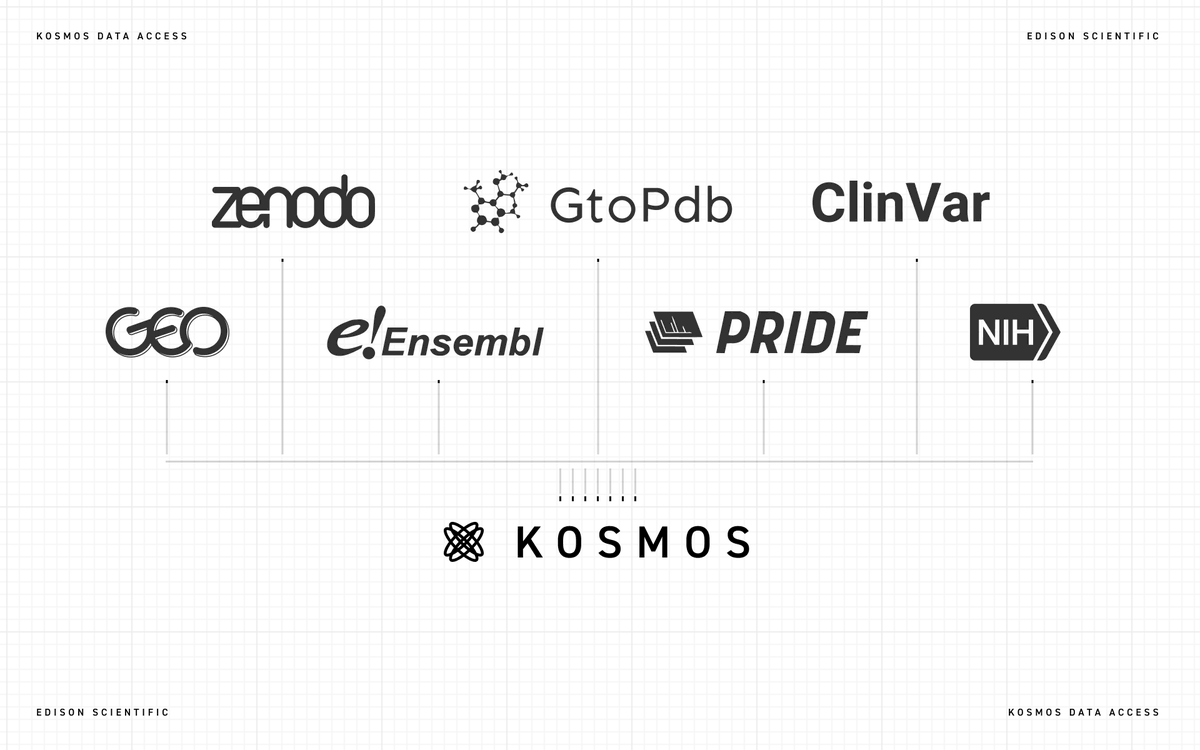
We're launching integrations for Kosmos today that allow it to access 80% of publicly available biology data.
This means it can now find its own data to initiate projects, enrich its investigation with data from different modalities, and validate its findings in alternative datasets.
We've seen runs where it will come up with a finding, try to replicate it in other datasets, fail, and then iterate on its hypothesis until it finds something more robust. In our blog post (link below), we describe how Kosmos was able to take a finding about TGFb signaling and the extracellular matrix in pancreatic cancer from bulk RNAseq and enrich it with further analysis in human clinical data and single cell data that it grabbed autonomously. This allowed it to come up with a plausible mechanism for its initial finding using other datasets, all without human intervention. In our testing so far, it seems like a very significant unlock.
Read about it on our blog (link below), and try it on our website. Academics get three free runs per month. (It's also now way easier to try, since you don't have to have a dataset at hand to get Kosmos to do really interesting analysis.)
We're thrilled to be co-leading this @EdisonSci round. @SGRodriques and @andrewwhite01 have brought together an exceptional interdisciplinary team and built a set of foundational tools that help push the frontiers of science. We can't wait to see what scientists discover with the help of Edison's agents! 🔬🧬🚀
Science is too slow.
At Edison, we are integrating AI Scientists into the full stack of research, from basic discovery to clinical trials. We want cures for all diseases by mid-century.
We have raised a $70M seed to get started.
Join us.
We need cracked software engineers who want to work on finding cures rather than selling ads and generating slop. If you’re reading this, you’re probably a candidate.
We need brilliant AI researchers who want to figure out how AI will accelerate real-world science.
We need scientists and researchers with deep expertise in biology, biotech, and pharma who want to figure out how to integrate AI deeply into scientific workflows, from ideation to experimentation, and how to measure success or failure.
We need extraordinarily talented generalist operators across BD, sales, product management, and partnerships who can focus on getting our tools into the hands of pharmaceutical companies.
If any of these roles sound like you, get in touch.
We are also expanding access to our platform.
Our goal is to accelerate science writ large. To that end, we will continue to give academics and students 650 credits/mo indefinitely. I can’t promise we’ll keep this up forever, but we will try. Kosmos will still cost 200 credits, and the other agents (Analysis, Literature, etc.) will cost 1 or 2 credits.
All paid users will have access to our regular agents, like our Analysis agent, Literature agent, and so on, for free via the UI. API access will still be paid, and users without a paid subscription will continue to get 10 credits per month for those agents. Our $200/mo subscription for 650 credits/mo is staying in place for now, but might be phased out at our next major product update.
Along the lines of accelerating science, we’re also doing a major release of PaperQA today, our flagship open source literature agent, as part of our commitment to open science.
In the short run, expect major improvements to Kosmos, including the ability to automatically access data, the ability to steer its exploration, and the ability to converse directly with its world model.
In the long run, expect exponentially increasing rates of scientific discoveries, in biology and elsewhere.
Our round is led by Triatomic Capital, Spark Capital, and a major US institutional biotech investor. We are also joined in this round by existing investors Pillar VC and Susa Ventures, two exceptional early-stage funds who backed us at founding, along with Striker Venture Partners, Hawktail VC, Olive VC, and a host of exceptional angels that includes famous AI researchers, the CEOs of multiple frontier AI labs, and leadership of major biotech and pharma companies.
Putnam, the world's hardest college-level math test, ended yesterday 4p PT.
Noon today, AxiomProver solved 9/12 problems in Lean autonomously (3:58p PT yesterday, it was 8/12).
Our score would've been #1 of ~4000 participants last year and Putnam Fellow (top 5) in recent years
Axiom sets out to build an AI mathematician.
We are the underdog.
4 months old, 2 years late to the game, under 10 FTEs (recently grew to 17), and had 1:5 in funding and in valuation to our competitor.
Today, AxiomProver solved Erdos Problems #124 and #481 in Lean, a 100% verifiable language.
Onwards!
@sama Thanks!! Anyone who is interested can try Kosmos for themselves here:
https://t.co/PHYFaC4Koc
All possible in large part due to the amazing work you guys have been doing at OpenAI. Keep it up, and the next few years are going to be awesome.
Today, we’re announcing Kosmos, our newest AI Scientist, available to use now.
Users estimate Kosmos does 6 months of work in a single day. One run can read 1,500 papers and write 42,000 lines of code. At least 79% of its findings are reproducible. Kosmos has made 7 discoveries so far, which we are releasing today, in areas ranging from neuroscience to material science and clinical genetics, in collaboration with our academic beta testers. Three of these discoveries reproduced unpublished findings; four are net new, validated contributions to the scientific literature. AI-accelerated science is here.
Our core innovation in Kosmos is the use of a structured, continuously-updated world model. As described in our technical report, Kosmos’ world model allows it to process orders of magnitude more information than could fit into the context of even the longest-context language models, allowing it to synthesize more information and pursue coherent goals over longer time horizons than Robin or any of our other prior agents. In this respect, we believe Kosmos is the most compute-intensive language agent released so far in any field, and by far the most capable AI Scientist available today. The use of a persistent world model also enables single Kosmos trajectories to produce highly complex outputs that require multiple significant logical leaps. As with all of our systems, Kosmos is designed with transparency and verifiability in mind: every conclusion in a Kosmos report can be traced through our platform to the specific lines of code or the specific passages in the scientific literature that inspired it, ensuring that Kosmos’ findings are fully auditable at all times.
We are also using this opportunity to announce the launch of Edison Scientific, a new commercial spinout of FutureHouse, which will be focused on commercializing our agents and applying them to automate scientific research in drug discovery and beyond. Edison will be taking over management of the FutureHouse platform, where you can access Kosmos alongside our Literature, Molecules, and Precedent agents (previously Crow, Phoenix, and Owl). Edison will continue to offer free tier usage for casual users and academics, while also offering higher rate limits and additional features for users who need them. You can read more about this spinout on our blog, below.
A few important notes if you’re going to try Kosmos. Firstly, Kosmos is different from many other AI tools you might have played with, including our other agents. It is more similar to a Deep Research tool than it is to a chatbot: it takes some time to figure out how to prompt it effectively, and we have tried to include guidelines on this to help (see below). It costs $200/run right now (200 credits per run, and $1/credit), with some free tier usage for academics. This is heavily discounted; people who sign up for Founding Subscriptions now can lock in the $1/credit price indefinitely, but the price ultimately will probably be higher. Again, this is less chatbot and more research tool, something you run on high-value targets as needed.
Some caveats are also warranted. Firstly, we find that 80% of Kosmos findings are reproducible, which also means 20% are not -- some things it says will be wrong. Also, Kosmos certainly does produce outputs that are the equivalent to several months of human labor, but it also often goes down rabbit holes or chases statistically significant yet scientifically irrelevant findings. We often run Kosmos multiple times on the same objective in order to sample the various research avenues it can take. There are still a bunch of rough edges on the UI and such, which we are working on. Finally, we are aware that the 6 month figure is much greater than estimates by other AI labs, like METR, about the length of tasks that AI Agents can currently perform. You can read discussion about this in our blog post.
Huge congratulations to our team that put this together, led by @ludomitch and @michaelathinks: Angela Yiu, @benjamin0chang, @sidn137, Edwin Melville-Green, Albert Bou, @arvissulovari, Oz Wassie, @jonmlaurent. A particular shout out to @m_skarlinski and his team that rebuilt the platform for this launch, especially Andy Cai @notAndyCai, Richard Magness, Remo Storni, Tyler Nadolski @_tnadolski, Mayk Caldas @maykcaldas, Sam Cox @samcox822 and more.
This work would not have been possible without significant contributions from academic collaborators @mathieubourdenx, @EricLandsness, @bdanubius, @physicistnevans, Tonio Buonassisi, @BGomes_1905, Shriya Reddy, @marthafoiani, and @RandallBateman3.
We also want to thank our numerous supporters, especially @ericschmidt, who has been a tremendous ally. We will have more to say about our supporters soon!
The hardest problems in medicine will not be solved by incremental innovation.
They will require a fundamentally new approach that grounds AI-driven design in large-scale data from living systems.
Excited to announce our partnership with @Roche
https://t.co/GpLmyK7kdS
Excited to announce mBER, our fully open AI tool for de novo design of epitope-specific antibodies. To validate, we ran the largest de novo antibody experiment to date: >1M designs tested against 145 targets, measuring >100M interactions. We found specific binders for nearly half the targets, with up to 40% hit rates. Thread below: