What makes it hard for robots to generalize to new environments?
In our study, we broke down the notion of an “environment” into smaller, more manageable factors of variation, such as lighting or camera placement.
https://t.co/08SD44xL5D
1/n
The future of robot butlers starts with mobile manipulation.
We’re announcing the NeurIPS 2023 Open-Vocabulary Mobile Manipulation Challenge!
- Full robot stack ✅
- Parallel sim and real evaluation ✅
- No robot required ✅👀
https://t.co/mggAbRhrLP
After working on curiosity-driven learning for many years, we finally scale it to real robot control.
In our #ICRA2023 paper, we present ALAN which explores w/o any rewards to collect its own real-world data & then repurposes its experience to achieve goals at deployment.
How can we enable robots to perform diverse tasks? Designing rewards or demos for each task is not scalable.
We propose WHIRL which learns by watching a single human video followed by autonomous exploration *directly* in the real world (no simulation)!
https://t.co/7XlOf4OyEm
What do Lyapunov functions, offline RL, and energy based models have in common? Together, they can be used to provide long-horizon guarantees by "stabilizing" a system in high density regions! That's the idea behind Lyapunov Density Models: https://t.co/tx1RlPAxmm
A thread:
Massive datasets have enabled many recent advancements in computer vision and NLP. ProcTHOR presents a platform to enable similar success stories in Robotics and Embodied AI in general.
ProcTHOR website: https://t.co/ftZoi9Cmdg
Details: https://t.co/D1OlA0JLxh
A talk that I preparing on how reinforcement learning can acquire abstractions for planning. Covers some HRL, trajectory transformer, offline RL: https://t.co/LKl3OgAjst
This was made for the "Bridging the Gap Between AI Planning and Reinforcement Learning" workshop at ICAPS.
To do daily chores, robots need to understand articulated objects. Sometimes a single picture of an object is deceiving. We propose a novel method that leverages temporal data to estimate the object articulation mechanism.
https://t.co/BBQFaSKOhh
🧵 1/9
Factory: Fast Contact for Robotic Assembly, our recent work, is a set of simulation methods & robot learning tools for contact-rich interactions for robotic assembly. It will be presented at RSS next month.
Paper: https://t.co/WoC8E6bZle
Website: https://t.co/BfBty65hky
Gato🐈a scalable generalist agent that uses a single transformer with exactly the same weights to play Atari, follow text instructions, caption images, chat with people, control a real robot arm, and more: https://t.co/9Q7WsRBmIC
Paper: https://t.co/ecHZqzCSAm 1/
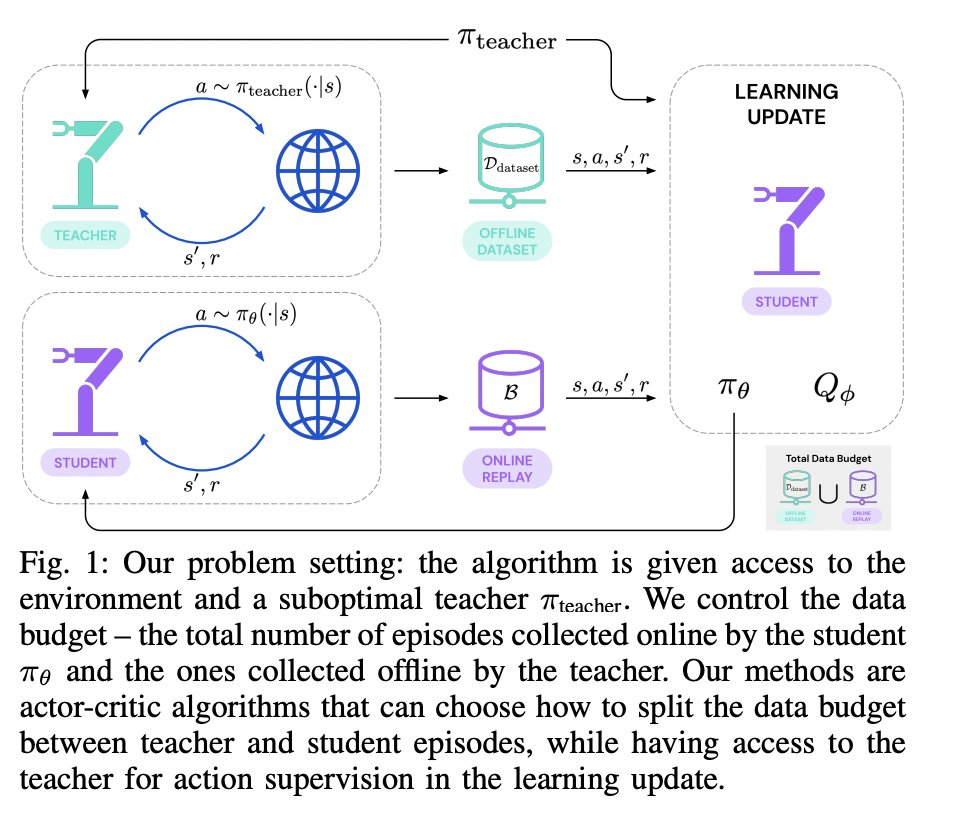
How to Spend Your Robot Time: Bridging Kickstarting and Offline Reinforcement Learning for Vision-based Robotic Manipulation
abs: https://t.co/AhJoIK94gS
#DeepLearning and manual training taught a #robot to open a door successfully more than 96% of the time, completing 15 rounds of back-and-forth in 30 minutes.
📝: https://t.co/oGy3YleJrg @SciRobotics
Super excited to introduce SayCan (https://t.co/NWyvPubhmE): 1st publication of a large effort we've been working on for 1+ years
Robots ground large language models in reality by acting as their eyes and hands while LLMs help robots execute long, abstract language instructions
Remember the kitchen env from Relay Policy Learning? This time it's in real!
In DBAP, we create system that continuously, autonomously improves on many tasks.
It's not enough to give demos to bootstrap tasks, demos should also bootstrap practicing!
https://t.co/m1F2PL5DuA
🧵👇
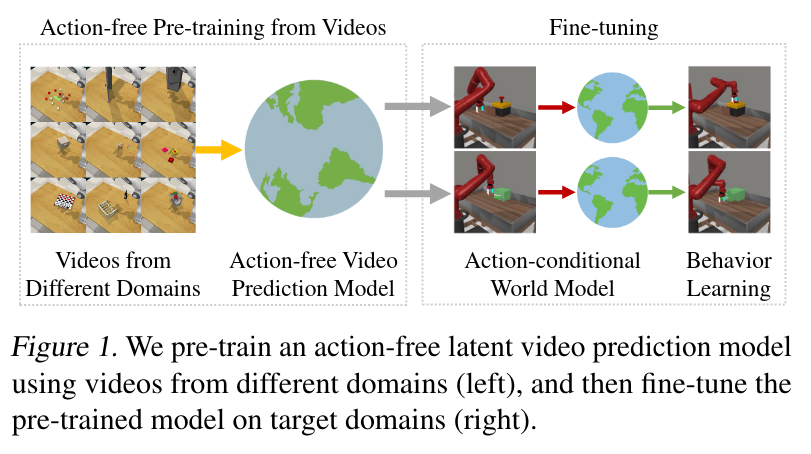
Reinforcement Learning with Action-Free Pre-Training from Videos
Significantly improves both final performances and sample-efficiency of vision-based RL in a variety of manipulation and locomotion tasks.
https://t.co/u1MMeLwurG