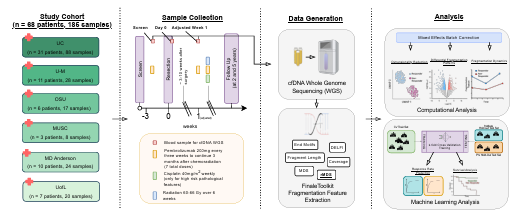
@kyunkiwhynot@TMWiseDraper@yapingliu@NUFeinbergMed Behind the scenes: Cell-free DNA extraction by research associate Hailu Fu and computational analysis of cfDNA fragmentation led by first author Ravi Bandaru, a medical student.
Congratulations to my colleague Dr. Yapig Liu @yapingliu for developing rMDS a cfDNA fragmentomics biomarker from whole-genome sequencing data that can predict response to perioperative pembrolizumab. This method outperformed PD-L1, tumor fraction, and other fragmentomic metrics and identified patients with improved disease-free survival. #HNSCC #LiquidBiopsy #CancerResearch @NU_BMG_SQE@NUFeinbergMed@NorthwesternU@jclinicalinvest https://t.co/jsurmCXD1J
A new @NorthwesternMed study suggests that a simple blood test could help identify which patients with head and neck cancer will be most likely to benefit from #immunotherapy, according to a study published in @jclininvest.
The advancement could help spare patients from ineffective treatment, said Yaping Liu, PhD (@yapingliu), who was senior author of the study. Read more: https://t.co/aSGxd11XeI
Thank you @GenomeWeb for covering our study: the variations of cfDNA end motif patterns may help predict immunotherapy response in head and neck cancer. https://t.co/w4lrfYX6yl
@NU_BMG_SQE@NUFeinbergMed@jclinicalinvest
Our paper is out at JCI https://t.co/DM42jcqMKV. We found that the variations of cell-free DNA end motif entropy across genomic regions predict immunotherapy response in head and neck cancer. Great collaboration with @TMWiseDraper. Congrats to @kyunkiwhynot
Federal funding for US biomedical research is moribund.
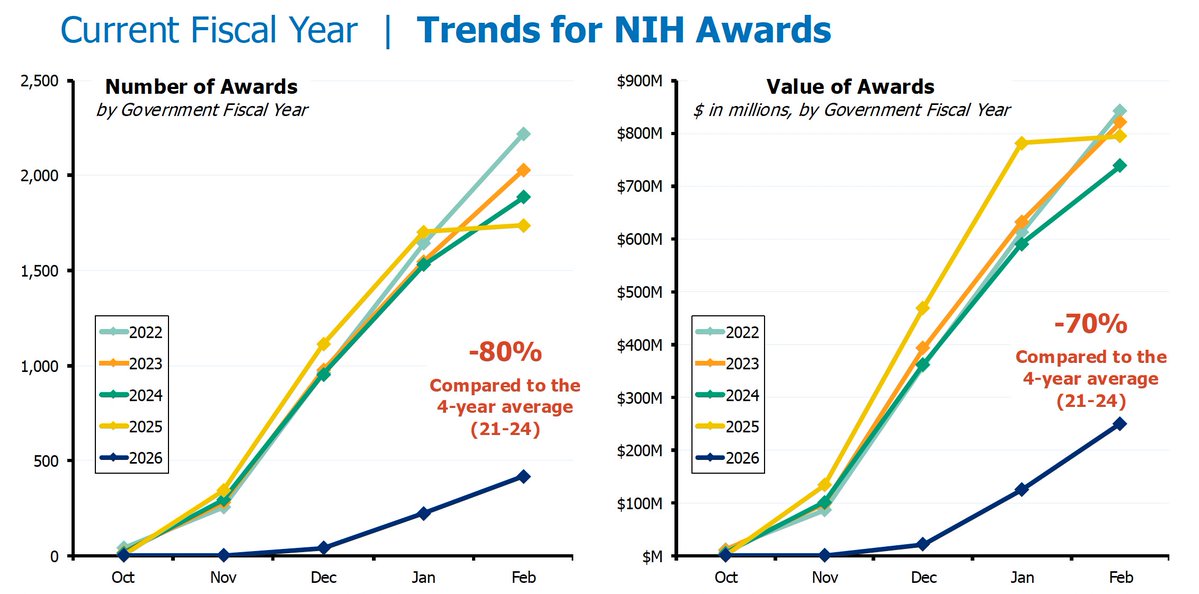
Since October 1 2025, NIH is -80% in new grants and -70% in values (total dollars).
Labs are closing down and researchers are leaving science.
To what end?
NIH is not issuing awards. You may think that it's because they it is coming up with new directions of research...The apposite is true.
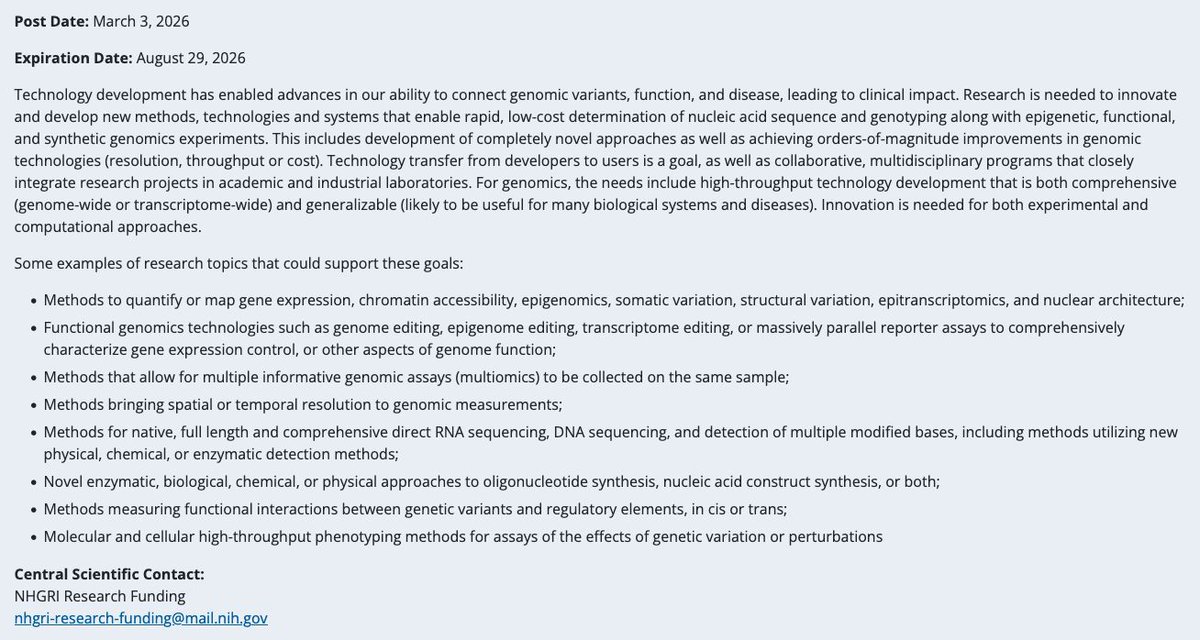
Here is a graph showing how many fewer new funding opportunities that NIH has posted over time.
-91%, a trend that started on Jan 2025.
Our paper on deep single-cell DNA methylation analysis is out in Nature Communications https://t.co/jpwk36NbR3. Super elegant work by Nathan Spix describing replication dynamics, X-inactivation, and cell lineage identification.
Thrilled to announce that our work on Expansion In Situ Genome Sequencing (ExIGS) is now published in @ScienceMagazine!
ExIGS allows us to sequence DNA and image proteins with super-resolution directly within single cells.
https://t.co/CEIsZdFrPU
We introduce EYKTHYR, a computational method that integrates gene expression and chromatin accessibility in a spatially aware model to identify transcription factors shaping spatial gene programs. Led by Lane Fellow @SpencerKrieger#spatialtranscriptomics https://t.co/rzLEgaBh4S
The vast majority over discoveries are low hanging fruit when they are made. The key to scientific progress is progressively making more fruit low-hanging. One of the deep problems we have in science is that we reward the people who pick the fruit rather than the ones who lower the branches.