Finally got around to incorporating all Github feedback on my open access textbook, making around 20 minor improvements, and updating some references. 17 chapters of state of the art stats and methods education, freely available for any course you teach. https://t.co/FdQIS63fVd
Tons of ways to "quantify uncertainty", but we don't talk enough about sources of uncertainty for ML models.
Is it uncertainty from model bias? Missing data or features?
Bookmark this: Sources of Uncertainty in Machine Learning -- A Statisticians' View
https://t.co/ciGY0OL0FG
A new chapter for Bluecat: uncertainty estimation for multimodel predictions, with open source software in R and Python, along with rigorous testing of the estimated uncertainty. Extremely simple and reliable, try it!!
https://t.co/6su5sbDqtS
I came across this really awesome explanation and comparison of a variety of methods to estimate predictive intervals from neural networks (in PyTorch). A great starting point if you’re thinking about how to add uncertainty to your model. https://t.co/cpdUfP3dXh
Cool paper out tonight on uncertainty estimation in generative AI [1]. You can use generative AI in medical imaging to flag anomalies, and enhance images - but wouldn't you like it to tell you how confident it is in its prediction?
💡The paper enhances a VAE (variational auto encoder) with a SLU layer (Stochastic Laplace Uncertainty) - after the VAE makes a prediction (like generating an image or flagging an anomaly), SLU uses a Laplace approximation to figure out how confident the model is about that prediction
💡The Laplace approximation looks at the curvature of the model’s loss function (how the error changes as you alter the parameters). If the loss function is flat (low curvature), the model is less confident, and if it's steep (high curvature), the model is more confident. By calculating this, SLU figures out how confident the model is in its prediction.
Bonus Q: can you see a connection to 2nd-order Tweedie's formula? **answer below in comments, +link to the paper
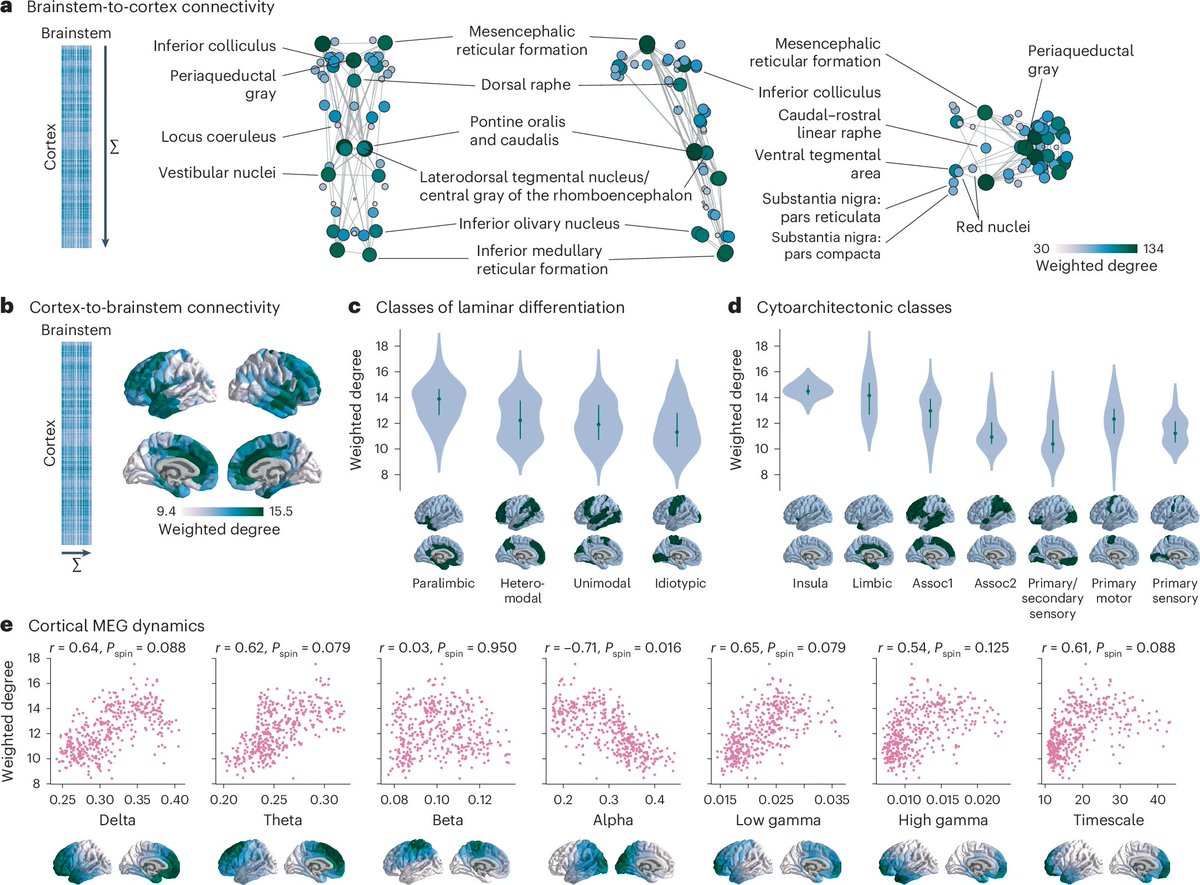
Integrating brainstem and cortical functional architectures | https://t.co/hmGC40nJq2
led by @JustineYHansen in @NatureNeuro
400 cortical regions + 58 brainstem nuclei. Lesgo 🤘🕶️⤵️
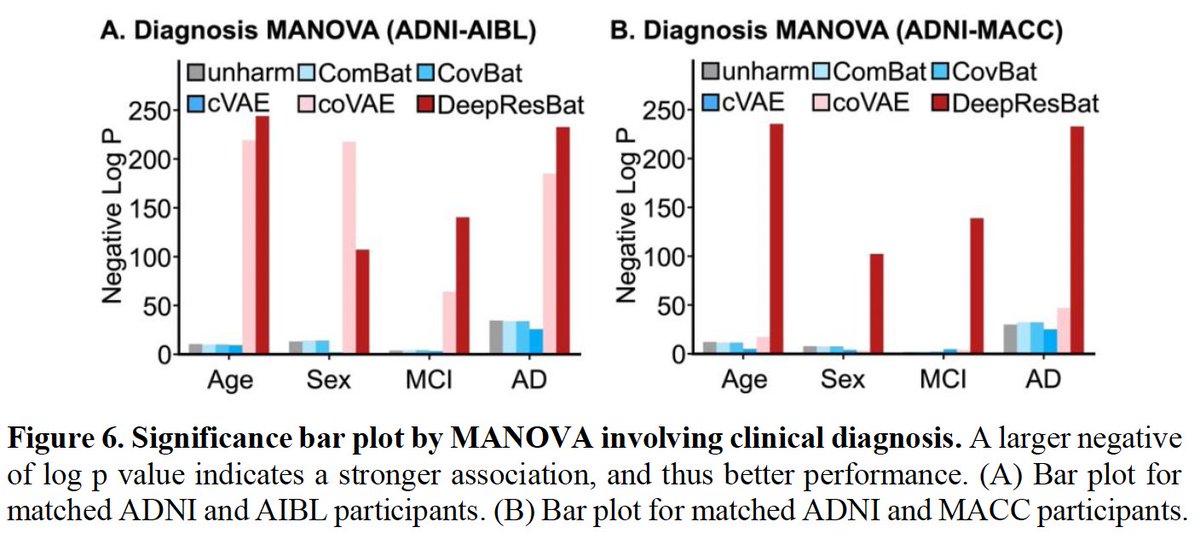
Backlog in announcing preprints, but here's goes! Preprint #3 by @anlijuncn https://t.co/b6Qh6L3fuv proposes DeepResBat, a deep learning alternative to ComBat that harmonizes MRI while accounting for covariates. We show large improvements over classical & deep learning baselines
We have updated NextBrain with:
- new atlas with improved brainstem.
- updated segmentation code.
- new labeled ex vivo dataset.
- new preprint.
Please see the project website for links and resources:
https://t.co/736q8mrfJo
WOW - @OHBM just put about 800 videos online including tutorials and symposia [1,2] from many years of past brain mapping meetings! https://t.co/8sY1np3bgd
[1] Some were there before but it looks like entire conferences were just added
[2] I am not involved with this, just appreciative - thanks to @StephForkel@sofievalk Kevin Sitek, Alfie Wearn
Happy to share that our work applying precision mapping to individuals with depression sampled longitudinally over an extended period has been published this week in @nature. Brief recap of the main findings and their potential implications below.
https://t.co/ZbTj6x7eyV
I'm literate in family-wise error rates, multiplicity correction, closed testing procedures & 'alpha spending'; but I've never come across the complementary notion, of family-wise power. Am I missing a term of art , or am I confused & this notion is somehow incoherent ('MNAR')?
I am thrilled to see this paper out after many years of work. It was an honor to be part of this group of leaders in the field, and it was a seminal experience that fast-forwarded my scientific career.
Thank you, Niko Schiff, for leading this initiative.
https://t.co/9nXaixd69y
Curious about power in the external validation of brain-phenotype predictive models? Our paper "Power and reproducibility in the external validation of brain-phenotype predictions" was just published in @NatureHumBehav https://t.co/MfcqvdL5YL
On Reddit's statistics forum, the most common question is "What test should I use?"
My answer, from 2011, is "There is only one test"
https://t.co/J5Ar4olekz
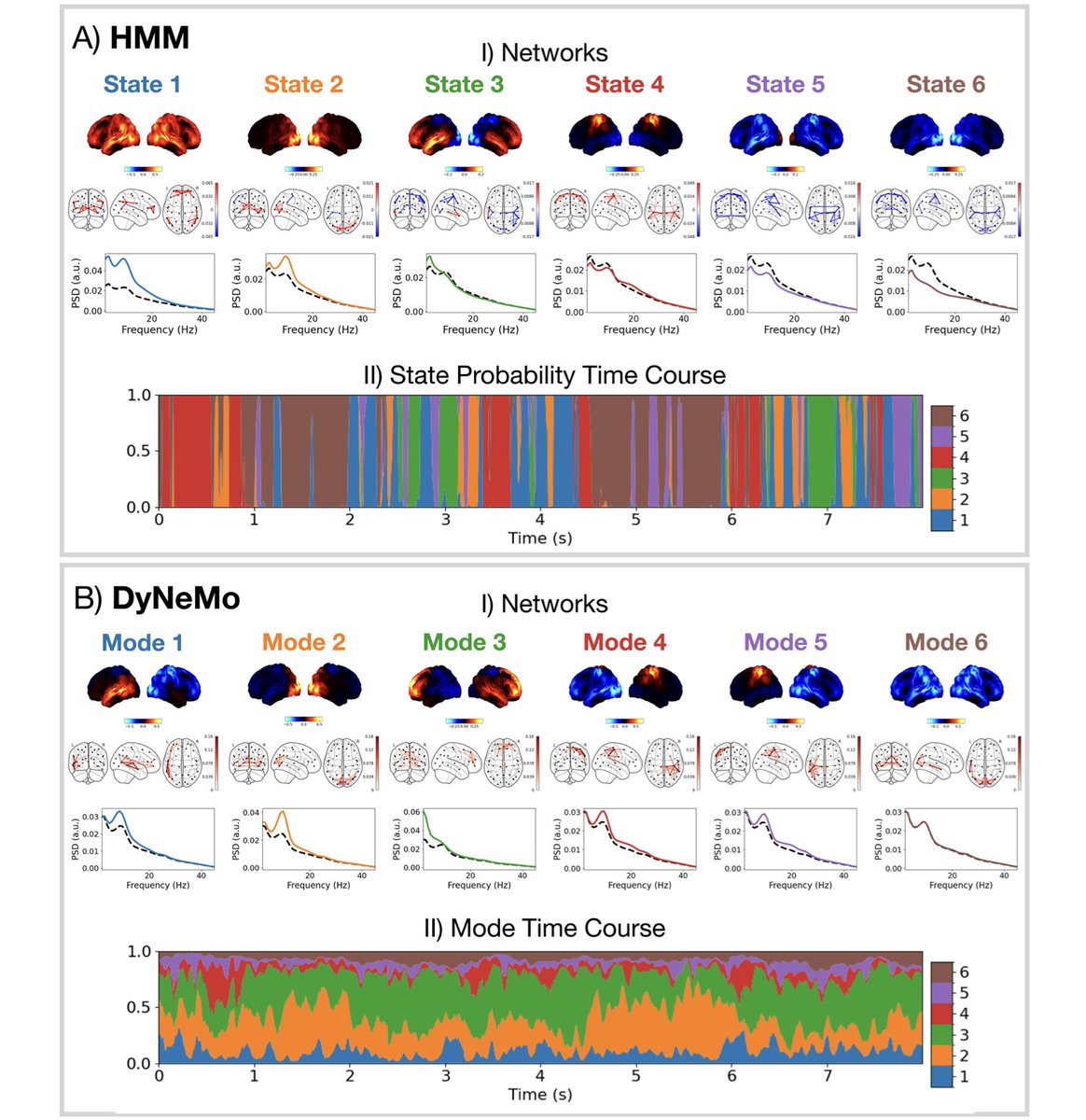
New paper in Imaging Neuroscience by Chetan Gohil, Mark W. Woolrich, et al:
Dynamic network analysis of electrophysiological task data
https://t.co/sMV3q5ET5u









![PTenigma's tweet photo. Cool paper out tonight on uncertainty estimation in generative AI [1]. You can use generative AI in medical imaging to flag anomalies, and enhance images - but wouldn't you like it to tell you how confident it is in its prediction?
💡The paper enhances a VAE (variational auto encoder) with a SLU layer (Stochastic Laplace Uncertainty) - after the VAE makes a prediction (like generating an image or flagging an anomaly), SLU uses a Laplace approximation to figure out how confident the model is about that prediction
💡The Laplace approximation looks at the curvature of the model’s loss function (how the error changes as you alter the parameters). If the loss function is flat (low curvature), the model is less confident, and if it's steep (high curvature), the model is more confident. By calculating this, SLU figures out how confident the model is in its prediction.
Bonus Q: can you see a connection to 2nd-order Tweedie's formula? **answer below in comments, +link to the paper](https://pbs.twimg.com/media/Gm3PrlUa4AAyxJL.png)


![PTenigma's tweet photo. WOW - @OHBM just put about 800 videos online including tutorials and symposia [1,2] from many years of past brain mapping meetings! https://t.co/8sY1np3bgd
[1] Some were there before but it looks like entire conferences were just added
[2] I am not involved with this, just appreciative - thanks to @StephForkel @sofievalk Kevin Sitek, Alfie Wearn](https://pbs.twimg.com/media/GW-Jt7UbUAAT7_l.jpg)