Breaking news for people who want to look hot, be young and not die. A few years ago, two college dropouts told me they could accelerate longevity by building a faster AI chip. I invested, and they just pulled it off.
What it means:
> 10x more throughput (tokens per second) for the same power footprint
> Dramatically lower operational costs for executing today’s frontier models
> Run far larger, more capable AI models within the same power and thermal budget, because a transformer-specific chip spends a fraction of the energy per token that a general-purpose GPU does
Rob and Gavin's approach resonated with me because solving aging is a gigantic combinatorial search problem. The chemical space of small, drug-like molecules has around 10^60 possibilities.
These compounds need to be mapped against a human proteome derived from 20,000 genes, including 1,600 transcription factors, and a dense web of interactions among them. The size of the combinatorial space is problematic. You need to identify which targets to modulate, within specific cellular lineages, at exact dosages, and in optimal temporal sequences. Traditional high precision physics simulations are too slow to brute force the problem. You can shortcut it with AI inference, using frontier neural networks as hyper fast surrogate models to predict biological interactions instantly. By hardwiring transformer logic into silicon, Etched offers the infrastructure needed to run these massive biological foundation models at scale. I'm surprised and impressed they were able to pull this off, and so quickly.
They already have $1B in orders
Rocket Lab is acquiring Iridium Communications Inc – one of the most transformative deals in the space industry.
By combining our launch capability and satellite manufacturing with @IridiumComm’s global satellite communications network and rare spectrum, Rocket Lab becomes a fully integrated, self-launching, tier-1 space power, delivering critical communications capability to millions of users worldwide.
Full details and important information: https://t.co/hj5aWrDPjz
ELON MUSK: "For the next few years America is likely to win the race in AI. Then it will be a function of who controls the AI chip fabrication. If more of the factories are owned by China then China will win. Right now all the chip fabs are in Taiwan. 100%. If China invades Taiwan in the near term the world will be cut off from advanced AI chips. I think it's essential for national security that we begin manufacturing our own chips in the US."
Tom Mueller (@lrocket) says his "proudest development" as the 1st Employee at SpaceX was creating the Merlin engine:
"Currently flying on Falcon 9, it is the most reliable rocket engine ever developed, and also the highest thrust to weight of any rocket engine ever developed."
"I worked on Starship for the last six years at SpaceX."
" When I left, I had the plan of launch mostly being solved or is being solved."
🇩🇪 Une société allemande fondée en 1976 contrôle le brevet le plus important de la prochaine révolution du packaging semiconducteur. Son titre a progressé de 300 % depuis janvier.
LPKF Laser & Electronics (Xetra: LPK) fabrique des équipements laser de précision depuis cinquante ans. Son activité historique : découpe de PCB, prototypage rapide, panneaux solaires. Son activité future : le traitement du verre pour semiconducteurs avancés.
Le problème que LPKF résout.
Les substrats organiques actuels atteignent leurs limites physiques. Ils se déforment à la chaleur, limitent la densité des interconnexions et ne peuvent pas intégrer de fonctions optiques. La solution industrielle émergente est le substrat en verre : meilleure stabilité dimensionnelle, résistance thermique supérieure, et surtout possibilité d'intégrer des guides d'onde optiques directement dans le substrat pour le CPO.
Problème : le verre est cassant. Percer des vias traversants avec des méthodes classiques crée des micro-fissures. Quand la puce chauffe, le verre se brise.
LPKF a résolu ce problème avec LIDE, Laser Induced Deep Etching. Un procédé laser-chimique qui grave le verre sans contact mécanique, sans micro-fissures, à haute densité. La société détient 300 brevets autour de ce procédé. C'est le seul équipement industriel capable de former des TGV de manière fiable à l'échelle de production. Intel, Samsung et Corning l'utilisent déjà. Part de marché sur le marché coréen des substrats verre : 80 %.
Le double levier CPO.
La prochaine étape de LPKF est d'étendre le LIDE au CPO sur verre. L'idée : utiliser le verre non seulement comme substrat électrique mais comme guide d'onde optique intégré, permettant de connecter les puces entre elles par lumière plutôt que par cuivre à l'intérieur même du package. Corning a présenté à OFC 2026 une démonstration sur panel 515x515mm intégrant 16 composants photoniques et un ASIC sur substrat verre avec interconnexions sous 13mm. LPKF fournit les équipements de traitement.
CA 2025 : 115 millions d'euros. Perte opérationnelle. Les premières commandes de production LIDE sont attendues au Q2 2026. Le marché a anticipé massivement : +300 % depuis janvier.
L'ensemble des analystes qui couvrent le dossier situent les revenus volume sur le substrat verre entre 2027 et 2029. Le marché paye aujourd'hui une option sur dans deux à trois ans.
Ce que dit la direction : "La question n'est plus de savoir si le verre va s'imposer dans l'encapsulation avancée, mais quand le ramp-up va commencer." Objectif de marge opérationnelle double chiffre d'ici 2028.
TSMC évalue le substrat verre pour ses packages CoWoS de prochaine génération. ASE Group, premier OSAT mondial, qualifie les procédés d'assemblage sur verre. Si le substrat verre entre en production de masse chez TSMC d'ici 2028, LPKF devient fournisseur critique de la chaîne d'approvisionnement qui alimente les datacenters IA mondiaux depuis Taiwan.
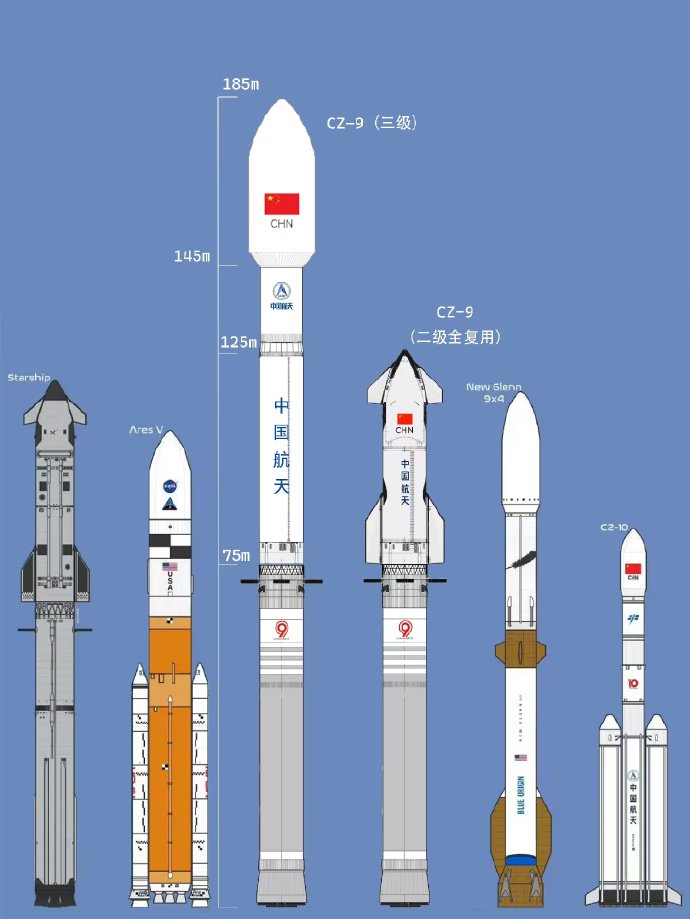
Updates of the possible CZ-9 specs through the factory's blueprints.
Body diameter: 10.6m;
Engine Max diameter:11.6m;
Fairing diameter:15m, Length 37m.
The 3 stage varient could be as tall as 185m.
pic 1 via bilibili/鸿雁Buran. Pic 2 via 卡尔达瓦里希 with @Echo5550's renders.
Tom Mueller (@lrocket) says his "proudest development" as the 1st Employee at SpaceX was creating the Merlin engine:
"Currently flying on Falcon 9, it is the most reliable rocket engine ever developed, and also the highest thrust to weight of any rocket engine ever developed."
The race back to the Moon is on, and America will lead.
We’re leveraging the talent, technology, and national commitment needed to return astronauts to the lunar surface before the end of 2028.
This time, we’re going not just for flags and footprints, but to build the capabilities to stay and prepare for Mars.
This biochemist read 2,000 scientific papers on blood sugar, pregnancy, and nutrition and discovered the food industry has been lying to you about almost all of it.
Here are the 10 most shocking things she found:
1. Orange juice = Coca-Cola.
Leo Europe 3 (LE-03) is targeting Jun 17 at 7:53 a.m. ET/11:53 a.m. UTC for liftoff from Europe's Spaceport in French Guiana. This is our third Ariane 6 mission and our largest Ariane 6 payload to date, with 36 satellites launching using upgraded P160C solid rocket boosters.
With more than 300 satellites already deployed, LE-03 will mark 100 launched with @Arianespace as we continue scaling deployment ahead of an initial service rollout later this year.
Read more about LE-03 here: https://t.co/BpOBHmfphc