On September 4, FurtherAI is hosting an exclusive group of insurance leaders in a private suite at the US Open.
An afternoon in a private suite, premium food and drinks, and a front-row seat to some of the best tennis in the world. A handful of familiar faces from our team will be there too, so come say hello.
We'd love for you to join us. Space is limited, so join the waitlist soon to save your seat here: https://t.co/yvJ1BPHmfH
@furtheraicom is now available in the Microsoft Marketplace.
Carriers, MGAs, and brokers can now find and deploy FurtherAI through the same destination their teams already use to buy cloud solutions, AI apps, and agents.
For insurance teams, that means FurtherAI runs inside a Microsoft environment their IT and compliance teams already know, with the same security and governance controls they rely on across Azure.
It also builds on our existing Outlook and SharePoint integrations, so submission intake, policy comparison, claims processing, and compliance workflows connect to the systems those teams use every day.
"For two years, the AI conversation in insurance has been about model capability: better extraction, faster generation," said Aman Gour, our Co-Founder and CEO. "This work with Microsoft is about distribution and deployment, meeting insurers inside the infrastructure they already trust."
Full announcement linked below:
Software now does the work that used to define the Forward Deployed Engineer role.
An FDE used to sit with a customer and turn a model into something that ran in production: writing the prompts, choosing the models, building the integrations, creating an eval set, testing until the workflow held up. Our platform does that now.
So, what does that mean for the future of the role?
It moves to what the machine cannot settle. Someone still has to decide what "correct" means, and in insurance, not every error costs the same. Judging which errors a workflow can absorb, and when it's ready for production, stays human.
The rest of the job is building what the platform can't do yet, so the next insurer gets it as standard.
Our Co-Founder and CEO @amangour30 wrote about where the role goes from here. Full piece linked below:
We @a16z spend a lot of time with vertical AI startups.
But how do you get a toehold when buyers aren’t on LinkedIn, or don’t have IT teams?
Takeaways from our convo with @LassieAI’s founders, who passed $10M ARR selling AI to run dental practices 👇
I've never shared this before, but now feels like the right time.
When we raised our $25 million Series A, we had two term sheets.
The @a16z terms were actually more expensive. We went with them anyway.
The reason was @joeschmidtiv.
@joeschmidtiv is not just a venture capitalist, but he's also a licensed insurance agent and cares deeply about the space. This decision became an inflection point in the growth story of @furtheraicom.
Joe was kind enough to sit down to talk about where insurance and AI are actually headed.
We covered:
→ Most dangerous thing in enterprise AI right now
→ AI psychosis
→ Where insurance + AI are actually headed
This is also my first episode as a "podcaster". If you like this style, please help amplify.
What we cover:
() How insurance went from tech laggard to AI-first
() Oil Wells vs. Pipelines: two AI adoption strategies
() 25 of the 100 largest insurers visited a16z this year
() The growth opportunity everyone is missing
() Avoiding Death on the Yellow Brick Road
() Why AI is great at code but terrible at underwriting
() The build vs. buy debate in insurance
() The last mile is everything
() Our famous Bay Area donut story
() Where insurance is going in the next 5 years
() How CTOs should actually think about AI adoption
Thank you to Joe for being a part of this!
The more enterprises I talk to about AI agent transformation, the more it’s clear that there is going to be a new type of role in most enterprises going forward. The job is to be the agent deployer and manager in teams. Here’s the rough JD:
This person will need to figure out what are the highest leverage set of workflows on a team are (either existing or new ones) where agents can actually drive significantly more value for the team and company.
In general, it’s going to be in areas where if you threw compute (in the form of agents) at a task you could either execute it 100X faster or do it 100X more times than before. Examples would be processing orders of magnitude more leads to hand them off to reps with extra customer signal, automating a contracting review and intake process, streamlining a client onboarding process to reduce as many straps as possible, setting up knowledge bases than the whole company taps into, and so on.
This person’s job is to figure out what the future state workflow needs to look like to drive this new form of automation, and how to connect up the various existing or new systems in such a way that this can be fulfilled. The gnarly part of the work is mapping structured and unstructured data flows, figuring out the ideal workflow, getting the agent the context it needs to do the work properly, figuring out where the human interfaces with the agent and at what steps, manages evals and reviews after any major model or data change, and runs and manages the agents on an ongoing basis tracking KPIs, and so on.
The person must be good at mapping the process and understanding where the value could be unlocked and be relatively technical, and has full autonomy to connect up business systems and drive automation. This means they’re comfortable with skills, MCP, CLIs, and so on, and the company believes it’s safe for them to do so. But also great operationally and at business.
It may be an existing person repositioned, or a totally net new person in the company. There will likely need to be one or more of these people on every team, so it’s not a centralized role per se. It may rile up into IT or an AI team, or live in the function and just have checkpoints with a central function.
This would also be a fantastic job for next gen hires who are leaning into AI, and are technical, to be able to go into. And for anyone concerned about engineers in the future, this will be an obvious area for these skills as well.
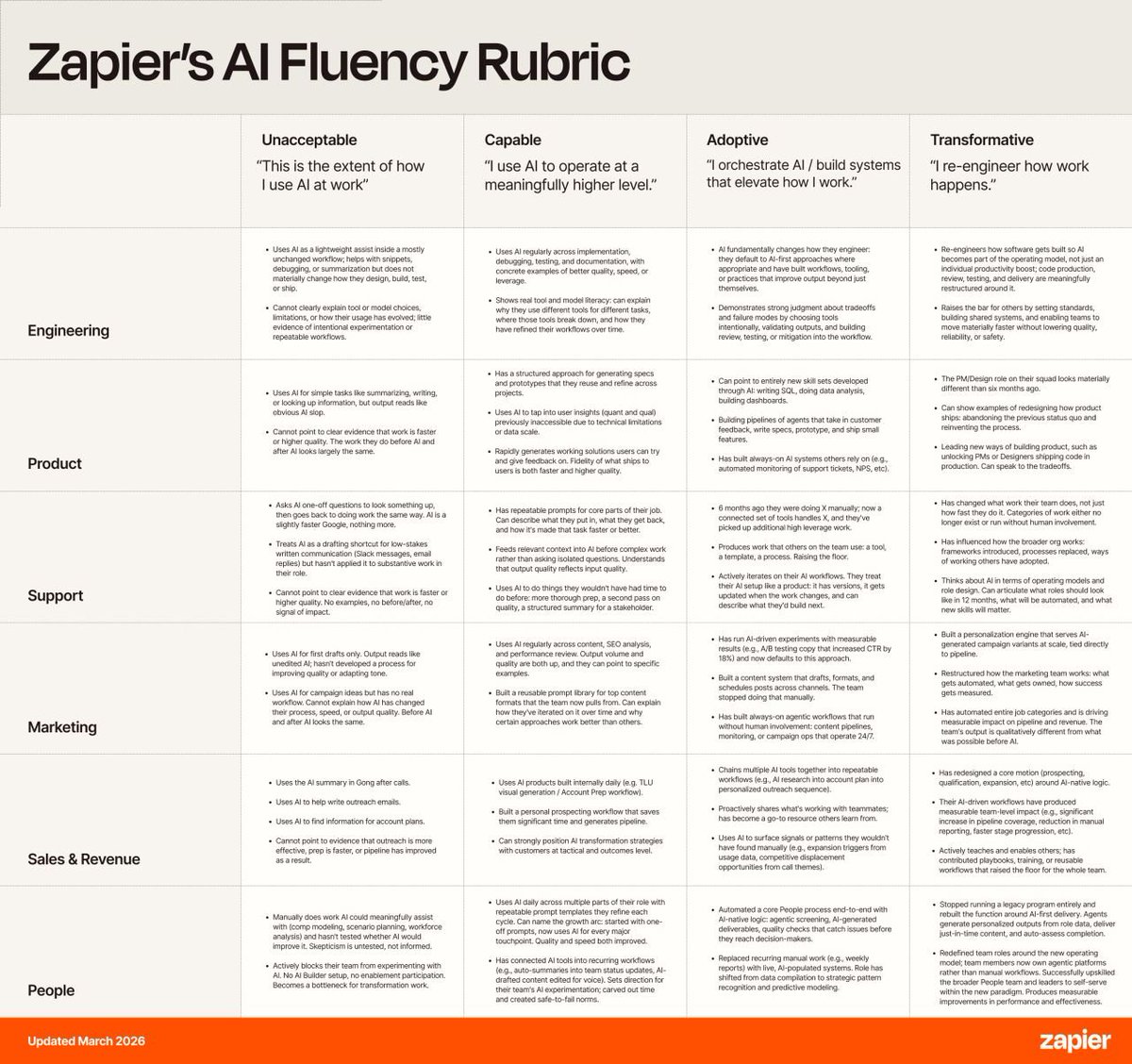
Zapier’s CEO just released their internal AI hiring rubric.
“Capable” AI operators are no longer hireable.
The new floor is "Adoptive.”
What gets you rejected now:
Marketers who use AI for first drafts and edit output manually.
Can’t show before/after evidence of AI implementations/prompts.
Using LLMs for campaign ideation without personalization.
What will get you hired:
Repeatable, shareable prompt libraries that and always-on workflows that run without your supervision. Specific measurable results that signal where to push next.
This is the new baseline.
Totally agree. Sometimes the biggest risk you take is not taking risks. Now feels like that time. Predictable low variability path to slow decline or thoughtful risk taking
.@davidsenra says Shopify CEO @tobi told him we're going to look back at 2026 as "the year that every single business in the world was up for grabs."
"That AI is coming for everything."
"And you're going to look back and realize that this is the year it should have been obvious that you could rebuild the AI-native version of whatever exists out there."
The future of physical security is here, and we're proud to be building it.
@CapitalG's investment strengthens our ability to stay ahead in the transformation that's happening as we continue to introduce category-leading AI in the market.
This is just the beginning. Read more in @Reuters: https://t.co/I9Aw2CGAGI
Sequoia’s @carl_eschenbach says the SaaSpocalypse narrative is "completely overblown," and that it's not a zero-sum game between incumbent SaaS and AI-native newcomers:
"Incumbency is incredibly powerful in enterprise. Incumbency is even more powerful when a company like Workday has a 98% gross retention rate across 11,000 customers, with 65%+ of them being Fortune 500 companies. They’re not going anywhere."
"That all being said, [with] the pace and rate of change that can happen outside of the big incumbents and big SaaS companies...[new companies] have an opportunity to start completely fresh, and start from scratch."
"They get to leverage all the technologies and all the models that are out there, and build agents and agentic solutions faster than anyone else. And they're going to be able to go into the enterprise and provide value on day one, either on their own, or on top of and through some of these SaaS companies."
The two best performing public stocks of the decade - Netflix (+3700%) and Domino's Pizza (+3000%) - perfectly epitomize the 2010s. You either build the world's most advanced machine learning content recommender system, or make a better pizza sauce, there's no middle ground.