There’s been a lot of sturm und drang about the future of intellectual thought and I have some uh…thoughts on this not as an economist but as a Classics major.
…AI doesn’t mean being compensated for doing intellectual thinking will necessarily go away. And it doesn’t mean intellectual thinking will necessarily go away.
I spent many years doing a lot of studying/research that was useful to…me. Maybe my advisor also cared? And it was great! And yes I wasn’t a professor, but my professors also did a lot of intellectual work that contained…approximately zero “productive” value. They did it (and do it) because it brought them joy.
Yes humanities funding and PhD slots etc are down. But if AI does make us richer…one thing we COULD do is invest in giving people employment to just…study things they care about. A lot of “I think about things” jobs right NOW aren’t “productive” jobs - they’re jobs where we as a society decided - wouldn’t it be nice to pay someone to just…think thoughts about that?
I think people in Econ and other more “science-y” disciplines are used to being able to think thoughts for a living and having those thoughts be “impactful.” And tbc as someone who is in that world…that gives you a ton of meaning. But thinking about how the development of the cult of personality in the Late Roman Republic parallels our own political moment (which is what I was thinking about in uh…2009) is also meaningful to the individual.
In 2018, when Powell was new and hiking rates, Trump said he was "a very good man" and, "I am not happy about it. But at the same time, I’m letting them do what they feel is best.”
We know how that movie ended.
Are we sure "this time will be different?"
https://t.co/3D0OuPKq8B
The introduction of AI refereeing in the publication process is the start of a momentous change in science, not just in economics. Refine is an outstanding tool, as many economists and other scientists have already testified. Papers will be much better by passing through this process (in equilibrium, they will have passed by it beforehand and the AI referee will find nothing new, as surely the founders must have noted). Happy that economics is proving so open to change.
I also think the way it will be implemented, using it for the "technical comments" and not for the larger substantive comments is correct. As @JohnHCochrane argued, we don't want a full area of knowledge to move in the direction one AI finds most sensible. The judgement must remain human
My warmest congratulations to the @RefineDotInk team, to @ben_golub and to @yanncalvolopez.
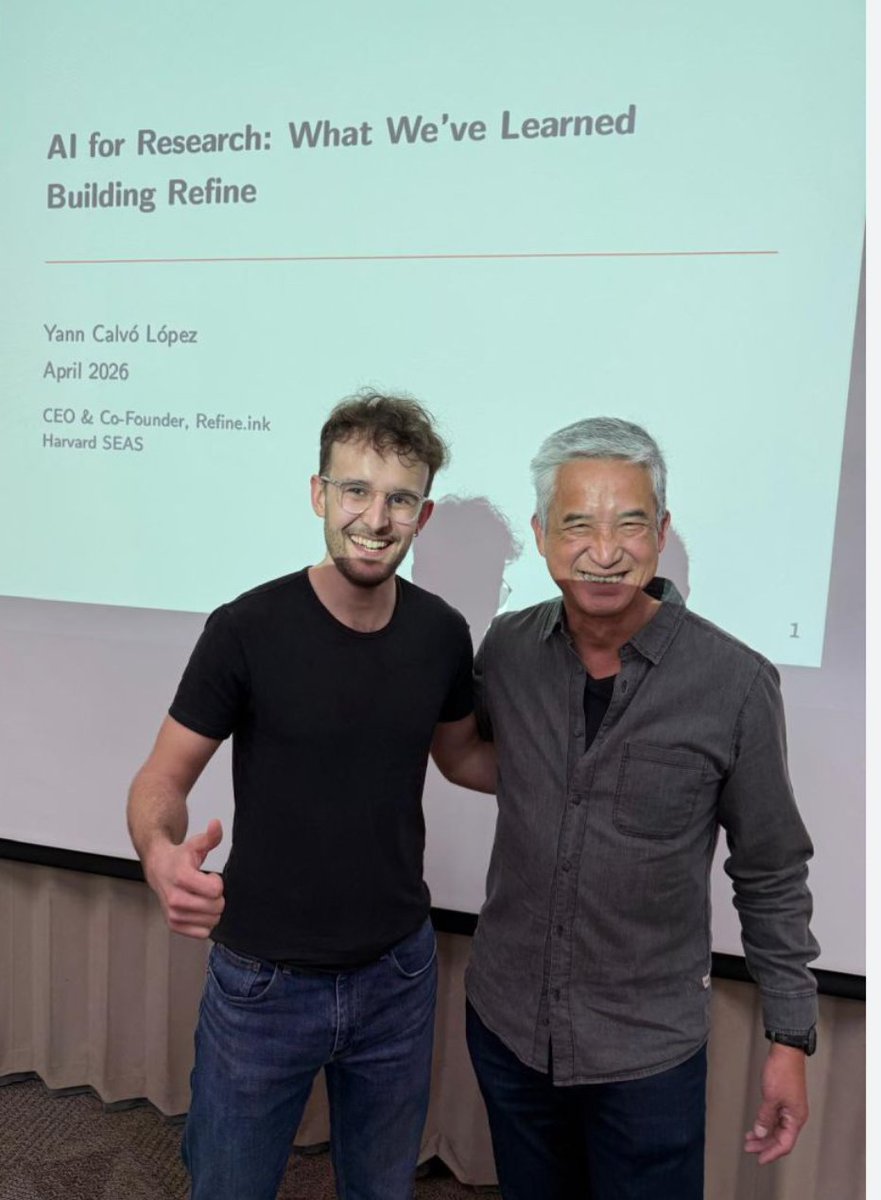
A personal note: I (and surely many others in the profession) feel an enormous personal satisfaction in seeing the success of Yann Calvó. He is the son of Toni Calvó-Armengol (left pic), a brilliant economic theorist who died suddenly in November 2007 when he was 37 years old and who did as much as anyone to make networks a part of economics. Ben Golub won the prize named after Toni in 2020. Golub's advisor, Matt Jackson, was Toni's closest coauthor. Toni spent his career on how opportunity travels through social ties. Toni would be thrilled.
That's right. And, for people who don't know this, there is a way to determine if a forecast is optimal. The mean square optimal forecast is a conditional expectation. This can be tested using a Mincer-Zarnowitz regression:
y_{t+h} = a_0 + a_1 \hat{y}_{t+h|t} + e_{t+h}
where \hat{y}_{t+h|t} is the out-of-sample forecast made h-step ahead. You estimate (a_0, a_1)' by OLS and use a HAC covariance matrix to build a Wald statistic and test jointly the null (a_0, a_1)' = (0,1)' against the alternative (a_0, a_1)' =/= (0,1)'.
The idea is that if your model asymptotically delivers the conditional expectation, then the true coefficients are (0,1)'.
If you don't like the frequentist test, then use a Bayesian approach. I would recommend a NIG prior, but with a small twist where you add serial correlation and heteroskedasticity to the error term. It's one of those cases where the special structure of the posterior allows you to use tricks: specifically, you can use Chan (2020)'s algorithm to do it fast (that's how I usually handle COVID in SVARs because it's blazing fast).
Then, you can ask two questions. One involves looking at the posterior and ask how much mass it puts near (0,1)'. I'd say this is the more meaningful question. But you can also ask the frequentist question: impose (0,1)' and re-estimate. Then compare the two models using standard statistics.
I don't know if any forecasts were optimal. Probably not, though they might be less crazy bad than people assume. Also, this assumes mean square loss is what the forecaster is trying to minimize. You only learn whether people are close or not to optimizing for a loss function that you chose for them, so what went wrong? Are they trying to do that and failing or did you just not pick the right objective?
I like this take, but long-term yields are fundamentally tied to expectations about future short-term rates. There's no benefit to playing coy, and real costs to being wrong.
Many are pissed that Warsh didn’t hike, citing the credibility issue as the long end rises — but Warsh just kept in telling us he is happy that the long end has risen during the intermeeting period.
The move in the long end is basically equivalent to a 25 bp hike. Warsh is probably happy about this —rather than see this as a bad thing.
This will be restraining the economy with the squeeze on the housing market and financial conditions being immediate.
Finding NBER Summer Institute talks on YouTube is surprisingly frustrating.
I asked Claude to build a searchable webpage that finds any talk by paper, author, or session, and jumps straight to where it starts in the video.
Link in the first reply.
Great work by @ernietedeschi on productivity growth, which is elevated but not due to AI, despite gains by Individual firms. Notable, higher productivity raises not lowers the non-inflationary fed funds rate.
Also notable, all that productivity growth not enough to hold inflation in check. I know, you are tired of me talking about inflation.
I have no problems with economists signing this letter, but I personally would probably not have signed it if I were asked.
Largely because it's very vague and I don't know what the concrete proposal is (besides that we should learn more, which goes without saying.)
To be clear, and contrary to some letter-haters, I think the goal of regulating AI to ensure it is pro-human and pro-worker is *good.* And we should devise institutions that can effectively do so.
@dggoldst@cblatts Fair concern! But even in good years I suspect the private sector may be slower to higher by this measure. If we followed up with the 2025 cohort now, I would expect most to have found work.
I have no problems with his scholarship, and if your goal is to convince me otherwise you're going to have to do a lot better than throwing some junior-high side eye.
Best tldr I've seen of this question: "Conceptually, this puts a lot of weight on a very hard turn in firms' expectations in reaction to the early, buggy ChatGPT that concentrates not on AI-exposed workers, but *young* AI-exposed workers."
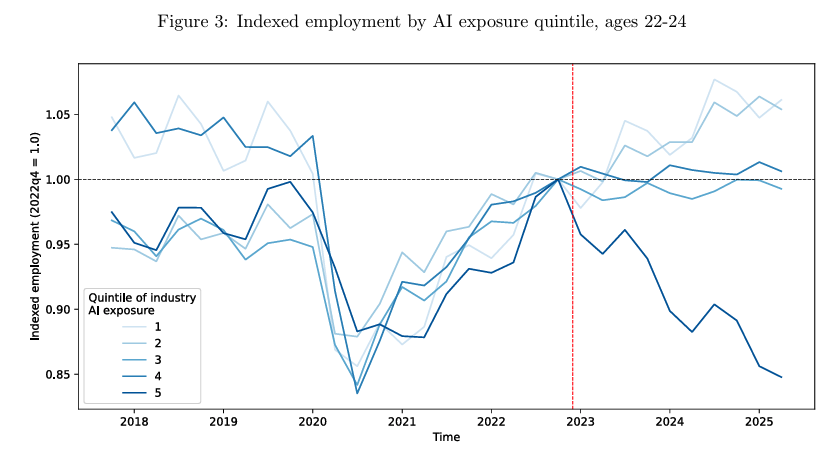
Very interesting paper by Lee C. Tucker at Census, "You’re (not) hired: Artificial intelligence and early career hiring in the Quarterly Workforce Indicators" (link below!). File this as another paper finding weak labor market performance for young AI-exposed workers, with some important nuance.
The paper uses data from the Quarterly Workforce Indicators and industry by state-level AI exposure measures crosswalked from occupation-level exposure data (Eloundou et al., 2024).
Like the Canaries in the Coal Mine paper, they find a kink in employment around the release of ChatGPT for the most exposed young workers (22-24), both in the descriptive statistics and event study regressions (w/ time and industry-state FE).
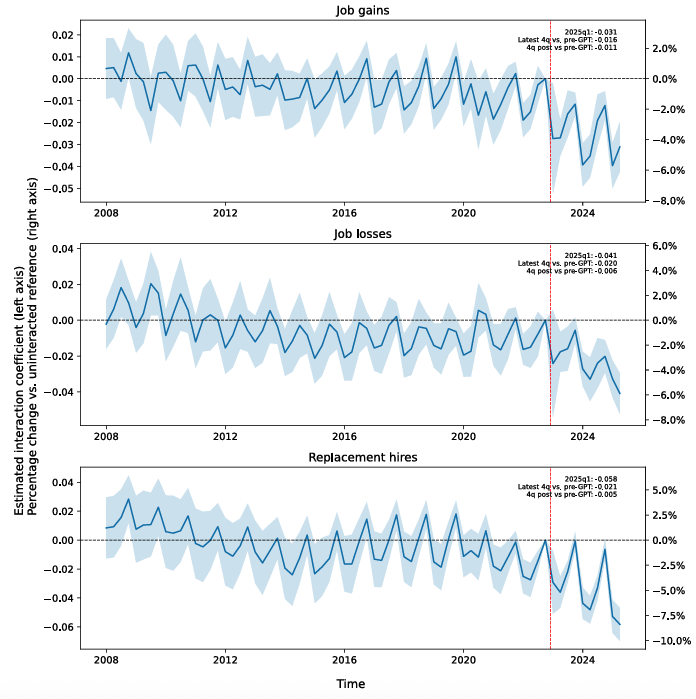
One of the unique contributions of this paper is that it separates out the hire and fire dimensions, showing that all of the decline in employment can be explained by reduced hiring.
The event studies are comparing outcomes of young workers in AI-exposed industry-state cells to young workers in other industry-state cells. A young-to-young comparison. But there could be a general decline in exposed cells not unique to young workers, which motivates a triple difference regression. This is where things get a little messier.
The triple difference measures the gap between young and old workers *within* highly exposed industries. Lee finds that employment, hires, and separations of young workers declined relative to older workers in those industries *before* the release of ChatGPT (similar in spirit to Frank et al. (2026) and Iscenko and Curto Millet (2026)).
To make sense of the triple diffs, Lee explores several explanations including remote work, delayed labor market entry (education), and the monetary policy shock. None of these look like a silver bullet, with monetary policy explaining about a 25% of the employment effects.
One of the more puzzling parts of the paper for me is the contrast between the clear pre-AI decline in young worker hires/separations and job gains/losses. Job gains (losses) are a subset of hires (separations) occurring at growing (shrinking) firms. The job losses and gains appear to turn closer to 2022q4, but they are also highly cyclical and noisy.
This paper should raise your priors that there is something happening in the labor market for highly AI-exposed young workers, but it's not clear yet whether that is due to AI. Timing matters, and sometimes it works and sometimes it doesn't. Plus, in the background of all these analyses is the pace of diffusion, which has been rising but was relatively low in 2023 (4%). Conceptually, this puts a lot of weight on a very hard turn in firms' expectations in reaction to the early, buggy ChatGPT that concentrates not on AI-exposed workers, but *young* AI-exposed workers.
PS: There is a symmetry between:
This paper <-> Johnston & Makridis (2026)
Brynjolfsson, Chandar, & Chen (2025) (Canaries) <-> Eckhardt & Goldschlag (2025)
In that Johnston & Makridis (2026) use QCEW to look at total employment effects of AI (via industry exposure) and this paper zooms in on young workers, and Eckhardt & Goldschlag (2025) looked at CPS data for all workers and Brynjolfsson et al. (2025) zoomed in on young workers.