New Anthropic research: progress on provable inference for large language models.
Here, we introduce FlashProve. Building on established cryptographic techniques, FlashProve allows developers to verify whether a given response came from a given AI model. It’s substantially more efficient than prior open-source methods for doing so.
These proofs have a range of applications. They can, for instance, make it harder for attackers to hijack a chat, or enable safety evaluators to verify that the model they’re testing is the same one being served to customers.
For our full write-up, see here: https://t.co/OIZWPb6QZa
Further progress in provable inference will likely be an important part of improving trust in AI deployment. To that end, we're open-sourcing FlashProve’s code, here: https://t.co/7ky3Ir8V06
We’re grateful to our collaborators: Alessandro Chiesa, @GiacomoFenzi, @gwberg95, @miranda__christ, Rahul Dalal (https://t.co/pjWKLHWXyz) and Ben Mayer (@transmissions11).
MiniMax M3.1 Flash: Space Performance + Bunny Speed
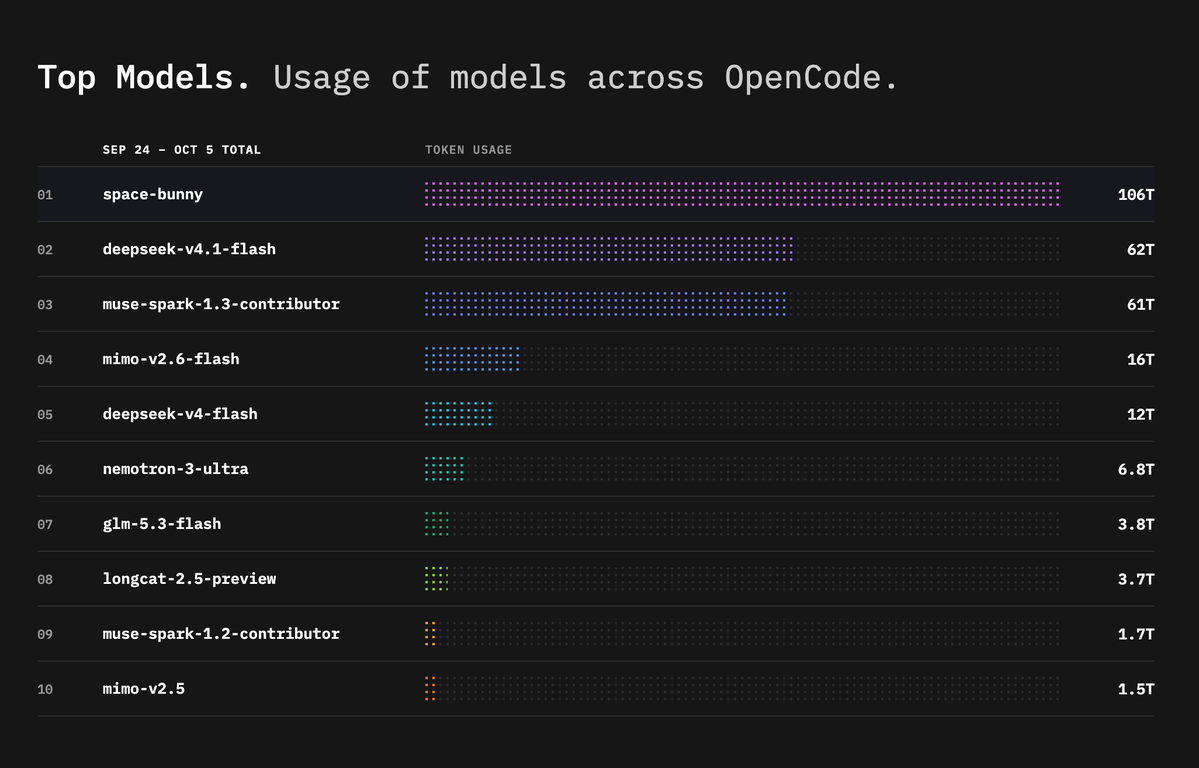
🚀🐰 Yes, Space Bunny - which has topped global leaderboards with 200T+ tokens - was an earlier version of M3.1 Flash.
💰Redefining the performance economics of agentic AI. M3.1 Flash achieves frontier-level intelligence across key tasks such as Cowork (Automation-Bench: 62%; ALE: 30%), Coding (DeepSWE: 74%) and Visual Reasoning (BabyVision: 91%), at 1/3 the cost of M3 and 3x the speed.
API pricing (flat rate): $0.15 / $0.60 per 1M input/output tokens, with cache reads at $0.015 / 1M tokens.
Model weights will arrive on Oct 23.
API: https://t.co/fHRdSV73Hr
M Plan: https://t.co/XfJWSyauda
MiniMax Code for desktop: https://t.co/SGmLTI2HQm
Open weights. Shared progress. MiniMax H3 is moving fast.
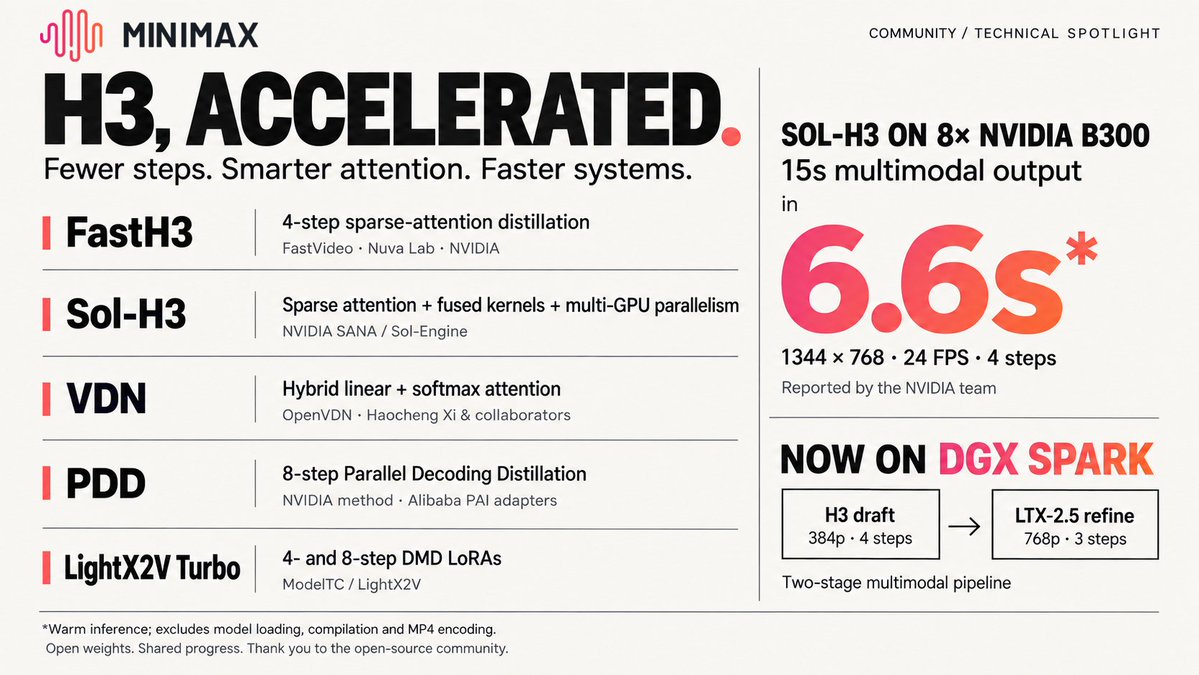
We built H3 for video generation with native stereo audio and multimodal reference control. The open-source community is making that capability faster, more accessible, and easier to build on.
Recent highlights:
• FastH3 — FastVideo, Nuva Lab and NVIDIA: 4-step distillation, now running on DGX Spark and Apple Silicon.
• Sol-H3 — NVIDIA’s SANA team: 15 seconds of 768p video + audio in 6.6 seconds on 8×B300, in the team’s warm-inference benchmark.*
• VDN — Haocheng Xi and the OpenVDN team: rethinking attention for faster H3 inference, with weights, training and inference code released.
• PDD — NVIDIA’s distillation method, brought to H3 by Alibaba PAI as 8-step Acc-LoRAs, now supported in ComfyUI.
• LightX2V — 4- and 8-step Turbo LoRAs, with workflows for text, image and reference-conditioned video + audio.
Behind every release are people training, optimizing, quantizing, testing and sharing. Special thanks to:
@haoailab@nuvalab@NVIDIAAI@xieenze_jr@HaochengXiUCB@ArashVahdat@julberner@LightX2V@ComfyUI
And to the individual contributors pushing the work forward:
@haozhangml@cxlcl1@lawrence_cjs@yitongli165665@haopengl33@songhan_mit@shanasaimoe
Thank you for building with H3 and helping make it faster, more accessible, and more useful for the community. Powerful models go further when we build together. Keep pushing H3. Excited to see what comes next. 🚀
Explore the ecosystem: https://t.co/F1S5IjUNi1
@MiniMaxAgent just shipped H3-based plugins for dynamic images and white-model rendering! Been playing around with them a bit. We're still tuning the white model quality, but this is already pretty fun to mess with~
Starting today, we’re opening the MMC TUI invite-only beta 🚀
Bring it into real repos, take on tough engineering tasks, and help us shape a coding agent built for the terminal. We’ll reset usage quotas for all beta participants later this week.
A huge thank you in advance to everyone joining us—we can’t wait to build this with you!
If u want to join our beta testing, please DM @MiniMaxAgent