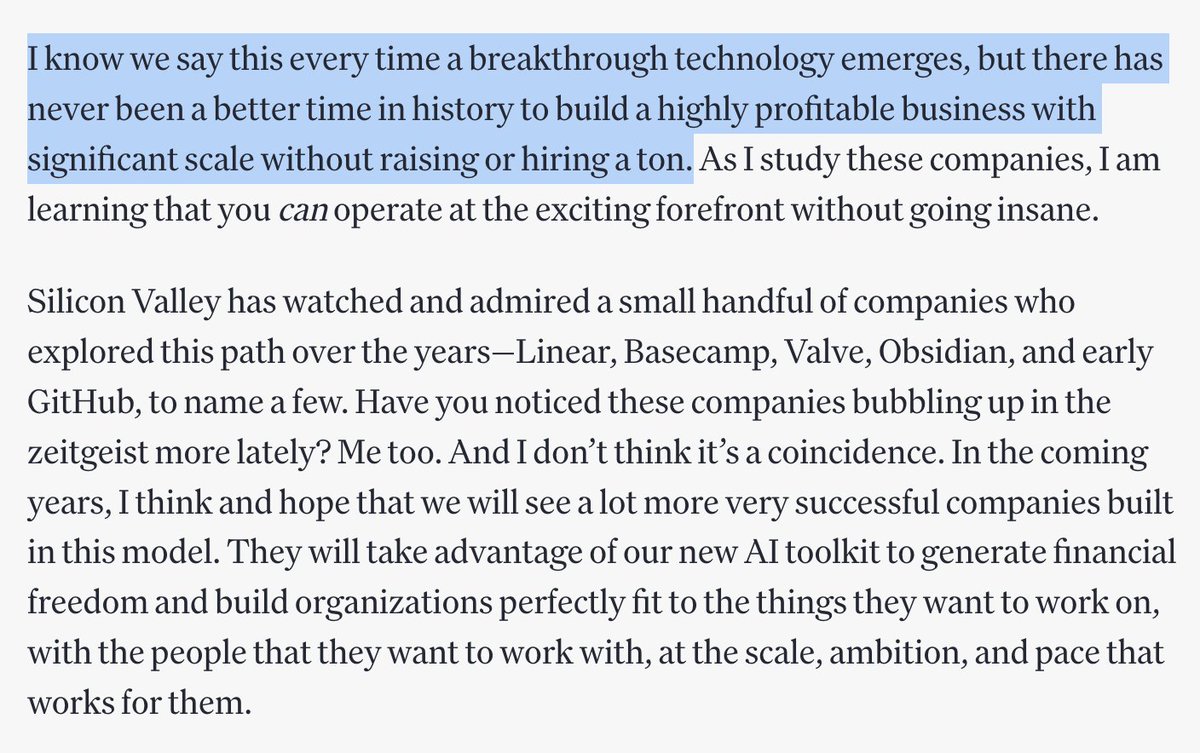
The opportunity to zig while the rest zag could be a whole follow up piece to this. Take the gains offered by “our new AI toolkit” and go find interesting problems to solve in verticals outside AI with an enhanced set of resources.
Absolutely true for financial tech but that’s one of probably countless.
Bravo @zebriez - great read.
The people of Silicon Valley are unwell.
If you work at a frontier lab or decacorn, you’ve got it bad. You haven’t seen your kids, your girlfriend’s annoyed, invites from friends to hang out are waning, even weddings are on hold. This is the time to make your mark and make your money, after all.
If you’re building a startup that’s trying to compete with or be one of these companies, you’ve got it bad. Maybe you passed up a job offer at one a couple years back, which means you left $100M on the table, you fucking idiot. Being an underdog isn't as fun as you thought.
If you’re working on a pre-AI startup, you’ve got it bad. Not too long ago you were the belle of the ball, but now your 30% year-on-year growth doesn’t feel like growth at all. It feels like death.
"Too many of my friends are spiraling," Brie Wolfson writes. "I don’t know how we’re supposed to live and work like this."
It’s all too much, too fast. Too much money, too much growth, too much power, too much change. Every month, a new frontier model is released. Every day, a new unicorn is minted. Seriously. 300 days into the year 2026, and 311 unicorns have been minted so far.
So what’s left for the sane ones? Brie went looking for teams playing a different game. She found one in Ottawa: a search infrastructure company that many of the AI darlings rely on.
It's growing fast, and its people are well.
Read @zebriez’s latest company dispatch from inside the sane asylum of turbopuffer.
https://t.co/wn0zpo9Gld
Did you know that we adjusted our Legacy Mesh Limits throughout our most popular routes?
You can send up to $17.5M USDT in one go from Ethereum to @trondao using our Legacy Mesh.
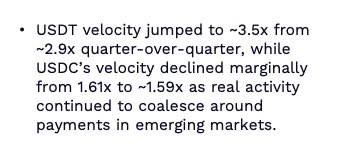
Measuring stablecoin adoption by supply is kind of like measuring a company's success by how many products they have stocked, rather than how many people are buying and using them.
Both matter, but products moving off the shelf and being put to work tell you a lot more about whether you've solved a real problem.
At @USDT0_to, we're much more interested in how often dollars move, where they're going, and whether people keep coming back.
That's how we identify demand, find inefficiencies worth solving, and decide what to build next.
Stat below from The DeFi Quarterly report by @ARKinvest.
THE BLOCK: Stablecoin supply has shrunk by $14.2 billion in the past 30 days, the largest contraction since the June 2022 bear market, according to Glassnode.
Market leaders $USDT and $USDC shed nearly $11 billion combined over the past month, The Block's data shows, leaving less dry powder for a crypto market rebound.
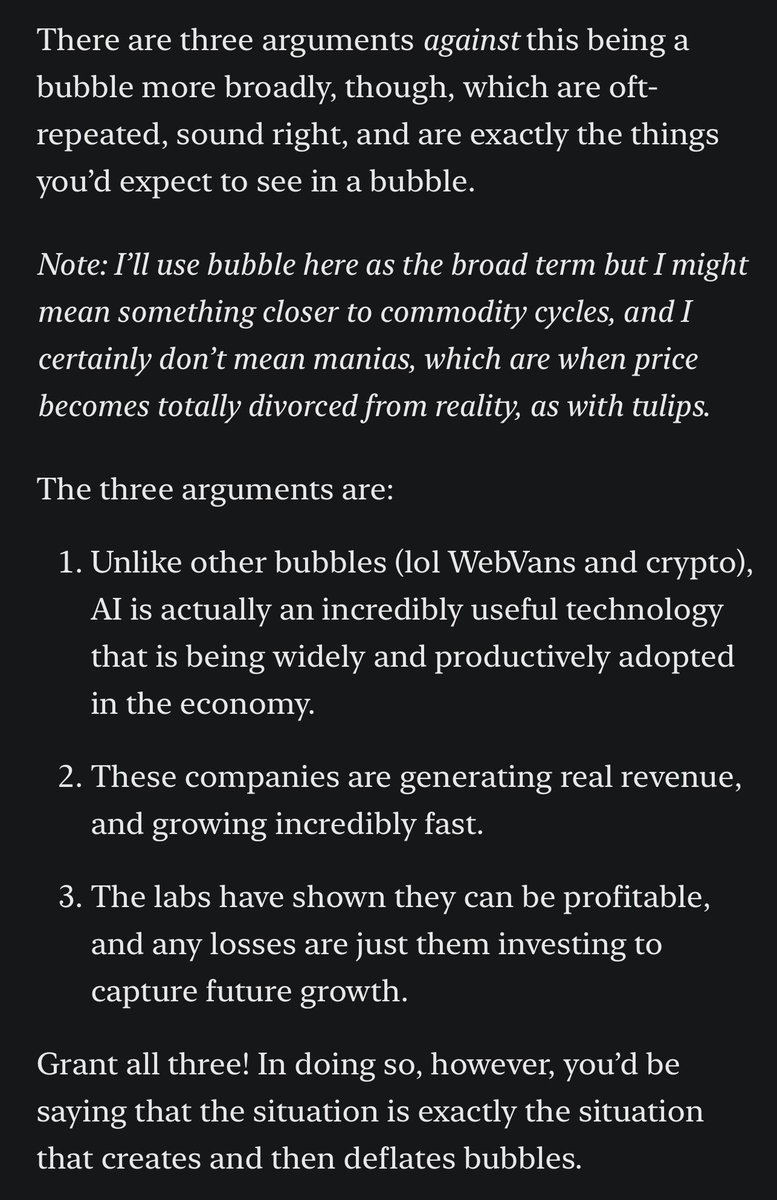
To use his words (and despite his “lol”), Crypto is actually “incredibly useful technology that is being widely and productively adopted in the economy”.
See stablecoin adoption for remittances, payments, settlement, etc. by the biggest financial institutions in the world.
The difference is that we have been able to speedrun this thesis.
Open code means anyone can fork you, so a market oversaturated with products arrives much faster.
That feature of our industry helped us quickly realize that the moat is rarely the tech itself, but liquidity and distribution.
AI is in the thick of a similar consolidation right now.
Miracle technology —> fast revenues and even profits —> competition —> oversupply —> low prices and consumer surplus —> shakeout.
Then, consolidator / low-cost producer wins as technology gets even bigger than people imagined —> age of miracles.
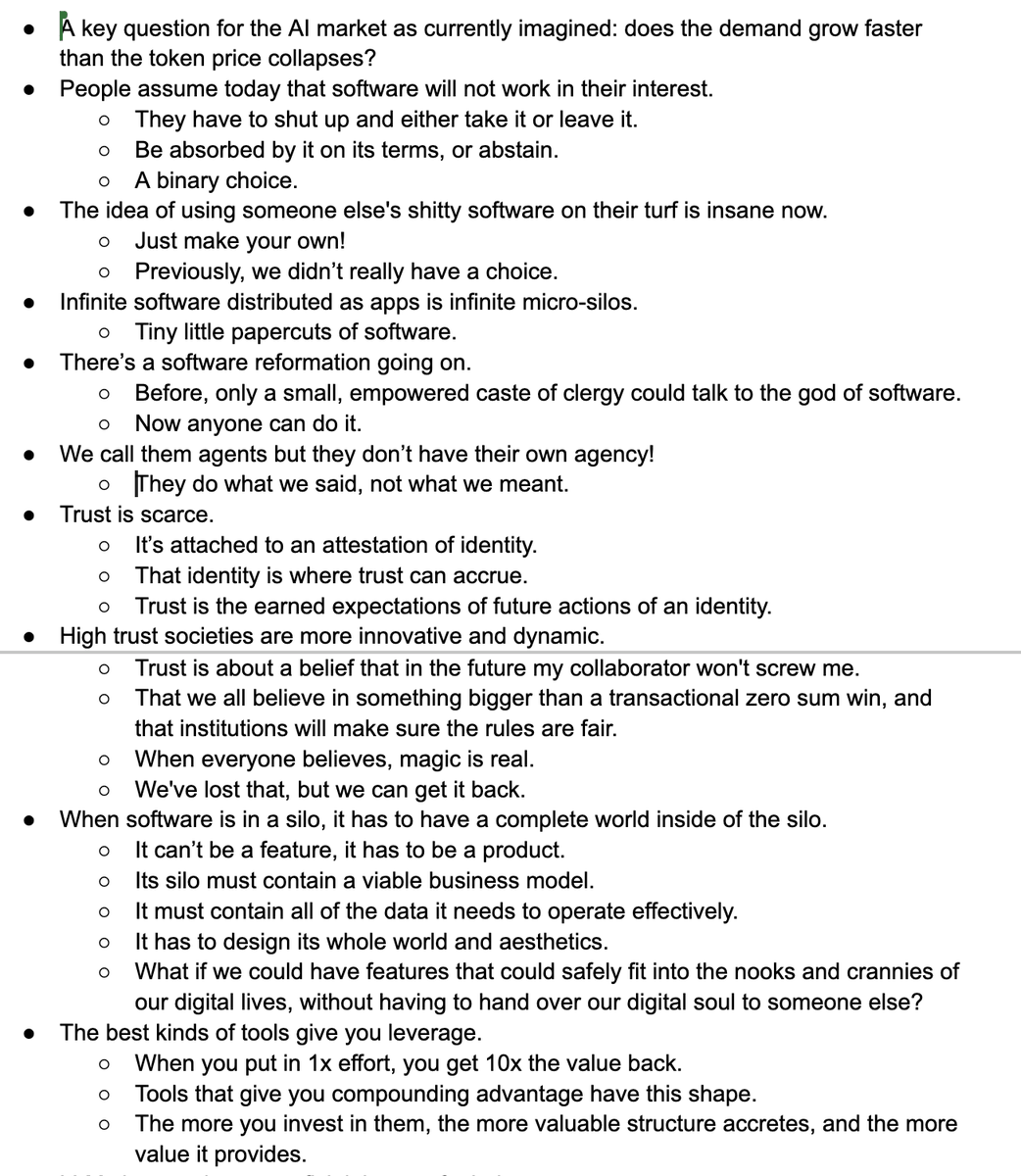
You can overlay this on the subset of software relating to money, and it all rings true. Infinite software still means infinite silos, and that’s exactly what we are seeing across the stablecoin space.
As more networks find PMF for differentiated use cases, we have this eruption of assets that folks can choose from.
Most of these networks do not have a “complete silo” (see 2nd last point), so we have to ensure that people & agents can seamlessly access and converge around assets they trust, even when the use case they need it for is net new.
I just published my weekly reflections: https://t.co/aJyKZp7PTh
Infinite papercuts. Absorb or abstain. The Software Reformation. Trust as earned expectation. AI Spandrels. Having to believe to see. Arm's length software. Social vibecoding. The edge of criticality.
Paraguay's president resigns following a crisis over a bank collapse, leaving millions of customers unable to access their money https://t.co/iqFr0NIuM8
This is a great read, but still more interesting to me and far less discussed is the teams that opt not to raise a big seed or Series A - there’s far less written about how to make that work.
My advice would be:
1. Start where demand exists then find inefficiencies projects or users will pay you to solve (ie. make it faster, safer, easier, etc)
2. Take a bet on what the world looks like in 3y and work back to a problem people are overlooking today.
3. Scale alongside what your business can support.
Having to generate revenue or attract & retain users are both amazing forcing functions to get clear very quickly on PMF and what deserves resourcing.
These constraints will help you build a business that lasts, over one that burns fast, bright, then out.
Since launch, we have seen a steady, albeit significant growth in USDT volume moving through our Legacy Mesh product.
Getting more hands on the product makes it easier to spot what inefficiencies we can solve for to keep improving the user experience.
One perk among many of growing a product with PMF.
Know before you go: liquidity edition.
Our new dashboard shows pool balances and transfer limits for USDT between @Ethereum, @trondao, @ton_blockchain, @Solana, and @Celo, refreshed every minute.
Preview, then make moves ↓
Business is coming back to basics: smaller teams, tighter focus, less complexity.
That’s been our approach from day one at @USDT0_to.
Working backwards from demand makes it easier to decide what to build and what to ignore.
Don’t lose your edge trying to do everything.
Our approach to product development has been to find existing demand then improve the user experience.
@Ethereum ↔ @trondao already had significant transfer vol, so we built this product with the goal of making the movement between the two easier.
Let demand guide the roadmap, then continue to iterate based on how people use the product
AI is exposing every point where moving money is constrained by inefficiencies imposed by tradfi.
Stablecoins solve the 24/7 problem, and @USDT0_to makes those assets work everywhere.
The next big opportunity is to connect this (better) infra to the financial systems businesses routinely use.
Machine speed money is here, now we need to connect it to the broader financial system. TLDR from my recently published piece:
- AI agents run 24/7 but banks still don't
- Stablecoins give agents machine speed money
- Fragmentation recreates issues in tradfi we set out to solve
- We need trusted assets that move everywhere 24/7
- Where humans oversight is still important
Our AI spend at Everdawn is up significantly too.
The more important number is output. That went up far more.
One engineer, or one team, per product is no longer efficient.
Internally we now push what I call a parallelization workflow instead.
Each engineer picks up several tasks across several products at once, with multiple agents running per workstation.
The bottleneck turned out to be the MacBooks themselves. We could not deploy more agents per machine. So we invested in hardware and allocated a dedicated AI budget.
The result is a lean team with the throughput of a 100+ person engineering org.
We launched Everdawn into a perfect storm. I have not had a period like this as an entrepreneur.
The alarm never rings at a convenient hour.
Really proud of our team and close partners stepping up to the challenge yet again.
We actively helped freeze funds stolen from Binance and we shut down the perpetrators who tried to route through @USDT0_to infrastructure…. we continue to remain proactive.
It’s an intricate coordination between investigations, security operators, signers and outside partners.
Thanks to everyone involved.