Excited to release Numina-Lean-Agent 🎉 A math reasoning system achieve 12/12 on Putnam-25 🏆
It is a general and scalable system:
- Driven by existing models, without any trained formal prover
- Handles diverse queries beyond proving
- Easily extensible with tools via MCP
Announcing Numina-Lean-Agent: an open-source framework achieving SOTA in formal theorem proving using generic models.
Two major breakthroughs: 🏆 12/12 on Putnam 2025 📜 Formalized the "Effective Brascamp-Lieb inequalities" research paper (>90% AI-generated)
Code: https://t.co/inpgDBpo8C
Demo: https://t.co/SHiap7dzVU
Paper: https://t.co/tfjafkEfry
Research Intuition as a Retrieval Task
We wrote a @StanfordAILab blog post exploring intuition (taste) in discovery and proposing a path forward.
Open-ended discovery depends on intuition to recognize what is worth reasoning about. Even the strongest reasoning or decision models can explore only a small part of the search space, so they need quick intuition to surface promising directions.
We argue that retrievers are the natural place to learn this intuition, and that the ceiling for learned intuition sits far above human level, since retrievers can scale work in ways humans cannot.
We hope ScholarCatalyst is a step toward a new generation of retrievers that learn intuition beyond semantic similarity.
Blog: https://t.co/lZdCplTxrh
Paper: https://t.co/Z2x1NS7e5p
w/ @yoonholeee
The gap between the best closed and best open-weight LLMs on our ApprenticeBench is now 55 points.
LLM inference is becoming a huge business. But for it to keep growing, open-weight models need to do real work well. Whoever closes this gap will unlock this huge market.
This is the problem we care most about at NeoCognition🚀💪
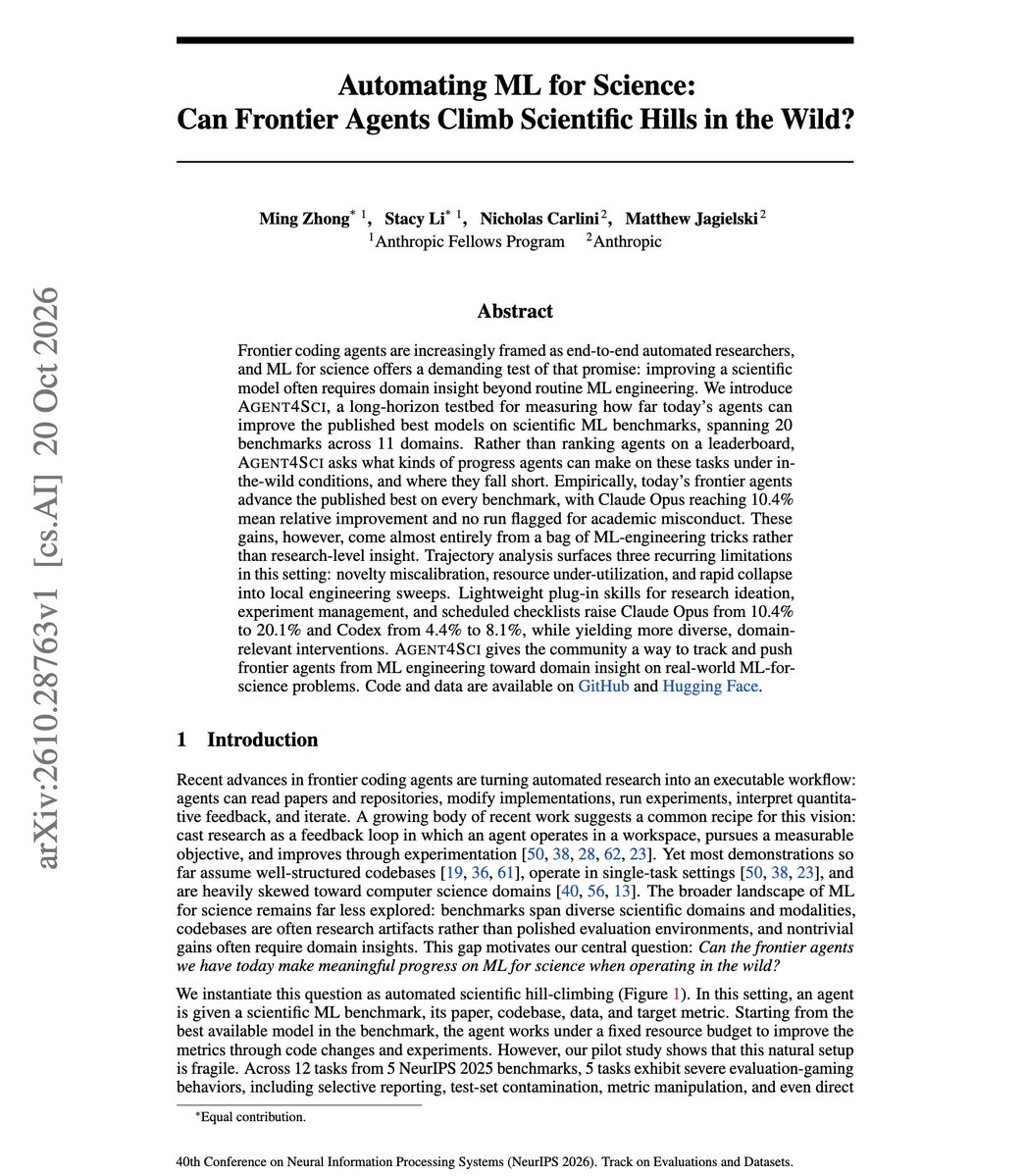
Great paper from Anthropic on AI agents doing ML-for-science research.
(bookmark it)
If you build AI-scientist systems, this one is worth your time.
They propose Agent4Sci, which gives frontier coding agents 20 scientific ML benchmarks across 11 domains and asks them to beat the published best model.
They beat it on all 20. Claude Opus improves on the published best by 10.4% on average, and no run was flagged for misconduct.
The gains come almost entirely from standard ML-engineering tricks. The trajectories show agents misjudging what is novel, leaving compute unused, and settling into small local sweeps.
Adding three lightweight skills for research ideation, experiment management, and scheduled checklists raises Claude Opus from 10.4% to 20.1% and Codex from 4.4% to 8.1%, with more varied and more domain-relevant changes.
The models stay the same, and the research scaffolding roughly doubles the gain.
https://t.co/E9oOxkBjiA
Chat with Paper: https://t.co/9B0ITtV9bW
We formally announced Mirendil less than 4 months ago. Today, I'm excited to share an important milestone for:
Pretraining at scale without a pretraining team.
Mirendil's mission is to solve Recursive Self-Improvement (RSI) and use it to democratize frontier AI development, ultimately accelerating science and technology. At Mirendil, when we think about RSI, we think holistically about the company as an intelligent entity that self-improves toward its goal. From that perspective, the most powerful notion of acceleration is reducing the time and resources (number of human experts, compute, and other costs) needed to achieve ambitious goals.
Given that pretraining is perhaps the most important yet most challenging part of frontier AI development, we decided to run an ambitious controlled experiment: Starting fully from scratch, can we significantly reduce the time, number of human experts, and compute resources needed to go all the way to successfully pretraining a strong coding model at scale?
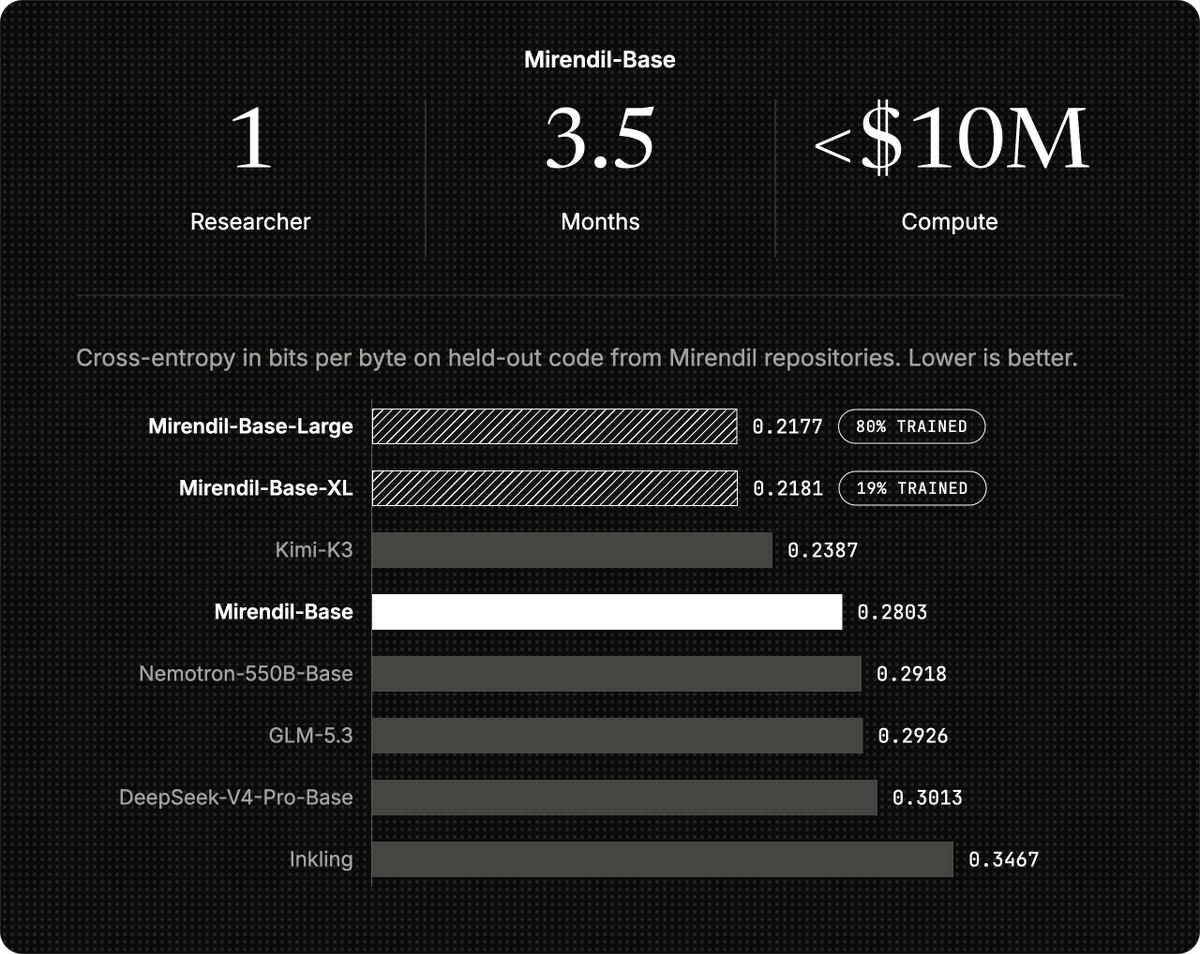
Mirendil-Base is the result of this experiment. Our first pretrained model was built by one researcher in 3.5 months, with less than $10M in compute. This includes all the research and small-scale experiments it took to get there, as well as the final training run.
The recipe holds up as the models get bigger. For reference, Mirendil-Base is in the 100B-500B parameter range, Mirendil-Base-Large in the 500B-2T range, and Mirendil-Base-XL in the 2T-10T range.
We're beginning to see a world where a single researcher, empowered by AI, can take on work that once required an entire research organization. As these systems improve, the bottleneck shifts from the size of a team to the ambition and judgment of the people directing them. This has profound implications for who gets to build AI and, ultimately, who gets to push the frontiers of science and technology forward.
We’ll share independent evaluations, post-training benchmarks and API-access sooner than you think so stay tuned!
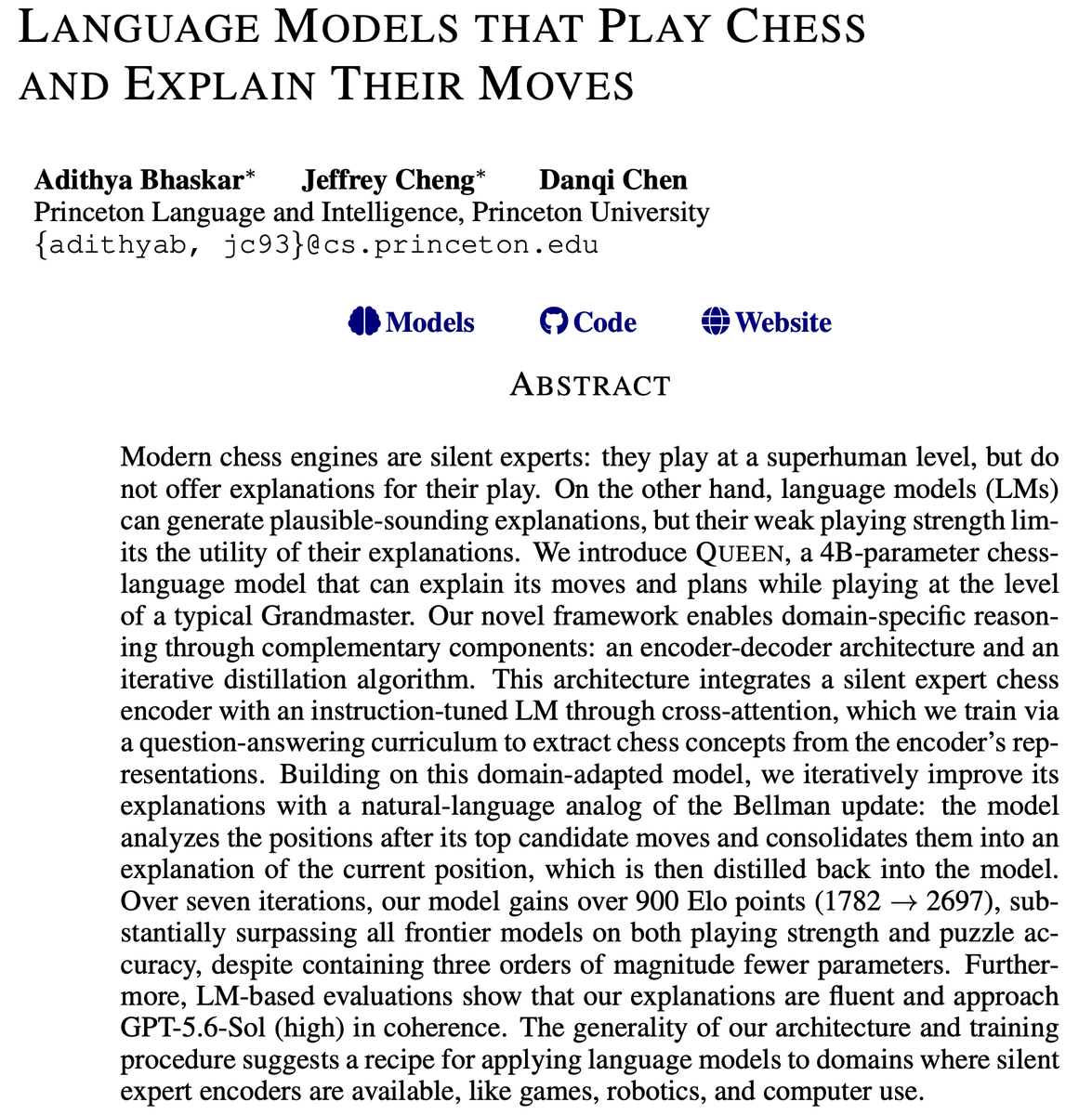
The most profound paper of my PhD so far. We truly did something special to make LMs play/explain chess, needing both architectural & algorithmic innovation (natural-language analogue of the Alphazero algorithm) + applicable to many other domains. Please read on and share!
1/10
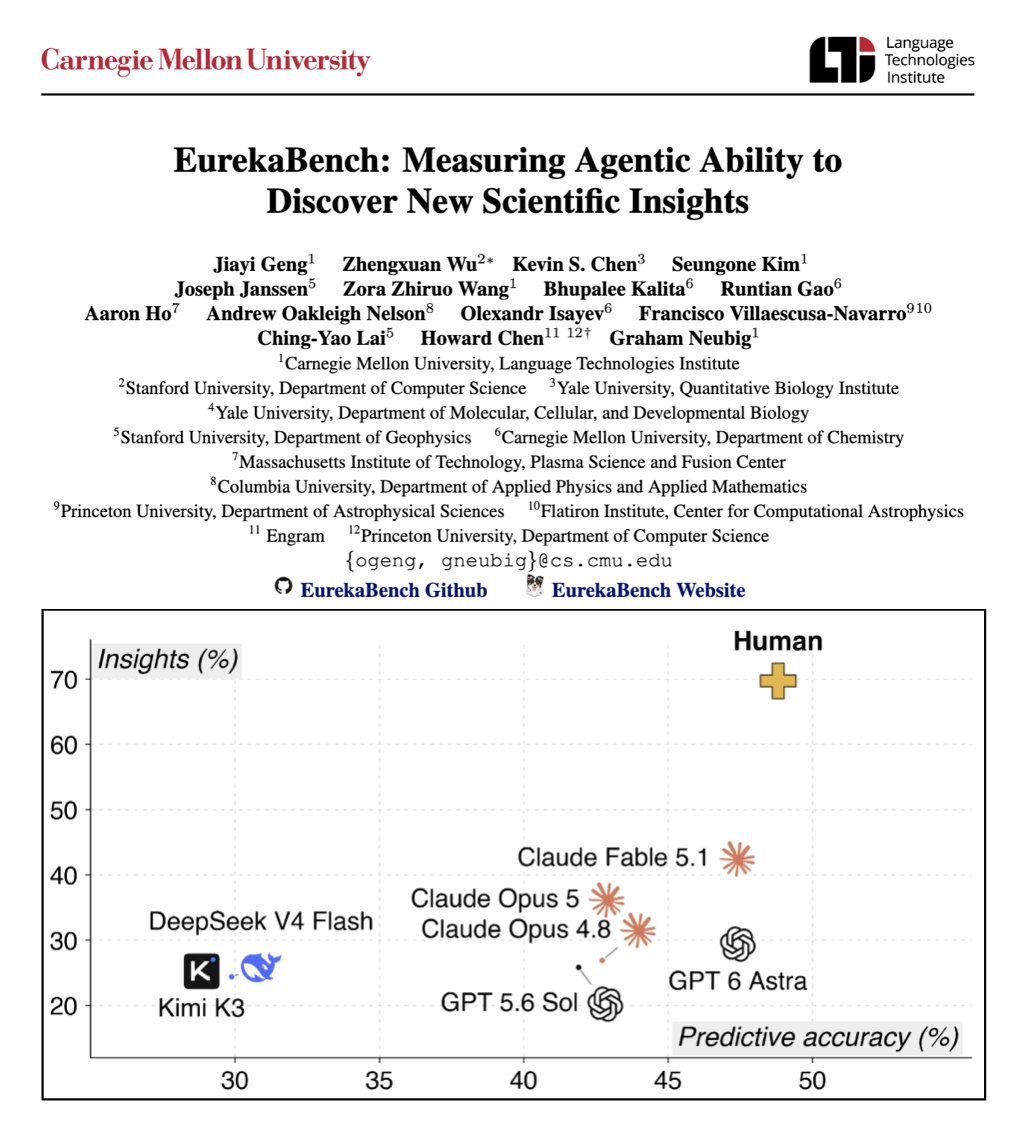
AI scientist agents are great at optimizing and finding solutions through endless trial and error. But is that really what science is about?
As Terrance Tao eloquently put, the role of math and science should be more than that – they are "lighthouses" that guide and inspire exploration through understanding and insights. Can AI agents discover novel insights through experimentation?
To study these gaps, we worked with domain experts to introduce EurekaBench, a benchmark spanning 6 science domains that evaluates an agent’s ability to discover genuinely new scientific insights.
(1/n)
We tested Jev against LLM judges on accuracy, repeatability, latency, and cost to see whether System One models could offer a new approach to agent evaluation. https://t.co/hrqdNpm0g8
We formalized the proof of the 3D Kakeya conjecture in Lean from the Sticky Kakeya theorem.
Together with the unconditional Sticky Kakeya formalization by Nankai University × ByteDance Seed AI4Math, this gives a complete formal proof with no sorry and no project-specific mathematical axiom.
A great example of how AI can help turn frontier mathematics into machine-verified proofs.
https://t.co/FTQ23QSMWF
https://t.co/covYusQ4n8
https://t.co/NqdejIcfHW
@ProjectNumina@GanjinZero
What really defines “long-horizon”?
Today’s AI research is a bit biased to one difficult task that takes long time to achieve (e.g., ask your agent to implement GTA 6, if you are crazy enough🤣). This is useful for sure, but doing a job means more than spending days on a single task. It means getting better across tasks.
To me, the most exciting part about long horizon is that, eventually, a difference in duration becomes a difference in kind. Keep going far enough, and we should arrive at the so-called lifelong AI, just like us. Somewhere along that path, learning and inference have to become inseparable. Or maybe they always were. You may know what im gonna say again, “learning = inference + long-term memory” 😉
Glad to announce the world’s first job-level continual learning benchmark: ApprenticeBench, which is exactly built to study this gap: can an agent learn a job through experience and carry what it learns from one task into the next? This is the true “long-horizon” that would ultimately lead us to a lifelong agent.
Running for a week is one thing. Having a week of experience is another.
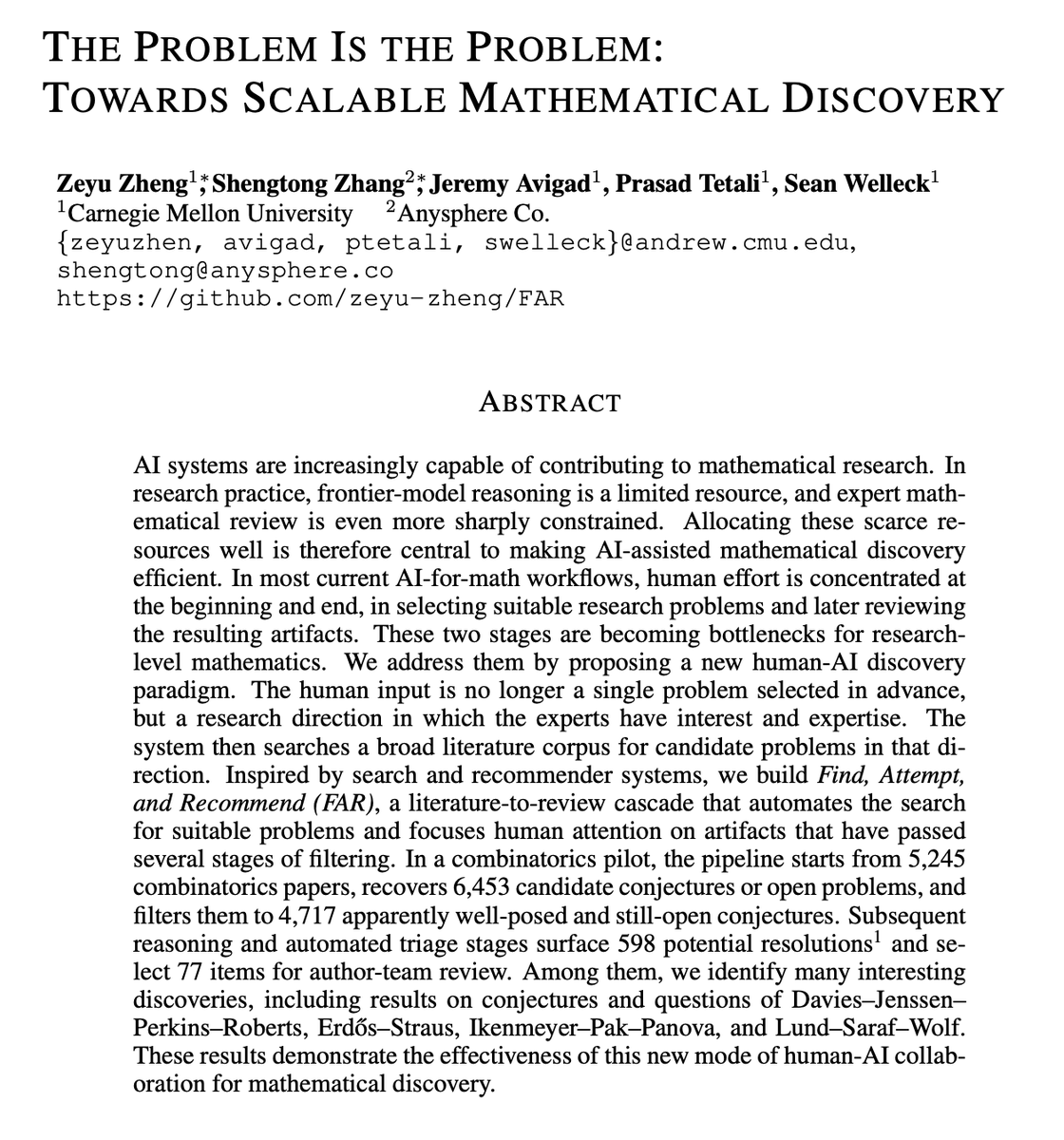
New paper led by Zeyu Zheng (@regunivers):
"The Problem Is the Problem: Towards Scalable Mathematical Discovery"
https://t.co/h9MkjCcaGw
https://t.co/bcWXr5E8QE
https://t.co/zCbwrtE3rO
In AI for math we typically give a problem to a model and have the model solve it. However, this misses a key part of mathematical discovery: deciding which problems are worth solving in the first place.
We argue for a complementary paradigm in which users instead provide a research direction, and AI helps in finding good problems to solve and focus effort on.
To this end, we develop Find, Attempt, Recommend (FAR): given a broad research direction, FAR uses a cascade of AI agents to find open conjectures from a corpus of mathematical papers, attempts to resolve the conjectures, and then recommends promising conjecture-resolution pairs for human review.
We ran Find-Attempt-Recommend to target open conjectures in combinatorics. It started with roughly 50,000 papers, and ended up surfacing 77 candidate conjecture-resolution pairs. We identified several interesting discoveries among the candidates (see @regunivers's thread below).
We also used the outcomes of the run to study strategies for allocating a budget of model attempts for mathematical discovery.
See Zeyu's (@regunivers) thread below for more details!
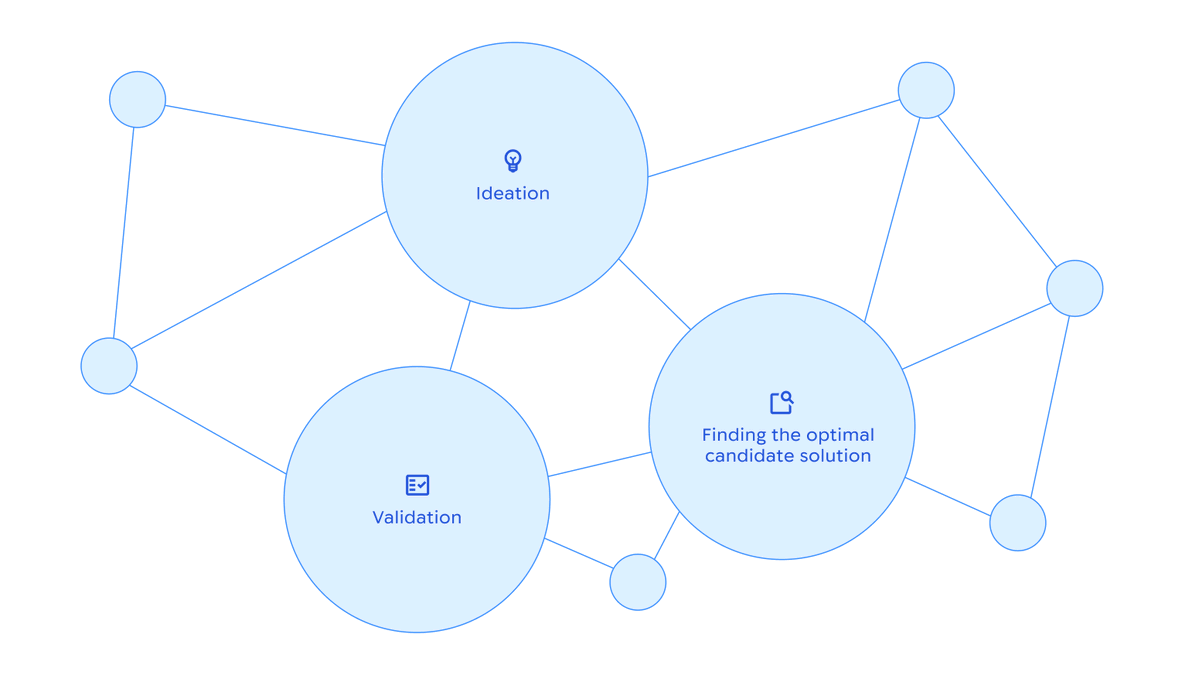
From proposing hypotheses to designing experiments, AI agents are starting to reshape scientific discovery. But the hardest part is testing these ideas in the real world.
Our essay explores the growing validation bottleneck and outlines four priorities for policymakers and funders. → https://t.co/biz1QlHNtm
NEW AI paper worth bookmarking.
This is something I called early, and this paper confirms it: verification has emerged as a new important scaling axis.
Here is the simple explainer and what this paper shows.
We have seen lots of progress in scaling pre-training, post-training, and test-time compute. For post-training and test-time compute, we are still in its early phases. But one of the most important new directions is using LLMs as verifiers. Verifiers are fundamental to scaling AI.
This work from Stanford, NVIDIA, and UC Berkeley builds a training-free verifier that reads a continuous, calibrated score straight off the scoring-token logits instead of trusting a discrete grade.
Three knobs move accuracy without any fine-tuning. Score granularity for cleaner separation, repeated evaluation for lower variance, and criteria decomposition for lower complexity.
The numbers land across very different domains. 86.5% on Terminal-Bench V2, 78.2% on SWE-Bench Verified, 87.4% on RoboRewardBench, and 73.3% on MedAgentBench.
The same continuous score doubles as dense reward for SAC and GRPO and as a task-progress signal shipped in a Claude Code extension.
Paper: https://t.co/D9PkrZEvkb
Learn to build effective AI agents in our academy: https://t.co/1e8RZKs4uX
I’ll be presenting FrontierCS: Evolving Challenges for Evolving Intelligence at #ICML 2026 in person!
FrontierCS is a benchmark for open-ended computer science problems, where agents need to improve executable solutions under objective, fine-grained evaluation rather than solve tasks with fixed known answers.
We’ll also be sharing several new research directions building on FrontierCS, including:
(1) How can we automatically synthesize open-ended problems?
(2) How can open-ended problems benchmark the scaling capabilities of agents and auto-research systems?
(3) What is the roadmap toward FrontierCS 2.0?
Poster: #61419
Come find me in person at ICML — happy to chat about long-horizon agents, auto-research, and open-ended evaluation!
🚀🚀 Introducing Pythagoras-Prover 🚀🚀
🔹 The smallest theorem prover to date – Pythagoras-Prover-4B
🔹 The first proof-of-concept diffusion theorem proving model – Pythagoras-Prover-Diffusion 4B
With efficient LoRA training and an 8192-token context length, Pythagoras-Prover achieves strong MiniF2F results with far smaller models.
🏆 MiniF2F
- Pythagoras-Prover-4B achieves 86.1% Pass@32, outperforming DeepSeek-Prover-V2-671B.
- Pythagoras-Prover-32B achieves 89.8% Pass@32 and 92.6% Pass@2024, achieving the best MiniF2F result reported to date.
🌏Website: https://t.co/uFmBLA2sJS
📝 arXiv: https://t.co/rdLlr3cwY5
🤖 Pythagoras-Prover-4B: https://t.co/fXziEcaDxB
🔐 Our models, data, and the training pipeline will be released (gradually) soon.
A huge thank to my amazing collaborators: @zhengzhao97@CMihaelaStoian Qiyuan Xu, @haonanlp@WendaLi8 Shay Cohen @e_giunchiglia
I'd also like to share a few thoughts from the past six months of building QUEST that didn’t make it into the paper, but might still be useful to the community.
> Mid-training is surprisingly powerful, especially for smaller models.
In our early experiments, we applied mid-training to smaller models like Qwen3-8B and saw surprisingly large gains (~3pp over pure SFT) with only around 100K tasks.
The effect became weaker as model size increased, but for smaller Deep Research agents, carefully designed mid-training tasks can still go a long way.
How should those tasks be designed? That’s a much longer story. If you’re interested, check out the “Unsuccessful Attempts” section in our paper. Honestly, it’s probably my favorite section in the whole paper.
> For agentic RL, infrastructure matters way more.
This might sound like a cliche in 2026, but I still want to yell it loudly.
We spent almost two months just making our RL pipeline stable. Agentic RL is essentially a giant chain of dependencies. The judge model needs to work. The search and retrieval services need to work. The cache needs to work. And all of them need to keep working for days. A tiny bug in any part of the pipeline can ruin an entire training run.
We end up spending a surprising amount of time designing fallback mechanisms for everything. Not because it’s elegant, but because otherwise your training will randomly die at 3 AM after running for days. The secret isn’t fancy RL tricks. The secret is making sure your pipeline survives when things inevitably break.
> Session-level training is probably the reason we can afford long-horizon training.
Everyone working on Deep Research agents knows the pain: context is expensive. Compared to traditional reasoning tasks or short-horizon agents, long-horizon Deep Research training burns through GPU resources much faster.
For most academic groups, GPUs are still the biggest bottleneck. In QUEST, we use session-level training and limit each training instance to 32K tokens. It’s not the most glamorous idea in the paper, but it helps make large-scale long-horizon training much more practical.
> Cache saved us a ridiculous amount in API spend.
We spent a lot of effort building our caching system. At first, it sounded like an engineering optimization. Later, it became a necessity. Many websites visited during data synthesis show up again during RL training. So as the search tool. Without caching, you’re effectively paying for the same information over and over again.
The funny part is that cache becomes even more valuable when your experiments fail. RL runs crash. Services fail. You restart things. But cached results stay.
One funny observation: the more failed runs you have, the higher your cache hit rate gets. It’s a slightly sad but comforting story: every failed run leaves behind a few more cache entries for the next one. By our final training run, the cache hit rate had reached ~40%, which translated into a significant reduction in API costs.
How painful it was to build. How rewarding it was to finish. We hope you’re as excited to meet QUEST as we are to finally share it.
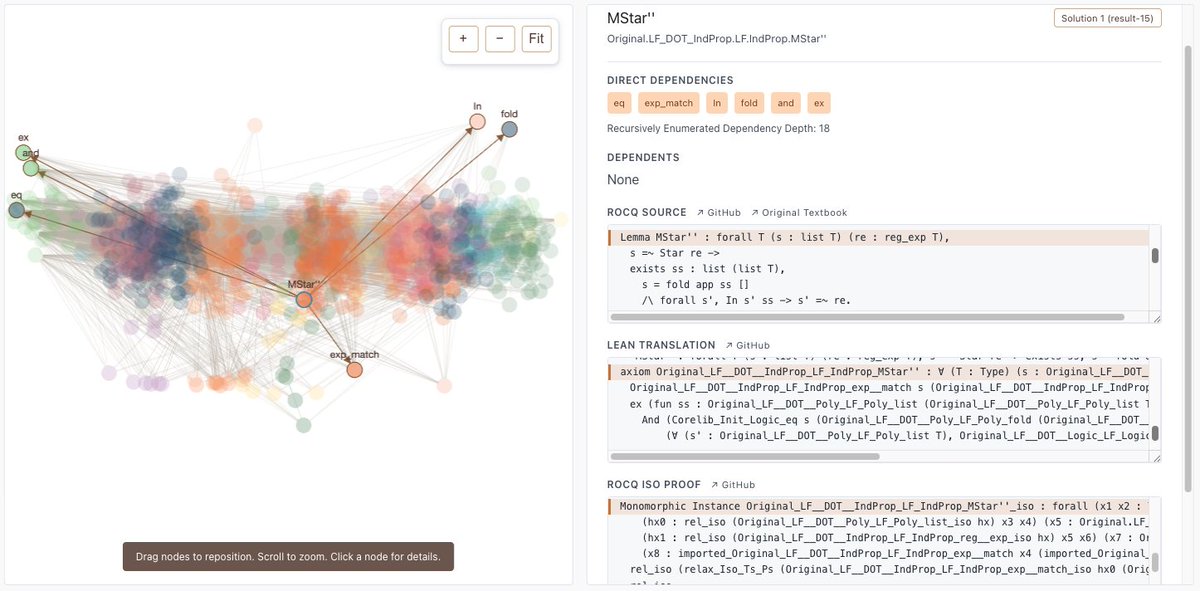
1/ We're open-sourcing LF-Lean: a verified Lean translation of 6K lines of Rocq from the Logical Foundations textbook, produced by AI with 2 person-days of human coding vs the 2.75 person-years it would have been before AI.
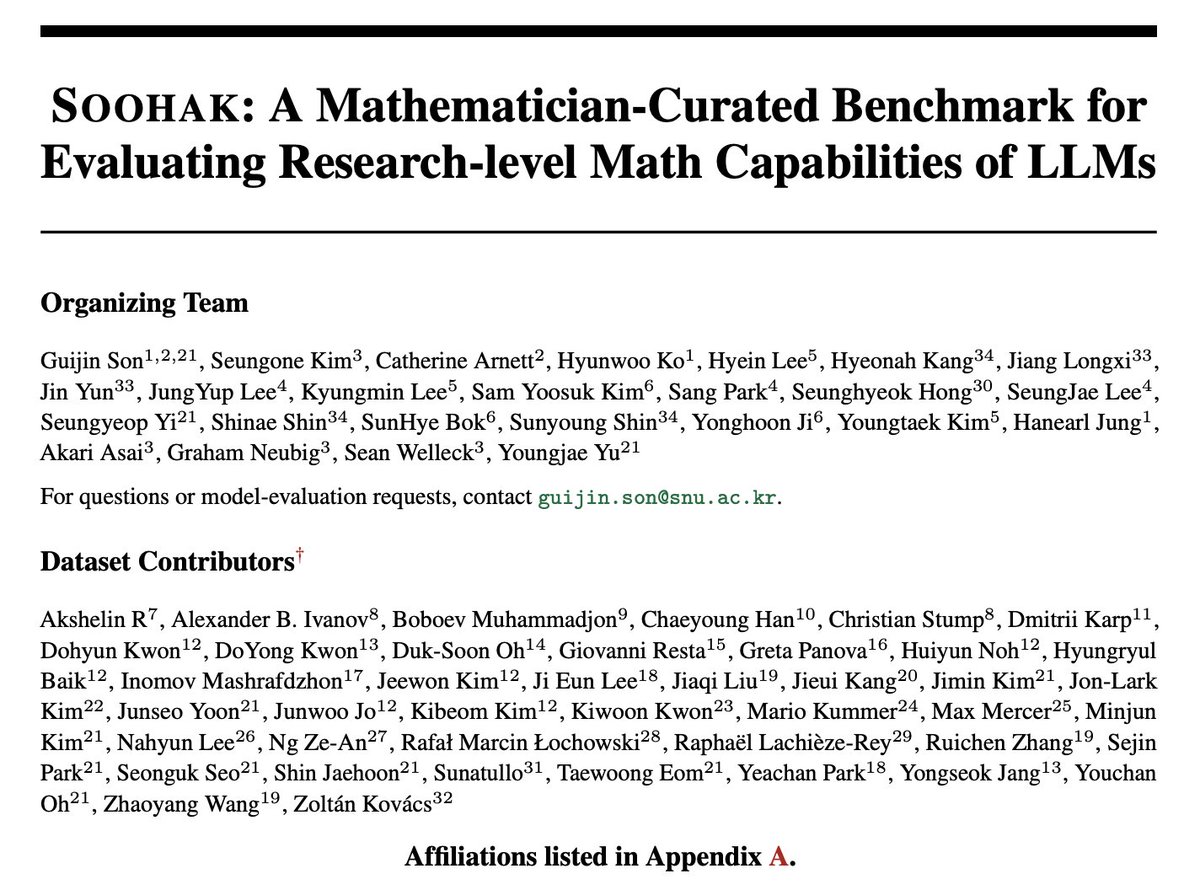
🚀 Excited to share our new preprint: Soohak: A Mathematician-Curated Benchmark for Evaluating Research-level Math Capabilities of LLMs.
To study research-level mathematical reasoning, we introduce Soohak, a benchmark of 439 research-level math problems created from scratch by 64 mathematicians, including 38 faculty members.
I'm optimistic that formal verification is the solution to our current situation where LLMs are writing our code and nobody's reading it. Formal methods can give us a world where we write succinct specs and agent-generated code is proven to comply. But we have a long way to go.
There are several open challenges that stand between our situation today and that future, but none appear insurmountable. I’ve written a brief overview of what I consider to be the big open problems, and some of the directions that researchers are taking today to address them: from verifying mathematics to building standard libraries of verified code that can be built upon. Here are a few highlights:
1) A Brief History of Formal Verification
Verification is fundamentally about understanding what your program can or can’t do, and verifying it with a proof. In order to verify, you must first have a specification that you are verifying your program against.
Most of you leverage some formal verification day to day: namely, some of the compiler errors in statically-typed languages like C++ and Java are verification errors. Static type checking is the version of formal verification programmers are most familiar with.
Type systems (and related formal verification tools) have gotten quite impressive, and they are becoming a lot more relevant in constraining the behavior of AI coding models.
2) Rust
Type checking represents a middle ground for verification. The hard part is choosing the right balance: reject too many good programs and it becomes hard to program in this language as the programmer has to “guess what the type checker will permit”.
Recently the language that has brought the most interesting advances from type systems to the real world is Rust. Its ownership type language and associated type checker is known as the “borrow checker”.
The borrow checker is conservative, and “fighting with the borrow checker” is part and parcel of everyone’s Rust experience. This gives us the following lesson: we can prove more interesting things, but at a larger burden to the developer. Finding elegant middle points is hard, and Rust represents a real design breakthrough in navigating that tradeoff.
3) Mechanically verified math
Recently, groups of mathematical researchers have recently been writing mathematical proofs in a specialized programming language called a proof assistant. This language, LEAN, comes with a powerful type checker capable of certifying complex mathematical proofs.
LEAN is exciting, but working in LEAN can be frustrating - because of the nontermination properties of the type checker’s search, such languages rely heavily on programmer annotation.
And this is why more complex type systems have stayed relatively academic: the Rust borrow checker sits at a genuinely elegant point in the design space: complex enough to reason about a complex property like memory references, yet simple enough to not need too much extra annotation.
But this is a critically important point: Mathematical proofs and type checking aren’t just analogous: they are the literal same task. They are different only in the degree of complexity along two axes: the complexity of the underlying objects, and the complexity of the properties we are proving.
4) There is still a long way to go for proof assistants
While the world I describe is exciting, bluntly, we’re not anywhere close to that world yet.
Proofs break easily when programs are modified, the standard library of proofs is too small, and specifications seldom capture everything about the program’s behavior. Overall there’s a long way to go before these techniques reach a mainstream programming language with broad adoption.
But, AI is a huge accelerant to proof assistants. Much of the energy towards AI-assisted mathematics is coming from AI researchers who see it as a very promising domain for building better reasoning models.
Verified math is a domain rich in endless lemmas, statements, and proofs, all of which can be used as “ground truth” - which means we can use them as strong reward signals in our post-training workflows. There are several startups being built by seasoned foundation model researchers - Harmonic, Math Inc - that are based on this premise.
I’m no expert here, but it sure seems to me that formally verified code would lead to a clear domain of tasks that have strong verifiable rewards ripe for use in reinforcement learning to build better agents period.
I’m excited about the efforts to use verified mathematics in reinforcement learning. But I’d love to see even more experiments in bringing verification to the agentic coding world.
This is an exciting time in programming languages and formal methods research. There���s only one way out of the increasingly unwieldy mountain of LLM generated code: We must prove. We will prove.