User funds are safe!
It does look like a hack on Binance. Appreciate the quick freeze from Tether (~$971m) and Circle (~$823m).
I don't manage Binance (.com) anymore, but as a shareholder, I expect all user funds will be fully covered.
.@naval on why you need to play in decades:
"Looking back on my career, the people who I identified as brilliant and hardworking two decades ago are all successful now, almost without exception. On a long enough timescale, you will get paid."
Everyone knows the trillion-dollar version of SpaceX. Almost nobody remembers that Elon's first rocket failed three times, and there was money for exactly only one more attempt.
DO NOT be afraid to fail.
“A friend is someone that supports you in difficult times.”
“If someone’s still supporting you when the chips are down—that’s a friend.”
“Fairweather friends are useless.”
“Everyone likes you when the chips are up, but who likes you when the chips are down?”
@elonmusk with @nikhilkamathcio
Every VC had a reason Vercel shouldn't exist.
Guillermo Rauch heard a different reason from every investor he spoke to when building Vercel, and he kept going anyway.
He joined us live at Mercury HQ in SF for Founders in Arms, and this was one of the sharpest moments in the conversation: the idea that consensus is a signal to walk away, not lean in.
Full conversation with Guillermo Rauch (CEO, Vercel) on the latest Founders in Arms episode. Link in bio.
We've raised $65 billion in Series H funding at a $965 billion post-money valuation, led by @AltimeterCap, Dragoneer, @Greenoaks, and @sequoia.
This investment will help us advance our research and expand our capacity to meet growing demand for Claude.
“ok this startup is cool but …”
1980:
… what if IBM builds this?
1995
… what if Microsoft builds this?
2010
… what if Google builds this?
Today
… what if <huge AI lab> builds this?
reality is, if founders listened to the “what if” pessimists we’d never have any startups or new products. That’s why they’re building and the pundits aren’t
My observation: When these huge waves happen, these new markets are so damn big there will be tens of thousands of new viable companies, hundreds of unicorns, and a few iconic companies that become generational. The big cos play a role but can never compete with the glorious open market known as capitalism
So for all the “what if” people - sit down, log off X for a bit, and let the founders do their thing. And let’s cheer them on when they do
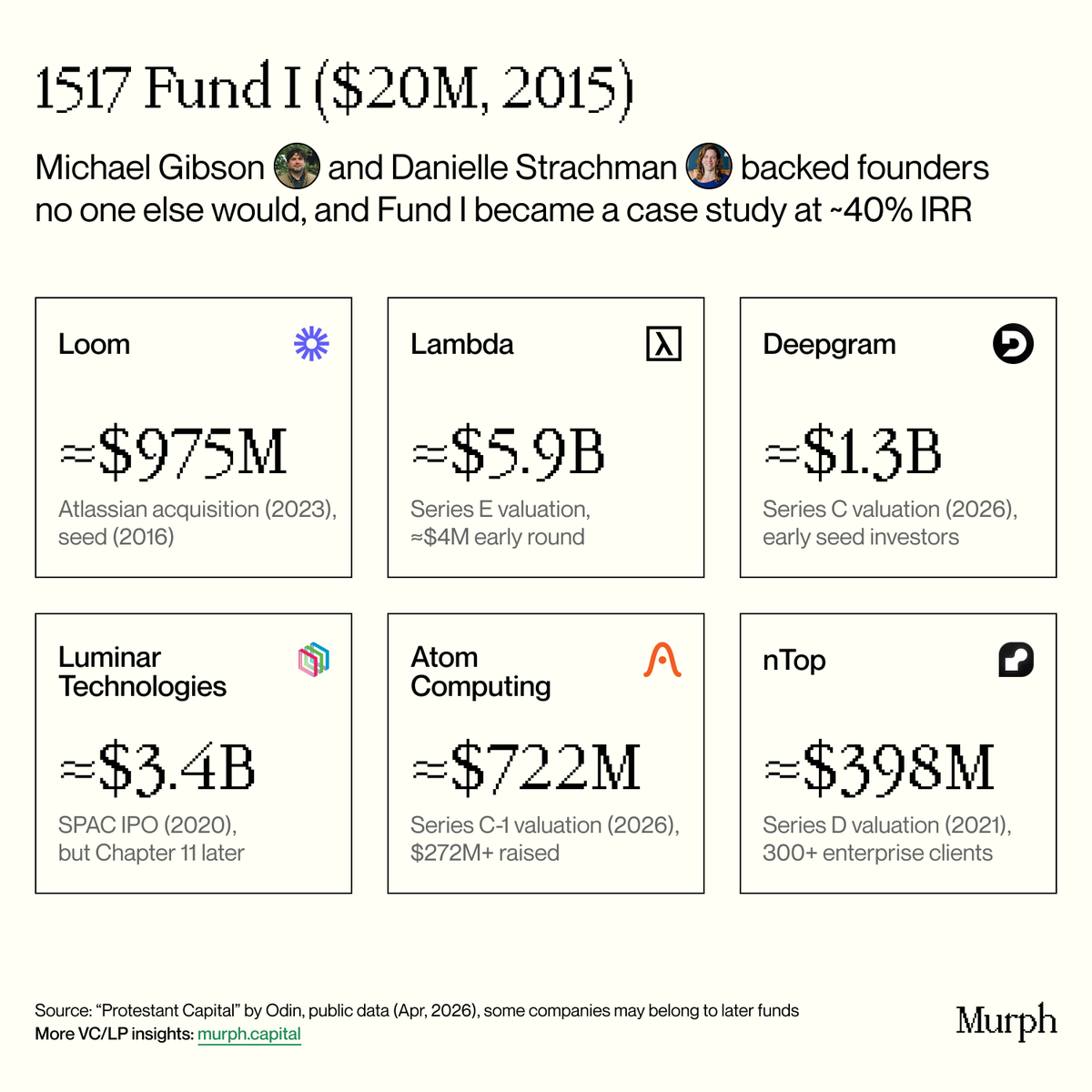
Look at @1517fund Fund I ($20M, 2015).
@William_Blake and @DStrachman left the Thiel Fellowship to back founders no one else would write a check to – too young, no degree, no pedigree.
As of January 2026: 9.65x TVPI, 4.41x DPI.
A few outcomes 👇
@loom (Seed, 2016 → ~$975M @Atlassian acquisition)
@LambdaAPI (~$4M early round → $5.9B Series E)
@DeepgramAI (Early seed → $130M raise at $1.3B, 2026)
@luminartech ($3.4B SPAC IPO, 2020 → Chapter 11, 2025)
@Atom_Computing (~$722M Series C-1 valuation, $272M+ raised)
@nTopology (~$398M Series D valuation, $135M+ raised, 300+ enterprise customers)
Net IRR: 38.86%, above Cambridge Associates' top-5% threshold for 2015-vintage funds (34.99%).
@1517fund is a reminder that early-stage outperformance often comes from underwriting founder intensity before the resume looks investable.
You have no experience.
You’ve never started a company.
You’ve never had a full time job.
Nike is going to kill you.
You’re a kid.
You don’t have technical skills.
You shouldn’t build hardware.
Apple is going to kill you.
You can’t build hardware.
You can’t measure heart rate non-invasively.
Athletes don’t care about recovery.
Under Armour is going to kill you.
It won’t be accurate.
You don’t listen.
You’re an ineffective leader.
You can’t recruit great talent.
You’re going to have to pay every athlete.
You can’t measure sleep non-invasively.
It’s too expensive to research.
Athletes are a small market.
The product costs too much to make.
The product costs too much to sell.
Your valuation is too high.
Consumers aren’t going to want it.
Hardware is too hard.
You should measure steps.
Fitbit is going to kill you.
You can’t build a marketing engine.
You can’t raise enough money.
You need a real CEO.
Google is going to kill you.
You can’t be a subscription.
You can’t build a brand.
You can’t do consumer in Boston.
Your valuation is too high.
You shouldn’t make accessories.
You shouldn’t make apparel.
Lululemon is going to kill you.
You can’t predict Covid.
Stay in your niche.
You are going to run out of money.
You can’t build a health platform.
Amazon is going to kill you.
You can’t measure blood pressure.
You can’t get medical approvals.
The market is too small.
You don’t understand AI.
The market is too competitive.
It won’t work internationally.
The supply chain is too complicated.
You can’t build an AI.
You can’t raise enough money.
It’s too competitive.
Healthcare isn’t going to want it.
…
Just keep going ✌️
A CEO from one of our portfolio companies shared this with their team. I’m re-sharing it with their permission, because it resonated and reflects what all founders and CEOs should be communicating.
--
We are living through a period of compounding change. And in moments like this, the biggest risk is no longer making the wrong decision. It is moving too slowly while the world moves around you.
There are two paths. We can play defense:
- Protect what we have
- Optimize what works
- Wait for clarity
It feels safe. It isn’t.
Or we can play offense:
- Learn faster than the environment changes
- Use new tools to solve old problems in better ways
- And create entirely new strategies and businesses
That’s where the opportunity is.
Challenge yourself to do things faster and better than you have ever attempted. Stay uncomfortable. Stay on the front foot.
TODAY 🚨: The Commission issued an interpretation that clarifies the application of federal securities laws to crypto assets.
This is a major step to provide greater clarity regarding the Commission’s treatment of crypto assets.
Read the release here: https://t.co/DDykVLHZQI
Raising money is a core part of your GTM strategy because it buys the ability to move faster than your competition
- discount the product to win competitive deals & steal market share
- pay resellers a higher commission
- comp sales aggressively to build a talent density