A dead MIT professor accidentally destroyed the $20 billion executive coaching industry with one hour of lecture, and ten million people have already watched him do it.
He filmed it once in January 2018 and died eighteen months later.
Executive coaches charge fifteen thousand dollars a session to teach a third of what he covered in that one hour for free.
His name was Patrick Winston. He ran the MIT Artificial Intelligence Laboratory from 1972 to 1997 and wrote the AI textbook every computer science major in the world read for thirty years.
Every January for four decades, he gave a lecture called "How to Speak."
His entire framework fits on a napkin.
Do not read. Be in the image. Keep images simple. Eliminate clutter. Start with an empathetic connection. End with a punch line the audience can repeat over dinner. Never open with a joke. Never end with "thank you."
That last rule alone has probably cost the executive coaching industry a hundred million dollars.
"Your success in life will be determined largely by your ability to speak, your ability to write, and the quality of your ideas. In that order."
That is the actual opening line of the lecture. Winston believed it strongly enough to spend fifty years teaching computer scientists how to talk.
Founders spend $80,000 on an MBA and then hire a communications coach to teach them the same material Winston filmed once for free. Engineers write brilliant code and lose promotions to teammates who watched this lecture on the train.
The lecture is free on MIT OpenCourseWare. The textbook is free on his page.
Winston died in 2019. Almost none of the ten million viewers have actually implemented the four rules on the napkin.
The napkin is free. The willingness to actually use it in your next meeting is the entire edge.
NVIDIA CEO, Jensen Huang:
"Nobody writes prompts anymore. The new job is building Loops and Graphs."
In 50 minutes he explains why the engineers who stopped prompting are already years ahead, and what they're building instead.
The missing piece most people skip: loops handle the work, graphs handle the loops.
Watch it, then read the full guide on loops and graphs below.
Powerful AI will change our institutions. Yet most of our attention is on aligning or regulating AI, while treating our institutions as fixed.
Introducing Pax Machina: a new publication about the institutions we need for powerful AI.
It is edited by @MaxKronerDale, @sebkrier, @NoemiDreksler, @LiamPatell, @chelcott9, @synchroaphasia, @ryan_t_lowe, @edelwax, and @klingefjord.
The editorial board consists of Peter Railton, @sethlazar, @saffronhuang, @AmmannNora, @xuanalogue, @IasonGabriel, @hamandcheese, and @deanwball.
Our goal is to seed rigorous debate about what a world of humans and powerful AI could and should look like.
We will publish proposals for new institutions, counterproposals, well-justified design principles, and analyses that change how a class of institutions should be designed.
I downloaded and reviewed NYC's grocery store RFP... as someone who has built biz's and bought a lot of food... wow.
Forget for a moment whether or not the govt should own a grocery store. Let's review the doc instead.
Here you go... /1
I was 27kg overweight, had a visible belly and double chin, and I needed to reach 13% body fat before summer ended.
I achieved it with these 26 rules:
1. STOP RUNNING (for your knees).
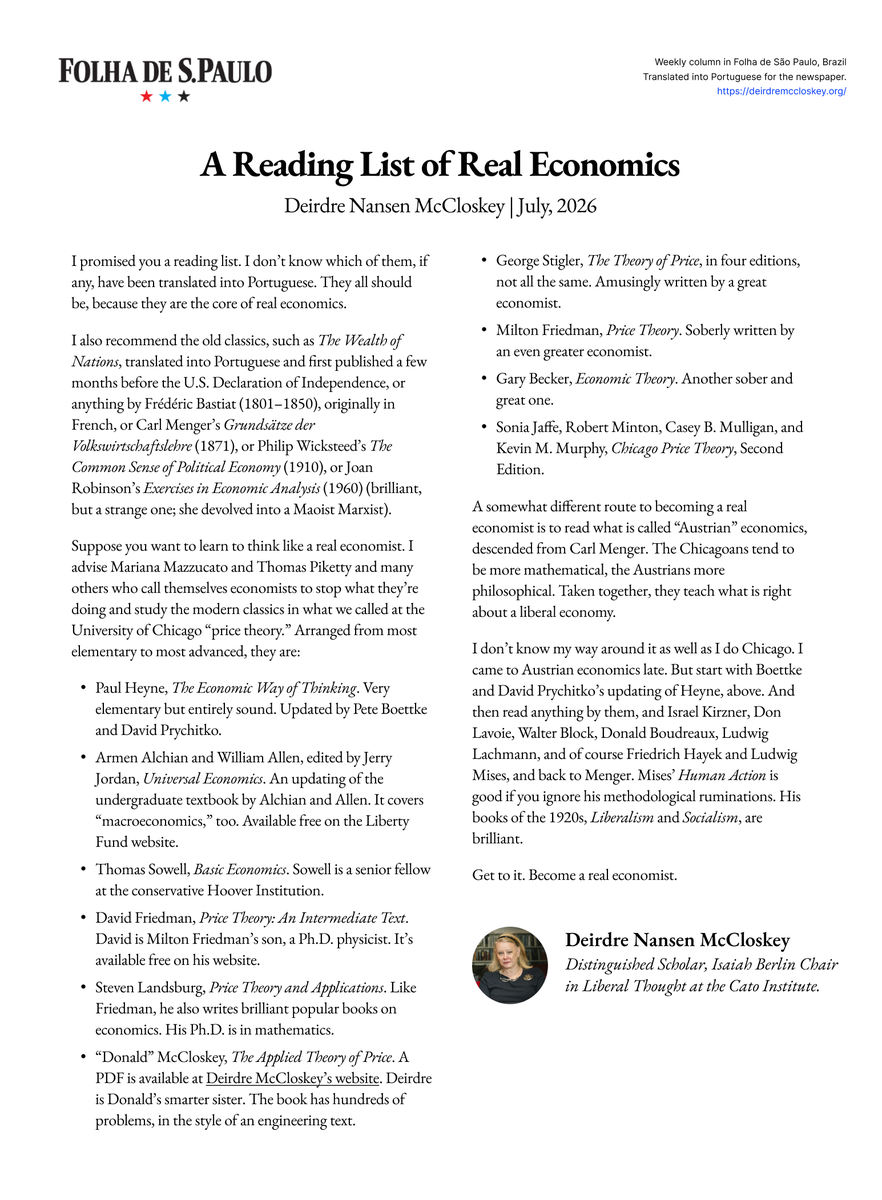
I promised you a reading list.
I recommend the old classics, such as The Wealth of Nations, first published a few months before the U.S. Declaration of Independence, or anything by Frédéric Bastiat (1801–1850), originally in French, or Carl Menger’s Grundsätze der Volkswirtschaftslehre (1871), or Philip Wicksteed’s The Common Sense of Political Economy (1910), or Joan Robinson’s Exercises in Economic Analysis (1960) (brilliant, but a strange one; she devolved into a Maoist Marxist).
Also, study the modern classics in what we called at the University of Chicago “price theory.” Below, I list them from most elementary to most advanced.
A somewhat different route to becoming a real economist is to read what is called “Austrian” economics, descended from Carl Menger.
The Chicagoans tend to be more mathematical, the Austrians more philosophical.
Taken together, they teach what is right about a liberal economy.
My latest column for @folha
I promised you a reading list.
I recommend the old classics, such as The Wealth of Nations, first published a few months before the U.S. Declaration of Independence, or anything by Frédéric Bastiat (1801–1850), originally in French, or Carl Menger’s Grundsätze der Volkswirtschaftslehre (1871), or Philip Wicksteed’s The Common Sense of Political Economy (1910), or Joan Robinson’s Exercises in Economic Analysis (1960) (brilliant, but a strange one; she devolved into a Maoist Marxist).
Also, study the modern classics in what we called at the University of Chicago “price theory.” Below, I list them from most elementary to most advanced.
A somewhat different route to becoming a real economist is to read what is called “Austrian” economics, descended from Carl Menger.
The Chicagoans tend to be more mathematical, the Austrians more philosophical.
Taken together, they teach what is right about a liberal economy.
My latest column for @folha
There's a lot of reasons to think the 2027 Sixers with LeBron could be most inefficient stacking of offensive talent in NBA history.
It's not just that the usage of the Rittenhouse 5 adds up to 140%. This alone is devastating. You are likely to get an offensive result that is worse than the sum of the parts.
If you look at the worst performing offensive lineups relative to their talent over the last 5 years, the top of the list is littered with such constructions. Several ishbiations of the Durant Suns teams.
Luka/Reaves/Bron lineups. With Ayton. This isn't 2K. You can't just stack high usage players and think you aren't eating diminishing returns. Most players need the ball and shots to exert impact.
It's also combining three heavy transition players and several questionable offball shooters together.
Embiid alone is tough to fit another star around. So is Jaylen. Maxey generates a lot of value from reducing team turnovers, which he'll have less opportunity to provide with the ball less. Maxey has some history of scaling down pretty efficiently with his shooting, which is nice.
If you asked me, where is Jaylen Brown most likely to be less impactful than his salary?
It's exactly on this kind of roster.
Last year, the Celtics roster was a great situation for him as he was surrounded by low-mid usage excellent role players. A substantial part of his value is in soaking up usage, which is what this team doesn't really need. Jaylen Brown has zero 60% TS seasons in his career. We need to see it this year.
The successful version of this year is one where JB cares more about defense than scoring 25 a game. He needs to exert his energy in other phases of the game. Specifically, we need to see improvements in defensive playmaking. A 1.5% steal rate, and nearly zero charges is not going to get it done, and this team could benefit tremendously on offense off those steals with transition talent. This Sixers defense with a 6'6 240 super-athlete playing aggressively and forcing turnovers feels much different than just a guy who can guard his man 1 on 1.
I expect the Sixers best lineups will include Dean Wade. An unheralded 9% usage, rapm maxxing defensive forward is exactly the type of piece that can be completely additive to an overloaded '04 Olympics lineup construction.
And then we get to LeBron.. can he be the brain of this team and get the most out of this group offensively? How cooked is he defensively at this age? Can he turn it on in the playoffs like he did last year?
It's gonna be absolute cinema.
I am pleased to announce that a memorandum of understanding has been signed between the Republic of Kazakhstan and Network School.
Our new campus will become a haven for global techno-optimism, with expedited visas, streamlined redomiciliation, and active recruitment of talent.
Is the United States Preparing for a Ground Invasion of #Iran?
🔹The escalating pattern of U.S. strikes against southern Iran in recent days – particularly over the past several hours – may point to a gradual strategy aimed at preparing the ground for a potential deployment of ground forces. Such an operation, if it were to materialize, could be intended to seize control of Iran’s southern coastal belt in order to remove Iranian control over the Strait of Hormuz.
🔹Reports indicate that recent U.S. strikes have targeted several bridges and railway links in southern Iran. At the same time, there have been reports of attacks on airports. These actions may have been intended to disrupt the logistics and mobility of Iranian military forces in the south. Additional reports also suggest strikes against fuel tankers in Bandar Abbas.
🔹Meanwhile, attacks in Sistan and Baluchestan in southeastern Iran targeted the Iranian Army’s 88th Armored Division, alongside similar strikes against positions of the 92nd Armored Division in Khuzestan in the southwest. Some analysts interpret these operations as an effort to degrade Iran’s military capabilities along its principal southern axes, aimed at reducing the risks associated with any future ground deployment.
🔹At the same time, in what appears to be a recurring pattern, U.S. strikes have continued to target Iranian military, missile, drone, and radar installations, as well as IRGC Navy facilities along Iran’s southern coastline on the Persian Gulf.
🔹Taken together, these developments increasingly suggest a gradual but persistent U.S. movement toward a possible ground operation in southern Iran. In other words, the campaign may extend beyond simply degrading Iran’s ability to threaten shipping in the Strait of Hormuz. It could instead indicate that Washington views control of Iran’s southern coastal strip as the only definitive solution to the Strait of Hormuz challenge.
🔹If such an approach exists, it would go well beyond earlier ideas centered on seizing Kharg Island to cut off Iran’s oil exports or occupying islands overlooking the Strait to secure maritime traffic. However, given the length of Iran’s southern coastline – roughly 1,800 kilometers – and the country’s considerable strategic depth, establishing comprehensive control would likely require hundreds of thousands of troops. Moreover, even capturing these areas would not necessarily translate into the ability to sustain long-term control.
🔹In any event, current indicators suggest that we may be approaching the most significant escalation in the U.S.-Iran confrontation since February, driven by Washington’s failure to achieve its strategic objectives. On the other hand, as noted previously, Iran’s actions thus far have also failed to present a meaningful obstacle to this gradual trajectory. One alternative for Tehran could be to shift toward targeting regional economic infrastructure – a move that would significantly broaden the scope of the conflict and lead to a region-wide catastrophe.
España acelera y aporta ya el 65% de lo que aumenta la población en Europa.
España representa el 10,9% de la población de la UE y explica el 65,4% de su crecimiento. Sin nosotros, Europa habría sumado apenas 244.000 personas en 2025, con once países perdiendo habitantes y 21 de 27 con más defunciones que nacimientos.
El dato dice tanto de la vitalidad demográfica española como de la vía por la que llega: 461.800 residentes más en un año, casi todos por migración, mientras la población nacida en España cae cada trimestre.
La cuestión relevante ya no es cuánta gente entra, sino si la productividad, la vivienda y los servicios públicos crecen al ritmo al que crece la población.
Por @mientrastanto.
https://t.co/saywEeKDNR
This reminds me of a comment by a DC insider who said one of the weirdest things about working with Silicon Valley was that if you mentioned regulating something in the normal way that milk or eggs were regulated, they would start quoting Orwell and say that surely that could only lead to dystopia.
My impression is that many pharmaceuticals are currently as regulated than chips would be under Plan A. They can only be made in special government-licensed factories, the government maintains the right to inspect those factories at any time, the factories have to prove that they're only sending them to licensed pharmacies, and the pharmacies have to keep excruciating records showing that they only dispensed them to licensed customers. Has this turned into a global surveillance state, or is it such a boring part of everyday life that nobody notices?
I assume the government has access to all of my financial transactions; certainly if I tried to send money to Ayatollah Khameini somebody would notice and stop it. This is creepy and probably does qualify as a global surveillance state, and crypto made a decent effort to dismantle it, and I supported that when it seemed plausible - but has anything bad beyond the obvious happened because of it?
I think there's a line between "regulate AI chips as much as we regulate Xanax" and "have a global surveillance state", and Plan A keeps on the right side of it. If you disagree, you'll have to tell me which specific part of it you're worried about.
I struggle with what to say about the new AI 2040: Plan A website. It all seems so implausible to me that I'm not sure where to start. There's an epistemic chasm between those who think superintelligence implies near-omnipotence and those (like me) who don't.
What happens to your memories when your entire brain turns to liquid soup? Here is a quick editorial summary of Dr. Michael Levin’s mind-bending work: inside the chrysalis, a caterpillar’s brain completely dissolves and rebuilds from scratch to become a butterfly. Yet, tests show the butterfly still retains the memories it learned as a caterpillar.
If a mind can survive its physical hardware being liquefied and entirely remolded, memory is clearly doing more than just sitting on a neural "hard drive."
So, where is that data actually stored?
#Neuroscience #Biology #MichaelLevin #Metamorphosis #CognitiveScience
https://t.co/GeYGPRZXGy via @discoverycsc@drmichaellevin
I've been enjoying Victoria Whitworth's new work, The Book of Kells: Unlocking the Enigma.
I've actually never seen the Book of Kells in person, somewhat to my embarrassment. I've been doing some reading about the origins of Christianity this year, however, and I figured I should know something about the most famous Irish manuscript. (Perhaps the most famous manuscript, full stop.)
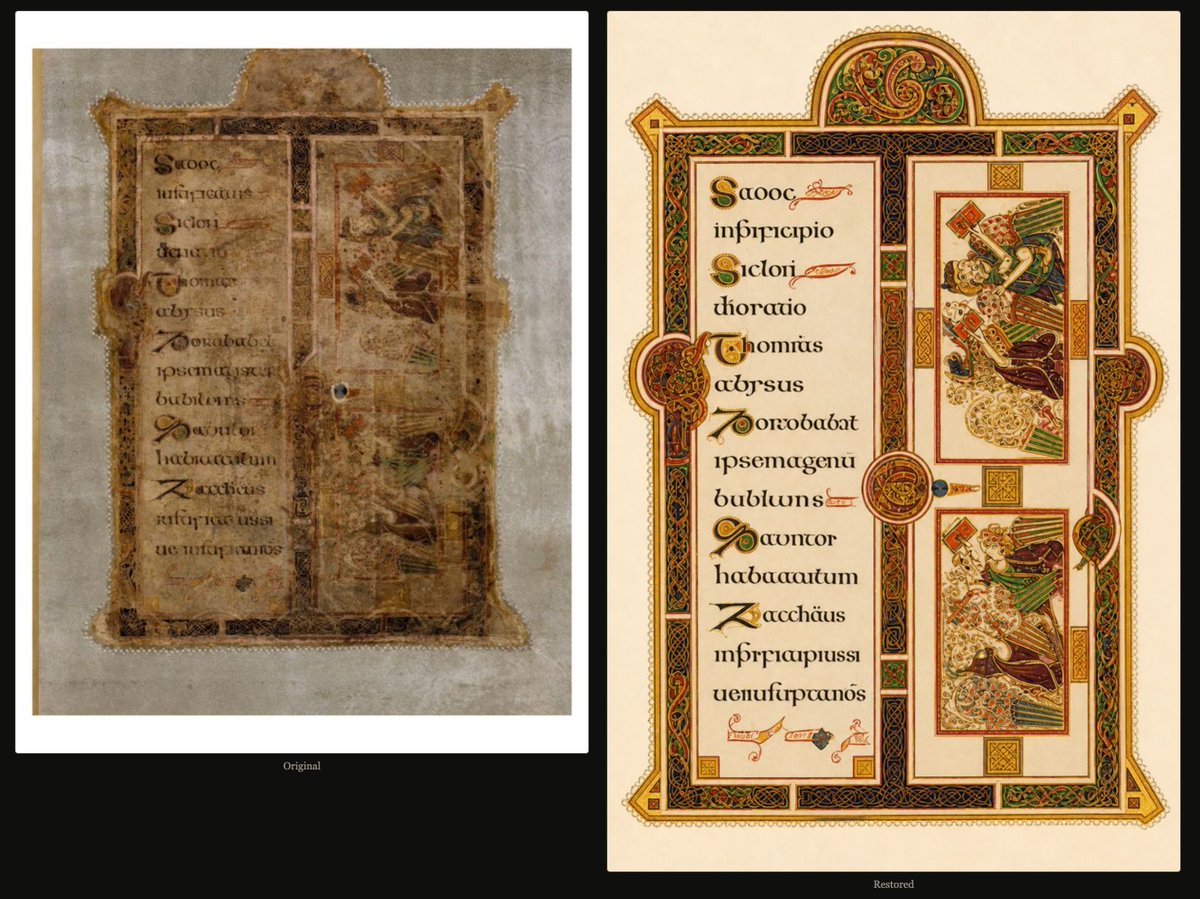
Reading the book, I was struck by how much the contents have suffered over the past ~1200 years (enduring everything from water damage to reckless malfeasance in attempted nineteenth century restoration), and I wondered whether AI could help give a sense for how the work might originally have appeared.
I downloaded the Internet Archive's PDF and asked my friendly neighborhood agent to use gpt-image-2 to render each page the way it imagines it might have originally appeared. Remarkably, this all worked with a single prompt, with the agent spinning up 48 workers, since each page took a minute or two. (I'm sure that someone wiser than me could prompt the model better, ensuring somewhat more historical accuracy in color restoration and so forth. There is no gold leaf in the Book of Kells!) This part of the project went from conception to completion before I'd finished my morning coffee.
I then wanted some easy way to view the results online, so I asked Stripe Projects (https://t.co/1tSgGbSLxM) to host the result on Vercel. That also worked in basically a single prompt: https://t.co/5ED9TM7lJB.
I also figured that people might want an easy way to download the full PDF of updated images, but it's a large (~200MB) file, so I decided that I should charge $0.10 to cover bandwidth costs using @MPP. I asked my agent to set this up, and it basically worked smoothly, though I had to tell it what MPP is (I guess it's not yet in the pretrain) and also manually set up the Cloudflare account that actually hosts the PDF and configure the API key. (Vercel seemingly has a 100MB limit.) The purchases now show up in my Stripe account alongside all other activity.
The site now has a ready-made agent prompt for anyone who wants to download the whole thing. I'm guessing that we'll see a lot more UIs like this in the future.
I remain pretty intrigued by the intersection of agents, micropayments, and stablecoins. I don't know much about managing crypto wallets from the CLI, but now AI can do that for me, while Stripe seamlessly handles turning it all back into fiat.
So what is the moral of the story?
• Whitworth's book is very good, and you should buy it.
• The Internet Archive continues to be wonderful and a civilizational treasure.
• While there are rough edges, setting up third-party services via the CLI now basically works. I'm pretty sure I wouldn't have bothered with any of this if I couldn't have outsourced almost all of the work to AI.
• The image models have gotten very good.
• There will probably continue to be all kinds of interesting applications of AI to history. (The Vesuvius Challenge of course being a shining pioneer.)
• These days, I often find myself building single-use sites for things I'm learning or for books I'm reading. I think this is a cool new category of software.
Massive synaptic pruning between birth and adulthood: the nervous system gets simpler with age! Two-decade connectomic effort in Lichtman lab @harvard reveals how the order in which motor neurons activate decides which connections survive. @NatureNeuro 👉 https://t.co/RqDv6Ea3hM