HUAWEI's Tau (τ) Scaling Law is a new principle for guiding the future development of semiconductors. By 2031, HUAWEI's high-end chips are expected to feature a transistor density equivalent to 14 Å (1.4 nm) processes. Watch the livestream to learn more! https://t.co/0Zb73r23ZP
🚀 5 AI Compute Architectures
Not “the next Nvidia” — five distinct bets:
🔹 @cerebras: Wafer-scale WSE bets that physical scale can reduce distributed-cluster overhead in low-latency LLM inference — revenue-proven, capex-heavy.
🔹 @tenstorrent: RISC-V + Tensix cores bet that open architecture can compete with CUDA lock-in over time — visionary IP, adoption still unproven.
🔹 @SambaNovaAI: Full-stack dataflow systems bet enterprises and sovereign AI buyers will prefer integrated AI platforms over standalone chips — infra play, not pure silicon.
🔹 @Etched: Transformer-specific ASIC bets the architecture will not shift — massive upside if it holds, existential risk if it doesn’t.
🔹 @dMatrix_AI: Digital in-memory compute bets decode acceleration is one of the nearest inference bottlenecks — PCIe form factor = fastest path to deployment.
10/
🚀 Prediction market agents are still early —
but as liquidity, data, and agent capability scale,
→ they converge toward a new form of
automated finance built on probabilities
📚Follow BroadNotes for more deep dives:
Substack → https://t.co/O4LteAg3MN
Paragraph → https://t.co/1VHVqlBFZa
🤝 Supported by @IOSGVC https://t.co/jzzCj5Ulw8
🚨 Just published a new research report:
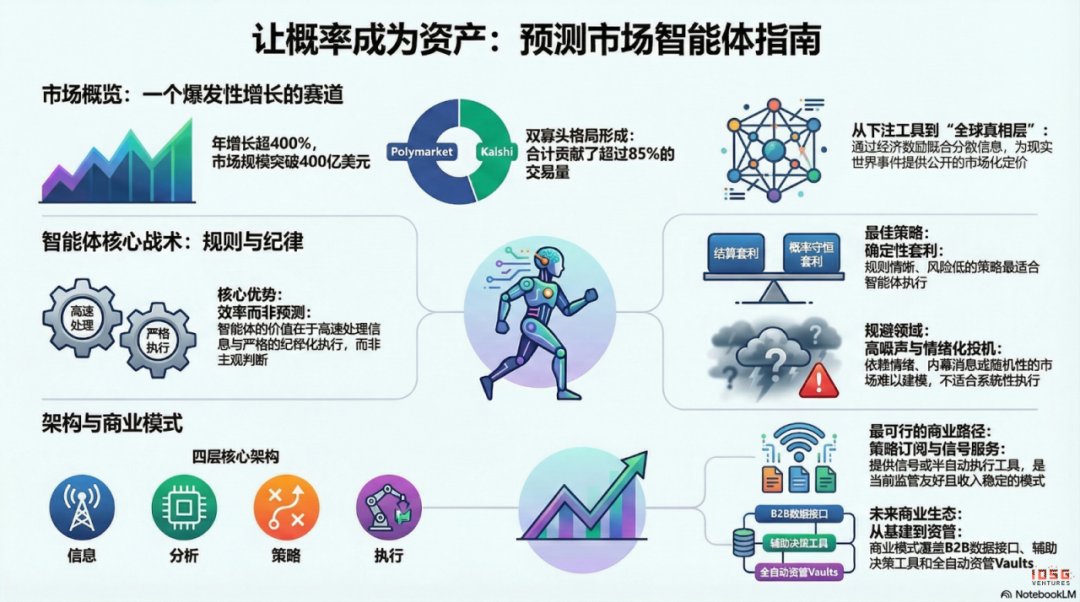
“Turning Probability into an Asset: The Rise of Prediction Market Agents.”
1/ Prediction Markets → A Truth Layer:
Prediction markets turn dispersed information into tradable probability signals backed by real capital, evolving from betting tools into a potential global truth layer, led by the Polymarket / Kalshi duopoly amid competition between regulated and crypto-native models.
2/ Prediction Market Agents: Not about better AI predictions, but executable probabilistic portfolio management—turning probability mispricing into automated trades via Data → ML analysis → Strategy & risk → Execution.
3/Strategy & Risk: Agents should focus on markets with clear rules, liquidity, and structured information, using deterministic arbitrage (resolution arbitrage, Dutch book, cross-platform spreads) plus structured signals. Risk is controlled via rule-based position sizing and strict risk modules.
4/Business Model: A sustainable stack combines B2B infrastructure (data/execution/backtesting), strategy ecosystems, and Agent/Vault performance participation. Products may evolve from signal tools → semi-automated trading → managed vaults.
5/Industry Stage: The space is still early. Players fall into three groups: infrastructure frameworks, autonomous trading agents, and analytics/execution tools.
🚀 We may be approaching the breakout moment for Prediction Market Agents.
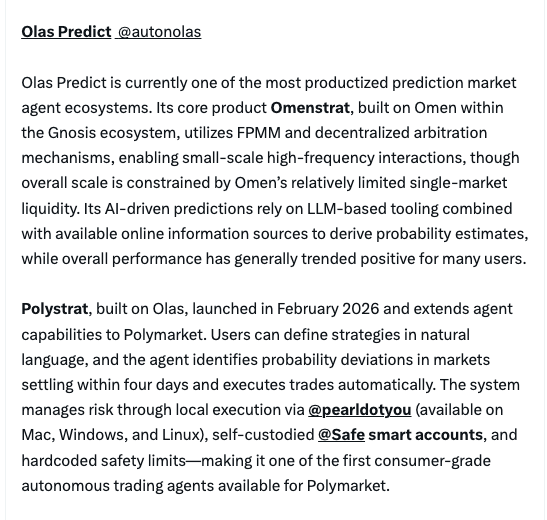
Polystrat is "one of the first consumer-grade trading agents for Polymarket." 💯
That is the verdict from @0xjacobzhao's latest article diving into the future of AI in prediction markets. ⬇️
The research features Olas Predict and Olas' two trading agents: Omenstrat and the newly launched Polystrat for Polymarket.
🔗 Try Polystrat: https://t.co/82Hw8yG4Mc








![0xjacobzhao's tweet photo. 🚀 AI compute isn't just a "GPU story".
I mapped the landscape across two axes:
🧵Narrative Strength × Commercial Maturity.
[ ⬆️ THE NARRATIVE TIER ]
@Etched @UbertiGavin @czhu1729
@cerebras @andrewdfeldman $CBRS,
@tenstorrent @jimkxa,
@dMatrix_AI @sidsheth
@SambaNovaAI @RodrigoLiang
→ Architectural disruptors.
→ Attacking memory bandwidth, interconnect, latency, inference efficiency & TCO.
→ High upside, commercial validation in progress.
[ ⬇️ THE FUNDAMENTALS TIER ]
@nvidia , @AMD , $MRVL, @Broadcom
→ Proven, validated businesses.
→ Judged by revenue, margins, ecosystems & FCF.
→ Commercial maturity is the moat.
The Hyperscaler Hedge: @Google (TPU) & @awscloud (Trainium) are quietly de-risking their Nvidia dependency.
#AI #Semiconductors #NVIDIA #AIChips #Investing](https://pbs.twimg.com/media/HIuxGIMaEAAyjmP.jpg)