Tomorrow in NYC we're hosting Top of the Block, a special pre-@ethconf event cohosted with @1kxnetwork, @BitMNR, @Auros_global, and @BlockdaemonHQ.
Financial institutions, licensed exchanges, DATs, hedge funds, market makers, node operators - the institutions powering the onchain economy all know that networking optimization is foundational to expanding it. Excited to bring them together for a great night in the city. 🥂
April fee data from the 1kx Onchain Revenue Report (1,000+ protocols tracked). Aggregate fees are down (-11% MoM, -20% YoY) as market volatility decreased both vs. March (Iran-uncertainty calming) and vs. last year’s Trump tariff-related moves, causing DEX and MEV-related fees to drive most of the declines.
It's a mixed picture on the category and protocol level, though.
• DeFi/Finance -11% MoM is a mixed bag:
--> Perps lost, e.g. @HyperliquidX -15%, though other markets gained, e.g. @Polymarket >3x in fees (largest gainer overall)
--> Lending markets gained in fees, led by @aave (due to utilization increase - see here: https://t.co/D5dzBCmy6w)
• L1 fee dispersion is widening. @ethereum 2x, @Zcash and @trondao up, while MEV-driven builders like @titanbuilderxyz give back March’s gains. Mostly a vol-compression unwind from March’s Iran-uncertainty spike.
• Middleware 7% growth driven by @chainlink and @CatFeeio
• DePIN 18% Fee decline almost entirely caused by @AethirCloud
• Wallet sector down 17% in fees, mainly due to interfaces like @AxiomExchange (-24%), @tradexyz (-18%). Even @phantom’s fee decline is mostly from their perps-trading interface
• Consumer overall flat-ish -4%, though bifurcation in Launchpads: @fourdotmemezh, @bonkfun, @farcaster_xyz with 50-80% declines in fees vs. @Pumpfun, @BagsApp positive. @printr as a new entrant
So what for 1kx: the decline in trading activity is in line with the compression in market volatility. Continuous growth in emerging DeFi categories like RWA is consistent with our Onchain Finance overweight. Prediction markets entering a fee-generating phase (Polymarket >3x) is consistent with our Frontier Applications thesis. Launchpad bifurcation tells us the consumer category is sorting itself.
Last week, 1kx Founding Partner @lalleclausen joined the "In Stablecoin We Trust: The Future of the Dollar" roundtable at the @MilkenInstitute Global Conference. A few takeaways.
Stablecoin payment volume (excluding bot activity) averaged $49B per day in Q1 2026, up 110% year over year and compounding at 50% CAGR over the past five years. That puts daily stablecoin payments above Visa (~$44B) and Mastercard (~$30B). Supply outstanding crossed $273B by quarter-end, up 28% YoY.
The growth is structural, not cyclical. Stablecoins are lower-friction payment rails picking up where the decline in correspondent banking has left off, and they offer better payment experiences for companies and individuals than the existing system delivers.
One of the most interesting threads of the discussion was about trust. The trust that US institutions and the dollar generate is, in effect, expressed through market adoption of USD-backed stablecoins worldwide. It is very hard for any other country, currency, or political system to replicate that. Whether a jurisdiction can produce a stablecoin that earns free-market adoption is becoming a useful signal of institutional credibility.
The build-out is happening in two layers. First, companies that handle the friction of integrating stablecoins into existing payment flows and treasury operations. Second, new banks being built that will flatten that friction into everyday treasury and payment work. Both layers are where we have spent the past several years deploying.
The closing analogy stayed with us. Stablecoins are to blockchains what email was to the early internet. Email was foundational, but it was never the point. Today, stablecoins are how we send a digital dollar back and forth. Blockchains will enable programmatic trading, clearing, and settlement of every existing financial instrument, plus financial primitives that weren't possible before.
Payments first. The rest is coming.
#MIGLOBAL
1kx will be at the @MilkenInstitute Global Conference in Los Angeles, May 3 to 6, where @lalleclausen joins the roundtable "In Stablecoin We Trust: The Future of the Dollar."
Milken brings together the CIOs, allocators, bank and asset-manager leadership, policymakers, and market infrastructure builders shaping the next decade of capital markets. This year, stablecoins and tokenized cash have moved from side panels into the core agenda: treasury, settlements, collateral, and liquidity.
We published our Cost of Trust thesis in 2019, arguing that blockchain reduces the cost of establishing trust to near-zero. What we're seeing now is institutions actually paying for that trust reduction at scale, in stablecoins, tokenized cash, and the settlement infrastructure underneath them. That these questions sit at the core of Milken's agenda rather than its periphery shows how concrete the shift has become.
The winners will be the structures institutions can actually hold, regulate, and plug into existing workflows. If you'll be at Milken and are thinking through what onchain finance means for your role as an allocator, issuer, or operator, our team would be glad to connect while in LA.
https://t.co/IgCENluzzh
#MIGLOBAL
@lalleclausen joins The Rollup today at 2:30 p.m. ET to discuss markets, onchain revenue, and the network fundamentals shaping our latest research.
Tune in live.
Congrats to the @0xPredicate team on launching Predicate Asset Compliance.
Stablecoin and RWA issuers have historically managed compliance manually, coordinating across compliance, legal, and engineering just to maintain basic controls like freeze lists and transfer restrictions. At institutional scale, that process breaks down.
Predicate enforces compliance at the token contract level: issuers set their policies and the controls execute onchain in real time, covering address freezes, transfer restrictions, and regulatory reporting without engineering involvement each time.
Day one customers include M0, Consensys, Centrifuge, Stellar Development Foundation, and Startale Group. We co-led Predicate's seed round in 2024 because institutional adoption of stablecoins and RWAs has always required this compliance infrastructure to exist. Now it does.
Introducing Predicate Asset Compliance: Automated compliance controls for stablecoins and RWAs.
Issuers define policies for who can and can’t access their assets. Predicate enforces them in real time, directly onchain.
Here's how it works and why we built it.
The stablecoin market has 200+ issuers. Most won't survive contact with institutional capital. A few are already building for it.
At the 2026 @rwasummit in Cannes, our Founding Partner @HeyChristopher moderated Stablecoin Wars: What Structure Will Win with @peterlih (@AllUnityStable), @Benjamin918_ (@CapApp), and @MartindRijke (@maplefinance).
Three builders, three fundamentally different architectural bets:
→ AllUnity is issuing MiCA-regulated euro and CHF stablecoins under a BaFin e-money license, 100% backed, legally redeemable, and designed for businesses outside the crypto ecosystem
→ Cap is targeting pension fund capital directly, arguing smart contracts can allocate credit more efficiently than human-led underwriting, at structurally lower cost
→ Maple has shifted its primary KPI from AUM to ARR, betting that fee income matters more than scale
Our read: yield efficiency and credit automation only matter if institutions can legally hold the underlying asset. Regulatory structure solves for that first.
The stablecoins that matter will be the ones connected to the productive economy. The rest will remain infrastructure for crypto, not for capital markets.
Full panel below.
https://t.co/mmLVJySlaX
Partner @1kxnetwork Peter Pan (@pet3rpan_) says there will be a class stratification in two directions in a post AI world:
"Specifically in two ways, it's sort of this K effect. You're going to have one: the upper class that's effectively entirely focused on life maxing. It's all about health, longevity, human connection."
"On the other end... you're going to have a bulk majority of the population who are going to wake up one day unemployed, misplaced, with more time than ever before, with less money than ever before, in a world that's more expensive than ever before".
"There's a lot of opportunity for future work, new ways to make money that weren't possible before, especially outside of traditional, I would say, white-collar jobs that sort of dominated the labor market over the last 10 years".
Crypto has a privacy problem. And the industry is still thinking about it wrong.
Blockchains are completely public: every transaction, every balance, visible to anyone forever. No institution runs its finances like that. But when $1.4B was stolen from Bybit, the only reason any of it got traced was blockchain transparency. Full privacy and that money is gone permanently.
Institutions won't move their finances onchain without it. For institutions evaluating onchain infrastructure, this is still an unsolved problem. It's also the thesis behind 1kx's investments in privacy infrastructure, where we're backing teams building the version institutions can actually adopt.
1kx Partner and cryptographer @_weidai writes in @Forbes on why threat-resistant privacy is the only version worth building:
https://t.co/M8JY2rENgR
Every company with a digital asset strategy is exploring onchain yield.
Introducing LI.FI Earn – the fastest way to launch and monetise an Earn feature.
Access strategies from 20+ vault protocols, with built-in cross-chain execution across 60+ chains, via a single integration.
We’re excited to share that 1kx led the pre-seed in @giggles_app - a new kind of social network where users can buy into videos early and participate in the upside as they spread.
We think Giggles opens up a compelling new design space at the intersection of social behavior, market design, and crypto-native coordination.
Congrats to @justinmujin, @itsedwinwang, and the whole team.
Big thanks to @TechCrunch and @asilbwrites for the exclusive: https://t.co/EtfJ0AAaDi
Will AI replace humans?
Every wave of technology replaces humans at a task. The printing press, the loom, the spreadsheet.
Each one triggered the same fear: "What will people do for work?"
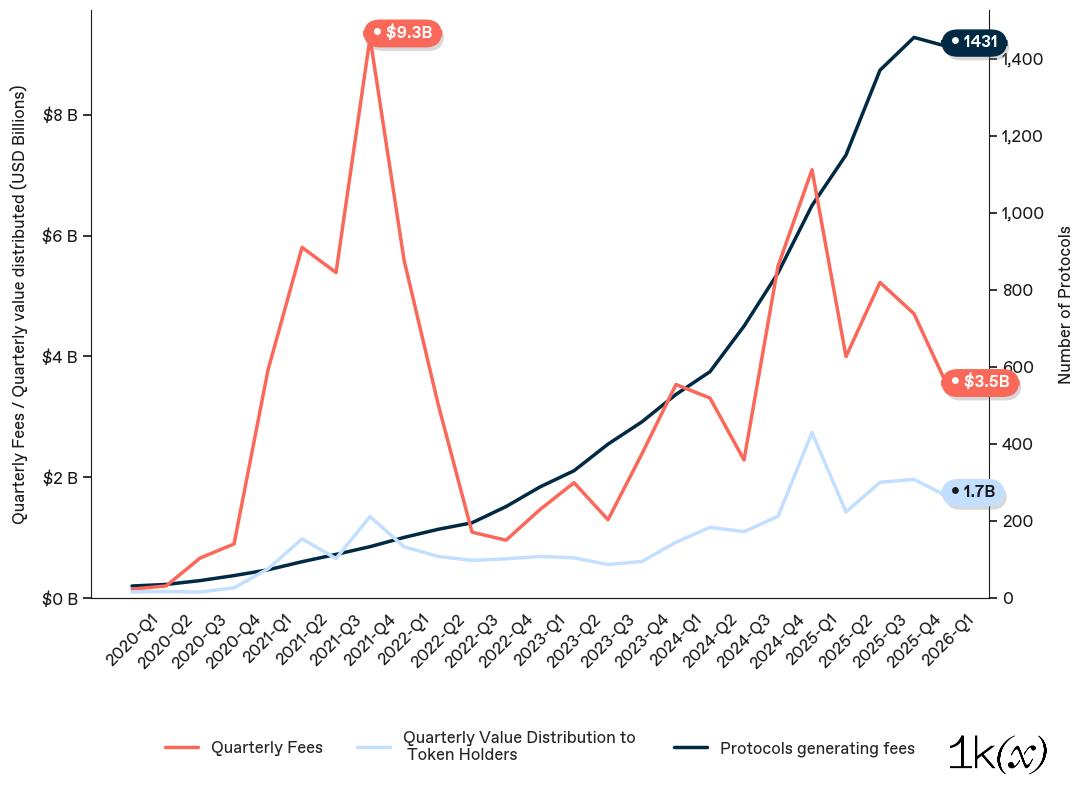
Mixed picture for onchain fundamentals in Q1 2026:
User-paid onchain fees are ~50% lower than last year, and 26% down QoQ. Value distributed to token holders remains stable, while the number of monetizing protocols has slightly declined for the first time.
Sector changes:
• Overall decrease purely driven by DeFi (-34%) incl. related infra, e.g. bridges -43%
• Perps hit hardest (-36%), Stablecoin issuance up driven by @SkyEcosystem
• Wallets -16%, Consumer -12%, though launchpads up 10%!
• DePIN the only positive sector, +13%
• Blockchains -5%, though @Zcash up 80% and @0xPolygon with +4x
Fee shares broadly in line with '25 avg: Blockchains 21%, DEXs 24%. Same for cohort view: protocols that first monetized in '24 or '25 still generate ~47% of all fees.
Protocol-wise: @Zcash climbed to #2, @Pumpfun fees up. Biggest mover: @BagsApp (+180 ranks), though the Jan fee explosion is fading. @farcaster_xyz now #25 after folding in @clanker_world fees.
Protocols that stopped monetizing: @level, @elixir, @mars_protocol, @EARNMrewards, @Lifinity_io (shut down/exploits). @kucoincom hasn't announced any burn yet this quarter. Some protocols had >$100k in fees last quarter and are now at $0 - Among them: @quanto@lava@rezervemoney
Shoutout to the data providers: @DefiLlama@tokenterminal@Dune@EigenPhi and many more 🙏
Featured charts: fee trends + token holder distributions / fee shares by sector / top protocols by fees Q1 2026 👇