You can get 95% of the results you want by calmly putting one foot in front of the other. One former Navy SEAL friend texted me a principle used in their training: “Slow is smooth. Smooth is fast.”
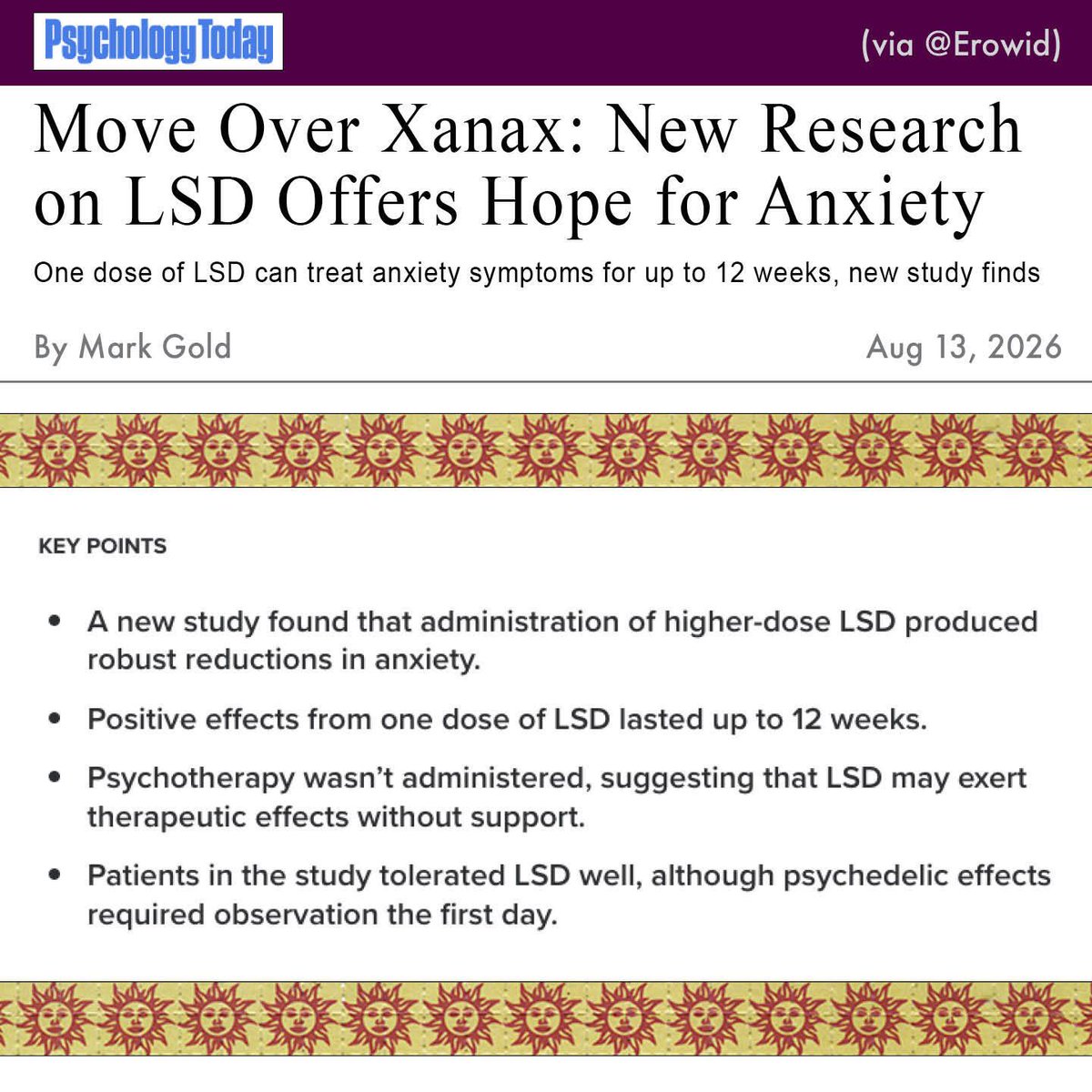
New LSD study by psychedelic pharmaceutical company Definium found a 100-200 mcg dose of LSD (brand name MM120) resulted in statistically significant improvement of anxiety *without* therapy.
https://t.co/AOzwf1idg7 (overview)
https://t.co/n91lUzOSnh (study)
#Erowid#LSD
Naval Ravikant: "You're going to die. It's all going to zero. What's there to stress about?"
"Stress is when your mind has two conflicting desires at once. You want to be liked, but you want to do something selfish. You don't want to go to work, but you want to make money. You have two conflicting desires, and that's stress."
Most people use stress and anxiety interchangeably. Naval says they're different things:
"Anxiety is this pervasive, unidentifiable stress where you're stressed out all the time and you're not even sure why. The reason is you have so many unresolved problems that have piled up in your life, you can no longer identify what the problems are. There's this mountain of garbage in your mind. A little bit is poking out the top like an iceberg; that's anxiety. But underneath, there's a lot of unresolved things."
His fix for it is thinking about death:
"One big anxiety resolver for me is just ruminating on death. You're going to die. It's all going to zero. You cannot take anything with you. If you can keep that idea in front of you at all times, what's there to stress about?"
Which raises a question. If nothing matters, isn't all time wasted?
"What is wasted time? Everything is wasted time in a sense because nothing matters in the ultimate. But in each moment, it's the only thing that matters. So if you're doing something you want to do and you're fully there for it it's not wasted time. If your mind is running away, wishing you were somewhere else, anticipating the future, regretting the past, that's wasted time. That's time you're not present for."
And the part most people miss:
"People get worried about dying and no longer being here. But they don't realize that so much of their life is spent not being here in any case."
"The fastest way to trigger neuroplasticity isn't playing brain games or reading research papers.
It's forcing your brain to fail repeatedly at something you have zero natural talent for. high frustration is the literal chemical signal that forces synaptic rewiring."
“What is the Jew? What unique creature is this whom all the rulers of nations of the world have disgraced and crushed and expelled and destroyed…and who despite there anger continues to live and to flourish…The Jew is eternal, he is the embodiment of eternity.”
~Leo Tolstoy
Remember that time Kamala thought there was an actual cloud floating above us with all of our data and digital files in it.
This is the anti-data center people in a nutshell.
I’m a retired brain surgeon and I wanna tell you why you feel like life is passing by. I just need one minute to explain this to you so hang in there.
Repetitive daily routines stop the brain from recording clear detailed memories. When every day looks the same, your brain does not track time the same as a clock does. It tracks change. If nothing new happens then days, months, and years start to blur together.
This is know as Time compression. When life lacks variety, your brain compresses past days together, making it feel like time is sped up.
To stop feeling like life is passing you by, add new experiences to your life. Break routine habits, like changing your daily home routine, taking a different route to work, or trying a new hobby.
Schedule small trips or plan new adventures so your days do not blend together.
Practice mindfulness by staying fully focused on what you are doing right now and not trying to race off to the next task.
Keep a journal and write down happy memories or memorable parts of the day before you go to sleep.
Take deep, calm breaths when you feel anxious or rushed to return your focus to the moment.
You can and you will retrain your brain to not feel like life is passing you by by following these few simple measures.
One of Einstein’s students asked him, “What does logic mean?”
Einstein replied with a question:
“Suppose two workers go down a chimney to clean it. One comes out with a dirty face, and the other comes out with a clean face. Who will wash their face?”
The student immediately answered, “The one with the dirty face.”
Einstein said, “That answer is not correct. The person with the clean face would wash their face because they would see that their colleague’s face was dirty and assume their own face was dirty too. The person with the dirty face would see that the other person’s face was clean and assume their own face was also clean.”
The student said, “That makes sense.”
Einstein replied, “No. The question itself is not logical. If both workers went into the same chimney at the same time, it would not make sense for one to come out clean and the other dirty.”
The lesson is simple: Sometimes the problem is not the answer. The problem is the question itself.
For 50 years, eggs were treated like a cardiovascular threat. The 1960s dietary guidelines capped cholesterol intake at 300mg per day. Two eggs put you at the limit. The advice moved millions away from the food, and away from a nutrient profile we didn't fully appreciate at the time.
A recent study from Loma Linda University followed 39,498 adults age 65 and older for 15.3 years. The team linked Adventist Health Study-2 dietary records with Medicare diagnoses. Over that window, 2,858 participants developed Alzheimer's disease.
Eating eggs 1 to 3 times a month: 17% lower incidence vs never-eaters.
2 to 4 per week: 20% lower.
5 or more per week, roughly one a day: 27% lower.
The mechanism story isn't new, but the cohort scale and 15-year follow-up are. Eggs are the densest natural source of choline in the American diet. One large egg supplies roughly 33% of the daily choline requirement. Choline is the substrate for acetylcholine, the neurotransmitter that drops in Alzheimer's. Donepezil, the most prescribed Alzheimer's drug, works by blocking acetylcholine breakdown. The disease is partly defined by cholinergic neuron loss.
Egg yolk also delivers lutein and zeaxanthin. These are the only two carotenoids that cross the blood-brain barrier and accumulate in cortical tissue. Higher tissue levels track with better processing speed and memory across multiple older-adult cohorts. Yolk also contains DHA, primarily in phospholipid form. Phospholipid DHA enters the brain more efficiently than DHA in triglyceride form, which is the dominant form in fish oil capsules.
This is observational. Causation cannot be drawn from a cohort study. The Adventist Health Study-2 cohort skews heavily vegetarian and health-conscious, so people who eat eggs in this cohort do not look like the average American egg-eater. The "never eats eggs" comparison group is largely vegan, which is its own dietary pattern with its own complications. Reverse causation also has to be considered. People in early Alzheimer's often change eating patterns before diagnosis. Some of the apparent protection could be that healthier brains keep eating eggs, not the other way around.
The mechanism story I outlined above is supported by adjacent literature, not by this paper. The study did not measure choline status, lutein levels, or DHA in tissue. It measured eggs in, dementia out.
In a 40,000-person cohort followed for 15 years, egg intake tracked with substantially lower Alzheimer's incidence in a dose-response pattern. The mechanism is biochemically plausible, supported by other lines of evidence, and consistent with what we know about acetylcholine and brain carotenoid status. The randomized trial that would prove causation has not been run.
if you are over 50 and not allergic, eating an egg most days has stronger evidence behind it for brain health than most products marketed for the same goal. Five days a week was the dose with the lowest risk in this cohort. Even 1 to 3 per month showed measurable benefit.
For 50 years the question was whether eggs were dangerous to your heart. The data behind that fear was always weaker than the guidelines made it sound, which is why the 2015 Dietary Guidelines for Americans quietly removed the 300mg cap. The brain question got asked too late.
Oh et al., J Nutr, 2026 (DOI: 10.1016/j.tjnut.2026.101541)
A Stanford neuroscientist admitted:
"Your belly stores cortisol waste. Kill it with this One habit before you sleep.. And your life will change."
Here is the 9 minute fix: