Some of my perspective on where the @ethereumfndn is going.
First of all, this is only my own view. The board is not just me, and I have no extra special powers on the board that the other board members do not. @aerugoettinea is the one executing much of this transition. My input has been largely on technical questions. The board is in the process of expanding, and my own power within the org will continue to decrease, which is honestly what I want.
The 2025 era brought many important improvements to EF and its ability to execute. Many issues were resolved, and EF continues to benefit from its improved efficiency and greater focus on concrete goals to this day. And so with those problems resolved, early this year, the largest remaining hole that I perceived was something different nagging at me: I would regularly spot people saying things like "vitalik says these beautiful things about ethereum needing to be decentralized, and have privacy, and be a sanctuary technology, but why do the EF's actions not reflect that?"
Now, you may have been hearing something different. You may not have been sensing a feeling of crisis at all, and maybe were hearing people saying that finally we were taking execution and BD seriously and the main task for us is to keep going that way and be even better and faster. Then probably there is genuine difference between you and me, in what kinds of criticism I take most seriously, and what kinds of critics through their criticism are most able to make me feel pain.
As an analogy, let's briefly switch over to a different domain.
One belief you can have about Google is that it is a success story, and has brought a lot of good to humanity in organizing the world's information. Another belief you can have about Google is that they had a beautiful idealistic beginning, but at some point the corruption of mainstream corporate attitudes seeped in, and they slowly bit by bit completely abandoned the "don't be evil" slogan.
My belief on Google specifically is probably somewhere between the two. BUT, if you had taken me back in time to ~2008, and offered me a button to press to make Google one or two standard deviations more "dogmatic", eg. give Richard Stallman permanent veto power over some key policies, I would immediately press it.
Why? Because a choice for one company is not a choice for the world, or even one country. Google existed and exists in the context of a technology industry generally drifting away from early idealistic don't-be-evil roots and toward greed for financial gain, totalizing visions of accelerated superintelligence, infiltration by sociopaths, and craven capitulation to (or worse, active participation in) government pressure for ideological control, surveillance and war. And so *one company* doing something different, positioning itself to be what George Bernard Shaw calls the Unreasonable Man, resisting the trend of the times, would have been better for freedom, balance of power and stability of society as a whole, than *all* large companies bending to dominant trends. This is a part of my version of pluralism.
This line of thinking is not just mine, but I also is not too far off from what Aya and others had in mind with the Mandate.
Now how does this all get to the role of the EF?
EF is not a "center of Ethereum", rather EF is "one node, with a defined purpose, alongside other nodes". We've always said that the EF should be the latter, but many in the Ethereum ecosystem (and even within the EF) wanted us to be the former. Now, we are taking action to ensure that we will be the latter.
This is particularly important because EF is a limited organization, with limited resources and limited organizational capacity. The EF has only ~0.16% of all ETH (less than many other individual ETH holders), whereas among other blockchains it's common for "the central foundation" to have 10-50%. Fiscally, the EF was originally designed to fulfill a limited work scope defined in the token sale docs and other pre-launch materials (building the chain software; getting through Frontier, Homestead, Metropolis, Serenity), which was fully completed in 2022; it was not designed to be an eternal steward.
And so today, the EF is choosing to use its remaining resources to pursue longevity over breadth (yes, this means we sell less ETH). The EF focuses *specifically* on those activities critical to the success of ethereum as a censorship/capture-resistant, open, private and secure system, that would not happen otherwise. This means making hard choices, and in some cases even activities that we highly approve of and people that we highly respect becoming outside of the EF. People of great technical talent, public respect and even alignment with the mission and CROPS being outside of the EF is in fact necessary if we want important tasks to be able to attract outside capital. This also means the EF taking opinionated stands culturally.
This is all intended in cooperation with all other parts of ethereum. We recognize that many other parts of the ethereum world highly respect CROPS and related values. But highly respecting is not the same as choosing to specialize and totally dedicate to a domain (Compare in a different domain: I think reducing animal cruelty is important, and I like vegan food, but am not full unconditional vegan myself)
EF is still in a transition period, and we expect its new long-term form to stabilize over the next few months. What are the guiding principles of this new form? Again, I am only one person, but I can give my answer from a technical perspective (there are also critical non-technical aspects).
At the core, *Ethereum must be impressive*. We are living in an age of highly intelligent AI and all kinds of other technological acceleration. "Status quo EVM, with a hard fork or two a year to optimize for short-term needs of users" is not interesting.
To some, "impressive" means: 250ms latency and 1M TPS. I think Ethereum trying to go that route is a mistake. Being as fast and as scalable as possible, and only a small epsilon more decentralized than the others, is a route to mediocrity, and if we try it we will lose.
I think Ethereum should scale. But I think Ethereum should strive the hardest to be deeply impressive in a different dimension: the CROPS dimension. This means things like:
* Provably bug-free Ethereum. This is a goal that all cybersecurity researchers would have thought is absurd and impossible, up until roughly 6 months ago. Now, it's on the cusp of being possible, thanks to AI-assisted formal verification. So we should be frontrunners in doing this.
* Available chain consensus. Ethereum is, and with lean consensus will cotninue to be, the ONLY chain that has both (i) traditional-BFT style properties that it's safe under asynchrony up to a high level of fault tolerance, and (ii) the bitcoin PoW-style property that under synchrony it's safe up to 49% attackers. As far as I can tell, literally no other chain has this or is planning for it; bitcoin goes for (ii) only and most other chains go for (i) only. Some will remember I fought hard for this, Unreasonably insisting that it is not OK for ethereum to rely on social consensus and hard forks to rescue ethereum from 34% of nodes going offline. It's OK for chains like hyperledger, bnb, solana, tempo, etc. It's not OK for bitcoin or ethereum or eg. zcash.
* Intermediary minimization. The fact that smart contract wallets, protocols like railgun, etc have to send transactions through intermediaries to get included onchain is honestly embarrassing, and it's a constant point of fragility. Hence the work on FOCIL and EIP-8141 (and 7701 and years of work before) to make transaction sending intermediary-minimized with public mempool and strong inclusion properties, in a truly general-purpose way, that covers not just eg. secp256r1, but also privacy protocols and much more. Kohaku is pushing intermediary minimization at the user layer, pulling Ethereum away from the dystopian status quo world where our wallets don't even verify the chain, send our private data out to a dozen third-party servers, and toward a brighter CROPS future.
Some of these goals are Unreasonable - maybe Ethereum would be "fine" getting only 50% of the way - what if we depend on intermediaries, but make it easy to switch? But going 50% of the way would not make Ethereum Deeply Impressive in the CROPS way. So we push for 100%.
Fortunately all these goals are compatible with high TPS, this is a major focus of research (esp. on scaling the state). Well-designed L2s can also help, especially L2s optimized for specific applications (eg. high-volume trading, privacy...). These goals are even compatible with significantly lower slot times, thanks to Raul's work on erasure-coded P2P, and many other optimizations.
The most high-value "product" of the ethereum blockchain, financially speaking, is ETH the asset. Ethereum secures $250 billion of ETH. The types of properties of Ethereum that I mentioned above are very good for ETH the asset. Nearly 90% of my net worth is in ETH, and most of the remainder is ~$40m of onchain fiat of which every dollar has already been allocated for some open-source biotech or software or hardware initiative. That said, there are aspects of supporting ETH the asset - *necessary* aspects even - that are outside the scope of the EF. This is where we need other heroes (some of whom hold more ETH than the EF does) to step in and help. EF has been recently thinking more about how it will relate to other such organizations, and give them needed initial support.
EF will be a smaller ship than in previous years, a more opinionated one - in some cases more opinionated in ways that might be difficult to comprehend - but a longer-lasting one, and one suited to making sure that ethereum brings something meaningful to the world. We are grateful to all those inside and outside the EF who are helping to make this happen.
There are THREE forbidden questions in crypto:
- Don't ask a $BTC maxi what happens when block subsidies goes to 0
- Don't ask Toly how much $SOL he and the foundation have
- Don't ask VCs why we need yet another L1 blockchain
$ETH fixes all these things, btw
ETH staking ETFs are being approved.
5.7% of ETH supply is about to be locked in staking.
+ 29.4% of supply already staked=35.1% supply locked
ETH supply shock incoming with increased demand from Wall Street adoption.
Ethereum is going to outlive us all!
Two months have passed since Ethereum crossed a psychological milestone. For the first time in human history, a technology has operated for a full decade without interruption. No resets. No scheduled maintenance. Not one stall in 315,360,000 seconds of continuous operation. That technology wasn’t a nuclear power plant or the global banking system. It wasn’t Bitcoin either.
It was @Ethereum.
Once again, Ethereum redefined what’s possible. Success, however, carries its own danger.
In celebrating 10 years of uptime and cheering for institutions hoarding ETH in their treasuries, we risk mistaking survival for victory. The resilience that brought us here can wither if we grow complacent with the system we’ve previously fought.
Victory or surrender?
Ethereum’s uptime is not the same as a single flawless machine humming away in a basement. Nodes crashed. RPCs faltered. That’s the point - no single point of failure can bring Ethereum down. It endures as both a technological design and a collective human commitment by thousands of developers and operators.
Yet beyond milestones lies a more complex question: Can we stay so resilient in the following decades?
The crypto movement was born in opposition. After the 2008 bailouts, Bitcoin made its case against governments, banksters and crony capitalism. Ethereum expanded the vision, turning blockchains from currency into computation. Our “enemy” was clear: legacy systems of power and control. As crypto gains legitimacy, something dangerous is happening - we are losing sight of what holds us together.
The disappearing enemy
With US President Donald Trump elected and many politicians worldwide following his lead by embracing crypto as part of their agendas, one might have concluded that we’ve won. After being ignored, ridiculed and chased, crypto reached cultural legitimacy. But after watching premature victory dances online, we should instead feel uneasy.
Success can be captured, diluted or repurposed before we’ve reached escape velocity - an imaginary finish line. The real fight has just begun - the battle for integrity.
Bitcoin’s story shows this clearly. Its birth in 2008 was triggered by the bailout of banks: a rotting financial system exposed for all to see. The enemy was obvious - corrupt governments, banksters, cronyism. But look at today. Bitcoin’s loudest voices celebrate dictators because they declare Bitcoin legal tender - irony at its peak.
Ethereum risks a similar fate. Is a pro‑crypto administration, or an EU‑operated blockchain, a recognition of our values? Governments shift overnight. Today’s “ally” can tomorrow become an opportunist, eager to bend crypto’s ethos of openness into something controllable. If the survival of decentralization rests on the right politician at the right time, then we’ve already lost.
The real threat
Bitcoin’s enemy isn’t Ethereum. Ethereum’s enemy isn’t Solana. The enemy is stagnation - and the subtle compromises that mimic decentralization while undermining it.
It’s in the temptation to optimize for convenience over resilience. In the small chokepoints that accumulate through regulation or corporate capture. In the gatekeeping of power by those who already hold the keys.
History is full of examples. Civilizations unify when threatened, then collapse once the external enemy disappears. If crypto ceases to define itself against corruption and concentration of power, it risks turning inward - trading bold experimentation for complacency, and innovation for rivalry.
Build for the long game
Ten years of uptime is impressive, but it’s only a psychological milestone in the grand scheme. What matters is whether Ethereum evolves instead of ossifying.
Forget the next 10 years. Despite all of the challenges, Ethereum will still be here in the next fifty, though everything beneath it will have changed. Clients will be written in programming languages that have not yet been invented. They’ll run on chips not seen so far. Consensus will be secured by mechanisms yet to be designed. It will have survived precisely because it doesn’t cling to one definition, language, or architecture. It stays alive by refusing to become legacy.
That is the true challenge of the next decade. To resist capture. To keep decentralization real. We must keep asking who the enemy is and ensure the answer is never “our fellow builders,” but the systems and mindsets that resist openness, sharing, and change.
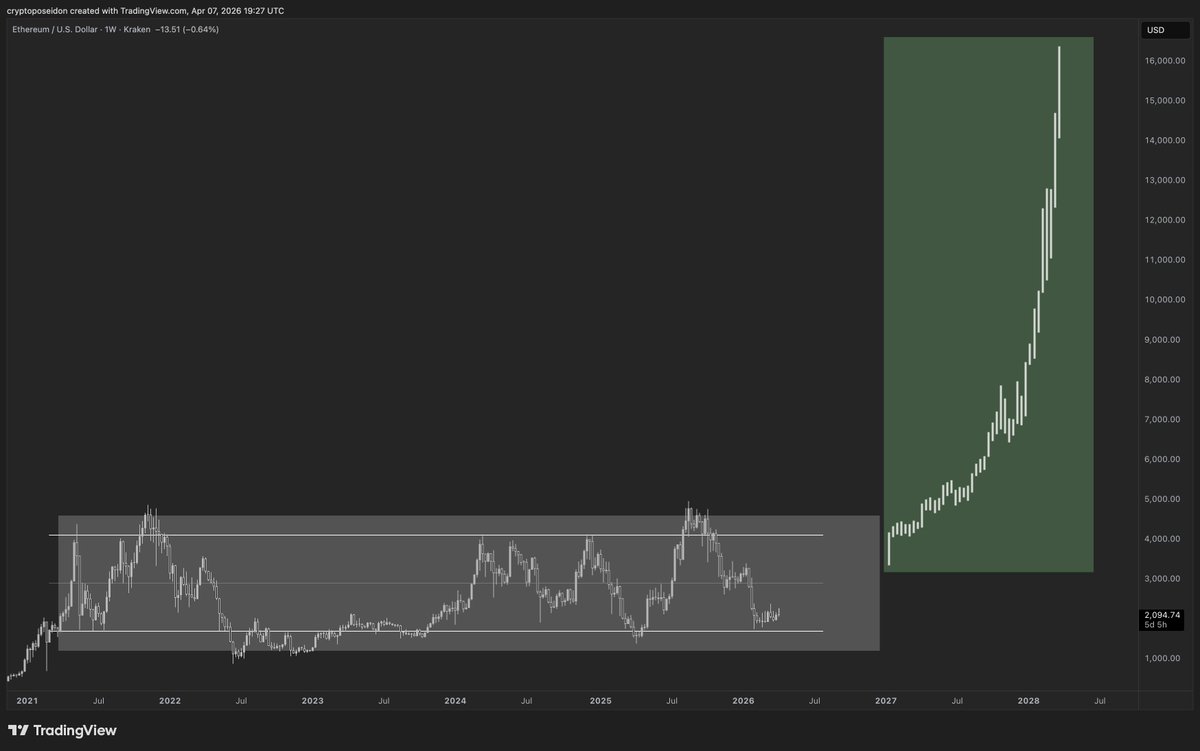
$ETH to $18,000
> perfectly retesting previous resistance
> rwa and stablecoins hitting ATH
> staking ETH coming
> ETH is SoV with 3% to 7% yield
> ETH weekly is forming bullish flag
> Wall Street and big companies are betting on ETH
Seize this dip as the final opportunity
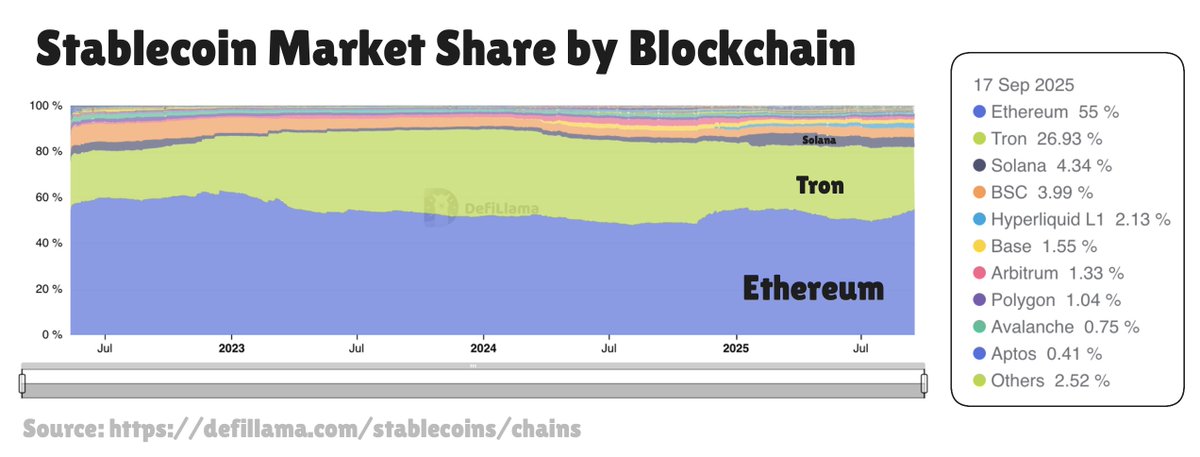
Dear @dotkrueger, I noticed you’re a Stanford PhD - someone who surely values accuracy and citing sources.
Your chart shows Solana with ~30% of stablecoin market share, but the real number is closer to 4% (about 8x smaller). I even struggled to fit the Solana label in my chart.
We’re starting a new AI Team at the Ethereum Foundation (the dAI Team).
Our mission: make Ethereum the preferred settlement and coordination layer for AIs and the machine economy.
The team will focus on two main areas:
- AI Economy on Ethereum = giving AI agents and robots ways to pay, coordinate, and follow rules without middlemen.
- Decentralized AI Stack = making sure the future of AI doesn’t rely only on a handful of entities but has open, verifiable censorship-resistant alternatives.
We believe Ethereum can be as useful for today’s AI developers as it will be for the sci-fi future. That’s why we’ll work closely with ecosystem projects to accelerate progress and push the boundaries of research and innovation at the intersection of AI and blockchains. Connecting two communities that have too often worked in parallel.
We’ll work side by side with both the Protocol and Ecosystem teams at the EF. Linking protocol improvements with the needs of AI builders, and funding innovative public goods that will make Ethereum the best home for AI.
Ethereum makes AI more trustworthy, and AI makes Ethereum more useful. The more intelligent agents transact, the more they need a neutral base layer for value and reputation. Ethereum benefits by becoming that layer and AI benefits by escaping lock-in to a few centralized platforms.
Acting with purpose and urgency, we’ll continue our recent work on ERC-8004—a standard for proving who an AI agent is and whether you can trust it— and continue to support new upgrades and standards. Inspired by the d/acc philosophy and Ethereum values, we’ll support projects that are leveraging Ethereum to build a more resilient and secure AI ecosystem where humans can flourish with AI.
Ethereum + AI is about making sure humans keep agency and AI can reach its potential. Neutral, verifiable, censorship-resistant infrastructure means AI works for the people, all of us.
The team starts with myself as lead, and we’re just getting started. Explore our job postings and resources below, and join us in building the future of decentralized AI on Ethereum.
🚨 Solana did NOT “hit 100,000 TPS.”
It gamed the numbers in typical Solana fashion!
On August 17th a Solana dev ran a stress test on mainnet.
They blasted the chain with blocks filled almost entirely with “no-op” transactions.
No-ops are dummy instructions that do NOTHING.
No state changes. No math. No balance updates.
One block hit ~107,000 TPS.
Then the entire Solana community including @solana@toly@mert pushed this BS claim.
Here’s the reality.
That block had 43,066 transactions in 412ms.
Of those, ~41,938 were no-ops.
That’s 99.5% filler.
Yes, you read that right.
99.5% of the transactions were meaningless filler to pad numbers!
Less than 200 were real transfers.
TPS inflated by junk.
On Solana, transaction weight is measured in Compute Units (CU).
A no-op burns ~1,000 CU.
A token send costs 3,000–5,000 CU.
A DEX swap runs 50,000–300,000 CU.
That means the 100K TPS figure came from txs 1/4th to 1/200th the weight of real activity.
Try hitting that with Raydium or Jupiter swaps. It collapses.
History already proves it.
True TPS (excluding votes) is ~1,000–1,200 on average (95% of that is bots too)
When organic spikes hit, such as memecoin launches or NFT drops, the network stalls, throttles, or flatlines.
THAT is the real ceiling.
Bragging about 100K TPS with no-ops is like claiming your car hits 300mph falling out of a plane.
It misleads developers.
It misleads investors.
It misleads users.
Solana is fast and cheap for simple ops.
But hype like this erodes trust.
If Web3 is going to scale, we need honest metrics.
Mixed workloads, transparent breakdowns, not smoke and mirrors which Solana is famous for.
We raised $60M for this moment: Introducing Slash Global USD (in partnership w/ @base).
It's the first banking platform that lets you open a USD account without an LLC, EIN, or the rampant account closures they call "account safety".
It took major legislative changes AND 3 years to pull this off.
Here's what makes it so different:
1. Banking without an LLC. Before Slash: You needed a LLC, $1K in fees, a virtual address, and a U.S. tax ID. With Slash you get a real U.S. account & routing number in ~10 minutes with your foreign documents.
2. No more hefty fees. PayPal charges a 3-4% conversion fee. We let you receive USD and crypto (USDC) with NO fees. Not enough? We pay you up to 4.5% cash rewards just for holding your money with us.
3. Account freezes. The big guys love flagging success as “fraud”. We're built for fast moving founders. We'll never wrongfully freeze your funds. I'm putting my money where my mouth is: If we do, I'll wire $10K to a charity of your choice.
------------------------------
In 2021, I dropped out of the number 1 school in America as a Venezuelan immigrant to build Slash. I pivoted the business 2x before getting our first customer.
Today:
- 3,000 businesses use @slashapp
- We bought the domain Slash . com for $1M
- $4B is spent on our credit cards every year
And we just raised $41M from the people who built fintech: @MenloVentures@NEA@ycombinator@goodwatercap
--------------------------------
To celebrate this launch, we're giving away our internal AI finance Agent free.
It watches your bank accounts 24/7. Flags double charges. Cancels forgotten subscriptions.
It saved us $39,000 last month.
You don’t need a Slash account. It works with any bank.
Retweet + comment “Slash” and I’ll send you a free access link.
🧵 1/10 #Ethereum just turned 10 years old 🎉
The past decade?
Incredible growth, resilience, and innovation!
But the next 5 years will be even more transformative.
🔸 Sub-$0.01 fees
🔸 100K+ TPS
🔸 $100B+ in tokenized assets
A detailed breakdown of WHAT'S NEXT for #ETH!👇
Dynamix, a publicly listed company, is preparing to merge with another entity to create a new company known as the Ether Machine.
The combined company plans to hold over 400,000 ETH ($1.5 billion). This will make the Ether Machine the largest ETH treasury company.
Accelerate!