Head of Engineering Shopify:
"AI writes the code, AI reviews the code. Your job is just to write the loops around it."
26 minutes on how AI changed the way 3,000 engineers work inside a single company.
Ignoring it while everyone else uses AI to do more is the fastest way to fall behind.
Watch it, then read the step by step guide on loops below.
If you're on your way to building a billion dollar company that involves a web app, here are some of my notes on architecting the frontend.
if you don't do this, it's probably fine but one day you'll hire someone to fix it but truly that person could be doing some other higher value thing if you make some key optimizations on day 1
you don't even have to learn anything you're gonna tell your agents to do it anyways!
okay here it goes:
- Make your server code generate a openapi spec which then generates all the relevant client side code. Never do this by hand. Typing backend types instead of generating them should be banned
- You need to make a decision on how the client talks to the backend. rest/graphql works in which case please just use tanstack query. other libraries will look similar but tanstack query truly is goated.
- if you want linear style sync setups or offline mode, think about this HARD and architect it from day 1. Bolting this on later is so tedious.
- People like using plain react router but things have gotten a lot better since then. Try their new framework mode or just even use tanstack router. Use route data loaders.
- If you store a lot of state in query params, make that a first class citizen and make sure its type safe. use nuqs or tanstack query.
- Most apps just need a single state management situation for server state and thats it. If you have other bespoke needs, i have quite like zustand and xstate/store.
- If you have a super interactive app where things come in and out of view, theres a lot of frontend state to maintain, music is playing and what not, lock in and learn xstate. Trust me if you wanna keep ur sanity, you need to model ur frontend as a state machine otherwise you're gonna be deep in useEffect hell
- React compiler is here my friends, the days of useMemo and useCallback are gone. Update your priors accordingly
- Tailwind is easy and fun but makes it really hard to maintain a large app with consistent styling. You need a "agent-first design system/component library" but maybe this is a rant for another day
- Don't be afraid to hack your routing library to fit your needs more closely. A lot of apps have "drawers" to show additional info. You should 100% be able to say "here's a route, make it a drawer" and everything should be handled from there.
- Managing loading and error states using isPending and isError is madness. Lean into Suspense and ErrorBoundary.
- Figuring out a blessed path for websockets and SSE on day 1 i think will pay dividends in the long term if you're building anything AI related.
- If you're building a SPA, don't use next.js. it literally makes no sense. Why would you do this.
- Definitely deploy on Cloudflare or vercel. There are other services but trust, there have weird missing features.
- Assuming you build something people want, the next job is to build the factory so it can efficiently build the thing. Act accordingly.
Dario is wrong.
He knows absolutely nothing about the effects of technological revolutions on the labor market.
Don't listen to him, Sam, Yoshua, Geoff, or me on this topic.
Listen to economists who have spent their career studying this, like @Ph_Aghion , @erikbryn , @DAcemogluMIT , @amcafee , @davidautor
This 2 hour Stanford lecture will teach you more about how LLMs like ChatGPT & Claude are built than most people working at top AI companies learn in their entire careers.
Bookmark this & give 2 hours today, no matter what. It'll be the most productive thing you do this week.
dylan field shared on lenny's podcast how he got figma's first users:
he wrote a script to scrape twitter, built a network graph of the design community in Gephi, ran an analysis to find the most influential nodes, then reached out to every one of them
"can I buy you a coffee?"
this is basically what smart outbound looks like in 2026, just with better tools:
1) use data to find who's actively talking about your problem space
2) rank them by engagement and network reach
3) reach out referencing something specific they said
the playbook from 2012 is still the best GTM strategy :)
the only difference is now you don't have to write your own scraper or limit yourself to one platform, just use the Crustdata API
THE CEO OF Y COMBINATOR JUST OPEN-SOURCED HIS PERSONAL KNOWLEDGE BRAIN
Garry Tan has 342 markdown files scattered across repos, obsidian vaults, meeting notes
he built a tool to make them all searchable
it's called GBrain
import your files → it chunks, embeds, indexes everything → ask a question in plain english → finds answers by meaning, not keywords
"what are our biggest risks?" finds pages about competitive moats and board prep even if those words don't appear
the man who funded Airbnb, Stripe, and Coinbase doesn't use fancy tools
he uses postgres + pgvector + hybrid search on his own markdown files
now you can too
→ https://t.co/uDQ9kXpJvm
Omg...
Claude just helped me build a full business plan, pricing strategy, and launch roadmap in 40 minutes.
A business mentor would charge $10,000 for this.
Copy and paste these prompts into any LLM and start building in 2026:
EVER WONDERED HOW GOOGLE, SHOPIFY, IBM, OR GITHUB BUILT THEIR UI? THIS REPO HAS ALL OF THEM
awesome-design-systems is a curated collection of design systems from the world's best product companies
google material, shopify polaris, github primer, ibm carbon, atlassian, salesforce lightning, stripe, airbnb all in one place
each entry shows what it includes components, voice & tone guidelines, designer kits, and source code
whether you're building your own design system or just want to see how the pros do it, this is the reference you need
18.9k stars and your design system excuses just ran out
https://t.co/sbq3M8PvYc
pls read this… genuinely feel like it’s a must for Eureka Labs
i used to love math… was actually pretty good at it too. but growing up in india, the system kinda kills that early. the stage where intuition and fundamentals matter the most… that’s exactly where things go wrong. parents and society start deciding what a kid should learn, what success looks like… and schools just go along with it
fortunately my parents aren't like that… but the system still is
in high school, instead of building fundamentals, they push you 2 years ahead… all in the name of exams like IIT. so you’re learning advanced stuff without actually understanding the basics. intuition collapses… memorization takes over… and that just ruins everything
some people survive that… but a lot of us end up scared of subjects like math, physics, chemistry. i was one of them. i avoided math as much as i could… even in undergrad i just did enough to get by
things only changed during my master’s… when i got into AI and started digging deeper. slowly things started clicking again… bit by bit. i’m not scared of math anymore… but that love i once had wasn’t fully back
i’ve always been more of an intuitive learner… for me learning is about forming mental representations… almost like building something in latent space. and that ability kinda got broken by the system. now i’m trying to rebuild it
then randomly one day, a friend took me to a bookstore… and this book just stood out: Mathematics: A Secret World of Intuition and Curiosity
it’s honestly an amazing read… feels like every line is written with care. it perfectly captures what it feels like to do math… how it’s actually an intuitive pursuit, not just symbols and formulas
and it’s not just about math… it’s about thinking itself. how learning really works… how you realize you’re missing something, go deeper, and then deeper again. how we build understanding
that’s why i’m tagging you… i genuinely think you’re one of the best teachers in AI. i’ve watched your content… it’s great
i’ve tried building AI-native education systems before… making learning intuitive and fun… but no one really cared. after reading this book, i also realized i was doing it wrong… it wasn’t truly intuitive
i don’t have the time to rebuild it properly right now… but i feel like you can actually make a difference here. and eureka labs is already moving in that direction
so yeah… highly recommend reading this 🙏
cc @karpathy@EurekaLabsAI
and huge thanks to @davidbessis for writing something this beautiful
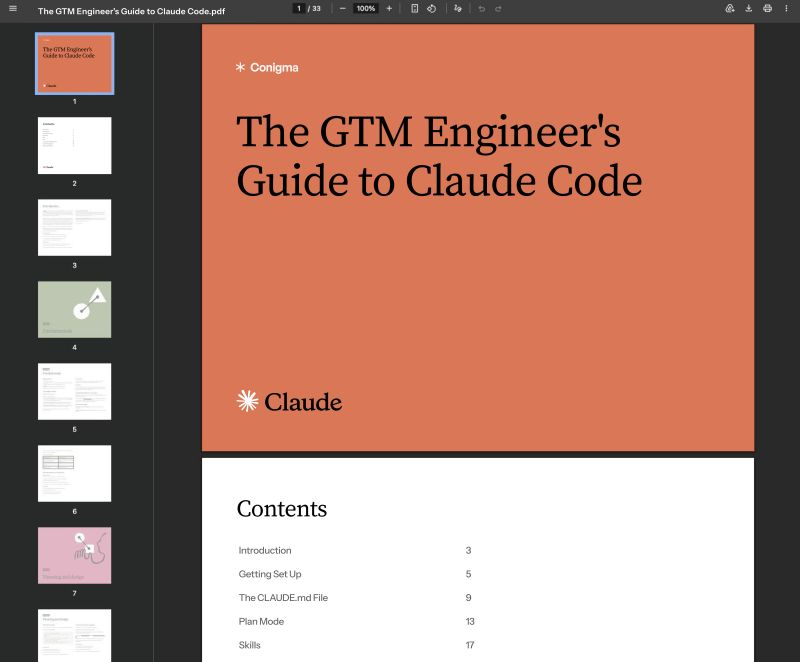
I put the entire Claude Code GTM Engineering Playbook into ONE Notion doc.
8 sections. No fluff.
- How to get set up correctly from day one: Pro plan, terminal install across Mac, Linux, and Windows, GUI install via Antigravity or VS Code, and bypass permissions mode
- What to put in your project brain file, what to leave out, and how to get Claude to update it automatically when it keeps making the same mistake
- How to run plan mode step by step and when to skip it for simple tasks
- How to build a skill file from scratch, fix one that keeps failing, and install 5 GTM skills worth building first: lead scraping, email labeling, proposal generation, outbound sequence writing, and client onboarding
- MCP install process, token cost checks after every install, the best MCPs for GTM work, and how to cut token usage by 50 to 100x by converting MCPs into skills
- Sub-agents and agent teams: the 3 cases where they earn their cost, reliability math for parallel runs, and how to enable parallel variant exploration
- What is eating your context before you type anything, how to use /compact and /clear correctly, and model selection for parent vs sub-agents
- Modal deployment: any skill as a live URL in under 2 minutes, form interface setup, and connection to n8n, Make, or Zapier
This is the setup I would have KILLED for before spending months piecing together how to actually get productive in Claude Code from documentation, YouTube tutorials, and scattered GitHub threads.
Like + comment "CODE" and I'll send it over
(must be connected for priority access)
Respected sir maybe there was a communication issue but the way I remmeber the last 3 questions of my cross examination this evening -
Do you feel remorse - No
Are you sorry about what you said- No
If you tender an unconditional apology this matter will be looked at differently - No I can’t as the apology would not be sincere. Also it would set a terrible precedent for other artists & their freedom.
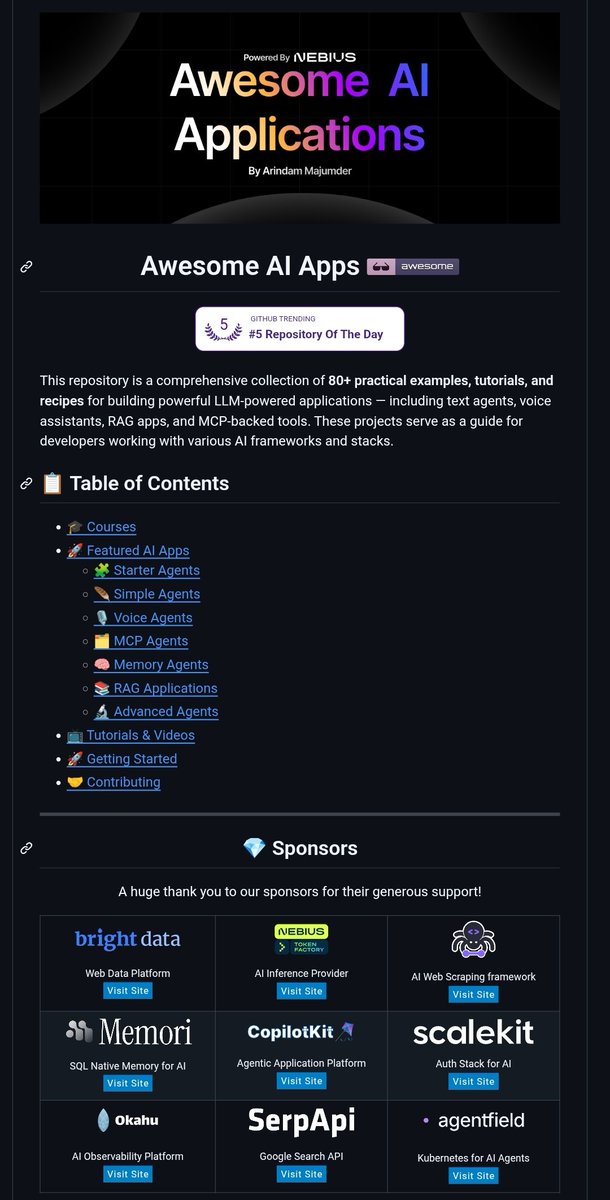
Building ai apps feels overwhelming until you see how others structure it
found this repo with 70+ examples rag, agents, mcp, memory, full pipelines
every major framework covered. every project is runnable
this is how you actually learn
https://t.co/TwxSHsHjrZ
As Yann LeCun and his team has brought a new wave of World Models research into 2026, we have compiled a reading list to recap some of the must-read papers to get you up-to-date about JEPA & World Modeling!
Claire Vo's first day with @OpenClaw it deleted her family calendar.
Now she runs 9 agents across 3 Mac Minis, and said "I haven't felt like this since I was a teenager learning to code."
Her sales agent Sam does a daily CRM sweep, identifies decision-makers from new signups, and sends personalized outreach—replacing a part-time salesperson she was paying 10 hours a week.
Her home agent Finn pings her and her husband every day at 3pm: "Which of you is picking up which kids?" Then flags when the oldest's basketball conflicts with the middle kid's soccer and asks how they want to split duties.
She also has agents for podcast prep, kids' homework help, and course project management.
Claire (host of How I AI, founder of @ChatPRD) started as one of OpenClaw's most vocal skeptics. She now calls it "a ChatGPT moment."
In our in-depth conversation, she breaks down:
🔸 Her exact setup: Mac Mini, separate Gmail, dedicated local account
🔸 The progressive trust model: first calendar access, then read email, then draft, then send — just like onboarding an EA
🔸 Why one agent is a mistake—and why she thinks about it like Slack channels, not a single assistant
🔸 How to use Claude Code as a "brain surgeon" to fix and manage your OpenClaw when things break
🔸 "The yappers API" — why rambling into a voice note is the highest-bandwidth way to set up your agent
🔸 Why management skills matter more than technical skills for making this actually work
Listen now 👇
https://t.co/PXMDm2LEGz