Testing rates are still lagging in prostate cancer, but treatment decisions increasingly depend on getting the genetics right.
Dr. Evan Yu and @TDorffOnc join @alantanmd to discuss germline and somatic testing, BRCA2-driven treatment strategies, PARP inhibitors, and the shift toward biology-based prostate cancer care.
This podcast is supported by an educational grant from Pfizer.
🎧 Listen: https://t.co/h58RRusVgz
#URO307 #ProstateCancer #GeneticTesting #UroOnc
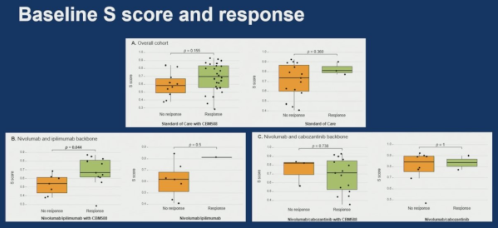
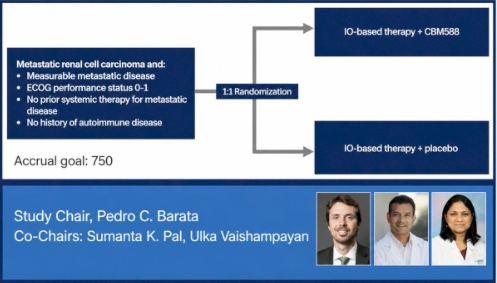
Microbial dysbiosis as predictor of benefit from CBM588 as an adjunct to immune checkpoint blockade-based first-line therapies in metastatic #RCC. Presentation by @RWinayak@cityofhope. #ASCO26 written coverage by @zklaassen_md@GACancerCenter > https://t.co/PpVwpc1XUf @ASCO
CaboNivo final results in non-clear cell RCC presented by Dr Darren Feldman: ORR 43% in Cohort 1 (papillary, unclassified, tRCC), with a striking 88% ORR in FH-deficient RCC. mPFS 11 mo, mOS 28 mo. No responses in chromophobe RCC. CaboNivo confirmed as a standard 1L option for these rare subtypes. #ASCO26 #RCC @OncoAlert@ASCO@OncBrothers
@bftd2025@RevMedicines@LocasaleLab No there’s is not a cure for metastatic pancreatic cancer…. But finally we have a step in the right direction. So I’m hopeful that in 20 years, we may have this.
Highly impactful update from SERENA6. Very nice plateau in the PFS curves with longer follow up, and dramatic reduction in ctDNA and improvement in QoL which suggests deep benefit. Harder to interpret PFS2. Hoping to have this option available for our patients soon. #ASCO26
People who don't follow cancer research often ask me why we haven't cured cancer. That perception masks a wonderful reality: We make amazing, stepwise progress every year, and the result is that many people live much longer today than they would have previously.
Right now we're in the thick of the annual meeting of the American Society of Clinical Oncology, the biggest research meeting on new cancer medicines, and this morning a bunch of really important studies dropped. I'm going to review them here.
This first image is the result for daraxonrasib, a treatment for pancreatic cancer that is generating consdirable excitement. The green line is the probability of living for patients who got the new drug; the gray one is the chemo control group.
If you follow cancer drugs, a chart like this will make your breath hitch a little. I'm going to review these and some other data here.
Absolutely practice changing!! One of the most stunning developments in the treatment of patients with metastatic pancreatic cancer !! It is one of the rare moments in oncology which you will always remember ! Like the imatinib, trastuzumab presentations @ASCO#ASCO26@OncoAlert
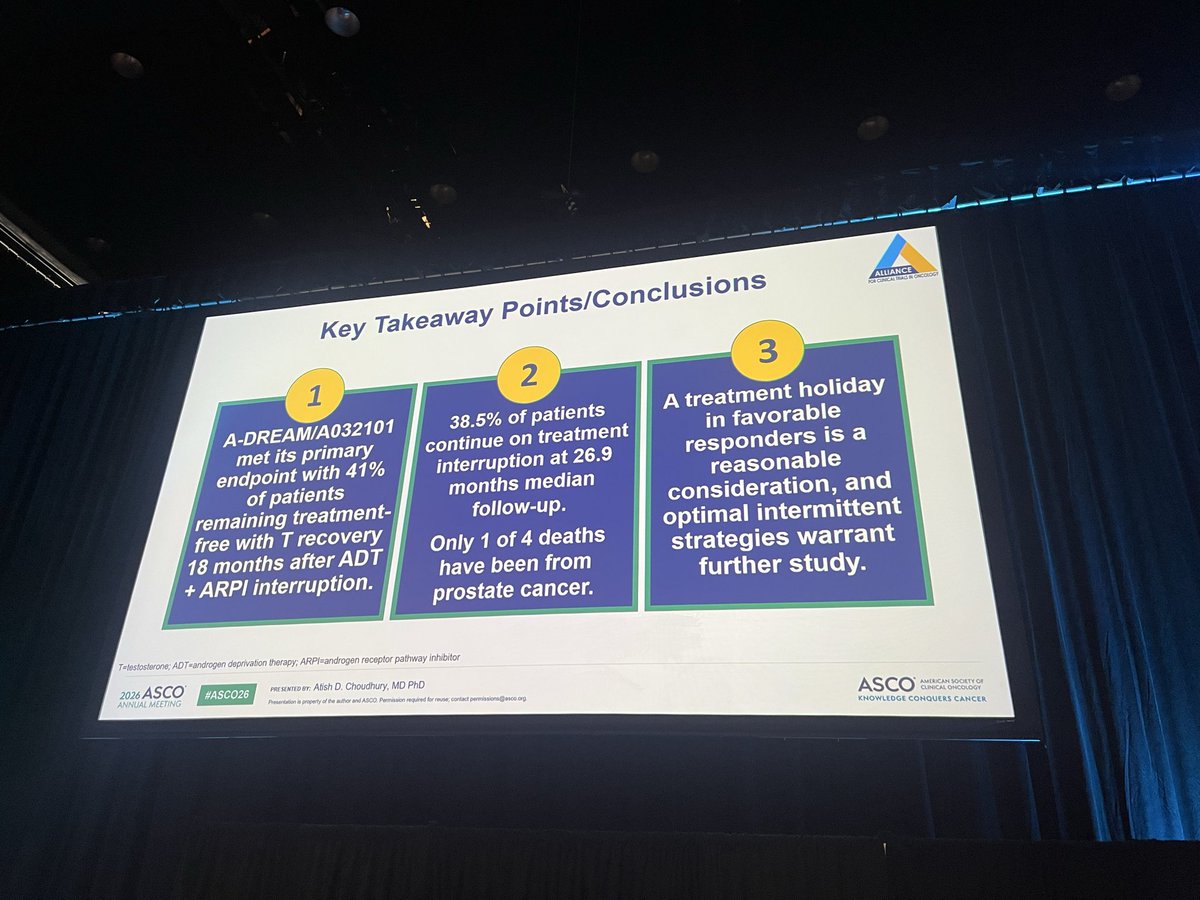
@DanaFarber and @DanaFarber_GU 's very own @AtishChoudhury presents compelling de-intensification data from A-DREAM/A032101 in mHSPC: 41% of favorable responders remained treatment-free with testosterone recovery 18 months after ADT + ARPI interruption, supporting treatment holidays as a promising strategy in selected pts.
#ASCO26 #ProstateCancer
@OncoAlert@ASCO@OncBrothers
Cheers to @neerajaiims on his presentation of the #TALAPRO3 data w simultaneous @NEJM publication! It reflects the dream of many clinical investigators in #oncology - to lead a trial & generate paradigm shifting data in a field that you have devoted your life to (in this case, #prostatecancer).
If you see him at #ASCO26, inquire about his remarkable story. At @huntsmancancer, he built the GU program from scratch into one of the highest performing programs worldwide. He did this over the span of nearly two decades through mentorship of his faculty & fellows (@umangtalking@maughanonc@ziremozay@ggebraelmd et al), extensive outreach to the local community & active participation & leadership in multiple studies (a mix of industry, ISTs & @SWOG). Simply amazing.
RAMPART is the 1st trial to compare PD-L1 vs PD-L1/CTLA4 vs surveillance in adjuvant renal cancer. Only the combination (durva/tremi) is statistically positive for DFS but the numbers are similar for durvalumab alone (especially in clear cell subset). Benefit may have been enriched in the high risk group. The combination has predictable toxicity. This support the premise of the benefit of ICI therapy in UC. It has not clearly resolved the issue of the additional benefits of CTLA4 #ASCO26 @OncoAlert
Bladder-preserving IO-CRT strategy shows encouraging early results in RAD-IO presented by #NicholasJames: durvalumab + chemoradiotherapy achieved 1yDFS 79%, 12-mo PFS 83%, and OS 96% with manageable toxicity in MIBC.
#ASCO26#BladderCancer@OncoAlert@ASCO@OncBrothers