I'm hiring for a cool role! I'm looking for a Senior Director of Product Management to lead our Developer and Ecosystem work on the Chrome team.
As agents change the way people get stuff done, we have a ton of work to do to make sure that people and agents work well together both in the browser and when visiting web sites more generally. This role will cover a broad area (more details below), but I want to highlight two:
1) How can we help people work with their favorite agents in Chrome? As users work with a variety of different agents (some general, some vertical-specific, some role-specific), they need to safely delegate tasks to all of them right in the browser.
2) How can we help sites and apps thrive in the agentic era? As agentic traffic increasingly surpasses human traffic, we need to design the capabilities and protocols for developers to make their experiences agent ready.
If you're interested, check out the details below.
Thanks @aripap and @ericfranchi for inviting me back on the pod and helping me get the word out about the new ad metrics in the Chrome User Experience Report (CrUX) and the even newer analysis @jouncemedia did using CrUX ad metrics.
I’m now 2 for 2 on getting heckled for acronyms on the @marketecturetv podcast. 🤣
Google’s @alextcone joins @aripap and @ericfranchi to unpack CrUX, ad clutter’s impact, and key industry deals. Catch insights on CTV, AI, and more in this episode.
https://t.co/vYvZeJM4Rn
One of my favorite UXs is when you get a new credit card. You add it to Apple Wallet, removing the old card. Later you get an email from Apple saying you have a billing issue with one of your Apple subscriptions (old card you recently replaced in Apple Wallet). You click the link to remedy and when you go to add a new card, Apple Wallet is nowhere to be found.
Today @ckane's @jouncemedia published data on Chrome's new ad metrics. All 4 metrics are correlated with Jounce's marketer conversion score metric. ⭐️ Average ad count and density in viewport are the most predictive. ⭐️
Jounce gives this advice to DSPs: "To drive maximum performance for buyers, DSPs should bid more often and at higher prices for low ad count domains. In the process, DSPs will also create healthier incentives for publishers." ❤️
Jounce Media subscribers can read the whole report and attend a webinar tomorrow at 1:30 ET. https://t.co/hARvwLoTwp
Thanks for sharing!
Starting with Chrome 159 (currently in Chrome Canary and due to be stable in early December) we will include main frame in ad CPU. Depending on traffic, sites should start to see the data reflected in CrUX (a 28 day aggregation) sometime in early January.
One thing I’m curious about in your report is why you didn’t spend much time on average ad count in viewport. From the Jounce report and data I’ve seen that’s not publicly shared, ad count has the strongest correlation with ad campaign outcomes and thus is most likely to be a signal the buy side uses.
If you’re curious about how @googlechrome is thinking about the present and the future, there’s no better place to turn than this interview with @jebank. I dare you to watch on 1.25x speed and keep up with how fast Jacob’s mind works.
Had a great time talking about the future of Chrome with @conorgrennan on the AI Applied podcast. A few of the topics we covered:
- Why AI isn't going to do everything for us
- How different users with different needs will use AI
- Why the browser presents cool opportunities for collaborating with AI
Check it out: https://t.co/rGcqh2E5Cg
Waaaaayy back in 2016, we shared a roadmap to mark HTTP as "Not Secure" and help nudge the web toward HTTPS by default: https://t.co/mNObCrcPzu
Here is a picture of our kick-off cake! 🔐🍰
A decade later, HTTPS is the standard—and today @googlechrome is enabling proactive warnings before insecure HTTP connections. 🧵
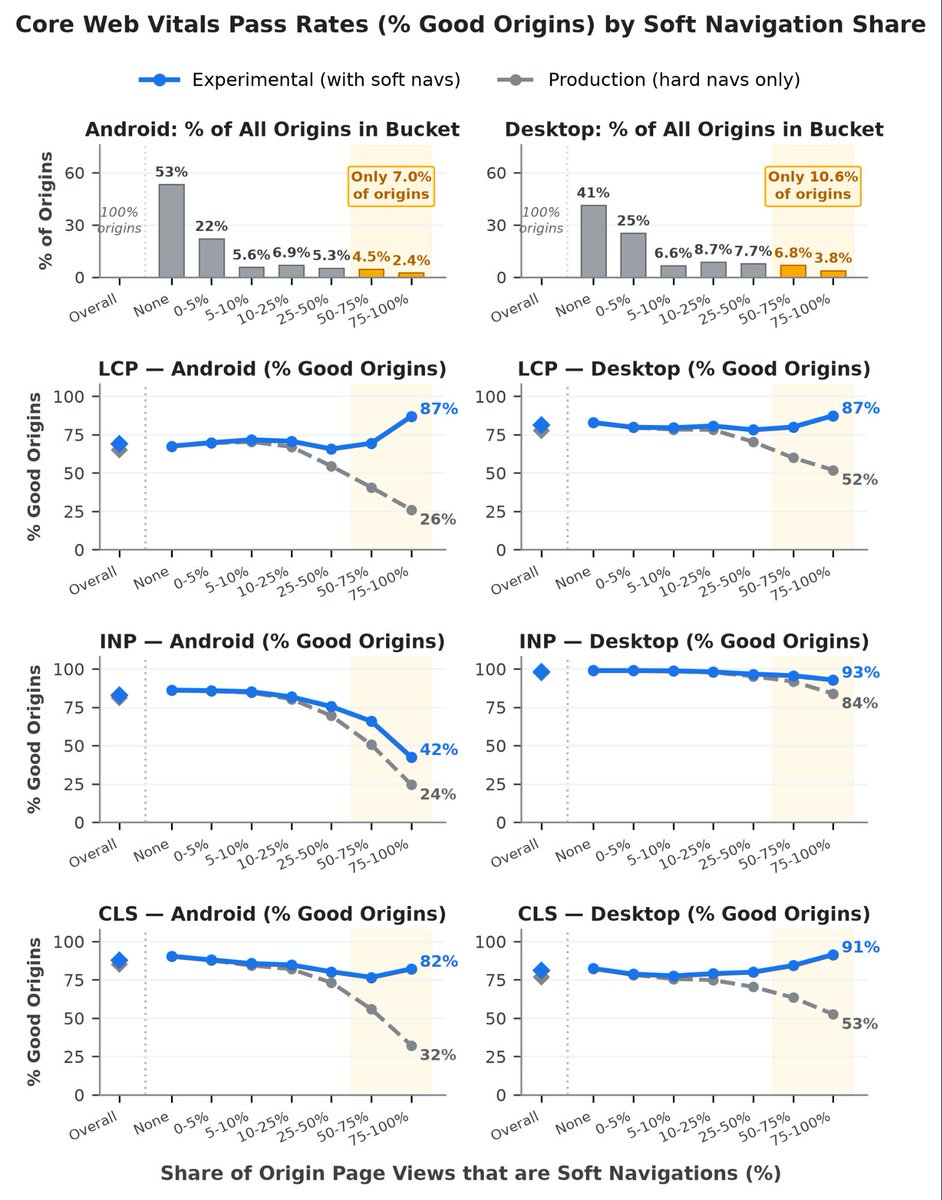
We've expanded Core Web Vitals to include special support for soft navigation (SPA)!
Since SPAs are handled differently in their implementation, they've required bespoke custom measurement, making it hard to compare directly across sites. Measuring performance is a little art, a little science. Over time, we've evolved CVW to best fit how the web is written, and we've found that giving SPAs their own unique metrics has had the best outcome.
More here, including access, and plans for SEO:
https://t.co/KFkscKZeRQ
Chrome is taking another big step toward providing a clearer picture of real user experiences on the web. Today, in the Chrome User Experience Report, we added experimental versions of Core Web Vitals with soft navigation measurements included. This comes on the heels of releasing two new APIs, DevTools and web-vitals.js upgrades that enable the ecosystem to measure soft navigations easily and comparably.
My colleague Annie wrote a helpful post to build understanding about what measuring soft navigations means. https://t.co/MPcMtyrC6m
This is a helpful overview of the ad experience metrics we launched a few weeks ago in the Chrome User Experience Report. If you're curious and you prefer video explanations to written docs, this one's for you.
Google has introduced a new set of performance metrics providing insight into how ads impact page speed.
This video explains what the metrics measure and how to view ad performance data in Chrome DevTools.
https://t.co/9gZMW6mmlm