In new working paper, we ask why East Asian countries, China, Japan and Korea, now have the lowest total fertility rate, despite the fact that the Confucian heritage long placed extraordinary emphasis on large families, i.e. Confucian Fertility Paradox.
https://t.co/TtMnRi0RT5
"Economic Models of Identity Formation and Cultural Transmission" is a brilliant literature synthesis who Alberto Bisin @albertobisin and Thierry Verdier @thierryverdier2, whose own contributions have defined the field. This is a wonderful demonstration of the successful integration of ideas from psychology and sociology into formal economic models. Invaluable for teaching and as a research reference.
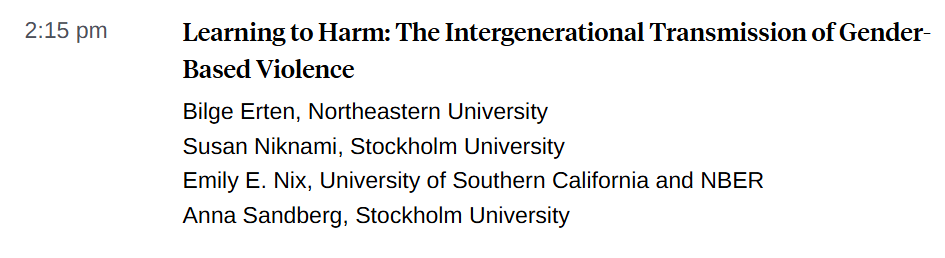
Excited to see our paper, "Learning to Harm: The Intergenerational Transmission of Gender-Based Violence," included at NBER SI 2026 Gender in the Economy! @nberpubs
https://t.co/ZjalKzJGPv
Looking forward to hearing my fantastic co-author @EmilyNix100 present it!
#Econtwitter
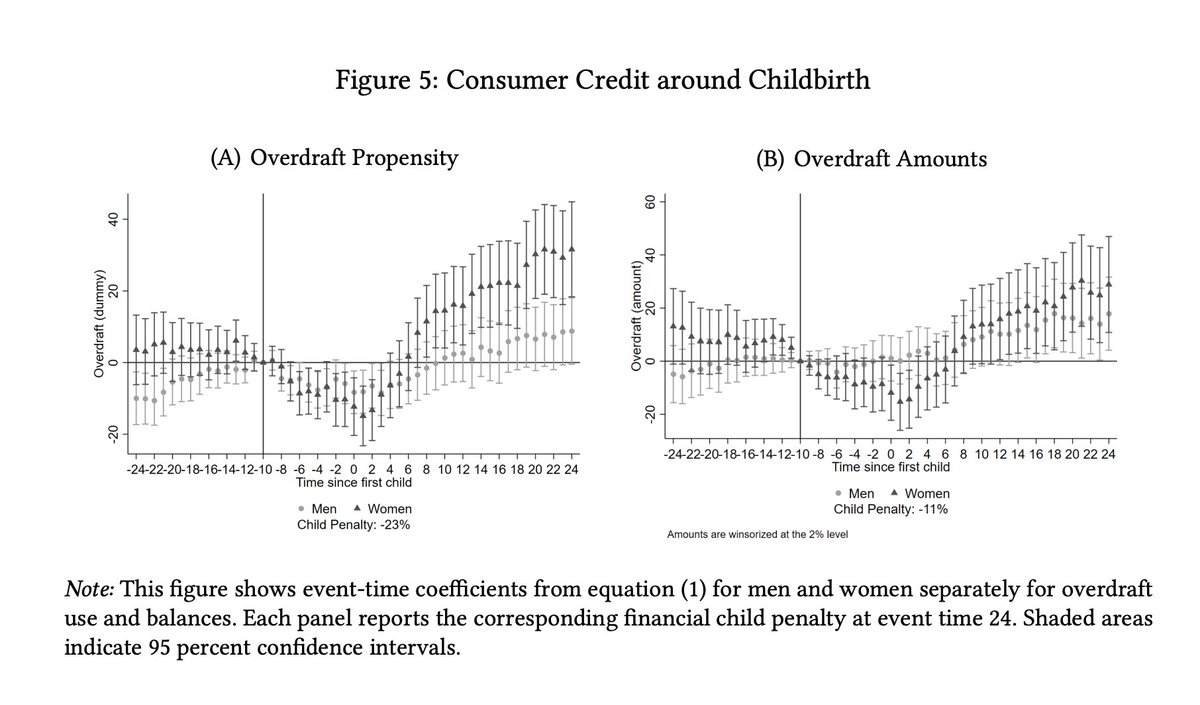
Child penalties extend to household financial outcomes:
• Women save less after having kids than men
• Women participate less in stock markets and risky assets
• More likely to have account overdraft
• Persists
https://t.co/fQZIFKBssM
by Arna Olaffson and David Westerheide
Finding NBER Summer Institute talks on YouTube is surprisingly frustrating.
I asked Claude to build a searchable webpage that finds any talk by paper, author, or session, and jumps straight to where it starts in the video.
Link in the first reply.
Download 698-page PDF eBook…
Everything You Always Wanted To Know About Mathematics* (*But didn’t even know to ask)
A Guided Journey Into the World of Abstract Mathematics, Theorems, and the Writing of Proofs: https://t.co/JLsDOmpP1q
Such great and varied papers at the @nberpubs Political Economy Summer institute 2026 and how fun to co-organize it. You can watch the livestream here: https://t.co/IPlqSwvyxa
🚀 Major update!
My Replication Package Guide is now the 🤖 AI-Assisted Research Project Management and Replication Guide.
1️⃣ Set up the project from Day 1
2️⃣ Build the replication package before acceptance
🔗 https://t.co/X6apuxJRfY
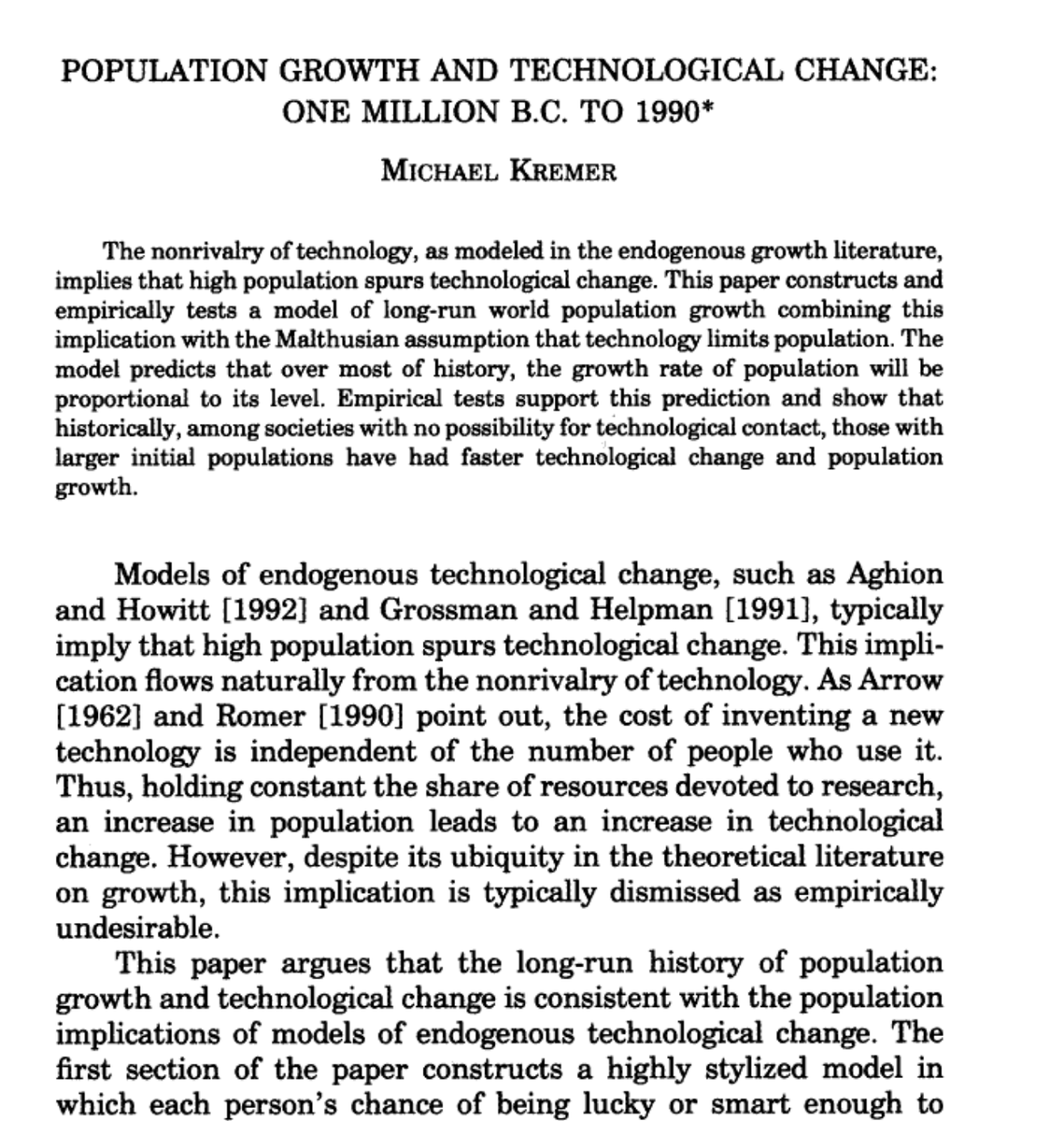
Since I am working on a new paper on demographics and growth (big surprise!), I have just reread Michael Kremer’s “Population Growth and Technological Change: One Million B.C. to 1990.”
I read it as an undergraduate. I read it again as a graduate student preparing for my growth prelim in Minnesota. And I read it years later, when I taught growth theory to undergraduates at Penn, where I even put together slides that I still use regularly for my economic history course.
And yet, however often I go back to it, I am still amazed at how elegant the paper and its argument are. As Italo Calvino once remarked:
“Every rereading of a classic is as much a voyage of discovery as the first reading.”
(Perché leggere i classici, 1981)
Kremer’s paper is exactly that. Oh, how I wish I could write papers like it!
By the way, read Calvino’s essay as well. In English here:
https://t.co/PlcWsl3kAy
📘 I revised my Guide to Recording AI Use following helpful comments from Gary (@kinggary) and @PolMethSociety
🔗 https://t.co/MgegLXvxLk
Please share widely! 🔄🌍 Comments welcome. 💬
@RonnieChatterji@ben_golub It will be interesting to see how things evolve. So many analyses that were not possible before were possible now. Like analyzing the emotional content of policy debates (over the really long-run too) as we do in this new paper: https://t.co/ewKghJlbNv
Fertility rates across many countries have converged, despite starting from very different levels.
(This Data Insight was written by @_HannahRitchie.)
In the thirty years since I was born, fertility rates in my country, the United Kingdom, have not changed much. In 1993, the fertility rate was 1.8 births per woman. Thirty years later, it had dropped only slightly, to 1.6 births.
Elsewhere, the change has been much more dramatic; fertility rates have dropped sharply and are now similar to those in the UK.
You can see this in the chart, which shows the change in fertility rates from 1993 (in blue) to 2023 (in red). In Qatar and Iran, rates dropped from almost 4 births per woman to 1.7.
Fertility rates have fallen a lot across Asia and South America, too — Malaysia and Colombia are two examples. This marks a much faster demographic transition than many countries experienced historically.
Convergence isn’t the whole story, though. Here, I’ve picked countries with fertility rates that are similar to the UK’s today. But some have fallen far below these levels: in Chile and Thailand, the fertility rate was 1.2 births per woman in 2023, and may have fallen even further.
Forthcoming in the AER: "Who Marries Whom? The Role of Segregation by Race and Class" by Benjamin Goldman, Jamie Gracie, and Sonya R. Porter. https://t.co/syIG0Xn2BG
I made 3 practical guides for using AI agents in research workflows 🤖📚
📦 Replication packages
https://t.co/X6apuxJRfY
🧹 BibTeX cleaning
https://t.co/7LzkVMb5Un
✍️ Shared Overleaf projects
https://t.co/MgegLXvxLk
Please share with researchers/students 🙏
📯 Call for Papers: first edition of the Italian Macro with Micro Data Workshop
🗓️ October 2, 2026 at University of Naples Federico II
Submit papers here: https://t.co/EfkXYqkWqH
With a keynote by the great @isaacbaley! Share with colleagues, especially if based in Italy!
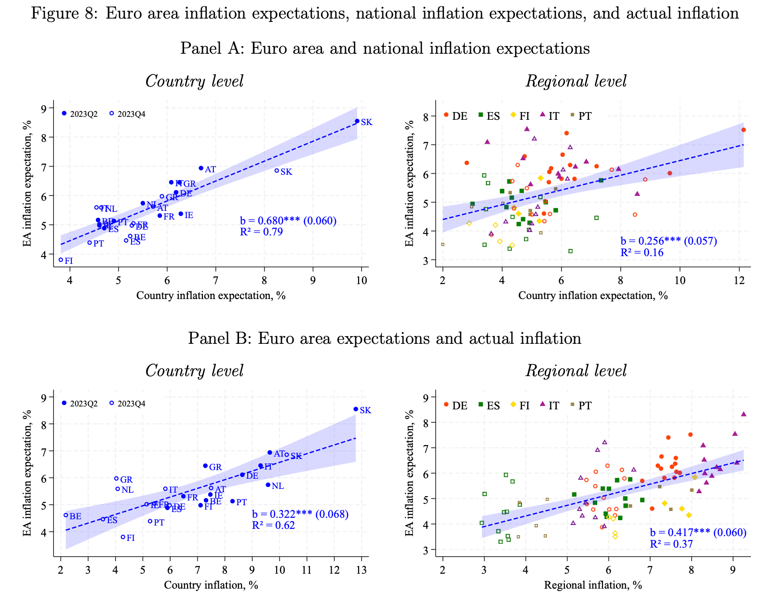
How do firms form inflation expectations in a heterogeneous monetary union? Using novel euro area survey data, including an RCT, the paper shows that firms' beliefs are consistent with Bayesian updating, extrapolating from regional and national inflation to euro area expectations
Until the middle of the 20th century, few countries had political leaders that were women. These were monarchs, who rose to their positions because of their royal lineage.
Since then, many more countries have had a woman as chief executive — that is, the head of state or head of government, depending on who has more power. This trend has been driven mostly by democracies.
This began with Sri Lanka’s democratically elected Sirimavo Bandaranaike in 1960. It has also included democratic leaders who were directly elected by their citizens (instead of being elected through elected representatives), with the first being Nicaraguan president Violeta Chamorro in 1990.
The chart shows that this trend has accelerated recently. More than 40% of countries have now had a woman leader (regardless of how they gained office; the purple line), and over 30% have had a democratically elected one (green line).
While there has been progress for women leaders, they remain underrepresented, especially in the highest offices.