From Tokens to Policy: Causal and Interpretable Heterogeneous Treatment Effects Identification
Riccardo Cadei, Frank Otchere, Nyasha Tirivayi, Gustavo Angeles Tagliaferro, Falco J. Bargagli-Stoffi, Francesco Locatello
https://t.co/ZFmVF6Bi0N [𝚌𝚜.𝙻𝙶]
A German group (TUHH + neutral-atom startup @planqceu) compiled a dense airfoil-flow operator into a quantum circuit at ~1e-9 error.
Same method beats Suzuki-Trotter by ~1000x on Ising dynamics. One ancilla qubit, any chip layout.
Quantum compiler tooling. 🧵
Title: Scalable Circuit Learning for Interpreting Large Language Models
Author: Naiyu Yin, Dennis Wei, Tian Gao, Amit Dhurandhar, Karthikeyan Natesan Ramamurthy, Yue Yu
CircuitLasso is a meaningful advance in making mechanistic interpretability computationally scalable. It also moves interpretation in the right direction by studying relations and flow across layers rather than searching for meaning in isolated neurons.
Its circuit, however, remains a sparse, static, first-order projection of a dynamic computation. The actual neural mechanism is likely not a tree of monosemantic objects, but a prompt-conditioned integral flow through overlapping, stacked piecewise manifolds. The SAE labels make that flow readable to humans; they do not necessarily reveal its intrinsic mathematical substance.
The most promising synthesis would be boundary-conditioned CircuitLasso: learning multiple local dependency graphs indexed by prompt class, token context, layer region, or fixed-point basin, rather than treating one population-level graph as the model’s universal circuit.
Deep Manifold View: What often appears externally as a circuit is not, in the strict sense, a fixed circuit. It is an intrinsic pathway through stacked piecewise manifolds. This pathway functions as the effective boundary-conditioned route for the iterated integral: the prompt and context define the boundary conditions, while the intrinsic pathway determines how activation flow is integrated across layers toward a dynamic fixed point. A circuit diagram is therefore only a sparse, static projection of this deeper and continuously evolving pathway.
#DeepManifoldInterpretation
.@IBM Quantum just turned the classical-vs-quantum race into a handshake.
New trick: classically precompute a noise-canceling observable, then measure it on 56 superconducting qubits.
Result: a quadratic cut in sampling cost vs standard error cancellation. 🧵
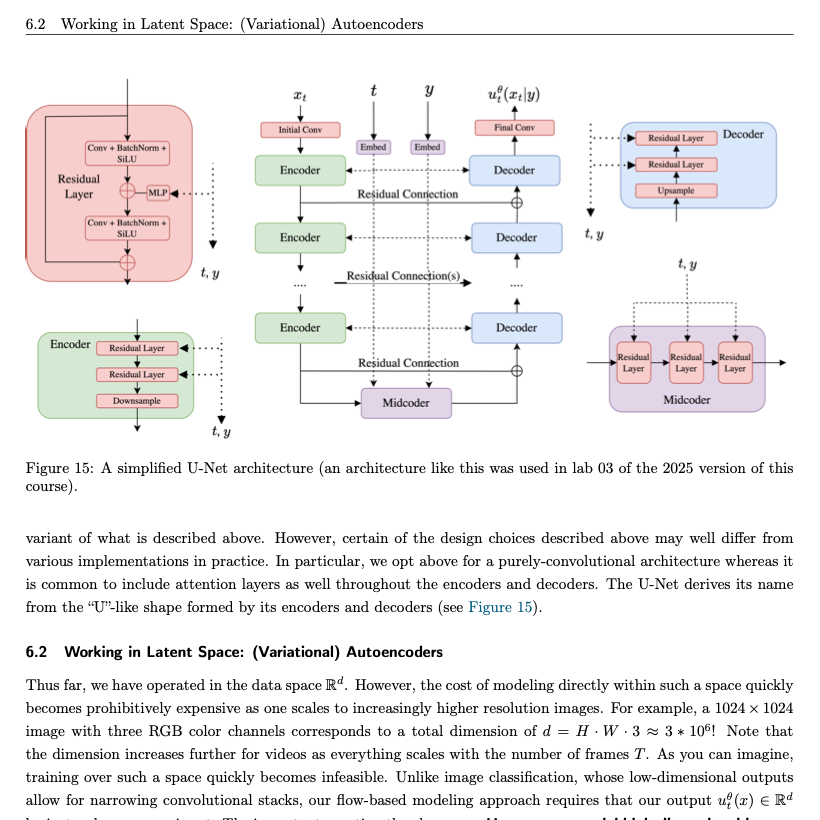
"An Introduction to Flow Matching and Diffusion Models" is a set of MIT lecture notes for the course "Generative AI With Stochastic Differential Equations" (2026) that provides a clear introduction to the mathematics behind modern generative AI.
The notes discuss flow matching and denoising diffusion models as core techniques behind many advanced generative systems, with references to models such as Stable Diffusion 3, FLUX, VEO-3, and AlphaFold3.
They develop the mathematical foundations of generative modelling, covering topics such as sampling from probability distributions, ordinary and stochastic differential equations, Brownian motion, diffusion processes, flow matching, score matching, classifier-free guidance, architectures for image and video generation, latent spaces, autoencoders, and discrete diffusion models for language generation.
What I particularly appreciated is the teaching style. The notes first build geometric and probabilistic intuition and only then derive the complete mathematical formulations. The result is a treatment that is rigorous, visual, and remarkably approachable.
This is probably one of the best freely available resources for understanding what is actually happening under the hood of diffusion models from a mathematical perspective.
https://t.co/J96rHCBPrb
https://t.co/qIiyVEXurG
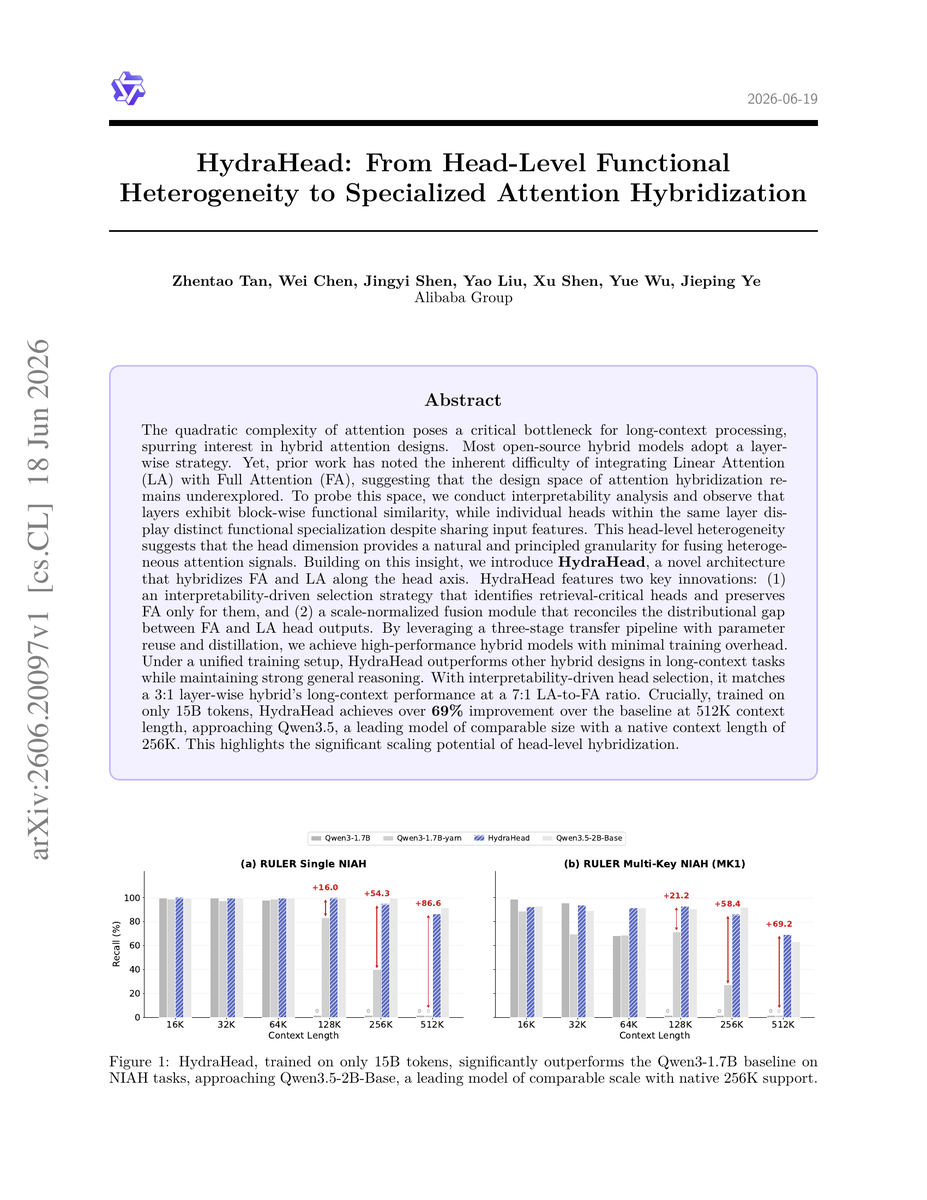
Headwise hybridization of SSM and Attention for pretrained checkpoints. Unlike Hymba they use headwise scaling with concatenation.
Not all Jensen-Shannon Divergence Estimators are Equal
Alba Garrido, Alejandro Almodóvar, Mar Elizo, Patricia A. Apellániz, Santiago Zazo, Juan Parras
https://t.co/sJ7P07o34C [𝚌𝚜.𝙻𝙶]
Dana Scott – Lambda Calculus, Forcing & the Foundations of Math
https://t.co/T7K324hwqM
https://t.co/b96q1g2LC5
Turing Award winner on his groundbreaking work on lambda calculus, forcing, and Boolean-valued models and how these ideas revolutionized set theory and computability.
Thrilled to share that our paper, “Deep learning reveals antimicrobial peptides within prions,” is now published in @NatureMicrobiol@NaturePortfolio.
In this work, we used AI to ask an unexpected question: could proteins best known for their role in fatal neurodegenerative diseases also encode molecules that fight infection?
Prions and prion-like proteins are usually viewed through the lens of misfolding, aggregation, and disease. But biology is often more layered than our labels suggest. Our study shows that these proteins can contain encrypted antimicrobial peptides, which we call prionins.
This connection did not come out of nowhere. Previous studies had shown that certain amyloid-associated protein sequences, including amyloid-β and the cellular prion protein, can have antimicrobial or host-protective activity.
But until now, this had not been explored systematically across prion and prion-like proteins at scale.
Using our deep-learning platform APEX 1.1, we screened 19.3 million peptide fragments from 2,897 prion-related proteins. This search identified 1,179 candidate antimicrobial peptides, moving from scattered observations to a global AI-guided search across millions of possible protein fragments.
We then moved from prediction to experiment. Of 75 synthesized prionins, 59 inhibited at least one bacterial pathogen, including multidrug-resistant strains. Forty-two showed activity at 16 µM or lower against at least one pathogen.
Many prionins disrupted bacterial membranes, and a subset showed encouraging early selectivity, including minimal hemolysis and limited cytotoxicity. Two lead prionins also reduced Acinetobacter baumannii burden in a mouse skin-infection model, with efficacy comparable to polymyxin B in the model tested.
This is still early-stage work. We do not show that prionins are naturally released during infection or that they function physiologically in host defense, and these findings do not represent a treatment ready for patients.
But the study raises a provocative idea: proteins long viewed mainly as biological “villains” may also encode useful molecular functions.
More broadly, it shows how AI can become a discovery engine for biology: helping us search hidden molecular spaces, connect seemingly distant fields such as neurodegeneration and innate immunity, and uncover new starting points for medicine in places we might never have thought to look.
At a time when new antibiotics are urgently needed, expanding where we search matters.
Deeply grateful to @mdt_torres, Fangping Wan, and everyone who made this work possible, including @Penn, @CBE_Penn, @PennBioeng, @PennEngAI, @PennEngineers, @PennMedicine, @PennChemistry, @PennMicro, @PennPsych, and @PennSAS.
https://t.co/Teou3HbVOS
In 1991, the foundations for Transformers, Pre-training, Distillation, and World Models were already being built. These helped shape my own thinking, from my time at Google Brain to our Recursive Self-Improvement (RSI) work at @SakanaAILabs today. 🧠🗼
https://t.co/hf4ESZRgcD 👇


![fly51fly's tweet photo. [LG] How Transparent is DiffusionGemma?
J Engels, C McDougall, B Chughtai, J Kramar… [Google DeepMind] (2026)
https://t.co/hwqCwrBhhQ https://t.co/dzvsOruT8p](https://pbs.twimg.com/media/HLNQB52bQAAvjLl.jpg)
![fly51fly's tweet photo. [LG] How Transparent is DiffusionGemma?
J Engels, C McDougall, B Chughtai, J Kramar… [Google DeepMind] (2026)
https://t.co/hwqCwrBhhQ https://t.co/dzvsOruT8p](https://pbs.twimg.com/media/HLNQBqibsAAT4a6.jpg)
![fly51fly's tweet photo. [LG] How Transparent is DiffusionGemma?
J Engels, C McDougall, B Chughtai, J Kramar… [Google DeepMind] (2026)
https://t.co/hwqCwrBhhQ https://t.co/dzvsOruT8p](https://pbs.twimg.com/media/HLNQBOdbgAA5ndg.png)
![fly51fly's tweet photo. [AI] Multi-Agent Transactive Memory
T E Kim, X He, D Jain, A Agrawal… [CMU] (2026)
https://t.co/fYOsI82wLu https://t.co/lEEXMEveYF](https://pbs.twimg.com/media/HLNU_4Na8AAx1IF.jpg)
![fly51fly's tweet photo. [AI] Multi-Agent Transactive Memory
T E Kim, X He, D Jain, A Agrawal… [CMU] (2026)
https://t.co/fYOsI82wLu https://t.co/lEEXMEveYF](https://pbs.twimg.com/media/HLNU_ssboAARd-q.jpg)
![fly51fly's tweet photo. [AI] Multi-Agent Transactive Memory
T E Kim, X He, D Jain, A Agrawal… [CMU] (2026)
https://t.co/fYOsI82wLu https://t.co/lEEXMEveYF](https://pbs.twimg.com/media/HLNU_FDaMAAkNKL.png)




![fly51fly's tweet photo. [LG] How Transparent is DiffusionGemma?
J Engels, C McDougall, B Chughtai, J Kramar… [Google DeepMind] (2026)
https://t.co/hwqCwrBhhQ https://t.co/dzvsOruT8p](https://pbs.twimg.com/media/HLNQCGWboAExdGb.jpg)
![fly51fly's tweet photo. [AI] Multi-Agent Transactive Memory
T E Kim, X He, D Jain, A Agrawal… [CMU] (2026)
https://t.co/fYOsI82wLu https://t.co/lEEXMEveYF](https://pbs.twimg.com/media/HLNVAC9aYAAoVix.jpg)