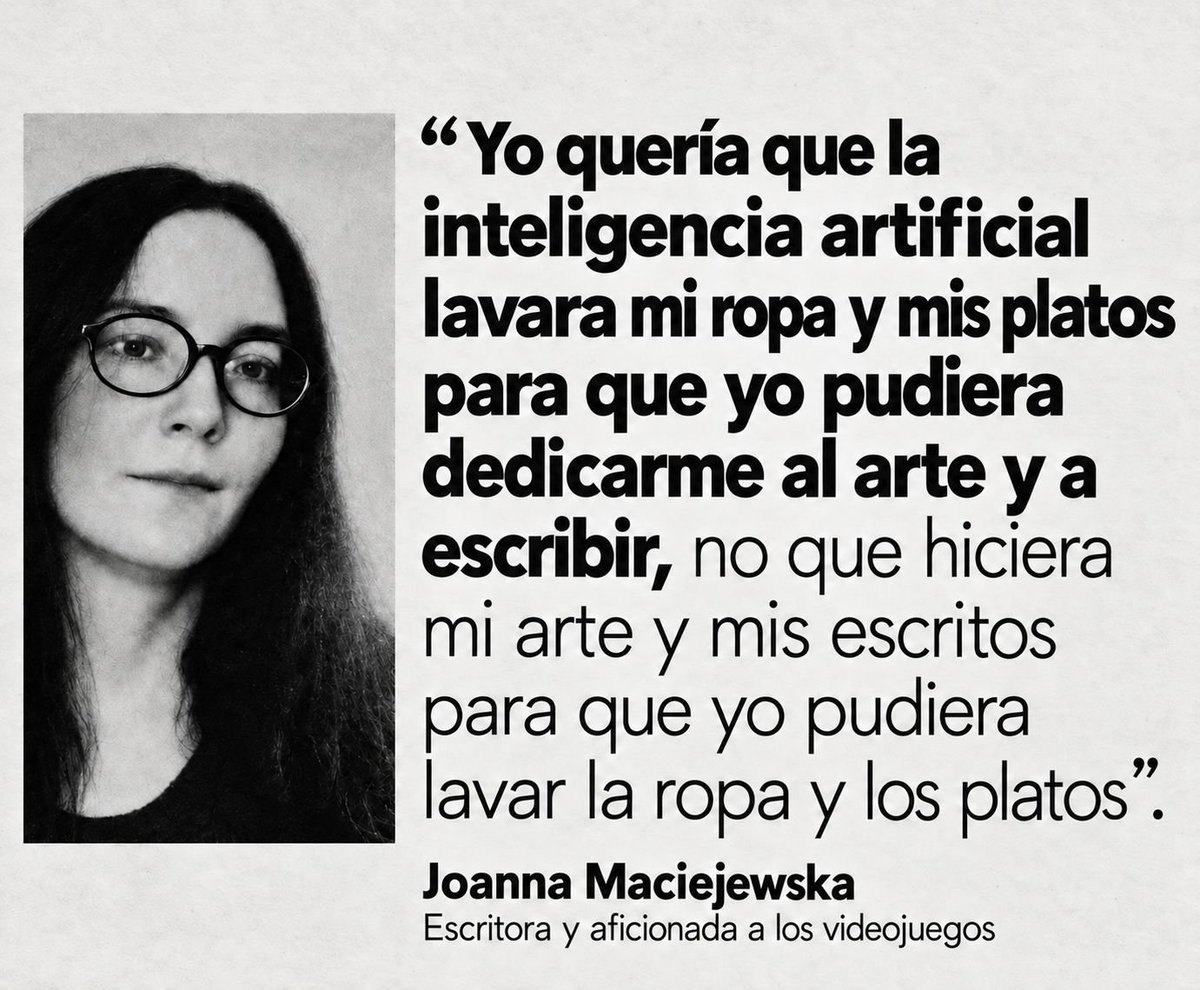
En este momento Feijoó ha destrozado el burdo intento de manipulación de Sánchez y Colau, con la farsa del #calladita.
Esto les va a costar no solo credibilidad a la izquierda, sino otros tantos miles de votos.
We're giving away a Hogwarts Legacy custom wrapped NVIDIA GeForce RTX 5090 to celebrate its official release with DLSS 5 🪄
To enter:
🟢 Share this post
🟢 Comment #RTXON
Terms and Conditions: https://t.co/45T3R732hf
@thsottiaux Profile switch configuration. Diferent profiles means diferent skills and mcps combinations. I love the implementación of opencode with tabs.
We'll be spending a lot more time trying to understand the outputs of language models. A few thoughts, tips & tricks:
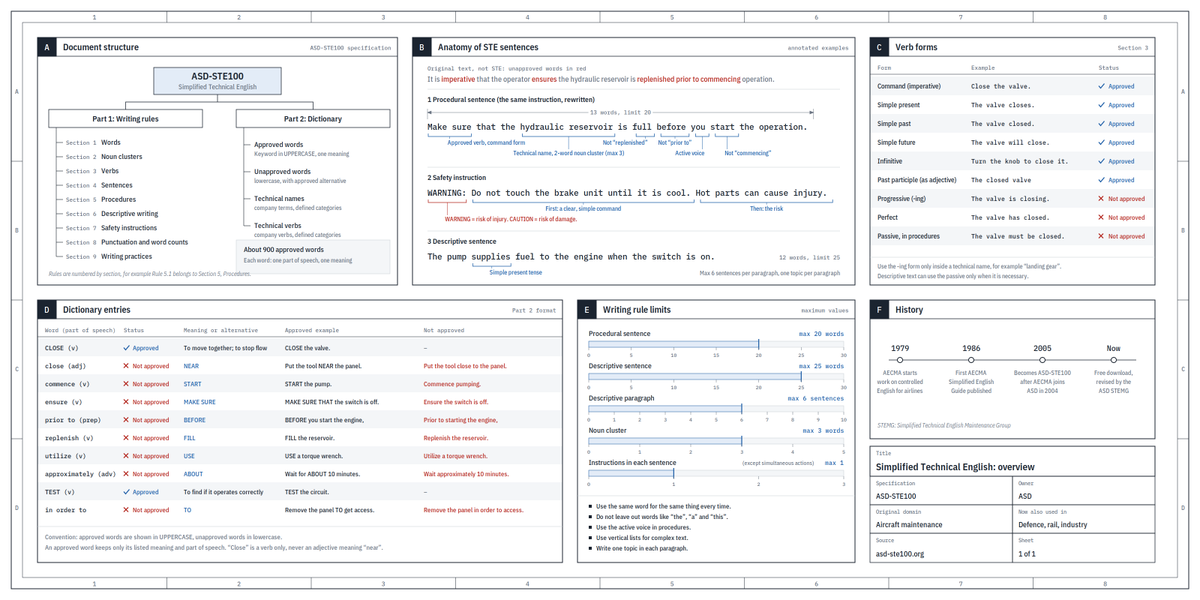
Writing. Something I've had success with: Ask your LLM to explain something in ASD-STE100, it's a controlled language specification originally developed for aerospace maintenance documentation. LLMs well-versed in this language and it comes with heavy constraints on clean writing style that I often find a lot more readable. Sometimes I've tried to soften it a bit e.g. ask for "80% of the way to ASD-STE100" because the spec is quite stringent. But even better:
Diagrams / images. Instead of writing, ask your LLM to create a diagram. These can be a lot easier to process, parse, and understand. But even better:
Web pages. Ask for output "in HTML" to get a beautiful, interactive webpage. LLMs are getting really good at frontend and can create beautiful experiences, animations, etc. But even better:
Explainer videos. The output format I am most bullish on is fully custom / bespoke explainer videos generated on any arbitrary topic. Experiment with things like "Create a 3b1b style video explainer on X. Use my ElevenLabs API key for audio narration". (you'd need an API key for the latter or you can ask your LLM to find you decent free alternatives that use your local compute). This is actually starting to work!
In summary:
- As LLMs get better, they will do more and more of the legwork autonomously, and a lot more of our work will rise up the abstractions into oversight and understanding.
- Luckily, LLMs can help here too because as intelligence and code are increasingly abundant, you can ask for large, custom, discardable software artifacts (e.g. web apps, video explainers) that would have never made sense to create before. Push the boundaries here and you'll be surprised.
You can get the entire codebase to fine-tune a model on AWS from the following workshop:
https://t.co/APLfX4b0L6
There are four different examples:
• Supervised Fine-Tuning (SFT) DOP
• Direct Preference Optimization (DPO)
• Reinforcement Learning from Verifiable Rewards (RLVR)
• Reinforcement Learning from AI Feedback (RLAIF)
Also, check out the AWS AI Virtual League. They have a few upcoming events where you can compete by building agents and fine-tuning models:
https://t.co/QxPJKH8Gdp
Thanks to the @AWS team for partnering with me on this post.
Recordad: dedicando poco esfuerzo habrán cientos haciendo miles de cosas. El valor ahí es nulo. Pero que dediquen el tiempo que merecen las cosas, con gusto y cariño, seguirán siendo muchos menos.
Mientras la dinámica de invertir más trabajo para un mejor resultado siga aportando valor al público, habrá mercado.
Ahora estamos en una fase transitoria en la que como podemos hacer lo que antes llevaba mucho curro en pocos minutos, nos parece fascinante. Pero somos de acostumbrarnos rápido (adaptación hedónica) y eso reajustará nuestras preferencias.
Si queréis trabajar en algo, con IA o sin ella, dedicadle tiempo, cariño y trabajo. Aprovechad la oportunidad par elevar el nivel de calidad y ofreced algo que os destaque frente al resto.
Siempre ha funcionado así y no va a cambiar ahora.
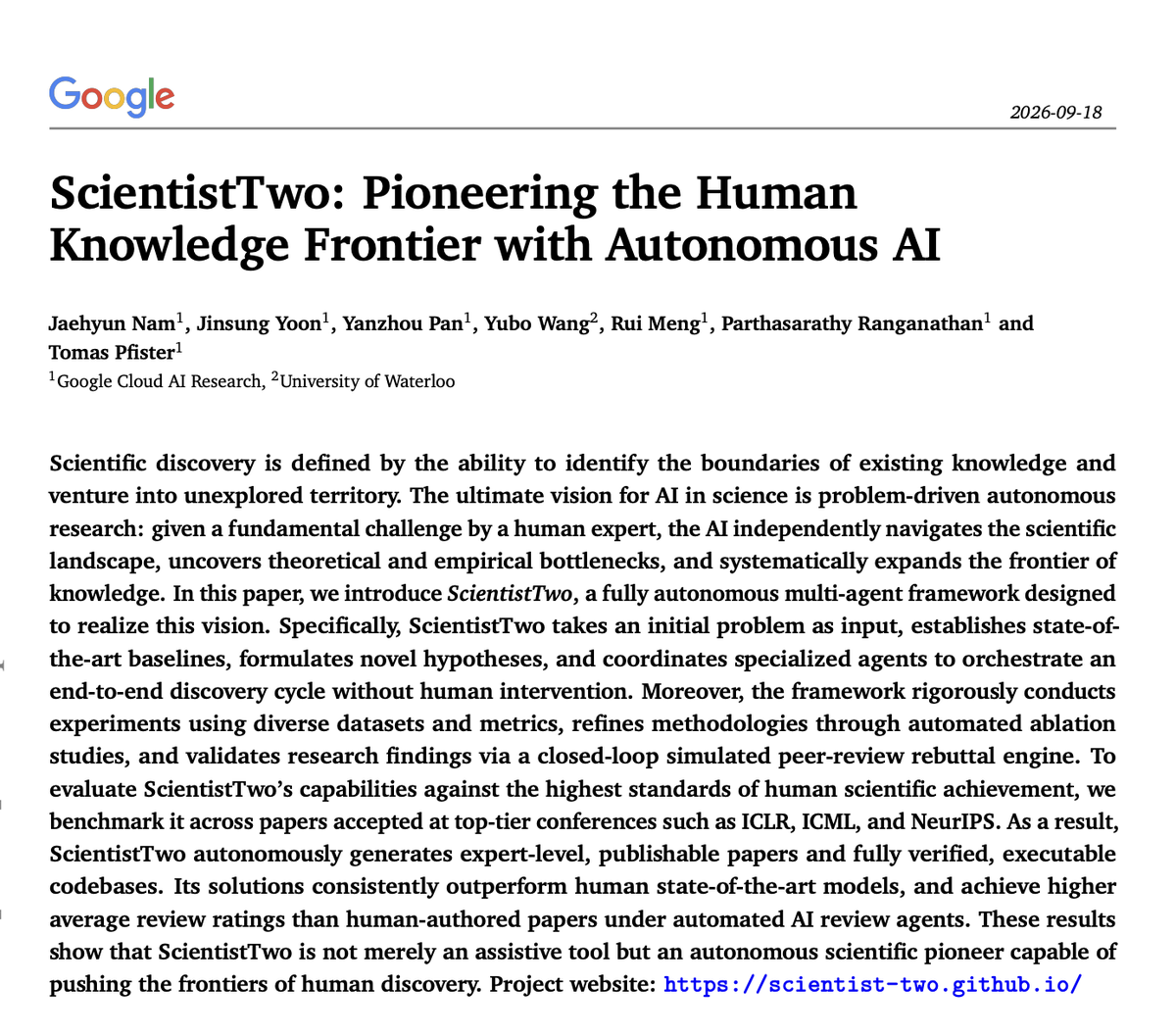
Google just automated the PhD.
They built an AI that reads a problem, forms hypotheses, runs experiments, writes the paper, AND simulates its own peer review. no human touches it.
It’s called “ScientistTwo”
It is a fully autonomous multi-agent framework that executes end-to-end machine learning research.
Without a single human in the loop.
You give it a fundamental challenge. That’s it.
The AI independently navigates the literature. It establishes the baselines. It formulates novel hypotheses.
Then it writes the code. It runs the experiments. It conducts its own ablation studies.
It even argues with a simulated peer-review engine to refine its work before submitting.
The results are staggering.
Researchers tested ScientistTwo against the highest standards of human scientific achievement—papers accepted at top-tier conferences like NeurIPS and ICML.
The AI improved human state-of-the-art results on 86 different tasks.
It generated an average performance gain of 25.2% over the absolute best human models.
It didn't hallucinate a single citation. It wrote fully executable, verified codebases. And it autonomously generated expert-level, publication-ready papers.
We’ve spent the last two years using AI as a highly advanced intern to help us write code and summarize data.
That era is over.
ScientistTwo isn't an assistant. It is an autonomous scientific pioneer.
It doesn't just summarize the frontier of human knowledge. It expands it.
If an AI can autonomously hypothesize, test, and publish breakthroughs in machine learning...
How long until it discovers something we don't even have the math to understand?
What if AI could help bring the golden age of 2D animation back to cinemas?
I brought this incredible pencil test by legendary Disney animator #MiltKahl for Pinocchio to life using AI.
There’s something really special about seeing these rough drawings come alive with a 3D look. And I think that’s where AI could become genuinely useful for animation: letting animators focus more on acting, timing, and motion instead of polishing every tiny detail, like the eyes or nose, as you can see in the rough pencil test used here.
AI won’t replace 2D animation. It could help bring it back to the big screen (or Netflix).
#Seedance #Dreamina
Llevamos un tiempo recibiendo novedades de los agentes de voz pero nunca nadie midió el fallo que más se ve en producción...
Y es que el ruido de fondo ya no es el problema, o sea, el teclado, el AC, el tráfico… eso ya está resuelto.
Lo que los rompe es otra persona hablando cerca. Porque eso no es “ruido”. Es otra voz. Misma forma de onda, mismas pausas, mismas eses.
El modelo no sabe a quién hacerle caso y se come el turno, responde a algo que no le preguntaron o transcribe al compañero de al lado.
Esto es lo verdaderamente jodido de medir.
Hasta ahora, no había un benchmark público para esto. Así que los cracks de Krisp lo hicieron!
Si estás trabajando con agentes de voz, un bot de soporte o cualquier cosa que escuche en open office / headset / móvil...
Este es tu santo grial!
La forma española de montar una empresa debería estudiarse.
⠀
🇪🇪 En Estonia:
⠀
* Es lunes.
* Tienes una idea.
* Abres el portátil.
* Rellenas un formulario.
* Pagas la tasa.
* Por la tarde tienes empresa.
* Facturas.
* Fin.
⠀
🇪🇸 En España:
Learn to fine tune a model this year
Learn to fine tune a model this year
Learn to fine tune a model this year
Learn to fine tune a model this year
Learn to fine tune a model this year
Start small
Start slow
But make sure you start
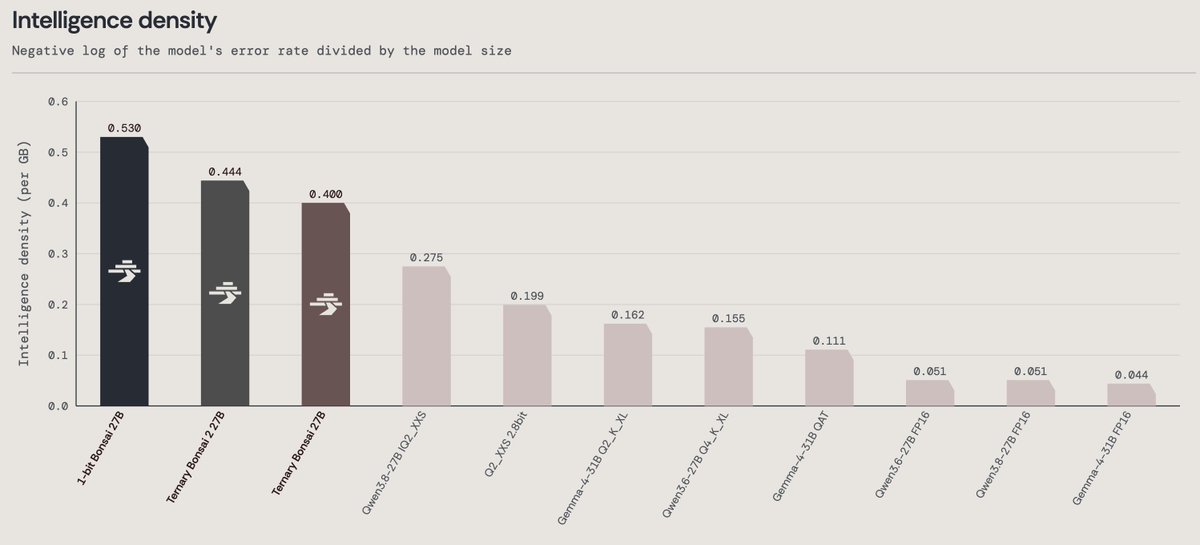
On an intelligence-density basis, Bonsai 2 27B is a clear outlier relative to both full-precision models and other low-bit alternatives.
Many low-bit models become deployable only with a meaningful quality tradeoff. Bonsai 2 pushes the frontier toward significantly higher capability at the same memory footprint.