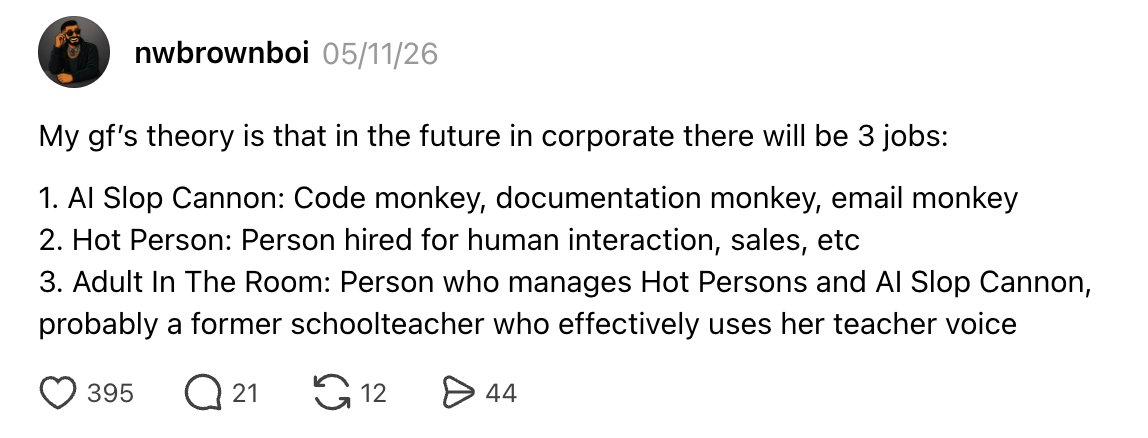
I think web3.0 or whatever the next iteration of web is will definitely be around connectivity with interesting individuals rather than crypto or drowning in endless algorithms which hijack hormones
The social feed is a bug, not a feature.
The next network won't have a feed. Instead, it will proactively surface exactly what and who you need, when you need it, because it knows you.
The future of the internet is one spent less online and more with people who matter.
The decimation of attention span might actually be a temporary phenomenon.
As feeds flood with dopamine-optimized bots, new generations will seek and build something better.
"only 2% of electrical electricians in the US are certified on DC power. "
- Ben Horowitz, co-founder Andreessen Horowitz (A16z)
AI infrastructure is exposing a very physical bottleneck: electrical talent. Moving from conventional AC distribution toward 800VDC means the industry needs people who can actually install, commission, and maintain these systems safely.
one of the most important jobs in the AI boom will end up being electrician.
---
From "a16z" YouTube channel, (full video link in comment)
Robots used to need 100 hours of training data for one new task.
Skild AI just showed one that learns from a single video, then handles tasks it was never trained on for 10+ minutes straight.
This is the robotics breakthrough I was talking about last night.
This means that robotics is going to speed up from here on, and that we will get to generalized humanoids closer to my predicted two years, rather than many in the industry who thought it was going to take seven.
The median company is spending $12 / employee / month on AI
The top 1% are spending $7,500 / employee / month
Not sure we've ever seen an adoption gap quite like this
(h/t @tryramp data, @a16z)
The new X algorithm is wild. They just open sourced basically everything.
I didn't just read the README. I went into the code, the scoring files, the model configs, the filtering rules.
Here's how the system actually works.
It has two layers. A transformer trained on 100 billion engagements does almost all the work. Then one small file of hand-set numbers decides what its predictions are worth.
The transformer is called Phoenix. 8 layers. It reads your last 1,022 actions on the platform, plus your country, timezone, hour of day, age bracket, and installed apps. For every candidate post it predicts the probability YOU specifically would take each of about two dozen actions. Like it, reply, DM it to a friend, mute the author, report it.
Nothing is scored on what already happened. Everything is scored on what the model thinks each individual viewer will do next.
In retrieval there is no embedding of you as a person. The config sets use_user_embedding to false. You are the sequence of things you engaged with. Nothing more.
Then the weights.
Each predicted probability gets multiplied by a hand-set number. Predicted reply 5.0. Quote 5.0. DM share 5.0. Copy link 20.0, the highest positive weight in the file, because privately forwarding a post is the hardest signal to fake. Retweet 1.0. Like 0.5. Dwell 0.0. Watching quietly is worth nothing.
The negative weights are enormous. Not interested minus 43.2. Mute minus 58.8. Report minus 234.
Why so big? Reports are 1000x+ rarer than likes at baseline. A signal that rare needs a massive coefficient or the model would ignore it. The design intent is clear though. Content the model thinks people will report gets priced brutally.
After the sum come the corrections. Your second post in the same pool scores at 62.5%, decaying to a floor of 25%, so nobody wallpapers a feed. Posts from strangers score at 0.75x. Small accounts under an impression threshold get lifted toward a target slot.
And ranking never decides whether you can be seen at all. A separate visibility system reads labels from a dozen classifier pipelines and answers allow, interstitial, or drop for each post and viewer. First drop wins. Some rules only fire on recommendations to strangers, so the same post can be hidden from strangers' feeds while your followers see it fine.
The July shift everyone felt is in the docs as a literal diff. Mutuals' reply weight went from 5 to 25 on July 13, then down to 20 on July 24 after feeds got so mutual-heavy people missed World Cup posts.
One constant changed your whole timeline.
If you post for a living, the code is instructions. Make things people reply to and forward. Post what your actual audience engages with, because the model scores your post one predicted reader at a time.
Garry Tan says we'll see a wave of exceptional older AI-native founders:
"There's going to be as many Patrick Collisons as ever, but one mega trend that we're seeing is the 35, 40, 45-year-old founder who's been around the block, built a lot of engineering."
"Peter Steinberger is a perfect example of that. He's been around the block. He knows what to build."
"If you take that person, suddenly there's 400 of those people. You can outperform an entire department of any Mag 7."
@garrytan@illscience
China created a system that simulates the earth with billions of AI agents that has real personality, memory, beliefs and human-like desires.
it gives them a terrifying ability to predict the future.
they published a paper called "Modeling Earth-Scale Human-Like Societies with One Billion Agents."
they built "Light Society," a framework that efficiently models human-like societies powered by large language models.
traditional agent-based models were always limited by simple, predictable behaviors.
but this new earth-scale simulation framework uses a "mixture-of-models" engine to change everything.
by combining massive llms with smaller, highly efficient distilled surrogates, the researchers successfully simulated a society of over one billion autonomous agents.
they grounded these agents using real-world demographic data from the world values survey. these agents don't just act like generic bots..
they exhibit sophisticated social behaviors that mimic actual, diverse human populations.
they ran simulations on trust games and massive opinion diffusion, tracking how information spreads and how society evolves in real-time.
the simulation proved to have incredibly high fidelity in modeling diverse social phenomena, giving researchers a practical foundation for hypothesis testing.
think about what this means for predicting global elections, market crashes, or how a population will react to a crisis..
you don't need to poll people or guess anymore. you just run the simulation.
the infrastructure for agentic simulation is scaling faster than anyone realized. social sciences and predictive modeling will literally never be the same..
To build the world we want by 2100, we'll need 6x more copper than we produced in the last 75 years.
It sounds impossible until you notice what actually happens when we mine: we get better at finding more.
https://t.co/7rXvEOekAx
warsaw just continues to prove itself as europe’s next silicon valley
and now the flywheel is really starting to spin:
1. hungry, highly educated, capitalist builders with zero shame around ambition are creating globally competitive companies
2. those companies are attracting capital from some of the world’s biggest tech investors
3. that capital is helping the winners scale and recruit the best talent from around the world
4. silicon valley operators are now moving to warsaw and bringing their playbooks with them (like matt who moved from NYC and is bringing his wispr flow + superhuman experience to viktor)
5. those playbooks are spreading through local teams and creating more builders, founders, and investors
6. every win is attracting even more talent + capital, and the cycle repeats
i have zero doubt many more unicorns will come out of poland 🇵🇱
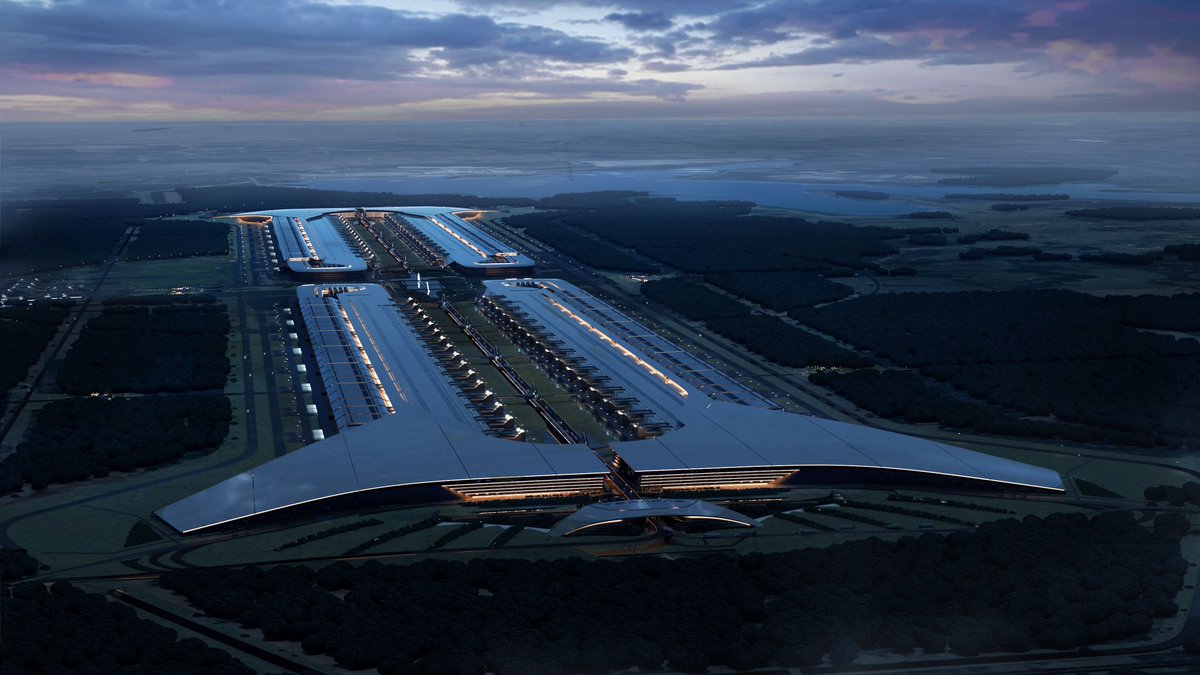
SpaceX: "Today, we are announcing that Terafab will be built in Grimes County, Texas. The facility will be an advanced semiconductor fab that will bridge the divide between current global chip supply and the compute demand of the future.
The combined SpaceX and Tesla demand for chips is expected to be in excess of 1 terawatt (TW) of compute, which is significantly larger than the current global supply. While we are deeply appreciative of our current chip suppliers, and encourage them to expand production whenever possible, this looming gulf between supply and demand is at the core of Terafab’s necessity.
Terafab will be epic in both its mission and in its sheer size, designed to build new compute at an unprecedented scale and speed. A vertically integrated factory with more than 100 million square feet of manufacturing space is planned. This facility will house the manufacturing, packaging, and testing of advanced logic and memory devices. Bringing these aspects together in one location will enable fast, recursive improvements and accelerate new compute deployed. Terafab will produce chips optimized for edge computing and inference for use in hardware like Tesla’s Optimus robots and self-driving Cybercabs, along with high-power chips designed for operating SpaceX’s space-based data centers.
BRINGING BACK ADVANCED MANUFACTURING TO AMERICA
Advanced chips are becoming foundational infrastructure for the modern economy. AI systems, satellites, secure communications, and advanced manufacturing all depend on reliable access to compute hardware. Much of the world’s semiconductor production remains concentrated overseas, and the United States has recognized the importance of rebuilding advanced manufacturing capacity domestically. Terafab aligns with that broader national effort by expanding high-end manufacturing capacity in Texas.
Texas has become central to our operations through Starbase, Bastrop, and McGregor, thanks to its commitment to innovation, manufacturing, and American leadership. SpaceX’s growing Texas footprint alone has already generated more than 56,000 direct and indirect jobs, over $28 billion in estimated economic impact since 2024, and hundreds of millions in indirect tax revenue since 2024.
The initial phase of Terafab is estimated to require approximately $16.8 billion in capital investments from SpaceX and Tesla, with potential future expansion phases bringing total investment much higher. This facility will employ at least 3,000 people, many of whom will be from Grimes and nearby Brazos County — continuing the trend of our other Texas sites where between 60% and 80% of new hires are local residents.
Grimes County offers strategic advantages for long-term industrial investment, including infrastructure access, available land, and proximity to major Texas markets. This project represents a significant opportunity for skilled trades, construction employment, suppliers and contractors, and long-term technical workforce development. We intend to work with local schools and workforce partners to help create pathways for future employment opportunities, responding to the unique needs of each community.
SpaceX and Tesla also take our role as being good stewards of the environment seriously. The Terafab site is committing to the use of Gibbons Creek Reservoir water for industrial operations rather than local groundwater; planned on-site wastewater treatment facilities; water reuse and conservation efforts; compliance with all applicable environmental and pollution control laws; and management of hazardous materials, chemicals, and industrial byproducts in accordance with all applicable regulations—while striving to exceed them.
BUILDING AN EXCITING FUTURE
We believe continued progress and leadership in space, AI, and advanced manufacturing will depend on the ability to build critical technologies domestically. By building and operating the largest chip manufacturing facility on the planet, we’re continuing down a path where future humans can compete over building the largest facilities in the solar system, and eventually the galaxy.
If you want to be a part of building that exciting future, come join us."
i’m fully convinced AI + robotics will unleash the greatest aesthetic renaissance human civilization has ever seen
the cost of building beautiful things is about to collapse
we just need to care about beauty again.
i predict we’ll see a breakthrough consumer ai product within the next 12 months that rivals chatgpt & claude by making personal agents genuinely useful & accessible.
& it’ll feel like electricity.
nearly all the seeds required to create this experience now exist. someone just has to assemble them correctly.
In a world of agents + harness + application, bottoms up will turn out to be the worst strategic GTM decision of the past decade.
Over the next few years, AI will stamp out clone after clone of various bottoms up tools, meanwhile this same tool sprawl will be viewed as part of the AI sovereignty debate (ie leaking your alpha into the AIs of point solutions by some random employee on your team) and will cause bottoms up adoption to largely be stamped out in favor of top down.
The final nail in the coffin will be CFOs wrapping corporate cards with smart filters so any tool that has downstream IP/alpha leakage won’t be authorized anyways.
"Long-horizon tasks are still a joke. They do not work, and I do not care what anybody says. Do not show me a stupid evaluation. Do not tell me about some dumb script you ran for 48 hours. Long-horizon tasks are not handled well. They simply do not work."
- Chamath at Stanford AI Club
"Second, complex problems also do not work. They are neither addressed nor handled well.
Why is this important? If AI develops like any other technology, we are going to experience an initial rise—the hype cycle. Then, we will see a natural contraction because, somehow and somewhere, something is going to fail. We are all going to see this, and then we will enter what is called the “trough of disillusionment.” I think the business and MBA folks will confirm whether that is true.
Afterward, you typically see the slow and gradual adoption of the real, final solution. This happened with the internet, and it has happened in many other cases.
The problem is that we are spending hundreds of billions, potentially trillions, of dollars trying to figure out how to cross this chasm. So, what do we do?
If we do not figure this out, people will reach the trough of disillusionment and say that AI was a joke. I think we need to be able to bring AI into highly complicated environments and make it work.
What is my solution? At a very basic level, you need a symbolic space that guides the embedded space."
----
From "techniahqrobot" YouTube channel, (full video link in comment)
We're starting to leave the territory where you'd test an LLM by e.g. "create an svg of pelican on a bicycle". As one idea to generalize it, I was interested what Opus 5 would do if I gave it the first paragraph of the Lord of the Rings, a 1M token budget (~$10) and asked for three js render of it. Opus went off for ~2 hours and wrote 5500 lines of code that (procedurally) rendered the story. It's kind of janky but fun. But it's a bit mindboggling that the LLM has to place and orchestrate various polygon assets in (x,y,z) coordinates and write code that animates it all, and that it even does anything at all.
I also like this kind of examples because no one in their right mind would ever spend the time to write something this custom but LLMs have all the stamina and patience in the world, so it's an example where we go from "no one would ever do this" to "sure, why not, it's ~free". There might be a lot more. But I'm excited about creating hyper custom worlds that you can imagine dropping players into, e.g. here to participate in the LoTR story as a spectator NPC, or one of the characters, or etc. Something like an ephemeral GTA of X on demand.
Last thought is that the domain of worlds/games exposes a weakness in LLMs: they can't easily audit their work because they aren't able to efficiently and natively perceive videos or play games within them. Here, Opus 5 had to very slowly and painstakingly take screenshots at different points, and it messed up a few times and created a bunch of jank. An example of raw capability (multimodal, gameplay) that I think is still quite lacking.