🔴 𝐓𝐚𝐫𝐢𝐪𝐮𝐞 𝐑𝐚𝐡𝐦𝐚𝐧 𝐚𝐧𝐝 𝐁𝐍𝐏 𝐋𝐞𝐚𝐝𝐞𝐫𝐬 𝐀𝐥𝐥𝐞𝐠𝐞𝐝𝐥𝐲 𝐀𝐛𝐬𝐞𝐧𝐭 𝐟𝐫𝐨𝐦 𝐅𝐥𝐨𝐨𝐝 𝐑𝐞𝐥𝐢𝐞𝐟 𝐄𝐟𝐟𝐨𝐫𝐭𝐬, 𝐃𝐫𝐚𝐰𝐢𝐧𝐠 𝐂𝐫𝐢𝐭𝐢𝐜𝐢𝐬𝐦
As devastating floods continue to inundate large parts of Bangladesh, millions are struggling to survive without adequate shelter, food, or safe drinking water. Amid the growing humanitarian crisis, questions have emerged over the visibility of the Bangladesh Nationalist Party's (BNP) relief efforts. Critics and some flood-affected residents argue that, despite the scale of the disaster, they have seen little evidence of large-scale rescue or aid operations led by Tarique Rahman or the party's leaders and activists.
The allegations have fueled public frustration, with many victims saying political leaders are quick to seek support during elections but are rarely present when communities face their greatest hardships. While Tarique Rahman has publicly expressed sympathy and concern from London, observers contend that these statements have not translated into sufficiently visible action on the ground.
BNP leaders reject the criticism, insisting that party members have been assisting victims where possible but that severe weather and limited coordination have constrained their operations.
As the flood crisis deepens, civil society voices are urging all political parties and organizations to move beyond partisan politics and prioritize humanitarian assistance, emphasizing that the immediate needs of flood victims should come before political divisions.
#Bangladesh #BangladeshCrisis
Did Bangladesh have the capability to deploy helicopter snipers in July 2024? Also, there's no publicly available forensic, ballistic, or operational evidence to support the claim. Extraordinary allegations require extraordinary proof—not repetition.
👉 https://t.co/1ocloNN4Yc
#Bangladesh #FactCheck #JulyConspiracy
In his latest article for Opinio Juris, @arafathosenkhan explores the death sentence against Sheikh Hasina in “Accountability as Instrument: The Death Sentence Against Sheikh Hasina and the Weaponization of Bangladesh’s International Crimes Tribunal.” The piece examines the rule of law, due process, and the dangers of using legal institutions as tools of political power.
https://t.co/hrz99GA1ZQ
"I believe in justice and I feel that once proceedings start, it will be clear to the people how farcical the court is — and that I want to prove it."
- Sheikh Hasina to @Reuters
👉https://t.co/8zu1dO3dys
#AwamiLeague#SheikhHasina
Did Bangladesh have the capability to deploy helicopter snipers in July 2024? Also, there's no publicly available forensic, ballistic, or operational evidence to support the claim. Extraordinary allegations require extraordinary proof—not repetition.
https://t.co/IWypmIl1oR
#Bangladesh #FactCheck #JulyConspiracy
In #Bangladesh, successive post-2024 administrations led by #Yunus and #TariqueRahman have weaponised the criminal justice system to target their principal political opposition- the #AwamiLeague.
Since August 2024, at least 120 former Members of Parliament, State Ministers, and Ministers from previous Awami League governments have been arrested in connection with criminal cases arising from the July–August 2024 violence, the majority of which are murder and attempted murder cases.
Among these high-profile political detainees, only 11 have been granted bail to date, while two have died in custody.
Virtually all of these former MPs and ministers face multiple criminal cases, with many named in 50–100 cases each. Almost all have remained in detention for more than a year, while more than half have been incarcerated for nearly two years.
More than 1,800 criminal cases have been filed in connection with the July–August 2024 violence. However, only 43 have reached the charge-framing stage, which means only 2.4% of these cases have progressed.
The overwhelming majority remain pending, with hundreds of accused persons continuing to be held in prolonged pre-trial detention without bail.
At BD Watch, we have repeatedly highlighted how the July–August 2024 cases have become a breeding ground for police corruption, political vengeance, personal score-settling, and opportunities for unjust enrichment by unscrupulous complainants and politicians associated with the ruling #BNP.
Report: https://t.co/6iefXfM6wT
….
#BangladeshCrisis @hrw@amnestysasia@StateDRL@UN_HRC@IBAHRI@ESandersFCDO@Ginitastar@cvoule@SRjudgeslawyers@UNHumanRights@volker_turk@PearsonElaine@EURightsAgency@CIVICUSalliance@fidh_en@forum_asia@FortifyRights@S_Asian_Rights
A defining moment for Bangladesh's democracy may be approaching.
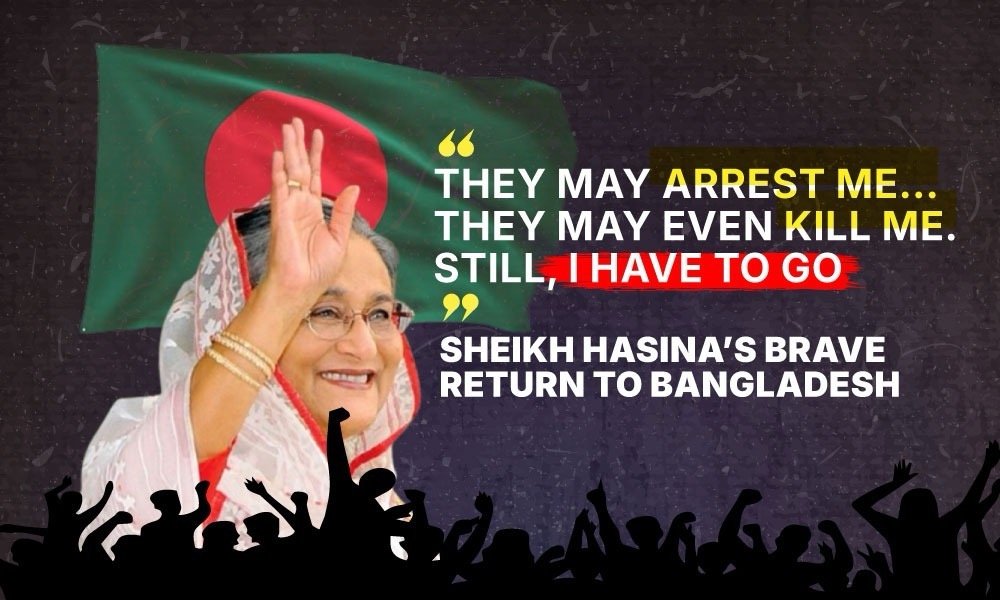
Former Prime Minister Sheikh Hasina has announced that she will return to Bangladesh this December from exile in India, despite facing serious charges. In an interview with @Reuters, she declared: "They may arrest me... they may even kill me. Still, I have to go." She says she and other senior Awami League leaders will voluntarily return to surrender before the courts.
Her decision sets the stage for one of the most consequential political moments in Bangladesh's recent history. According to this perspective, her return will test whether the country's institutions can uphold judicial independence, due process, and the rule of law, or whether the courts will be perceived as instruments of political retribution.
The stakes extend far beyond one individual. The handling of her case could shape public confidence in Bangladesh's justice system, influence domestic political stability, and affect the country's international reputation. A trial that is widely viewed as transparent and evidence-based could strengthen institutional credibility, while one perceived as politically motivated could invite greater scrutiny from democratic partners and human rights observers.
Ultimately, Bangladesh's democratic credentials will be judged not by political rhetoric, but by whether every accused person—regardless of political affiliation—is afforded a fair trial, equal protection under the law, and justice based on credible evidence.
👉 https://t.co/nkwAR1A7xm
#Bangladesh #Democracy #RuleOfLaw #Justice #HumanRights #SheikhHasina #AwamiLeague
Was July 2024 a revolution—or a regime change? Genuine revolutions require a clear popular mandate, transformative ideology, institutional change, and broad public consensus—criteria it contends were absent in #Bangladesh.
👉https://t.co/kXhJCkeNxn
Watch the latest @BBCBangla news report (with English subtitles) on the alarming deaths of political activists associated with the #AwamiLeague while in law enforcement and/or prison #custody in #Bangladesh.
The report focuses in particular on the two most recent custodial deaths:
28-year-old #ChhatraLeague activist Pranto, who died in police custody in #Faridpur, and #JuboLeague activist Nurul Alam, who died in prison custody just hours after his arrest in Satkania, Chattogram.
The families of both Pranto and Alam allege that they died as a result of torture while in police and prison custody, respectively.
The report also highlights the dire state of medical care in Bangladesh’s prisons, as well as allegations of negligence by prison authorities in providing even the limited medical treatment that is available.
According to Ain o Salish Kendra (ASK), 61 people died in prison custody in Bangladesh during the first six months of 2026, while four others died in law enforcement custody.
Since August 2024, at least 60 leaders and activists of the Awami League and its affiliated organizations have died while in law enforcement and/or prison custody.
Many of these deaths have been accompanied by allegations of torture, custodial abuse, and the denial of adequate medical care.
….
@amnestysasia@AgnesCallamard@omctorg@meeganguly@cnni@PearsonElaine@StateDRL@AP@justiceinfonet@S_Asian_Rights@HannahEP@ESandersFCDO@AFP@CIVICUSalliance@ANI@BonaveroIHR@forum_asia@HRF@UN_SPExperts@DoughtyStIntl@volker_turk@UN_HRC@omctorg@FreefromTorture@ReutersAsia@TheDavidBergman@cnni@MujMash@CharlieCamp6ell
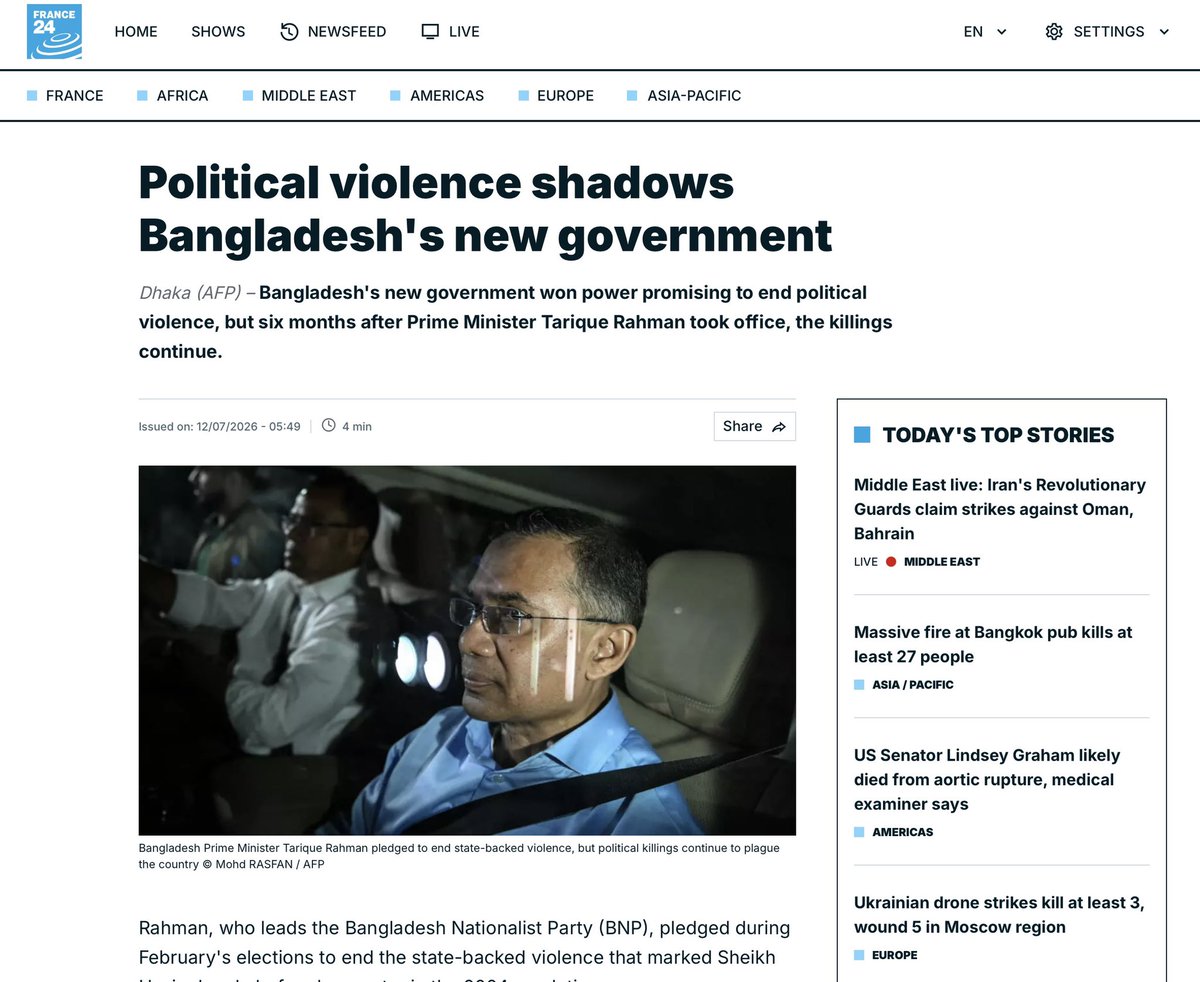
Political violence shadows Bangladesh's new government - @AFP Report.
#Bangladesh's new government won power promising to end political violence, but six months after Prime Minister #TariqueRahman took office, the killings continue.
Rights groups say political rivalries, weak law enforcement and a culture of impunity are driving continued violence after the elections brought Bangladesh's first elected government to power since the uprising.
Prominent rights organisation Ain o Salish Kendra (ASK) recorded at least 66 politically related killings, along with 61 deaths in police custody, 11 extrajudicial killings and other alleged human rights abuses over the last six months.
"Deaths in jail and police custody appear to be rising," ASK senior official Abu Ahmed Faijul Kabir told AFP.
The government disputes that.
It insists the situation is improving and argues that the increase in reported killings reflects historic cases because surviving relatives only now feel secure enough to report them to police.
Others tell a different story.
In June, 17-year-old Mohammed Suman joined a rally held by Hasina's Awami League. The rally was banned…and Suman vanished.
Three days later, police recovered the teenager's rotting corpse from the Turag River in Dhaka, along with the bodies of two others.
Suman's family said they pieced together what happened from friends, who said police and a mob broke up a flash Awami League rally, forcing them to flee by boat across the river.
"We have heard that, after being chased by local BNP leaders, they crossed the river only to encounter police," said Supreme Court lawyer Arif Sarkar Pavel, who is representing seven men arrested during the same incident and held under anti-terrorism laws.
"Some people also beat them with bamboo sticks after they jumped into the river," he added. "Police are trying to bury the truth."
Police have denied accusations of brutality and said that there was "no incident" of killing.
The violence has included local power struggles within the political parties, with at least two BNP leaders themselves getting killed in intra-party turf-wars in June 2026.
The political violence comes against a backdrop of continued violent crime, with police statistics recording an average of at least 10 murders a day, including 1,238 murders between March and June.
Read Full Report:
https://t.co/5iSeA7Aye3
…
#BangladeshCrisis #PoliticalViolence #Impunity #RuleOfLaw @BBCWorld@Sabir59@TheDavidBergman@HannahEP@CordeliaSkyNews@MujMash@paulocasaca1@Chellaney@amnestysasia@hrw@ESandersFCDO@EURightsAgency@StateDRL@UNHumanRights@CharlieCamp6ell@cnni
Did Bangladesh have the capability to deploy helicopter snipers in July 2024? Also, there's no publicly available forensic, ballistic, or operational evidence to support the claim. Extraordinary allegations require extraordinary proof—not repetition.
👉 https://t.co/8valVT4ohs
#Bangladesh #FactCheck #JulyConspiracy
Deaths in Custody Raise Fresh Questions About Bangladesh’s Justice System
---
Two detainees died within days of being taken into custody in June, renewing concerns over accountability in Bangladesh’s police and prison system.
According to a BBC Bangla report, 28-year-old Ishtiaq Ahmed Pranto died one day after being detained by DB police in Faridpur, while Nurul Alam died shortly after being transferred to Chattogram Central Jail. Their families have raised questions about the circumstances surrounding their deaths, while authorities say investigations are underway.
Human rights groups argue that long-standing problems, including allegations of custodial abuse, inadequate healthcare, and weak oversight, continue despite expectations of reform.
According to Ain o Salish Kendra (ASK), 61 people died in prison custody and 4 in police custody during the first six months of 2026, highlighting the urgent need for transparency, accountability, and meaningful institutional reform.
#Bangladesh #HumanRights #CustodialDeaths #RuleOfLaw #Justice
Calls for Sharia During Coordinated Anti-#India protests in Bangladesh.
Over the past few days, several groups aligned with the #BNP, the #JamaatEIslami, and several #Islamist groups have organised rallies and processions against what they describe as "Indian hegemony."
At one such procession in #Dhaka, organised under the banner of "Ulema and Mashayekhs" (Islamic scholars and students), thousands of participants chanted various slogans such as:
"Delhi or Dhaka? Dhaka, Dhaka"
"Agents of India, Beware"
AND
"Sharia is the Answer."
Video: OBC PLUS.
...
#BangladeshCrisis #Islamism #SouthAsia @paulocasaca1@CJBdingo25@Chellaney
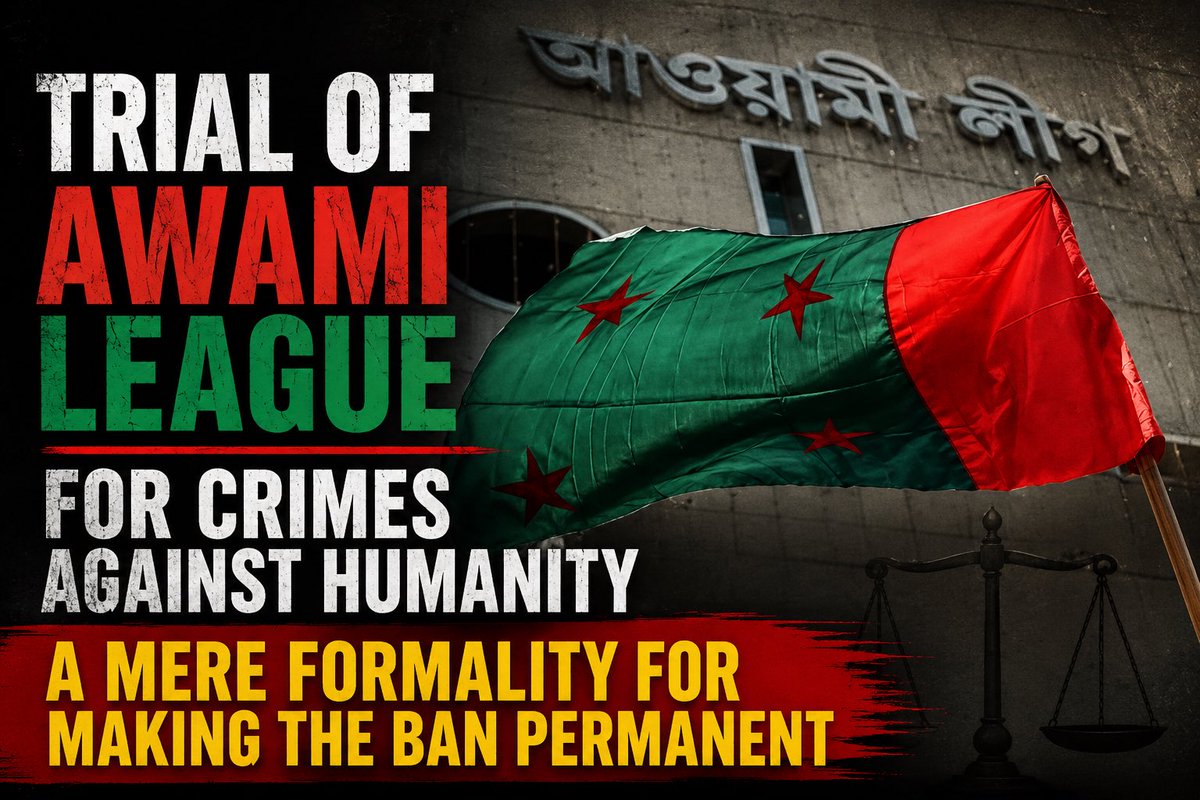
The #BNP Govt has embarked on a process to make the existing ban on the activities of the #AwamiLeague (AL) permanent by prosecuting and convicting the country’s main secular political party for crimes against humanity.
Given the prevailing political and legal circumstances in #Bangladesh, there is little reason to expect that these proceedings will constitute a genuinely independent or impartial judicial process.
Instead, the trial is likely to amount to little more than a formality designed to provide legal justification for a political decision that has, for all practical purposes, already been made.
Why Mere Formality?
1. AL Remains Effectively Banned
Since May 2025, the activities of the AL have remained prohibited under the Anti-Terrorism Act. The scope of the ban extends well beyond the party's organisational activities.
Public expressions of support for the Awami League have also been criminalised. During the past year, thousands of party leaders, activists, and supporters have reportedly been arrested under the ATA.
The proposed prosecution therefore appears less like an effort to determine legal responsibility than a mechanism to permanently legitimise an existing political reality.
2. No Meaningful Ability for Defence
An equally significant issue concerns the ability of the AL to participate meaningfully in any legal proceedings.
Virtually all senior leaders of the party and its affiliated organisations are either imprisoned or living in exile. This raises an obvious question: who will be able to instruct counsel, coordinate the party's defence, collect evidence, identify witnesses, and formulate legal strategy on the party's behalf?
Even if such coordination were somehow possible, there remains the issue of legal representation. Lawyers associated with the AL have themselves faced judicial proceedings, harassment inside court premises, and exclusion from bar association elections.
These circumstances raise serious questions about whether the party can realistically mount an effective legal defence before the tribunal.
3. The Political Environment
The broader political context further undermines confidence in the independence of the proposed proceedings.
Public statements by leaders of the ruling BNP, as well as their opposition allies #JamaatEIslami and the #NCP have repeatedly suggested that the principal objective is the judicial ban of the AL itself.
Whether the party is ultimately found to have committed crimes against humanity appears, in many of these public statements, to be a secondary consideration.
4. The ICT and Questions of Credibility
The BNP Govt has indicated that it intends to prosecute the AL before the controversial International Crimes Tribunal (ICT). However, as a neutral judicial forum, the ICT presently suffers from a serious credibility deficit.
The tribunal has already become the subject of significant controversy.
Concerns raised include allegations of corruption involving prosecutors and investigators, questions regarding the competence, neutrality, and independence of judges, the appointment of politically affiliated prosecutors, and legal provisions and procedural rules that fall short of globally recognised fair trial standards.
Additional concerns have emerged regarding the ICT's apparent willingness to impose capital punishment on the basis of unreliable evidence such as untested call records and testimony from plea-bargained witnesses who may have faced coercion, intimidation, torture, or political pressure.
Taken together, these issues raise substantial questions about the ICT's ability to adjudicate a case of such immense political significance with the degree of independence and impartiality that would be expected under int’l standards of criminal justice.
Against this backdrop, any future ICT proceeding to determine the criminal responsibility of the AL is likely to be viewed as a formality rather than a genuinely independent judicial process.
…
A new @bbcbangla report on the custodial deaths of political prisoners in #Bangladesh highlights one of the central issues underlying these cases: the state of medical care for prisoners across the country's jails.
Below are translated excerpts from the report:
Nurul Alam, who was associated with the Jubo League, died a day after being detained by Detective Branch (DB) police and sent to prison. His family has questioned how a healthy man could die within just one day of entering custody.
Nurul Alam's death is not an isolated case. On June 21, Ishtiaq Ahmed Pranto died the day after being detained by Detective Branch (DB) police in Madhukhali, Faridpur.
According to human rights organizations, four people died in police custody during the first six months of this year, while at least 61 people died in prison custody over the same period.
In particular, allegations have emerged that, following the July 2024 mass uprising, leaders and activists affiliated with organisations linked to the banned #AwamiLeague, along with former members of parliament and former ministers, have died under unusual circumstances while in prison.
Domestic and international #humanrights organizations have long expressed concern over deaths in police and prison #custody under successive governments in #Bangladesh.
According to data compiled by the human rights organization Ain o Salish Kendra (ASK), at least 61 people died in prison custody and four people died in police custody during the first six months of this year. The organization recorded 116 deaths in prison custody and at least 11 deaths in police custody in 2025.
According to the Department of Prisons, 129 inmates died in prisons across Bangladesh during the past six months. Of those, 74 died before they could be transferred to a hospital.
The issue of medical care for prisoners has therefore come under renewed scrutiny. Prison authorities themselves acknowledge the severity of the crisis.
Although Bangladesh's 74 prisons have 150 sanctioned positions for round-the-clock doctors, only two of those positions are currently filled. More than 50 prisons lack ambulances to transport sick inmates.
The Directorate of Prisons also says that modern medical equipment for advanced treatment, including diagnostic facilities, was purchased nearly a decade ago for the country's 200-bed prison hospital. However, the equipment has never been put into use because there is no staff available to operate it.
Bangladesh's #prison system has long faced allegations of inadequate healthcare, neglect, and severe deficiencies in emergency medical services.
A woman who spent several months in prison told BBC Bangla that she witnessed the deaths of two inmates who, in her view, did not receive adequate medical treatment.
Describing her own experience, she said she suffered a miscarriage because of inadequate medical care and neglect while in custody. She also alleged that many people being held in prison without trial are not receiving proper medical treatment.
Report: https://t.co/WR52DIoZkt
….
#Bangladesh #HumanRights #CustodialDeaths #RuleOfLaw #Justice #Impunity @amnestysasia@AgnesCallamard@omctorg@meeganguly@PearsonElaine@StateDRL@justiceinfonet@S_Asian_Rights@HannahEP@AFP@AP@ESandersFCDO@AFP@CIVICUSalliance@BonaveroIHR@forum_asia@HRF@UN_SPExperts@DoughtyStIntl@volker_turk@UN_HRC@omctorg@FreefromTorture@TheDavidBergman@cnni@MujMash@CharlieCamp6ell
The BNP–Jamaat–Yunus alliance has prevented, and continues to prevent, Bangladeshi media outlets from broadcasting Sheikh Hasina’s statements. They could, however, try sending similar objections in the form of a notice or request to international media outlets and see how that goes.
Yet another opposition activist has died in jail #custody in #Bangladesh, bringing the reported number of custodial deaths of #AwamiLeague leaders and activists over the past 23 months to at least 60.
Moniruzzaman Monir, a leader of Jubo League, the youth wing of the Awami League, died on 8 July 2026 at Dhaka Central Jail. According to his family, he had long-standing heart disease and diabetes.
Despite his serious health conditions, he remained in custody for more than one and half years without being charged with any crime.
Although he secured bail on two occasions, he was reportedly re-arrested from the jail gate each time and shown arrested in additional cases, a practice that has become increasingly common for individuals affiliated with the Awami League in Bangladesh.
News: https://t.co/TpztFAOc0R
Custodial deaths in prisons, particularly those involving political detainees, have emerged as one of Bangladesh's most serious human rights concerns since August 2024.
Between September 2024 and June 2026, at least 60 leaders and activists of the #AwamiLeague and its affiliated organisations reportedly died while in the custody of law enforcement agencies and/or prisons. More than 95% of these deaths occurred while the deceased were under prison custody.
List: https://t.co/DD7InokJ6J
To date, not a single reported custodial death has been subjected to an independent, prompt, impartial, and effective investigation, despite serious concerns regarding the treatment of detainees, conditions of detention, access to adequate medical care, and the accountability of state authorities.
According to family members in many of these cases, the deaths were preceded by custodial torture, other forms of cruel, inhuman or degrading treatment, or the denial of timely and adequate medical care.
Several families have also alleged that they were unable to file criminal complaints because of a lack of cooperation from the police and other authorities.
In numerous cases, authorities have reportedly attributed the deaths to sudden "heart attacks" or natural causes, while post-mortem examinations were allegedly delayed, omitted, or conducted under circumstances that failed to inspire the confidence of the victims' families.
The continued absence of credible investigations not only denies victims' families their right to truth and justice but also reinforces a climate of impunity, increasing the risk that similar abuses will continue without accountability.
….
#Bangladesh #HumanRights #CustodialDeaths #RuleOfLaw #Justice #Impunity @amnestysasia@AgnesCallamard@omctorg@meeganguly@PearsonElaine@StateDRL@justiceinfonet@S_Asian_Rights@HannahEP@AFP@ESandersFCDO@AFP@CIVICUSalliance@BonaveroIHR@forum_asia@HRF@UN_SPExperts@DoughtyStIntl@volker_turk@UN_HRC@omctorg@FreefromTorture@TheDavidBergman@cnni@MujMash@CharlieCamp6ell