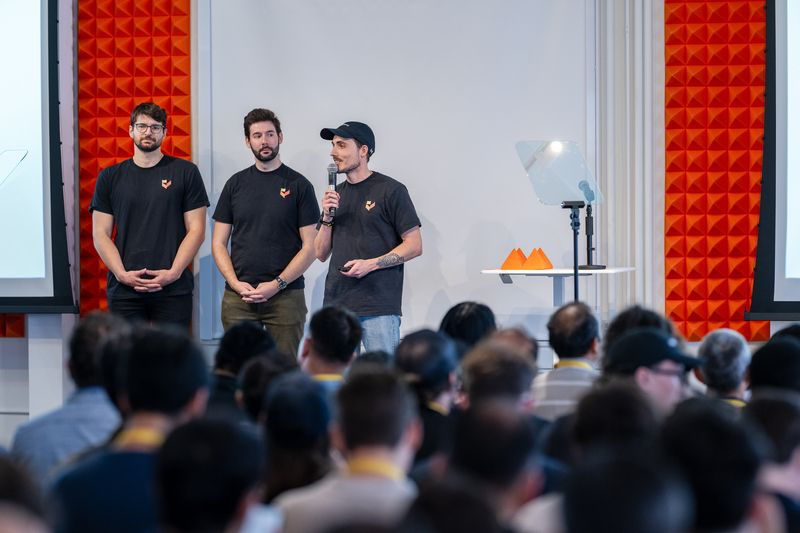
.@OpenRouter co-founder Alex Atallah, in his first podcast since Stripe acquired the company, joins @Replit co-founder Amjad Masad and a16z's Erik Torenberg on why the future of AI is independence and specialization.
In this conversation, Alex walks through how the Stripe deal unfolded, why he wasn't originally looking to sell, and why "payments and inference are going to blend together."
Pre-OpenRouter, the typical AI workflow had one model provider to choose from, and little pressure on that provider to lower prices. Now enterprises are diversifying across labs and open-weight models, and every board is asking about AI costs and benchmarks.
Amjad argues if your company depends on one AI lab, it can turn into your competitor. So Replit is building the layer that lets enterprises use any model and any cloud, without being locked into either.
Alex and Amjad are split on personal agents – Amjad runs one agent across his whole company and loves the cross-domain joins, while Alex says general agents cause you to sacrifice understanding, and argues 10 specialized chiefs of staff beats one superagent.
0:45 How the Stripe deal unfolded
5:05 Why mixing models beats one model
7:25 Forcing the labs to compete on price
8:50 Enterprises want open-weight models
10:30 Every board asks about AI every month
12:25 Why companies must own their intelligence
14:15 Replit as the independence layer
15:10 Everyone is building the same agent
16:35 Why Amjad built bring-your-own-cloud
18:10 Amjad's agent that runs his whole company
19:55 Why 10 specialized agents beat one
23:35 Machines, not humans, should specialize
27:30 Guardrails for agents talking to agents
31:10 Models training their own replacements
33:45 Most tasks don't need a frontier model
40:50 Training small models on Qwen 8B
43:25 The Rust cycle is coming for AI
45:10 Fusion models: frontier quality at half the cost
YouTube: https://t.co/stL1g14F3q
@alexatallah@OpenRouter@amasad@eriktorenberg
Test 13 is joining @Replit .
18 months ago, @gunnarkolbeins and I started Test 13 on a simple belief:
AI is changing how software is made, and as a team of two, we should be able to:
1. Build a portfolio of profitable SaaS solutions by throwing spaghetti at a wall and see what sticks
2. Offer our local market 60-80% lower prices on software services (contracting gigs and agency work)
Replit made that possible.
In 18 months, we generated over $700k and our business was growing 400%+ YoY.
More importantly, we got to solve real problems, and work with an incredible group of customers who took a chance on us. I’m deeply grateful to every one of them.
Today, Replit has acquired Test 13.
I'm thrilled to be joining the company that gave us super powers and excited to help give that same leverage to builders like us, all around the world.
Earlier this year, I sent Replit’s founder @amasad a message that said:
"The Icelandic market is tiny, and sometimes it feels like I’m geographically isolated from where the frontier of AI innovation is happening. Test 13 is helping businesses solve real problems, but it still feels low impact compared to what’s happening globally right now as AI reshapes literally everything. I want to spend the next decade building at the center of this AI shift, not watching it happen from the sidelines in a tiny market."
A few months later, here we are.
Thank you Amjad for keeping an open mind, being terminally online, and ultimately giving us the opportunity to join the amazing team at Replitopolis.
And thank you to everyone who has been part of Test 13.
What an incredible 18 months.
Now back to building.
SpaceXAI will livestream a three-person team attempting to build an entire company from scratch with Grok Bot, September 15–17.
mattyp, poteto and roshan_s will start with an idea and work through the business plan, product decisions and engineering, with viewers following the process live.
The event, Grok Bot Galaxy, also includes live demos and hands-on sessions with the Grok Bot team, covering engineering, product, sales, marketing, customer support and use cases for founders.
You can join online or attend sessions in San Francisco. Registration is required for both. 👇
tristan buckmaster just published a statement that is, if accurate, one of the ugliest things i’ve read out of a frontier lab.
not because of the math. because of what happened after openai found out two people were about to beat them to the punch.
buckmaster and levent alpöge spent a year pushing the córdoba / martínez-zoroa program to smooth forcing. august 15 they got blowup for boussinesq and 3d euler. lean-verified august 22.
they were paying openai out of pocket and dumping every draft into private codex sessions.
the program is obscure. almost nobody else was on it. this was not “paste the clay problem into a chatbot.”
then this:
> thursday sept 3, buckmaster emails openai privately. rumors are flying. he is trying to stop a mess, not start one.
> they reply the same day: give us details so we can “avoid competing.” also, want free compute?
> sunday they suddenly need a call “at any point today.” sebastien bubeck gets on. levent is not invited.
> openai says an internal model has a ~100-page proof of forced navier–stokes blowup. fefferman options c and d. the exact route buckmaster and alpöge had quietly chosen.
> they show him a prompt and claim the model was “simply given the problem statement.” levent is told “very little human input.”
> that falls apart on the same call. a whole team had been on it. they started on the unforced problem, warmed the model up on easier equations including euler, and even the prompt they showed him was written by prompting codex.
> he asks when the first prompt went out. they stall. then agree: the past few days. after information about his work reached openai.
> he asks whether the model was trained on, or had access to, the private codex sessions where they put every draft of this project.
> answer: the model does not look up user data.
> he asks again. about training.
> no answer.
then it stops being a science story and becomes an hr story.
> offer 1: you post euler. we post navier–stokes the next day.
> offer 2: after you post euler, you alone write the navier–stokes paper, credit our model, and we cut levent.
> bubeck says twice he wants levent removed from authorship because he works at anthropic.
he declines both.
he says if they release it that way, he goes public.
the reply is not a scientific objection.
> “why would you ruin your career?”
> “if you don’t want me to be nice, then i don’t have to be nice.”
later, a text to levent proposing a one-on-one:
> “i don’t know if tristan is being fully rational right now.”
that is not how you treat a collaborator. that is how you split one.
openai got word two researchers were closing a path almost nobody else was on. they spun up a team on that exact path. they would not answer whether the researchers’ unpublished drafts in openai’s product were used. they tried to dictate the announcement order. they tried to remove a coauthor because he works at a competitor.
when that failed, someone reached for a career threat.
this is a lab finding out academics were about to publish, sprinting the same narrow program, refusing the data question, and trying to manage credit around a rival affiliation.
really slimy if even half of this holds.
what the fuck is happening.
I'm 30. I built an AI startup called @GojiberryAI doing over $4M ARR in one year. Got accepted into YC.
No one wants to hear this, but there's no magic distribution channel.
We got there by experimentmaxxing one channel at a time, based on our MRR level.
$0 → $6k MRR: pure outbound. Cold email + LinkedIn, using our own early product on ourselves. No brand, no audience — just us reaching out to people showing intent and starting conversations. Ugly, manual, effective.
$6k → $25k MRR: Reddit. Our first real acquisition breakthrough. We posted educational breakdowns in SaaS subreddits and pulled 10M+ organic views. Traffic quality wasn't amazing, but the volume flooded our trial funnel for months. Cost: basically zero.
$25k → $75k MRR: content + free blueprints. All-in on LinkedIn content, YouTube, motion-design videos, and giving away our internal systems as free "blueprints." Content got the reach, blueprints earned the trust, and a chunk of readers converted. This is where founder-led content started compounding.
$75k → $150k MRR: partnerships + X. We added Twitter, B2B influencers, sponsored newsletters, and a lifetime affiliate program that became a major lever. We also joined YC around here — the intensity went vertical.
$150k+ MRR: paid + hiring. Meta ads, Google ads, influencer agencies, and our first serious hires: growth, sales, engineering, product.
To get to $1M+/month, it’s mostly going to come down to hiring the right people and putting the right structure in place.
Here's the part people miss: none of these stages replaced the last one. They stacked. Outbound never stopped. Content never stopped. We just added the next lever once the current one was clearly working.
If you take one thing from this: don't chase five channels at once.
Beat one until it works. Then add the next.
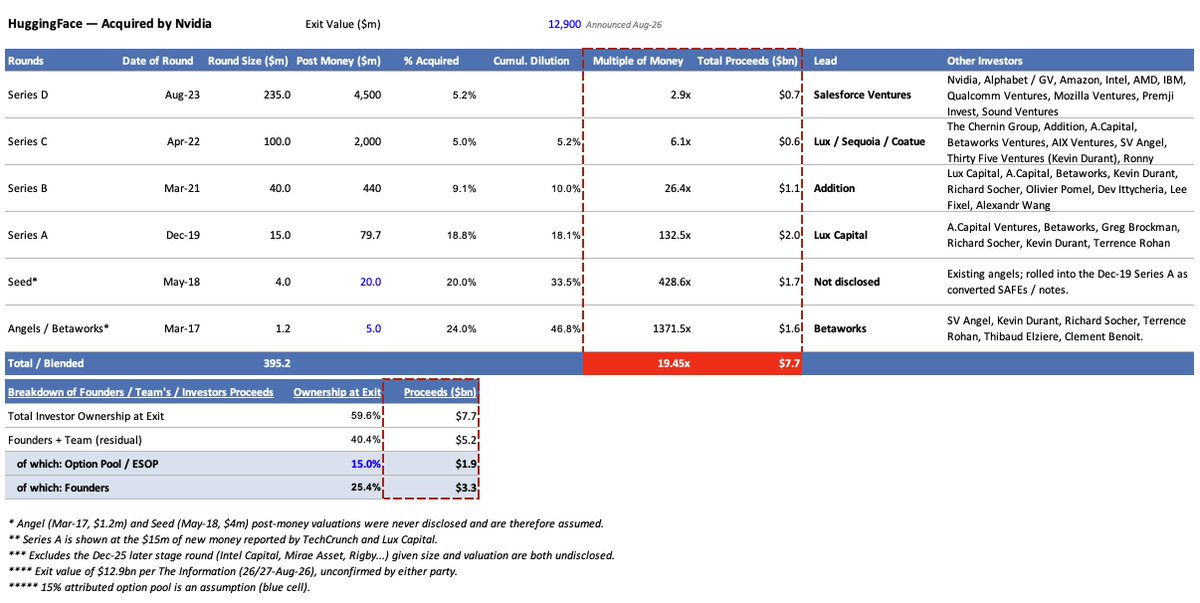
Nvidia acquires Hugging Face for ~$12.9bn. But who gets the 💰? My usual breakdown below 👇
*Investors are sharing ~$7.3bn of profits on <$400m invested. A cool ~20x blended.*
*1) The single biggest winner here? Lux Capital.* 👑
Lux is taking the crown for the most $ returned in this transaction. The two rounds they led (Series A & Series C) generated ~$2.6bn combined. They also participated in the Series B.
Congrats to @wolfejosh and team. The $15.0m Series A alone will return ~132.5x the capital invested, or ~$2.0bn. The most lucrative round in absolute $ returned.
*2) Backing an exceptional team paid off with a >1,000x return for Betaworks and the angels* 📈
The story few people know: Hugging Face started life as a chatbot for lonely teenagers... You sent it a selfie and a sad emoji, it told you it understood. Quite far from where it landed!
That is why backing an exceptional team in @ClementDelangue, @Thom_Wolf and @julien_c is always the right thing to do. It paid over 1,000x for Betaworks, Kevin Durant and Thibaud Elziere.
*3) Founders and team are crushing it: not taking too much dilution along the way paid off* 👏
I estimate they will share ~$5bn in proceeds, assuming no secondary was taken along the way. A life changing outcome for them and many employees.
Taking a 15% attributed option pool at exit, this would mean ~$2bn for the team and >$3bn to share for the three co-founders. Legendary!
*4) Salesforce Ventures is cementing its reputation as one of the very best corporate VCs.* 🥇
Salesforce is adding Hugging Face to its long list of successful exits: Snowflake, Zoom, DocuSign, nCino, Auth0... Very few investors can claim as many successes, let alone corporates.
The $235m round they led returned $675m in just three short years. Meanwhile, Salesforce's own stock has been flat for the period. Capital well invested!
*5) This is a little bit of a heartbreak: but I wanted to congratulate @joinstationf here:*
Hugging Face walked into StationF as a 4-person team on day one, June 2017. Back when it was a chatbot for teenagers. They went through multiple corporate programs (Microsoft, Ubisoft, then Naver). Unfortunately they were not investing or taking equity at the time - but they contributed to making it possible. And so for that: hats off.
And of course, congratulations to all others involved: Addition, Sequoia, Coatue and many others. No one will be left out!
Going from $0-$1M is an art
Going from $1M-$100M is a science
I took AppSumo from $3M to $84M in 6 years while cutting my own hours in half doing it.
Here's the recipe:
hot take :) The biggest and most productive people in the AI era are the folks who are already good at their jobs. AI as a multiplier, not an equalizer/democratizer
For $299 a month, you can get the weight-loss ingredient in Ozempic through Medvi's website. A regular pharmacy charges $1,300 to $1,500 for the brand-name version. That gap made Medvi $401 million in its first year. They're tracking $1.8 billion this year.
Gallagher's last company was Watch Gang. A subscription box that mails you a new watch every month. He bootstrapped it to $250 million in sales, then exited. Medvi runs the same model. Subscription product, social media ads, scale fast. He swapped watches for weight-loss injections.
The "two employees" part needs context. Gallagher's only hire was his younger brother, Elliot. They don't have doctors on staff. A separate company, OpenLoop Health, provides the doctors who evaluate patients and write prescriptions. Other pharmacies manufacture the medication and ship it. Medvi handles the website, the advertising, and customer service. That's what two people run. Everything medical is someone else's job.
The FDA has noticed. STAT News reported in March that Medvi was among the companies the FDA warned about misleading marketing of weight-loss drugs. The agency has sent warning letters to more than 70 similar companies in the past 6 months. The drugs Medvi sells aren't made by the same manufacturers as Ozempic. They're mixed by smaller pharmacies using the same active ingredient, but without going through FDA review for safety or quality. These pharmacies were legally allowed to make their own versions while the brand-name drug was in short supply. The FDA declared the shortage over in February 2025.
The $20,000 in AI tools built the storefront. The $1.8 billion comes from 30 million Americans taking drugs like Ozempic, up from 4 million just six years ago. Over 40% of American adults are obese. The whole market is worth $58 billion this year. Hims and Hers, a company you've probably seen ads for, did $2.35 billion in revenue across all its products in 2025, with thousands of employees. Medvi is approaching that with two.
Gong grew from $200k ARR to $200M ARR and $7.2B valuation in a 5 year span.
Buyers told us our demos were 2nd to none.
9 lessons I learned about SaaS demos I'll never forget:
We offered 5 people a Porsche 911 GT3 RS if they could get @WisprFlow to make a mistake
It's the fastest and most accurate AI voice dictation app that's 3x more accurate than ChatGPT, Claude, or Siri.
Today, we’re finally launching on Android. Download now: https://t.co/TJhnUhDSLv
As a part of the launch, we’re giving away 6 months of Wispr Flow Pro for free.
Like, retweet and comment ‘Wispr Flow’ to get it. Enjoy.
— Written with Wispr Flow