I’m thrilled to share that I’ve been awarded a 2025 #BrinsonPrizeFellowship and will be joining @MIT this fall!
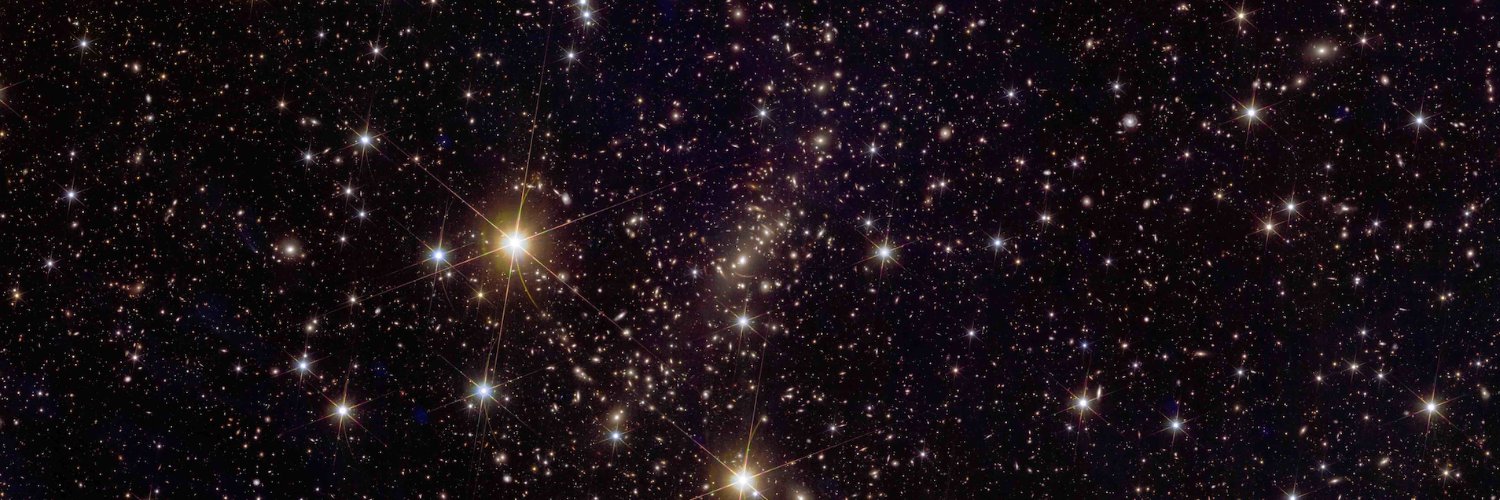
I’ll be using #ESAEuclid to study cosmic dawn and the first galaxies.
Grateful to The Brinson Foundation and @STScI for this opportunity.
🔗 https://t.co/ixYPzcmw8j
This is just the beginning for Euclid! Soon we’ll have even deeper data over a total of 53 sq. degrees: the Euclid Deep Fields. Take a peek from optical images taken by our team to complement Euclid’s near-infrared survey: https://t.co/xBCbl26Lik
Stay tuned for more!
BIG paper day for #ESAEuclid! Thanks to Euclid’s infrared sensitivity and wide field of view, myself and a 100+ team (incl. @SinaTml, @dyonysos ) found 29 ultra-rare UV-bright z~6-8 galaxies! They’re missing in visible light, many with huge 2 mag breaks! https://t.co/JMYar8zTZM
Beyond the 29 z~6-8 galaxy candidates, we also found a whopping 139 extremely red objects that also lack visible light. Likely a mixture of extremely dusty and quiescent galaxies at z~1-3 — need far-infrared data to confirm!
Euclid celebrates first science with sparkling cosmic views! 🤩
From faint to bright, from distant to nearby, from the most massive of galaxy clusters to small planets, these images demonstrate @ESA_Euclid 's ability to unravel the secrets of the cosmos.
Access them here👉 https://t.co/N1c7EL3Wiu and read more about each image below 🧵👇
The first scientific studies from @ESA_Euclid have just been released, and many years of Danish involvement is paying off.
One study, led by @AstroWeave, explores invisible galaxies.
🇬🇧 https://t.co/SAoJa7yYBS
🇩🇰 https://t.co/OLfbD18WQZ
@GrundforskFond@Carlsbergfondet
Gorgeous #JWST spectrum of a z=9.76 galaxy from @grobertsborsani and team on the arXiv tonight!!! A vivid demonstration of how easily JW can confirm/refute the similarly luminous/more luminous Universe-breaking candidates at even higher redshifts!
In MNRAS and open access: "Dust and the intrinsic spectral index of quasar variations: hints of finite stress at the innermost stable circular orbit", Weaver & Horne. This is Fig. 12: for the caption and to read the paper visit https://t.co/pK09KALY8N
How do supermassive black holes interact with their accretion discs? Long-term variability can teach us a lot. Find out the unexpected physics we may have uncovered:
https://t.co/UUxpHIbNmB
@DAWNCopenhagen
@PhysAstroStAnd
@GrundforskFond
Credit: NOIRLab/NSF/AURA/J. da Silva
#cosmos2020 is live! I am thrilled to finally have this enormous galaxy catalog accepted to ApJS and posted to arXiv today!
https://t.co/6ZulcEtH75
Catalogs are now public: https://t.co/nkzGf6VZql
@cosmosastro@DAWNCopenhagen
Opening day of #NAM2021! Looking forward to seeing familiar faces, and meeting new ones. I’ll be discussing the latest results from the #COSMOS survey during the FLARE I Session later today.
@cosmosastro@DAWNCopenhagen
Excited to talk about “Beasts in the Bubbles” - ultra-luminous galaxies at cosmic dawn - at the #SAZERAC2 meeting in ~40mins. You can tune in live here: https://t.co/djznNqDleQ
@Jurgenvilla @Caltech@caltechipac@cosmosastro Had to sort out some technical/security details, but here it is! https://t.co/AMTo2OBY3s The link will expire after 48 hours. Please let me know if you have any questions, thanks!
Excited to talk about my latest work on the COSMOS2020 Galaxy Catalog later today “at” @Caltech@caltechipac@cosmosastro
Info here: https://t.co/jqeHddsYIU