You deposit into a vault. You earn yield. But do you actually know what they're doing with your money?
Most people don't ask that question. They see an APY and click deposit. That's it. No idea where the yield comes from, what pools the funds are sitting in, or how much risk is being taken on your behalf.
@flareforward is looking at building a public transparency page where you can track exactly how protocols like @upshift_fi manage vault funds. Every position, every pool, every layer of risk laid out in the open.
Web3 makes this possible. The data is already there. We just want to make it easy for you to see it.
Would you use a page like this? Let us know. Like, comment, share. If the community wants it, we'll build it.
At @Firelightfi , we are trying to build a world class team that combines many skillsets: DeFi, blockchain, tradfi, insurance and others. Makes it fun and full of intellectually intensive debates.
Recently, I had a fascinating discussion with one of our team members about the "refresh rate" of risk in traditional finance versus DeFi. And the need of what we call algorithmic actuaries.
In TradFi, the "Actuary" is a batch processor. They take a static dataset of historical failures—car accidents, floods—and compile a probability table. This table updates maybe once a year.
In DeFi, the solvency state of the world changes every 12 seconds.
A protocol that is "safe" in Block N can become critically insolvent in Block N+1 because a whale pulled $50M of liquidity or a lending parameter was tweaked via governance.
The root of it: We are trying to insure a high-frequency economy with a low-frequency tool. You cannot underwrite a 12-second block time with a 365-day feedback loop. The latency is fatal.
Enter the Algorithmic Actuary
This is the architectural shift we are building at @Firelightfi . We are deprecating the human actuary in favor of the Algorithmic Actuary.
We don’t view risk assessment as a "consulting job." We view it as a computational primitive running in an infinite loop.
Here is the difference in the stack:
1. From Static Tables to Dynamic OraclesThe traditional model asks: "What is the historical probability of a hack?"Firelight’s Sentora Stack asks: "What is the current state of the pool? Has the utilization rate spiked? Is the collateral factor drifting?"We are moving from looking at the rear-view mirror to looking at the radar.
2. Streaming Risk Premiums (The Price Signal)Because the risk assessment is continuous, the pricing is continuous. If a protocol becomes riskier—say, its TVL drops below a safety threshold—the Firelight premium creates a gradient. The cost of cover rises in real-time. This is the ultimate DeFi signal. It tells LPs to exit before the crash. It is "Risk Discovery" acting as a leading indicator.
3. Deterministic Settlement (No Voting)Most DeFi insurance today relies on DAO voting ("The Wisdom of the Crowd") to decide if a hack occurred. In finance, this is called a conflict of interest. The Algorithmic Actuary doesn't vote. It verifies. It runs a deterministic simulation on the chain state: Did the vault violate its invariant?If True, the Uncorrelated Vaults (XRP/XLM) pay out automatically. Zero governance drama. Just execution.
The "Programmable Solvency" Moment
We are effectively turning the "Insurance Company" into a smart contract primitive.
The inputs are on-chain vectors (transactions, liquidity depth, volatility). The output is a price. The loss function is solvency.
We cannot scale DeFi to trillions of dollars if we rely on committees to price risk. We need to push risk assessment down the stack, into the protocol layer itself.
The Actuary of the future isn't a person. It's a daemon.
The UK’s shift on mandatory digital ID highlights something bigger than a policy reversal: the world’s identity systems are reaching a trust ceiling.
People expect digital services that protect their privacy, not systems that gather and store unnecessary personal data. Organisations want verifiable outcomes without the liability of holding sensitive information. Governments need trust, compliance and security without creating surveillance-style identity frameworks.
Digital identity has to evolve. It should be:
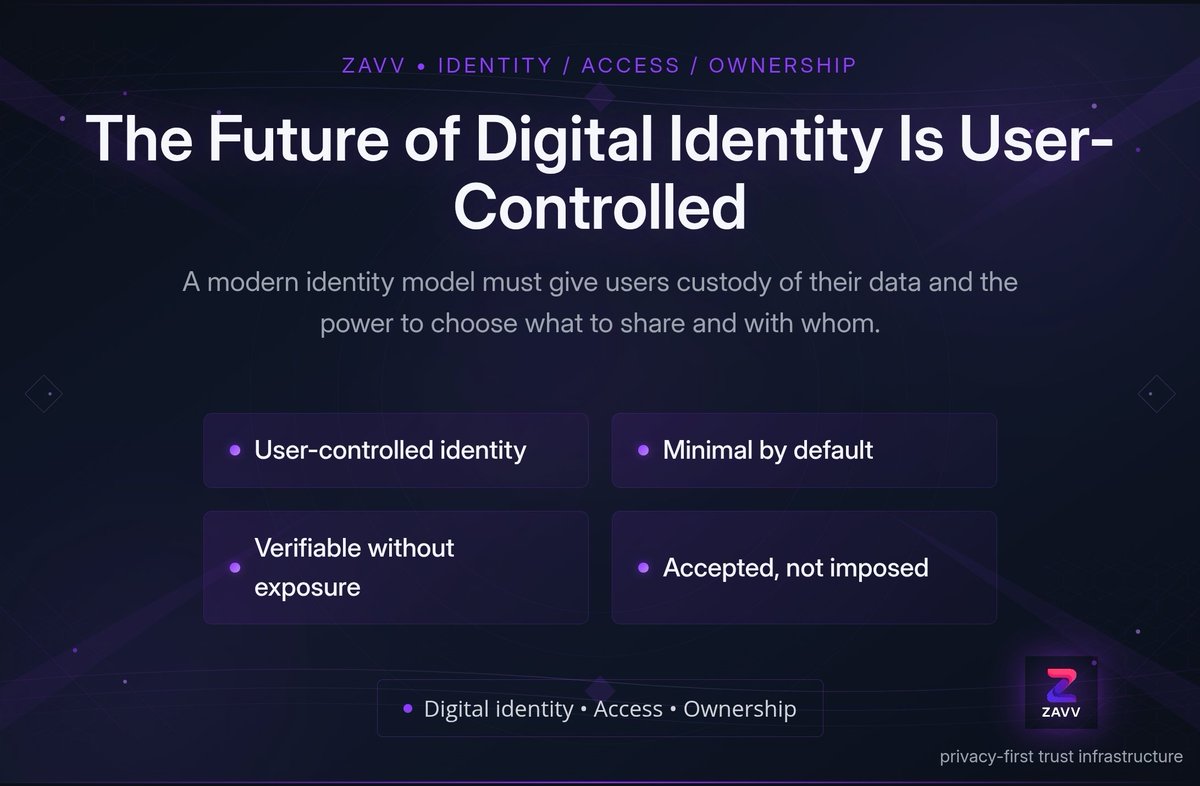
• user-controlled
• minimal by default
• verifiable without exposing underlying data
• portable across systems
• consent-driven
• auditable without surveillance
• based on proof, not data accumulation
Because the future isn’t government-held identity or corporate-held identity — it’s user-held identity, where people choose what to share, when to share it and with whom.
Zavv is built on this trust-first model.
We leverage the strengths of Xahau, Evernode and on-ledger Hooks to enable selective disclosure, outcome-based verification, cryptographic proofs and user custody — without expanding data exposure or centralising identity.
This global shift is already underway: from collecting data to verifying outcomes, from identity dumping to minimal disclosure, and from siloed records to privacy-first infrastructure.
Identity systems earn trust not by collecting more data, but by giving users control — and by proving only what is required, nothing more.
#DigitalIdentity #DigitalTrust #GovTech
@GOVUK@ICOnews@OpenWalletOrg
We want to have the choice, that’s what innovation is about. In any logical world the holder of the asset gets the yield! This isn’t blurry or not clear.
Yet you guys in congress once again love to support the extractors who are funding them. Robbery treachery and betrayal, people are watching.
The way we handle digital identity is broken.
Most systems still treat identity as data collection — the more you hand over, the more “trusted” you're expected to be.
That model is outdated. And it’s failing users, businesses, and governments alike.
Trust should come from:
🔹 Verifiable proof
🔹 Explicit consent
🔹 Minimal data exposure
🔹 Clear, auditable outcomes
Zavv is built on that principle from the ground up — a privacy-first infrastructure for proving eligibility, access, and ownership without turning people into data sources, and giving organisations trust and compliance without hoarding information.
Because:
✔️ Identity shouldn’t be intrusive
✔️ Access shouldn’t require oversharing
✔️ Ownership shouldn’t be disputed
A better model of digital trust is not only possible — it’s necessary.
#DigitalIdentity #DigitalTrust #PrivacyByDesign
@ICOnews
CRITICAL - PAY ATTENTION
The Bank 🏦 Lobby is trying to hand China the keys to the future of money. 💰 💴
Right now, U.S. Senators are being pressured to "revisit" the GENIUS Act to ban third-party rewards on Stablecoins.
THIS IS A NATIONAL SECURITY TRAP 🪤
Today, the stakes are higher than ever because China officially began paying interest on the Digital Yuan (e-CNY) - making it a "yield-bearing" competitor to the USD.
Meanwhile, the Bank Lobby - the American Bankers Association - is currently pressuring the Senate to close the "third-party loophole" in the GENIUS Act - which would stop companies like @coinbase@krakenfx@Gemini or @UpholdInc from giving those rewards to everyday Americans.
If we ban American companies from offering yield to YOU - we’re not "protecting banks" like the bank lobby claims - we’re forcing the world to use China’s currency instead of the USD.
Why is the Bank Lobby so afraid of your Digital Dollars? Because they can’t "rent" your money back to you if you’re earning the yield yourself!
That’s why the Banking Policy Institute, led by Jamie Dimon, wrote @ewarren’s Anti-Crypto Bill in 2024 and why I continue to call her and @EdMarkey puppets for the Banking Industry.
If the Senate sells out to the Bank Lobby they are effectively taxing every retail investor and customer in MA and across the country to protect Wall Street's bottom line. PERIOD.
President Trump promised to make the U.S. the Crypto Capital of the World. We can't do that if career politicians serve as puppets for the bank lobby at the expense of ordinary Americans while also threatening NATIONAL SECURITY.
Stand with regular Americans - not the lobbyists - and keep the "Genius" in the Act and stop this sell-out.
@realDonaldTrump@SenatorTimScott@SenLummis@berniemoreno@SecScottBessent@DavidSacks@davidsacks47@howardlutnick@BoHines@patrickjwitt@tyler@cameron@bgarlinghouse@s_alderoty@chrislarsensf@brian_armstrong@faryarshirzad@iampaulgrewal@jespow@DavidLRipley@SMcLoughlin00@gregkidd@paoloardoino@DonaldJTrumpJr@EricTrump
#mapoli #MASen #Deaton
Hello world 👋
Meet Zavv — identity, access and ownership, re-imagined.
Every day people are asked to give up far more data than necessary just to get access.
We believe identity, access, and ownership should work differently.
Zavv is privacy-first infrastructure that lets people prove who they are, what they’re eligible for, and what they own — without oversharing personal data — while giving businesses the trust and auditability they need.
With Zavv, users can:
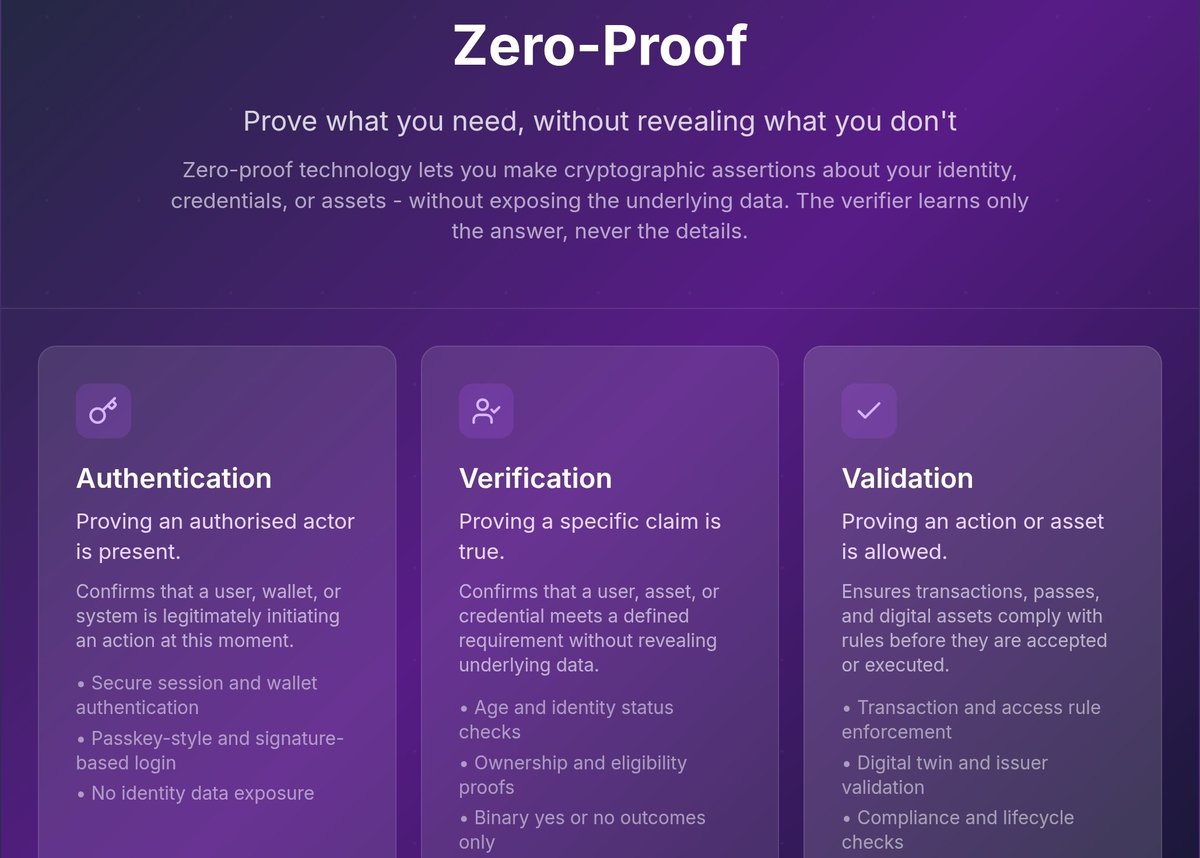
🔹 Prove eligibility and ownership, not expose raw data
🔹 Sign in using their wallet via QR and explicit approval
🔹 Control what’s shared, when, and with whom
🔹 See a clear, auditable history of access and ownership use
For businesses, Zavv enables compliant, real-world verification and access flows built around user consent, minimised data, and verifiable outcomes — not data hoarding.
This goes beyond login.
It’s identity, access, and ownership you control.
More updates soon.
Visit our website at https://t.co/NZx50yvz1Z for more information!
#Zavv #DigitalIdentity #DigitalOwnership #PrivacyByDesign #UserOwnedData #AccessControl #IdentityWallet #ZeroProof #DigitalTwin #Xahau #Web3 #XRP #XRPLEDGER #XRPL #Blockchain #EverNode @XahauNetwork@EvernodeXRPL@DecentralizedID @W3C @trustoverip@OpenWalletOrg@owasp
With @Firelightfi , we have been considering a new metric for DeFi protocols: Total Value Covered(TVC) as a complement to TVL.
Every DeFi protocol faces the same dilemma. You build a vault, an earn program, or a lending protocol. You audit the code. You offer attractive yields. But eventually, you hit a glass ceiling.
Retail users might ape in for 20% APY, but the massive, sticky capital—institutional funds, family offices, and risk-averse whales—stays on the sidelines.
Why? Because in the current landscape, depositing into a protocol is a binary bet: You either get the yield, or you lose the principal.
This is where the conversation needs to shift from Total Value Locked (TVL) to Total Value Covered (TVC). Or at least take TVC into consideration.
The "Risk-Adjusted" Era
For a lending protocol or yield vault, TVL is just a measure of current liquidity. It says nothing about the durability of that liquidity.
Firelight changes this dynamic. By providing "Economic Security Services" (ESS), Firelight allows protocols to wrap their products in a layer of protection.
Think of the difference between two vaults:
Vault A: 12% APY. Uninsured. 100% loss upon exploit.
Vault B: 10% APY. 100% Covered by Firelight.
Vault B might have a slightly lower nominal yield due to the cost of cover, but its risk-adjusted return is infinitely higher. Vault B is the only one that can attract serious capital.
How @Firelightfi Unlocks Growth
@Firelightfi isn't just an "ambulance" waiting for a crash; it is infrastructure for growth. We allow protocols to transform their native TVL into TVC.
For Earn Programs: You can offer "Principal Protected" tranches, where Firelight’s stakers underwrite the slashing risk, allowing you to onboard conservative users who would never touch DeFi otherwise.
For Lending Markets: You can insure against bad debt creation or oracle failure, effectively acting as a decentralized FDIC for your depositors.
The New Standard
We are moving toward a future where "Uncovered TVL" will be seen as "Junk Bond" status—high risk, speculative, niche.
To break the glass ceiling and unlock the next trillion dollars in DeFi, protocols need more than just smart contracts; they need economic guarantees.
Firelight provides that guarantee. We don't just protect the downside; by enabling High-TVC environments, we unlock the upside.
The question for builders is no longer just "How do I get liquidity?"
It is: "How do I make my liquidity safe enough to stay?"
Flare has a lot of big announcements coming this quarter. Which one will have the biggest impact? fBTC? Firelight cap increase? Smart accounts?
I used to be skeptical that smart accounts would have a big impact, subscribing to the thought that the current process was ‘good enough’.
However, as I’ve studied more, I’m beginning to believe that smart accounts is not only better, it’s the ONLY way to MASSIVELY scale network usage.
Current way: Bridge XRP → mint FXRP → switch to EVM wallet → hold $FLR for gas → stake in Firelight or lend elsewhere. It works for early adopters, but friction kills mass participation. It just does. It’s too many steps and too complex for those conservative xrp holders, who just want a ‘simple’ way to earn yield. (And there’s LOTS of those simpletons).
Smart Accounts simplify everything by abstracting away the complexity. Stay in Xaman, (or your preferred wallet), and send a SINGLE payment with a memo encoding your intent (ie., "stake in Firelight"). Flare's Data Connector verifies it, and a proxy account executes on Flare’s side. No bridging upfront, no gas in FLR, no chain-switching.
It's seamless, non-custodial, feels native to the user, and allows them to earn yield without having to understand the underlying complexities.
fBTC/fDOGE will expand assets, Firelight Phase 2 unlocks real rewards... but without Smart Accounts removing barriers, adoption stays limited.
Smart accounts are the way to unlock exponential growth. Conservative XRP holders will finally participate in DeFi, effortlessly.
Excited for what @HugoPhilion and the @FlareNetworks team have in store.
Hey @FlareNetworks community!
I've poured the last 3 months (700+ hours!) into building Apex Trading Platform: a non-custodial automated grid trading system on Flare. It's designed for spot trading via OpenOcean aggregator, using Flare's native FTSO v2 oracles for reliable prices—no external dependencies, full on-chain transparency, and you keep complete custody via personal smart contract vaults.
I built this for my own use, but it's got killer features like ratcheting anchor prices to capture volatility profits, slippage protection, position management, and more. This isn't perps or futures—it's systematic spot grid trading that buys low, sells high automatically, without needing constant monitoring.
Attached is a 5-minute overview video—definitely watch it to see the full potential and why I'm excited to use this daily.
Question for the community: Would you want this deployed publicly on Flare for everyone to access and use?
If we get strong interest, I'd prioritize making it happen. There's a lot ahead: security audits, additional hardening, and potentially ecosystem support like grants to cover those hurdles. But without enough demand, I'm happy keeping it as my personal tool.
Show your feedback—likes, retweets, and especially comments/replies will help gauge real traction and could attract help from key players to push it forward.
What do you think, Flare fam? Let's discuss!
@HugoPhilion@0xQuantic@FlareDevHub@Firelightfi@fassko@j00sko@Burstnodes@OxenFlow@4DadsFtso@xrpen15@Tabbakhh@cobi_bean@whale589@AceThaGreatest@SchwetyBigBags@SparkDexAI@enosys_global@Thana_Enosys
Tens of millions in TVL within weeks.
Zero clarity on what Points mean.
Phase 2 maybe April 2026.
I'm in @Firelightfi. I respect @TheJesusRodrigu and @hugoPhilion.
But I have questions.
This isn't FUD. It's due diligence: https://t.co/nly6QJguAy
🧵1/8👇
Building an ecosystem around an asset like XRP is so much more than opening up a custodial bridge like cbXRP and others (cough cough). You need:
•Seamless on and off boarding to lower the barrier to participation to the absolute minimum.
◦As a starting point this means that the Bridge HAS to be non custodial - because limiting the minting and redemption ability to the customers of a single exchange or custodian is just disastrous for market formation. As YOU aren’t a customer of theirs do you really want to have to sell your XRP on an exchange for a stable coin and then withdraw that stable to another chain and then buy their wrapped version of XRP - probably not. The second part of seamlessness is UI & UX, see @BifrostWallet , @OxenFlow & soon XRP smart accounts @FlareDevHub which changes the game entirely.
•A cohesive end to end economic ecosystem for the bridged token. You need all the basic defi primitives see: @SparkDexAI , SparkDex & @flamix_trade perps, @enosys_global , Enosys loans, @Kinetic_Markets , @spectra_finance , @blazeswapdex , @IgniteMarketX .
◦Then you need something special that brings it all together and provides ecosystem differentiation. See @Firelightfi
•Then you need to bootstrap liquidity. In reality this means onboarding the omnichain version of the world’s largest stablecoin. See @USDT0_to . And of course working towards having the stablecoin that the community really wants. See RLUSD @Ripple
•But none of this works by itself you have to bootstrap liquidity because if there isn’t liquidity the user experience is terrible and the financial incentives are broken. See the growth of USDT0 and rFLR.
•Then you need to be continually innovating to make both the experience and the product better. See Flare 2.0 and compute. https://t.co/r8KgYkag2b
•Lastly you need to be constantly working with partners new and old to encourage ecosystem growth, working on education and both user and developer resources and marketing the hell out of the ecosystem because there is so much going on that making yourself visible is paramount.
•Then if your aim is to be the seamless hub for all non smart contract tokens you need to repeat the same for BTC, XLM and the rest.
Time, team, dedication and unwavering vision is what is required. Throwing stuff at the wall and seeing what sticks hasn’t worked historically - not even for mega giants like Coinbase.
This is why Flare is the place to build with XRP.
We are building @Firelightfi not only for the existing DeFi demographic but mainly for new institutions coming into the space.
If DeFi insurance works, it won’t just “add a feature” to DeFi.
It has the potential split the market in two.
On one side, you’ll always have the DeFi degens.
They live on the edge, they farm whatever is new, they rotate fast, and the expected value of a protocol blowing up is just part of the game. For that audience, insurance is almost irrelevant — it adds friction, lowers yield, and kills the thrill. They opt in to risk as part of the experience.
On the other side, you have the institutional channels: funds, market makers, treasuries, exchanges, fintechs.
They don’t optimize for thrill. They optimize for risk-adjusted yield, capital preservation, and governance constraints. For them, the absence of insurance is not a minor UX issue — it’s the main reason a huge amount of balance sheet never touches DeFi in the first place.
This is where DeFi insurance becomes a structural unlock.
If you can turn protocol risk into a priced, transparent, underwritten layer — instead of a vague fear in a risk memo — you don’t just protect existing users, you redefine who can participate:
•Aave and Morpho depositors with institutional capital behind them.
•Centralized exchanges routing treasury into DeFi strategies.
•Fintechs embedding yield products without inheriting raw protocol risk.
Project @Firelightfi is built mostly for that second world.
It uses staked large-cap assets to underwrite DeFi risk and turns “protocol can blow up” into something you can quantify, price, and insure against.
If we get DeFi insurance right, degens will keep playing their game.
But the real expansion of DeFi will come from the quiet, boring, massive pools of institutional capital that finally have a risk primitive they can live with.
@SolidiFiHQ Thanks but the MetaMask button does not work.
Have iPad with no MM installed and do not want MM on my iPad. I simply want to connect my Songbird Solidifi wallet to the https://t.co/vWWrJQs6YW website, just like I do with my Bifrost wallet? How can I do this please, thank you
@SolidiFiHQ Hello
How can I connect my SolidiFi wallet to a website please for (Songbird SGB)
It offers Wallet Connect but I do not see how to scan this with SolidiFi ?
Please advise
Thank you