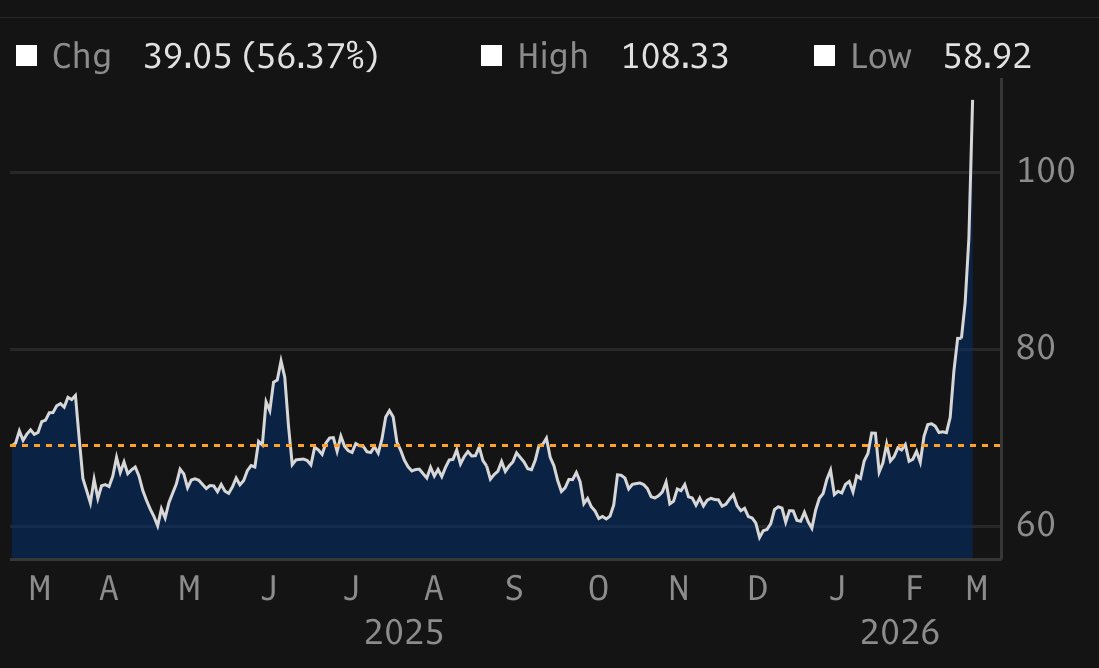
Michael Saylor is about to funnel $1 trillion of capital into an asset with a $1.4 trillion market cap, >95% of terminal supply in circulation, 5-10% of supply lost forever, a growing base of people who will simply never sell, and at a time when $BTC-backed lending is maturing and large banks and institutions are just beginning to understand.
Very soon there are going to be more AI agents than humans making transactions.
They can’t open a bank account, but they can own a crypto wallet. Think about it.
BREAKING: The world is now experiencing its largest oil supply shock in history, losing nearly 20 million barrels of oil supply per day.
Top oil supply shocks:
1. Hormuz Closure (NOW): -20 million b/d
2. Iranian Revolution (1978): -5.5 million b/d
3. Yom Kippur War (1973): -4.5 million b/d
4. Iraq-Kuwait War (1990): -4.3 million b/d
5. Iran-Iraq War (1980): -4.0 million b/d
6. Russia-Ukraine War (2022): -2.0 million b/d
The current supply shock is roughly the same size as the top 2-6 COMBINED.
JUST IN AND UNUSUAL
CHINA is recording the US war live!
The US attacks on Iran have become a veritable military intelligence laboratory for China.
More than 300 Jilin-1 satellites are recording every detail, second by second, from munition refueling to missile trajectories.
China is turning US war doctrine into a database, including refueling times and air defense responses.
According to experts, this data could give China a military research and development advantage that will last for decades.
US war tactics are being thoroughly analyzed.
And another - this will continue to escalate - buy and hold assets - the money printer is warming up - Universal Basic Income will be paid in Stable Coin.
AMAZON PRIME VIDEO BLOODBATH
2,847 employees got the email at 6:47 AM PST
"Your role has been eliminated effective immediately"
Badges dead by 7:15 AM. Slack access revoked mid-sentence
Senior engineers who built the entire streaming infrastructure. Gone
The team that shipped 40% faster last quarter using Claude for code generation. Eliminated
847 contractors in Bangalore just got handed their prompt libraries and deployment scripts
Same streaming platform. Same feature velocity expected
14 remaining Seattle engineers to "manage AI-augmented offshore delivery"
The kicker: those eliminated seniors spent 8 months documenting every architectural decision into internal wikis
Every code pattern. Every debugging workflow. Every performance optimization trick
That documentation just became training data for the AI systems replacing them
VP of Engineering sent company-wide: "This transition represents our commitment to AI-first development"
Severance packages include mandatory 90-day non-compete clauses
Meanwhile the Bangalore team already pushed 12 commits using the extracted knowledge base
One former L7 told me: "I literally trained the AI that made me redundant"
If you're at FAANG and not seeing this coming you're already dead
DMs open for anyone who needs to talk
The Strait of Hormuz has been closed for 8 days. Everyone thinks this is about oil. This is about what oil becomes. 92% of the world's sulfur comes from refining oil and gas. Close the Strait of Hormuz and you don't just lose 20 million barrels of crude per day. You lose the feedstock for sulfuric acid, the single most produced chemical on Earth. Sulfuric acid is how we extract copper. It's how we extract cobalt. Without it, you can't make transformers, EV batteries, or the substrates inside every data center on the planet. One chemical, made from one feedstock, shipped through one chokepoint. The cascade goes further: Qatar ships 30% of Taiwan's liquefied natural gas through Hormuz. Taiwan has 11 days of reserves left. TSMC, the company that makes 90% of the world's advanced chips, draws 8.9% of Taiwan's total electricity. No gas, no power, no chips. Then food. 33% of the world's nitrogen fertilizer feedstock moves through the Strait. Half of all humans alive today exist because of synthetic nitrogen. Sulfur, semiconductors, food. That makes three supply chains, one 21-nautical-mile chokepoint, and zero domestic alternatives at scale.
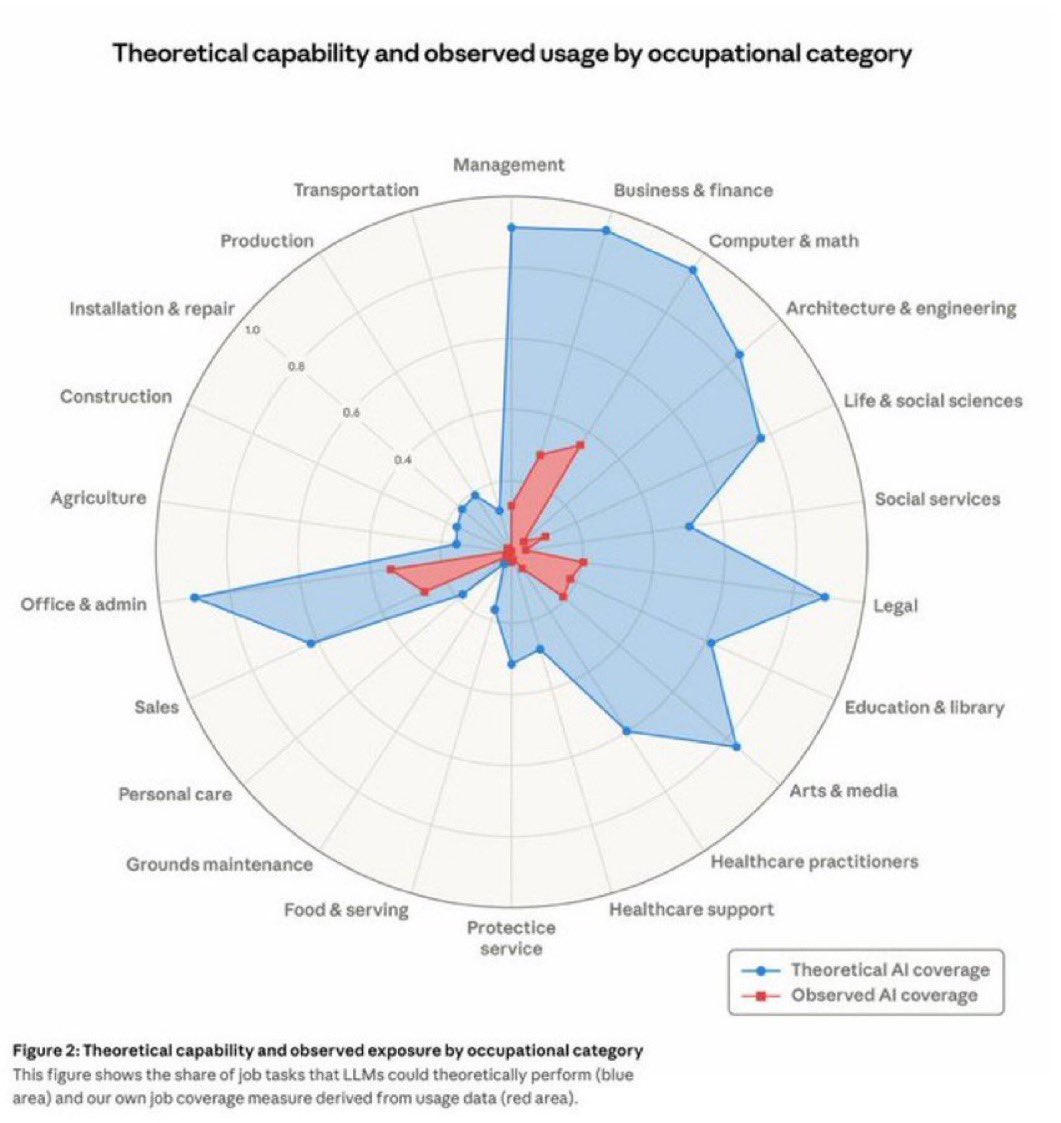
Anthropic's Revealing Chart on AI's Impact on Jobs
Anthropic has unveiled a pivotal chart that underscores the chasm between AI's capabilities and its real-world application in the workforce.
Derived from analyzing 2 million actual conversations with Claude, this radar chart, titled "Theoretical Capability and Observed Usage by Occupational Category," paints a stark picture of untapped automation potential across various job sectors.
At its core, the chart is a spider web diagram plotting occupational categories around a circular axis, with values ranging from 0 to 1.0 representing the share of job tasks.
The expansive blue area illustrates the theoretical coverage tasks that large language models (LLMs) like Claude could perform right now based on their inherent abilities. In contrast, the much smaller red area shows observed usage, drawn from real user interactions.
The visual disparity is immediate and profound: blue spikes outward significantly in fields like computer and math (reaching about 0.75), business and finance, and office administration, while red hugs close to the center, often below 0.2 across most categories.
This gap isn't just academic; it's a "career runway," as highlighted in discussions around the chart. For programmers, 75% of tasks are theoretically automatable, yet actual usage lags far behind.
Similar vulnerabilities appear in customer service, data entry, and financial analysis, roles traditionally seen as white-collar strongholds. Meanwhile, hands-on fields like construction, agriculture, and protective services show lower theoretical exposure, with blue areas dipping to around 0.1-0.3, suggesting AI's current limitations in physical or unpredictable environments.
Broader data amplifies the chart's message. As of early 2026, 49% of U.S. jobs expose at least 25% of tasks to AI, up from 36% a year prior. Yet, mass layoffs haven't materialized; unemployment in AI-vulnerable roles remains steady.
Instead, subtler shifts are underway: a 14% drop in hiring for 22-25-year-olds in exposed positions indicates companies are prioritizing experienced workers, shortening entry-level pathways for recent graduates.
The implications are clear: while AI's red footprint grows incrementally each month, the blue expanse signals accelerating change. College-educated, higher-earning professionals, once insulated are now most at risk, flipping the script on traditional labor disruptions.
Anthropic's chart isn't a doomsday prophecy but a wake-up call, urging workers and businesses to bridge the gap through adaptation, upskilling, and ethical integration of AI tools.
Please read the 5000 Days Series at https://t.co/tcKeuiQyql for answers on how you can thrive in the Interregnum.
The US national debt is $39 Trillion, but that number is a lie because the government uses accounting rules that would get a CFO arrested.
Here's what they don't count:
The government owes $430.2 trillion in Social Security and Medicare benefits over the next 75 years. It expects to collect $350.6 trillion in taxes to pay for them.
That leaves a $79.5 trillion shortfall
$79.5 trillion in Social Security and Medicare promises already made to living Americans.
Benefits people have spent 40 years paying into.
The government excludes them because Congress can cancel them anytime.
So they don't have to list them.
Add federal pensions, veterans benefits, and other long-term obligations and the audited total hits $158.6 trillion.
Against $5.7 trillion in actual assets.
But here's the part nobody talks about:
$9.2 trillion in debt will mature in 2026
Except 2020's rate was ~2.5%, today's is ~4.5%.
That single repricing will push annual interest to $1.2 trillion.
The US collects $5.6 trillion in taxes per year.
$1.2 trillion of it, 1 in every 5 tax dollars, pays interest before a single road gets paved or soldier gets paid.
And governments that can't grow or cut their way out of this have one move left - print
The question isn't whether your $ savings will lose value.
It's how much you've already lost while you were reading this.
Gotta hand it to the authorities. At first I was mad when they scrubbed the Banksy, but they have unintentionally made one of the most powerful artworks of all time.
Balaji: People don’t understand what it means for something to go up 100 million X.
When historians look back at Bitcoin going from less than a penny to $100K it will seem like Fiat immediately collapsed and Bitcoin took over.