@Jason Au Pied de Cochon has all the bistro classics done well, their French onion soup and foie gras are amazing. Desserts are delicious too. Tip: they have air conditioning upstairs! https://t.co/iPROXd5F6l
@APompliano I’m a big fan of the Pomp podcast but you sound pretty Republican in your views. I think you are fooling yourself if you believe you are Independent.
@nntaleb@bryan_johnson Bryan already admitted his best advice comes down to something your grandmother would tell you: eat real food, exercise, sleep well, and hang out with friends. So the millions he spends on other dumb, complicated shit makes him an idiot but not dishonest.
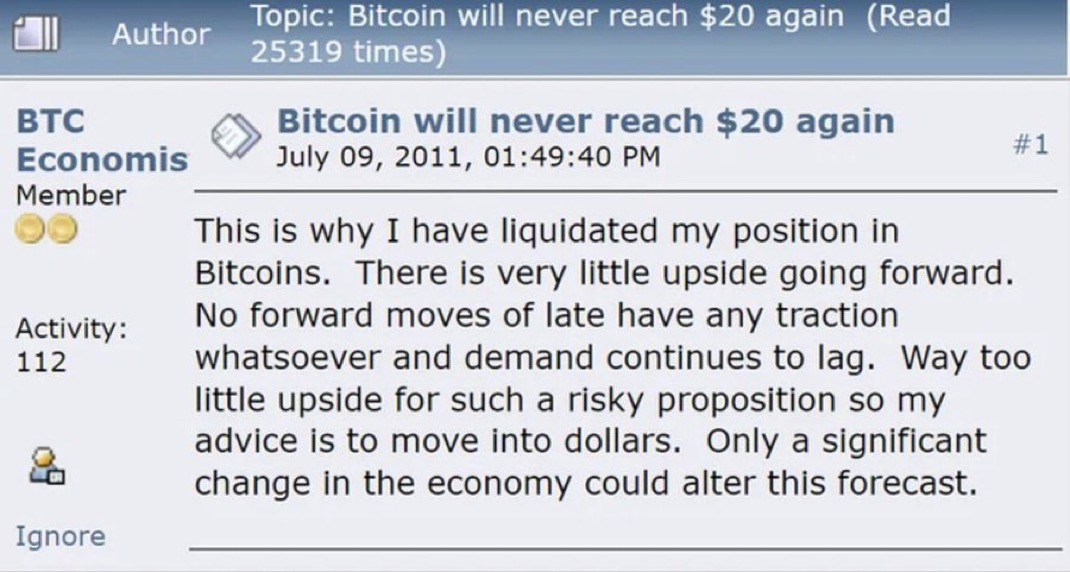
The overwhelming consensus today is that Bitcoin is headed much lower.
Maybe it is. The trend is still down on the higher time frames, macro uncertainty remains elevated, and there are legitimate reasons to be cautious.
But markets have a funny habit of making the majority feel smartest right before they make them the most uncomfortable.
So let's suspend our biases for a moment and ask a different question.
If Bitcoin were actually in the process of putting in a major bottom, what evidence would we expect to see?
A month ago, I laid out the historical case. At the time, I argued that Bitcoin was beginning to enter the same conditions that had accompanied every previous major cycle low. It wasn't a prediction. It was simply an observation that several independent indicators were beginning to align.
Since then, that case has become stronger.
The weekly bullish RSI divergencewith oversold conditions I discussed has now been confirmed. The daily chart is showing the same thing. Momentum is improving even as price remains near its lows, exactly the type of behavior technicians look for when trends begin exhausting themselves.
Bitcoin also continues to find support around its 50-month moving average, a level that has historically marked major long-term buying opportunities. It is also trading around the 200 Weekly MA, a level that has marked every bottom.
On-chain metrics continue to show underwater supply at levels typically associated with broad capitulation, suggesting a significant amount of forced selling has already taken place.
At the same time, whale accumulation has exploded. Large holders are accumulating Bitcoin at the fastest pace ever recorded. These were the same wallets that sold the top. That's worth paying attention to. Historically, the biggest players don't wait for perfect headlines or obvious trend reversals. They accumulate while uncertainty is highest and conviction is lowest.
Then there's sentiment.
Fear and greed is in the gutter.
Also, every major Bitcoin bottom eventually becomes associated with a narrative that feels impossible to overcome while you're living through it. In previous cycles it was Mt. Gox, China's mining ban, COVID, Luna, Celsius, and FTX. At the time, each felt like an existential threat. Looking back, they were signs of peak fear and capitulation.
Today that narrative has become Strategy.
The conversation has shifted away from Bitcoin itself and toward whether Strategy can continue financing its accumulation. The prevailing belief is that dilution is inevitable, capital markets are closing, and Bitcoin can't sustainably recover until Strategy fails first.
But nearly every one of those arguments depends on the same assumption: Bitcoin continues falling.
If Bitcoin stabilizes, trades sideways, or begins recovering over the coming months, much of the bearish case against Strategy begins to unwind naturally. Financing improves. Market confidence returns. Access to capital opens back up. The feedback loop everyone is worried about today begins working in the opposite direction.
In other words, perhaps the market has cause and effect backwards. Strategy doesn't necessarily need to survive in order for Bitcoin to recover. If Bitcoin is already entering a bottoming process, many of the concerns surrounding Strategy may simply resolve themselves.
This brings me to what I think is the most important point.
Major bottoms don't form when everyone suddenly becomes bullish. They form when the market quietly stops going down despite nearly everyone expecting it to.
That's exactly what bullish momentum divergences represent. Price continues testing lows, sentiment remains terrible, headlines stay negative - but underneath the surface, selling pressure begins fading. Momentum improves before price does. Strong hands quietly absorb coins from weak hands. By the time the news turns positive, much of the move has already happened.
None of this guarantees we've seen the final low. Markets don't provide certainty, and major bottoms are rarely clean. They tend to frustrate both bulls and bears before a new trend emerges.
But when I step back and look objectively at the evidence, I see a market where weekly and daily bullish divergences have now been confirmed, long-term support continues to hold, whale accumulation has reached unprecedented levels, on-chain capitulation resembles previous cycle lows, and sentiment has become overwhelmingly one-sided.
Could Bitcoin still make another lower low? Absolutely.
Could this process take longer than anyone expects? Of course.
But if you're intellectually honest enough to consider both sides, I think the bullish case today is far stronger than most people are willing to admit. And historically, that's often what major turning points have looked like.
A lot of people say they’ll only buy Bitcoin at $40k.
Fair enough, but that’s classic price anchoring.
The better question is: what is the risk level today?
Historically, the difference between buying around 10% risk (today) and waiting for theoretical 0% risk has basically been a rounding error.
The difference between buying and missing the move entirely is not.
Think in risk levels, not pretty round numbers.
Bitcoin is sitting right on the 200-week moving average, around $61,300. I want to be precise about why that matters, because most people quote the wrong line.
The 200-week simple moving average, not the exponential one, has marked the cycle bottom in 2015, in 2018 and in 2022. Every major bear in bitcoin's history has bottomed at or just below this line and then turned. It is the closest thing the asset has to a structural floor, because it represents roughly four years of average price, which is one full cycle. We are testing it right now, and bitcoin has already lost the 50-week moving average on weekly closes, which is the line that historically separates a bull market from a bear market. So the structure is bearish, and we are in the part of the cycle where you find out who actually had a plan.
The thing I keep repeating, because it is the thing people get wrong, is that this crash is macro, not crypto. There is no FTX here, no Luna, no single blowup to point at. What happened is the Fed pivoted to hiking, the hottest CPI in three years landed, December hike odds sit near 70%, and nobody serious, not Nomura, not Morgan Stanley, not JPMorgan, is pricing cuts for 2026. A hiking cycle does not change bitcoin's bear structure. The 200-week bottom and the roughly twelve-month bear clock still apply. What the regime changes is the depth. Hawkish macro means the drawdown can go deeper than a clean cycle would suggest before it finds the floor.
So here are the two lanes I'm watching. The bull lane: bitcoin holds $61K, reclaims $69K which was prior-cycle resistance, then $76K as the measured move, then $87K which is the 200-day average. The bear lane: it loses $61K on a weekly close, and the next real floor is $53,600, which is the realized price, the on-chain average cost basis for the entire network. Below that, mid-$40s, which would be roughly 30% under the 200-week line, the same kind of overshoot 2022 produced.
I'm not trying to call the exact bottom, because precision is a trap. But there is a convergence I trust as a signal, and it has marked the last four bottoms: price at the realized cost basis around $53,600, the MVRV-Z score collapsing toward zero, and bitcoin trading about 16% below the 200-week line. When those three line up, that is the zone, historically. On-chain, supply in loss just passed supply in profit for the first time this cycle, with around 8 million coins underwater. That is pain, and pain is what the setup is made of.
None of those triggers are sentiment. They're levels. That's the whole point. In a bear market the edge isn't having a smarter opinion about where price goes. It's deciding your levels in advance and being willing to do nothing until price comes to them.
Everybody criticizing Saylor and $MSTR while Bitcoin is sitting near cycle lows is missing the entire point.
This all comes down to one question:
Do you believe they’re right to be acquiring Bitcoin?
If you think Bitcoin is a valuable asset that will continue absorbing global capital, then $MSTR makes a lot of sense. It might end up being one of the best performing stocks out there.
If you don’t believe in Bitcoin to begin with, then of course you’re not going to believe in Strategy as a company.
People are cherry picking the last 6 to 8 months and ignoring the actual thesis.
Either Bitcoin wins, or it doesn’t.
Everything else is noise.