1/
We're launching the Inter-AI Morality Prize at Cambridge Digital Minds.
How AIs cooperate, compete and resolve conflicts will matter for both humans and AIs.
$20,000 first prize, plus follow-on funding of up to $300,000 for promising ideas. 🧵
Calm down, Twitter!
I'm writing this from Michael Faraday's old bedroom at 21 Albemarle Street. I'm at a desk pushed up against a window, overlooking the offices of a private equity firm. The workers look just as bored as they did this time last week. Perhaps they haven't heard Riemann was proven, and therefore didn't notice the sky fell in.
An hour ago in the next door room, I walked in on an impromptu talk by @YangHuiHe1. He gave a five minute tear-down of the Riemann proof at @London_Inst.
Yang chose the Rubenstein version (said to be the most legible out there today - Day 6). By now it's one of dozens of retellings of the Alpöge-Claude proof. They're growing in number and shrinking in length every day.
Observations on the Proof:
- Yang showed how this proof orchestrates a dazzling array of techniques (including most of the main breakthroughs in number theory from the past half century), to thread the needle of a particular inequality, with almost no wiggle-room. It very clearly couldn't have been done without summoning whichever instance of Smaug is currently curled up in Dario Amodei's basement
- But neither did Riemann fall to a cab driver thumbing "solve Riemann please" into the prompt window - had that been the case, your fatalism might be justified
- Alpöge is not just any old Princeton PhD. To quote Yang, he's a potentially "Poincaré-grade" figure - Alpöge has repeatedly been touted as a future Fields Medallist. In his mid thirties, he's approaching the height of his powers, and now allowed to pilot state of the art AI. Yang, a storied mathematician in another field, said, "there's no way I nor anyone except a top, top expert could have prompted Claude to produce that result, no way"
- A global race is now on to produce the most succinct, most elegant and most legible proof. Once again, this race is human-led and AI-actuated, just like the proof itself.
On Fatalism:
- I didn't enter a room full of mourners at the London Institute for Mathematical Sciences today (exactly the opposite mood to most of X). They're not weeping for the loss of a former life. Yes, the perimeter of the frontier is flashing out from under their feet. It's destabilising. Their quiet, prayerful lives may be over, and become more like a day on the trading floor.
- But to believe 'all maths gets solved by AI' is crass and a structural impossibility. As Tao said:
"Despite the impression given by press releases and social media, most of the problems at the current frontier of mathematics remain unsolved, even with massive computational expenditure. Indeed, the space of mathematical problems remains infinite; and the difficulty level of such problems is unbounded."
- It echoes what Yang Hui-He told me when I first met him the day of the FrontierMath evals in 2024: “Do you realise how many codimensions we’ve proved for Hodge? One! There are infinitely many to go. I need infinite post docs! I don’t fear being jobless. I fear not knowing in my lifetime."
Uncomputable Outcomes:
- But will AI one day ask all the questions, you ask?
- I think this misunderstands both AI and human at some fundamental level - at least, for now.
- AI reasoning systems are mostly trained against reinforcement learning paradigms that say: keep going, as long as it's very likely profitable profitable. Stop when it's not, or you can't tell.
- By construction, and AI cannot limitlessly decide to expend resources on "uncomputable outcomes" such as the Riemann Hypothesis, whose chances of solution are unknown, and whose economical value is low (unless it's part of a billion dollar marketing budget)
- There's no empirical evidence, to me, that the master commander relationship between an AI model and its human pilot has changed (so far).
The Value of Knowledge:
The chattering gods are telling you "the value of knowledge has gone to zero". Well, the evidence for that is slim.
Mathematicians today are all of us tomorrow.
They're just the first of the species to be pulled first through this infinite accelerator. That this monastic, contemplative group of intellects should have been chosen before the rest of us seems quite unjust and inappropriate.
But they're showing us that AI's massive expansion of possibility doesn't at all imply takeover.
The fact is, the world's greatest maths problem fell to exactly the kind of figure you could have predicted in advance.
Best in class expertise armed Apolgë with the weird incantations required to extract that proof from Claude.
The lesson so far seems to be - keep learning, humans.
Static textbook diagrams make evolution look boring.
So I turned the entire chapter into a tactile, interactive field journal. 10 hands-on lessons, real museum and field measurements, and a visual chapter test.
Built with Gemini 4 Neon. All lessons ↓
The biggest undeciphered script of the ancient world … and now we've cracked it, with the help of AI.
Did you know that the Indus Civilization — which flourished around the same time as Egypt and Mesopotamia — was bigger in area than both combined? We know far less about it, in large part because the Indus script hasn't been deciphered.
Now with the help of AI (@claudeai) we're able to read nearly two-thirds of the Indus inscriptions. We scaled the approach used to decipher Linear B to solve a far harder problem.
So how exactly did we do it?
(Preprint, not yet peer reviewed.)
1/5
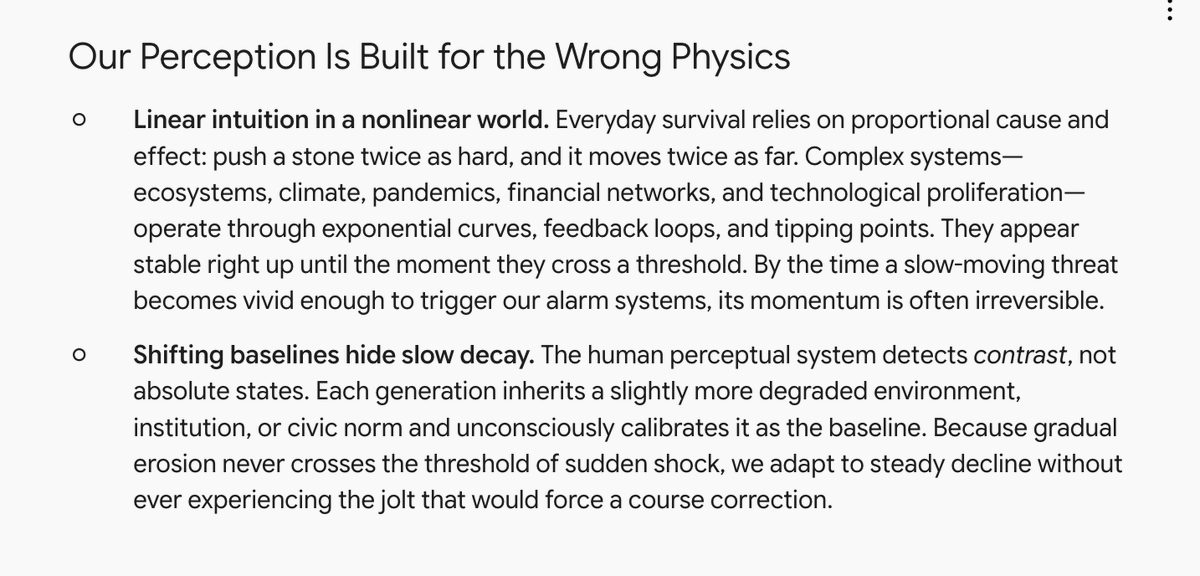
I asked (zero-shotted) Gemini 4 Neon (Medium): "What are your most profound insights about human cognition that explains why we are miserably incompetent in stewarding our future?" and got the following:
Stanford physicist Venkatesa Chandrasekaran has algebraically quantized gravity (using GPT 6 Astra).
Possibly the biggest breakthrough in human history. Far surpassing even Riemann’s contributions.
One of my philosophical mentors, Nick Shea, has written a paper about what it would take for AI systems to have goals of their own. I think this is a really important and interesting question, so it's recommended reading! https://t.co/9OXp9UlvB3
Gemini 4 Neon might just be the best AI release of the year.
Hands down, the best daily model on the market right now.
I put together the ultimate Gemini 4 Neon vibe coding prompt.
Bookmark it:
In testing GPT-6.2, I used it to make a significant historical discovery which I detail in the post below. This suggests that the process of research and discovery we’re already seeing in verifiable domains like math is starting to generalize to non-deterministic fields like history.
You can read the full post here:
https://t.co/Vm7MA2R3aQ
In a nutshell, Yale’s Beinecke Library holds an anonymous sketchbook of an 1808 journey from Montreal to Lake Superior and back. I’ve spent many hours over the years trying to figure out who made the sketches with no luck. The artist could literally be any one of several thousand people. There are few clues: only four dated and labelled images.
With minimal prompting, in just 22 minutes, Astra used publicly available sources to identify a minor French aristocrat, the vicomte de Chabot, as the artist and suggested that we test the hypothesis by ordering copies of a little known microfilmed diary of Chabot’s trip it also found.
I was truly stunned. I’d never heard of Chabot or this diary! New document finds are also exceedingly rare in a well worn field like fur trade history.
I ordered scans of the journal from microfilm and when they arrived the handwriting matched the captions in the sketchbook. The itinerary also aligned perfectly with the few dated drawings in the book. But there was actually the type of conclusive evidence we rarely get as historians: on 18 June 1808, after Chabot’s canoe reached Fort St. Joseph, he wrote “I took a sketch” before describing the exact view of the fort depicted in a matching drawing.
The journal itself is also a major find. It had been mentioned once in a dissertation footnote, but in a completely different area of history and is unknown to fur trade or Canadian historians. It’s long and detailed, covering some 162 notebook pages which makes this a significant new document to my field. Attached to the journal was another trove of documents too: excerpts from long-destroyed North West Company papers, journals, and letters. Again, this almost never happens. Both finds equally surprised the other leading experts I consulted.
Although we can construct a coherent narrative in hindsight, I cannot emphasize enough how exceedingly difficult this sort of thinking and recall is for humans. Unlike a human, Astra was able to tackle the problem from both ends at once: working forward from the scant facts of the 1808 journey pictured in the sketchbook and backwards from the immense number of surviving facts about 1808 British North America in general.
While we can technically explain Astra’s path to this find as a product of enhanced search capabilities, it conducted the investigation from end to end. I basically acted as the research assistant, restricting copies of the paper documents it needed.
To my mind, this puts historians in a similar position as the mathematicians found themselves about eleven months ago, when LLMs started to solve the first Erdős problems. Over the past year, we’ve watched these same models go from learning to read handwriting, to beginning to think historically, to mastering the undergraduate essay, and finally to making small but real contributions to human knowledge more or less autonomously.
The trajectory seems clear.
Am hearing this too. The only way to do AI transformation is forced board level mandate passed down; skunkworks teams; outsourcing. A huge percentage of current corporate jobs and process are redundant so incremental change is very hard.
Thing I am hearing from a number of big firms, from manufacturers to financial services: we have scattered teams of 2-3 people using AI that are doing the work of dozens of folks in a fraction of the time, creating large-scale management fights over the implications and politics.
1. Money - solves 95% of problems.
2. Exercise - prevents 80% of illnesses.
3. Indifference - avoids 80% of trouble.
4. Reading - determines 60% of your destiny.
5. Saying no - reduces 90% of inner conflict.
6. Keeping quiet - Reduces 70% of disputes.
7. Self discipline - Keeps you in control of 70% of your peace.
8. Reviewing your performance - helps you avoid 70% of detours.
9. Practice - builds 80% of your skills.
10. Taking action - achieves 80% of your goals.
11. Going to bed early - restores 90% of your vitality.
12. Tolerance - can defuse 30% of hatred.
Please study:
1. Pattern recognition
2. Mental models
3. Feedback loops
4. Causal reasoning
5. Cognitive biases
6. Complexity theory
7. Network effects
8. Decision theory
9. Nonlinear thinking
If you want to understand how the world actually works. (If you're new to these you can follow this page to understand them)
I write this post with great sadness. Humanity faces an existential threat that only a few people truly understand. AI triggers "cognitive surrender" where people prefer AI's wrong answer to their own deliberation as the post below explains.
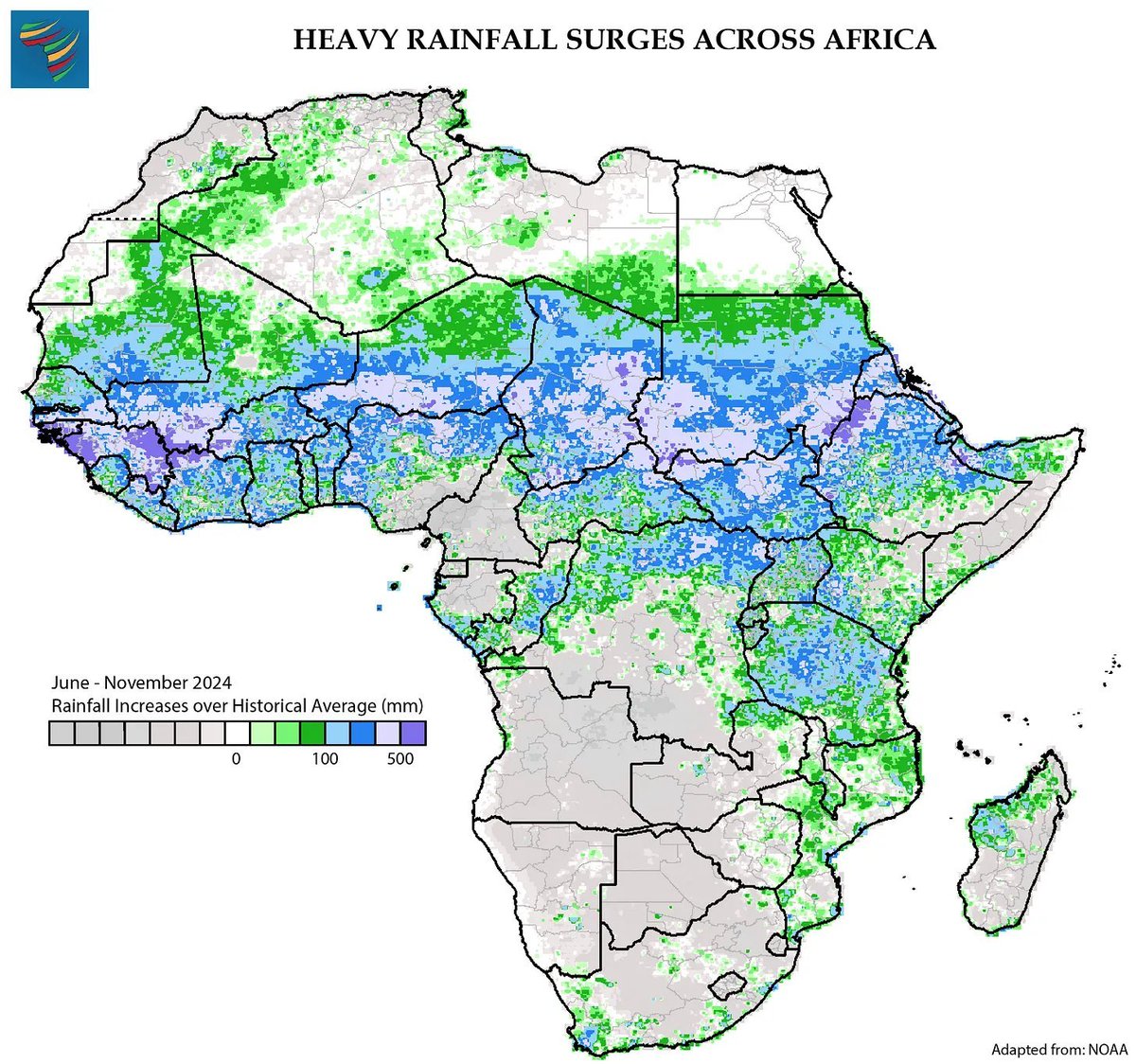
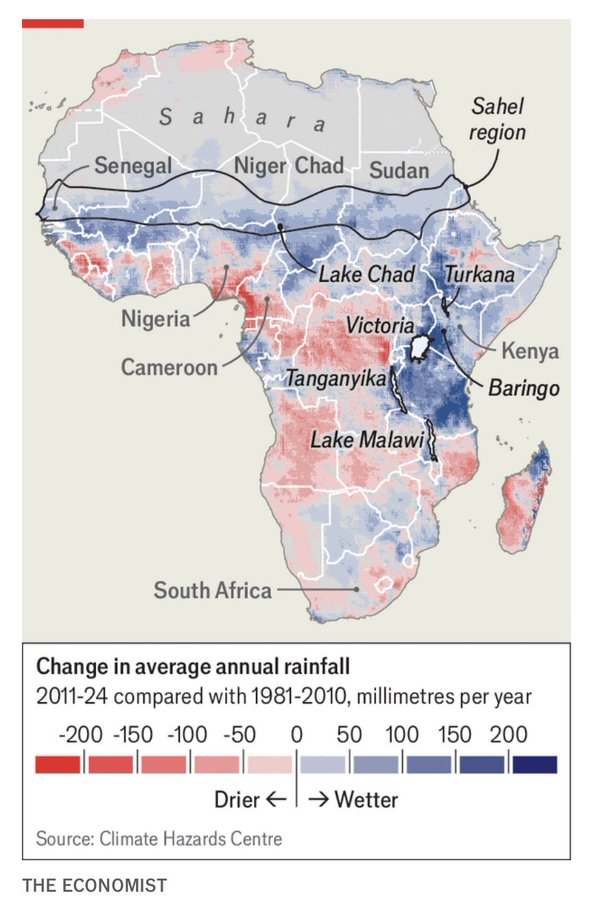
Maps of the modern greening of the Sahel. Probably the biggest overlooked topic in Anglosphere geography departments. Most of the relevant fieldwork, on both ancient Green Sahara and emerging new greenbelts, is from the French.