This guy coaches Sam Altman.
He also works with leaders at Anthropic, Google, Apple, and SpaceX.
I sat down with him to learn how he coaches billion dollar businesses.
Here are Joe Hudson’s 7 operating rules:
1. Kill your 1:1s
These meetings lead individuals to solve problems instead of the team. Much better to bring problems to the whole team so everyone feels responsible for solving them. I agree, haven’t done them for years...
2. Rotate who runs recurring meetings
When the same person always leads, people focus on pleasing or rebelling against them. Spreading the authority makes everyone accountable to the team instead.
3. Give anyone the power to change a bad meeting
Everyone already knows when a meeting isn’t working (and usually why). Giving people permission to say it makes meetings more effective.
4. Make every employee run at least 5 experiments a quarter on their own job
It makes the team more productive, keeps people interested, and helps retain smart employees who would otherwise get bored.
5. Ask your team to push back on your ideas
If you try to sell them on the idea, they may nod in the room and do nothing afterward. Asking for objections tests the idea + gets everyone aligned before you commit to it.
6. Start by building the part you understand the least
If you leave the confusing part until the end you might find out it doesn’t fit and have to rebuild everything around it.
7. End every email with an action needed
Name the person responsible, the action they need to take, and the deadline. Joe says this rule increased productivity in his business by 35 to 40%.
Thanks for coming on @FU_joehudson and sharing how you run your business.
Search “BigDeal pod” on youtube.
Kaia quotes a great point here:
Software-driven manufacturers with proprietary process IP are not “just manufacturing”, they're becoming a new asset class that's behaving like a Tech Company.
Given that @PwC says highly automated processes are expected to rise from 18% up to 65% by 2030 in manufacturing and other industries, the competitive advantage will shift from tools and machines alone to computational systems and processes.
Ultimately, this new asset class will be more resilient based on how fast systems can learn, adapt and create more value without losing traction.
American factories aren't dying because of workforce shortages; they're dying due to lack of investment incentives.
Manufacturers can't expect banks to fund what doesn't make financial sense to them.
And right now, betting on a U.S. manufacturer is still a harder sell than offshoring.
Jamie Dimon’s thoughts on this are spot-on. America needs:
→ Tax breaks and lower rates for domestic manufacturing loans
→ Government guarantees that de-risk factory investment
→ Real policy behind reshoring, not just rhetoric
We have the workforce and the demand exists. All that's missing is for capital to join up.
Give American banks a reason to bet on reindustrialization and they will.
Is Apple’s reshoring strategy having a significant impact in the American economy?
The short answer is yes but here's what you need to know:
Apple is collaborating to set the blueprint for the highest-value layers of tech manufacturing:
• Semiconductors
• Advanced components
• Precision manufacturing ecosystems
This creates:
– Stronger, more resilient supply chains
– High-skill, high-paying jobs
– New industrial clusters across the country
Apple is not going back to old manufacturing; they're building a smarter, more advanced version of it.
These are the very first steps for a new era of “Made in America” cutting-edge technology.
Which other startups or companies are shaping the future of American manufacturing? Tag them in the comments 👇
@ReshoreNow@USJobCreation This is a great initiative!
Reshoring is critical to the long-term resilience and competitiveness of American manufacturing.
Helping companies quantify the real cost of offshoring vs. domestic production is something very few organizations are actually doing, most founders still rely on assumptions around cost savings.
We need more organizations that help and guide entrepreneurs toward rebuilding U.S. industrial capacity. Do you agree?
WHOOP just dropped a massive lawsuit on Bevel.
and it could permanently change the entire health tech industry.
WHOOP is suing Bevel over "lookalike" app claims.
they are claiming trademark and patent infringement over how Bevel presents its recovery scores and dashboards.
but the timing of this is exactly what you would expect.
- Bevel recently opened up their core features for free
- they started gaining massive traction with users
- WHOOP immediately responded with a multi-angle legal attack
it is a massive $10B giant trying to legally crush a 20-person team before they take over the market.
Kevin O’Leary thinks the highest paying job right now is customer acquisition on social media
“I used to pay those guys $48,000, now I’m paying them $250,000 because you can measure their work based on customer acquisition every week”
“Most of them become contractors, they make half a million dollars a year because they know how to take content, turn it into a 59 second ad on social and acquire 200 customers”
“Those people in their early 20’s are so valuable now. If you know how to use your phone, somebody wants to hire you”
Most VCs, angel investors put into consideration PMFs before investing, but most founders don't know what it really is.
Product-market fit is one of the most overused terms in startups.
But most founders misunderstand what it actually means.
Product-market fit is not:
• launching a product
• getting early users
• raising a seed round
Product-market fit is when demand starts pulling the product out of you.
▪️Users keep coming back.
▪️Retention becomes visible.
▪️Growth starts compounding.
Before that, everything else is still just experimentation.
And capital poured into experimentation usually disappears very quickly.
What do you think, can a startup raise successfully without real product-market fit?
This post from @kaiarhodes reflects something data is already confirming:
• Around 4.5M U.S. manufacturing jobs have been lost since 2000
• Reshoring improves supply chains by reducing dependence on distant production
• 38% of American companies are reshoring due to geopolitical risk
• Near 50% are reshoring for speed and proximity, prioritizing customer satisfaction
• 96% of American companies report positive outcomes after reshoring
What other measurable gains could Americans see in jobs, resilience, and long-term competitiveness over the next five years if the reshoring trend continues?
When I started my first company, I thought mistakes were failures.
By my second, I realized mistakes were inevitable but I still thought I could prevent them.
By the fifth? I stopped worrying about them.
Every business throws challenges you’ve never seen before:
markets change,
customers surprise you,
decisions might lead to new paths
people come and go...
Experience doesn’t shield you against mistakes.
It just changes how you perceive them.
Now, I see mistakes as important signals.
They teach faster than success ever could.
What experience actually gives you is the ability to keep building when everything feels uncertain.
The real skill isn’t avoiding the stumble,
it’s learning how to rise without losing momentum.
That’s what separates the founders who keep going from the ones who stop at the first misstep.
Mistakes don’t disappear.
You just get better at dancing through them.
Here’s some advice most VCs won’t tell you directly when you’re raising funds as an early stage startup.
Probably helpful for YC founders as you go into pitchapalooza next week..
> first, never monologue. A VCs attention span is worse than a toddler. trust me I have one and I am one 😅
> speaking of attention span, you have 7-9 minutes to make an impression that makes a VC lean in. Everyone tries to give our full attention. But, the first few minutes are crucial to ensure that we’re leaning in.
> for early stage, you have to ensure you can flag what’s your unfair advantage from a product/tech, distribution and “you” perspective. Yes, you. Why were you born on this planet to make this startup happen?
> market is the one that most founders take for granted that a VC will understand. most won’t. especially if it “feels” small. explain what’s hidden underneath the iceberg. why is it hiding in plain sight? what do you know that no one else does?
> you are much better off spending time with a VC who’s convinced about the space vs. trying to change their mind. it’s generally a waste of time - just let it go.
> best founders are generally competition aware, but not obsessed. don’t dismiss the competition but have a very clear why you’ll win. why your strategy is right.
> the more esoteric details you tell us about the space the better. don’t fake it but it shows depth. shows you care. and that’s all that usually matters.
> have a very clear answer on why you want to raise money. even if the answer is just because you can. the very best founders are also excellent at capital allocation.
> finally, clarity + obsession is the killer combo. obsession is hard to fake. clarity often comes with practice. So practice!
And last but most importantly - don’t lie. VCs talk to other VCs all the time. This is how we know if you actually have a term sheet. Some might get away with it, but I have seen this backfire far more than you can imagine.
Good luck!
On-demand production in the U.S. is harder than it looks.
Here’s how we approach it at @AOSwag_
✔️ From our 80,000 sq. ft. facility in DFW, our team handles everything: custom orders, inventory storage, and fast nationwide delivery (1–3 days).
✔️ Our vertically-integrated model balances speed, flexibility, and scale without sacrificing quality.
✔️ We've developed a process that makes on-demand fulfillment reliable and predictable.
Would love to hear from other teams,
What strategy is your company using to meet customers’ growing demand for immediacy?
@sequoia 's 2025 portfolio moves and what they reveal:
1️⃣ Their three new positions (Alphabet, Tesla, Credo Technology) all tie back to one thesis: Preference for AI infrastructure over AI usage.
2️⃣ Nvidia is now their single largest holding at $620M after adding 46% more shares. That's not a passive position, that's a conviction call.
3️⃣ The most telling move was cutting Meta by 64% while simultaneously piling into Nvidia and ASML. Again, switching from AI spenders to AI enablers.
4️⃣ Sequoia exited over $1.59 billion worth of positions including Oracle, Palo Alto Networks, Cadence, and Spotify. A sweeping cleanup, not minor trimming.
5️⃣ Their private-to-public crossover strategy is alive and well, keeping stakes in Klarna, ServiceTitan, Chime, and Figma as those companies grow in the public market.
In short, Sequoia is not betting on one winner. They're owning the track everyone has to race on.
What's your take?
📊 The swag market is now $27B+, with online sales making up 20%.
A recent study shows 48% of distributors say digital marketing and e‑commerce platforms positively impact sales.
Virtual stores using personalized experiences, interactive designs, and AI assistants see higher engagement and faster growth.
Are you investing in online sales, or leaving this opportunity on the table?
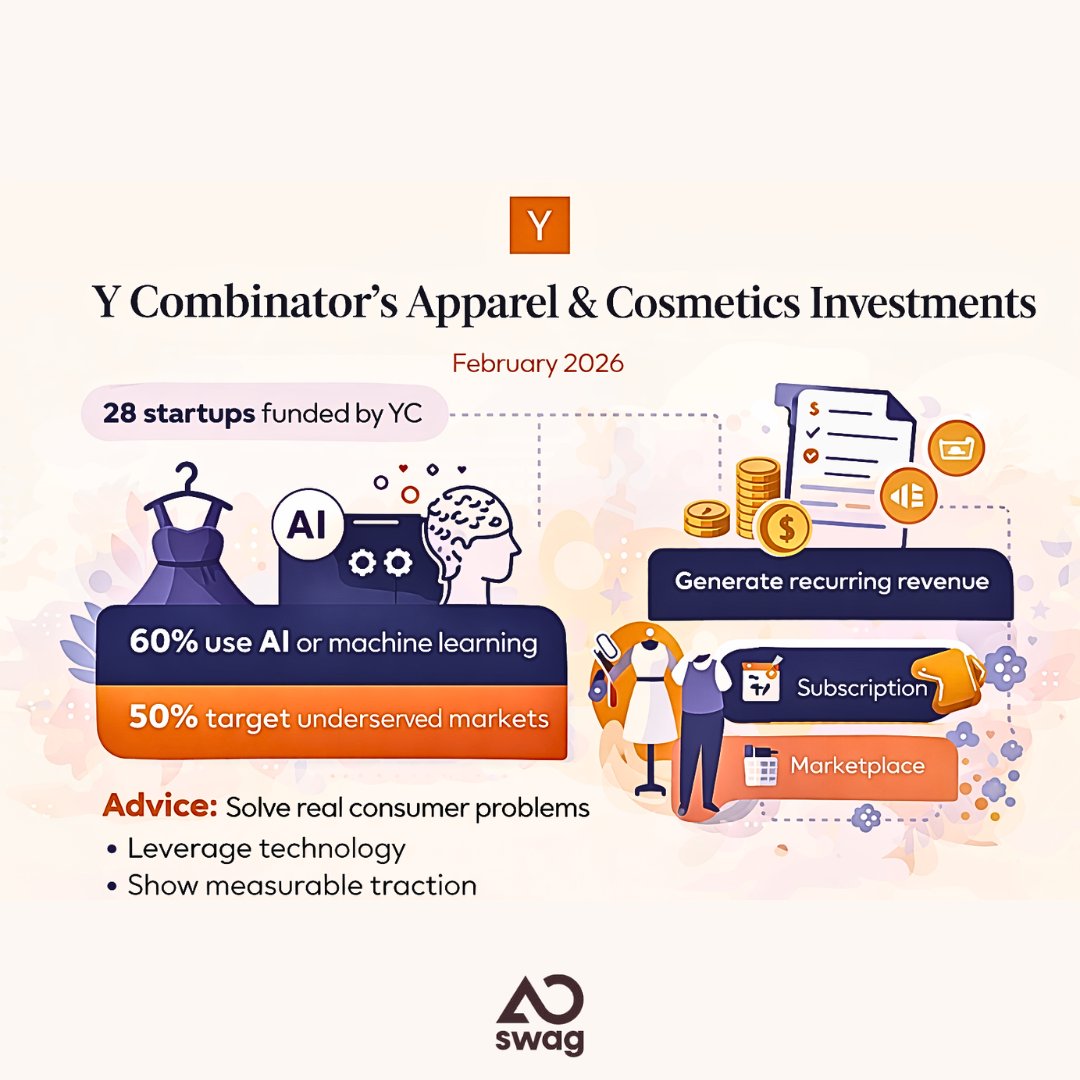
In 2025, @ycombinator funded several cosmetics and apparel startups that combine direct-to-consumer models, personalization, and tech-powered experiences.
✔️ Across their Top-28 cohort, 60% focus on AI or machine learning to improve fit, style, or product recommendations (e.g., @vastrm, Retrofit, Jamble).
✔️ Nearly 50% address underserved segments or niche markets, like petite sizing (Short Story) or textured hair (@LUSbrands).
✔️ Subscription and marketplace models dominate, enabling predictable, recurring revenue (@Scentbird, @getwantd).
✔️ YC favors founders who solve specific consumer pain points while demonstrating scalable growth and strong unit economics.
Advice: 🎯 leverage tech for personalization and CX, focus on solving niche problems, and prove market traction with a data-driven approach.