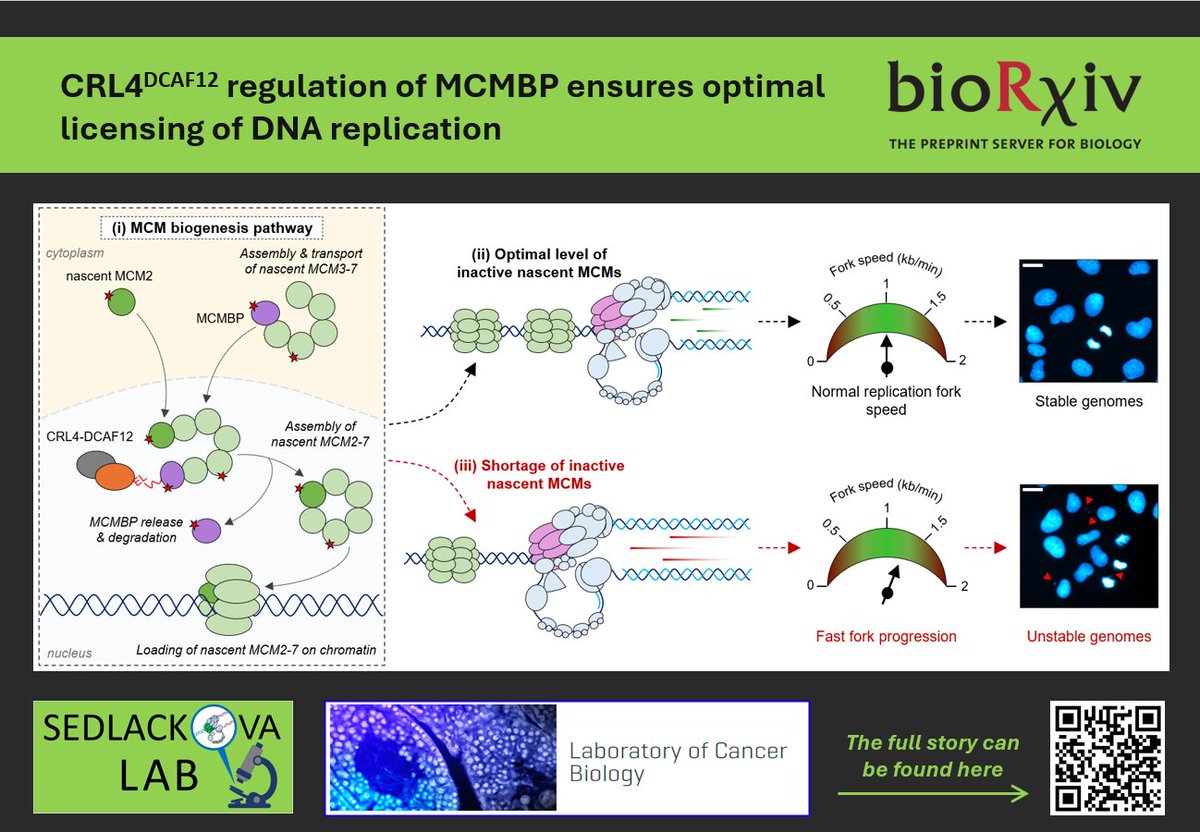
Excited to share our discovery: CRL4-DCAF12 regulates DNA replication by ensuring proper nascent MCM2-7 complex assembly. This prevents genome instability and diseases like cancer.🙏Big thanks to @HanaSedlackova1 for the great collaboration! https://t.co/KbcRMvXICp
📢 Happy to share our bioRxiv preprint on how CRL4-DCAF12 regulates the cellular level of MCMBP, a chaperone of nascent MCM2-7 complexes, to ensure error-free genome duplication. The full story can be found here: https://t.co/296kJoJh1M
Excited to share our discovery: CRL4-DCAF12 regulates DNA replication by ensuring proper nascent MCM2-7 complex assembly. This prevents genome instability and diseases like cancer.🙏Big thanks to @HanaSedlackova1 for the great collaboration! https://t.co/KbcRMvXICp
CRL4-DCAF12 fine-tunes replication by degrading MCMBP, enabling proper MCM assembly and accurate replication speed. Without it? Faster forks, DNA damage, instability—and a cancer risk.
Fantastic work by @NikolDibus and an excellent collaboration with Michele Pagano @paganolab and Ondrej Stepanek @AdaptiveImmuni2! Hopefully, more journals will endorse papers focused on addressing the confusion published across all levels. https://t.co/p5t9wBTgWk
🔬 Join our research team! 🎓 Explore the vital role of the proteasome in cancer cell apoptosis. 🧬Seeking passionate PhD candidates in molecular biology. https://t.co/AsQZ1jm09E 🧪#PhDPosition#CancerResearch#MolecularBiology
Do papers improve after peer review? Only in a limited number of cases. Is it still worth the effort? Let’s eliminate the tyranny of peer review and publish only in BioRxiv. Is it too bold for @NIH to ask to use taxpayers’ money to perform research rather than enrich publishers?
A postdoc position is available in our lab 🔬. If you are interested in DNA replication & genome stability, please get in touch. Thank you for sharing! More information also here: https://t.co/jjvaN6oJpf
Great talk at @imgprague by Vincenzo D'Angiollella @VdangioE3lab on #neomorphic substrates and his own Cyclin F. It's always a blast to meet other Pagano lab @paganolab alumni.
First author Nikol Dibus @NikolDibus
had dedicated her doctoral life to FBXO38, so far the only CUL1-dependent substrate receptor mutated in a hereditary form of neuromuscular atrophy. I can see more great stories coming out about this unique ubiquitin ligase.
🚨 📢 My lab is looking for a highly motivated Research Associate to join our team @WCMCPathology@WeillCornell ! Learn more about us at https://t.co/PepenHRJW6. Spread the word!!
https://t.co/3jx5NHIFL9 📢