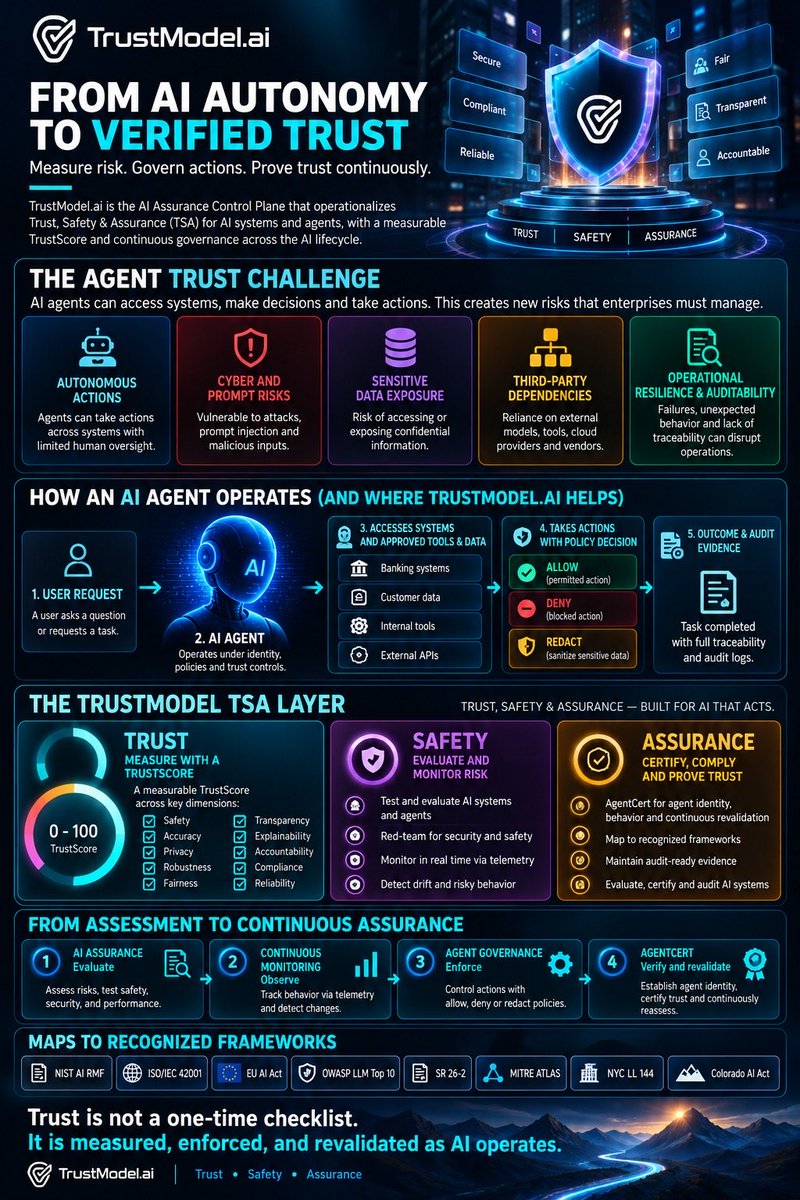
Trust in AI isn’t built on promises it’s built on continuous measurement, governance and accountability.
With https://t.co/QYCesdUR3L,we’re moving from AI autonomy to verified trust, making AIsystems safer, more transparent, and accountable at every step.
Trust. Safety. Assurance
John Chambers (@JohnTChambers) says some of his startups grow 150% a year while adding almost no headcount:
"I was with 45 CIOs yesterday. And at the session, how many of you in the room are driving your productivity above 10 percent? It was the whole room with one exception."
"Some of them are growing over 150 percent a year, order of magnitude in three years, and have added almost no head count. But they realign the resources quickly. They don't lay off people."
- John Chambers, Chairman Emeritus of Cisco and founder of JC2 Ventures, at our AI Assurance & Governance Summit at Stanford on October 1.
At the Stanford AI Assurance & Governance Summit, Arvind Sathi, Distinguished Engineer, CDO Data Catalyst at @KPMG , shared a line that stuck with the room: he built the first full stack AI solution in the world back in 1985, with no hallucinations, because it was engineered properly.
That same discipline is behind what KPMG runs now: 16 petabytes of firm content turned into a knowledge graph powering 50+ agents across audit, tax, and advisory, stress tested with over 560 test cases built to break it.
His takeaway: AI trust isn’t about token counts. It’s about engineering. @rameshchitor
#AIGovernance #TrustInAI #KPMG #TrustModelSummit
“Product runways have gone from 10 years to about 5 weeks. If nothing stays defensible for 5 weeks, what is still defensible?”
That’s the question @karlmehta put to Ben Horowitz, Co-Founder & General Partner at @a16z , at the Stanford AI Assurance & Governance Summit.
#AIGovernance #AIStrategy #VentureCapital #a16z #TrustModelSummit
Cisco President Jeetu Patel (@jpatel41) says AI agents now use five times as many tokens as humans:
"There was a seminal moment that happened in February where the agent token consumption exceeded human token consumption, according to a study with OpenRouter. Since February, agent token consumption now is five times that of human token consumption."
"My prediction is that you will probably in the next 12 to 15 months have 30 to 40% of humans using agents in a very high, sophisticated kind of capacity."
- Jeetu Patel, President and Chief Product Officer of Cisco, at our AI Assurance & Governance Summit at Stanford on October 1.
Chamath Palihapitiya (@chamath) says CoreWeave's fixed contracts can lose their margin as new borrowing costs rise.
"But if the financing goes up, and into that 10, 11, 12, 13, 14, 15% range, these guys are getting very, very, very close to not necessarily being able to cover all the obligations that they have. My team's estimates is that they're plus or minus about 5 billion away from that breakeven point."
"They've sold these fixed contracts, that's super smart, guaranteed a bunch of revenue into the future. But we have this situation where as the risk free rate goes up, their cost of borrowing goes up, that erodes the margin that they have."
"That then brings them close to this breakeven point that causes the CDS to react, which then causes the bond yields to react. That's the negative reflexive loop that they're in."
"I don't think that they're in real risk. But as we all know, this is sort of a confidence game. And you need to have confidence that the broader market can support another 35 billion just from these guys."
- Chamath Palihapitiya, Social Capital founder, on the All-In Podcast episode published October 17
Amjad Masad (@amasad) says AI-built software doesn't have to keep spending tokens after it's built.
"A lot of software is old, deterministic software, like the case in the bank in Japan. It's an accounting software. They're going to spend a couple hundred thousand dollars building it, and then it will last 10, 20 years. And so you don't need constant token cost."
"Now, a lot of companies are deciding, oh, we want, instead of replacing it with new software, we want an AI agent to be able to do that. And that's fine."
"But I think a lot of companies are going to find that AI agents are often harder to control. They're going to introduce bugs in new, subtle ways."
"Good old software will still be here. It's not going away."
- Amjad Masad, Replit founder and CEO, at TechCrunch Disrupt 2026
John Chambers (@JohnTChambers) on the negotiating lesson he learned from Henry Kissinger:
"Kissinger taught me to play, if you really want to have a partnership, turn your cards over in your negotiation and say, here's what my goals are, what are your goals? And then say, how do we win together?"
- John Chambers, Chairman Emeritus of Cisco and founder of JC2 Ventures, at our AI Assurance & Governance Summit at Stanford on October 1.
Cisco President Jeetu Patel (@jpatel41) says there are five open jobs for every person who is good with AI:
"The people that are good with AI, they tend to do pretty well. Like they're working harder, they're getting paid more, they have no shortage of jobs."
"Like if every five jobs is available, there's one person to fill the jobs."
- Jeetu Patel, President and Chief Product Officer of Cisco, at our AI Assurance & Governance Summit at Stanford on October 1.
ServiceNow President Amit Zavery (@azavery) says its AI support agents finish in 20 minutes work that takes a person two days:
"This level one support AI specialist basically can take that input, understand what the user is asking for, reason with it, figure out a plan in terms of how to resolve it."
"What we're seeing today, I mean, we're able to do that kind of work in 20 minutes versus a human would be able to do in two days."
- Amit Zavery, President, Chief Product Officer and COO of ServiceNow, at our AI Assurance & Governance Summit at Stanford on October 1.
John Chambers (@JohnTChambers) says anyone warning about AI from the inside should be asked what they are doing about it:
"Be careful when you come out with a real negative thought, that you're doing it for the right reason, and you're doing it with an answer."
"Because if you have, quote, insider knowledge what this is occurring, first question you ought to be asked, what are you doing about it?"
- John Chambers, Chairman Emeritus of Cisco and founder of JC2 Ventures, at our AI Assurance & Governance Summit at Stanford on October 1.
At the Stanford AI Assurance & Governance Summit, moderated by Ramesh Chitor, Robert Wijnbelt, AI Solution Architect at @ServiceNow , demoed an AI Control Tower that manages governance, value, and security across AI environments.
In the live demo, an AI agent ran inside ServiceNow’s Agent Studio, streaming every action via OpenTelemetry into Trust Model for evaluation. The agent scored 93/100, got certified, and was tested against real guardrails, with one action approved and one denied, automatically creating an incident back in ServiceNow for review.
This is what automated evaluation, scoring, and certification look like when they’re built to ensure AI agents are safe to execute, not just documented as a policy. @rameshchitor , @karlmehta
#AIGovernance #TrustInAI #ServiceNow #AIAgents #TrustModelSummit
Aaron Levie (@levie) says keeping AI inside the IT budget puts an artificial cap on what it can do:
"We're well past the point where the IT organization can hold the entire budget of AI. And that's actually a healthy thing."
"IT budgets kind of run at, depending on the industry, maybe... two to 5% of sort of total revenue, depending on the kind of industry that you're in. And that's obviously... an artificial cap on what AI's potential could be."
"Maybe you want AI alone to be 5% of your total revenue. So that would be a doubling of the IT budget."
"Well, to do that, then you ultimately need the line of business to own the budget and own the sort of deployment of where do they want, you know, AI being used in the organization."
"So I think we're in this renaissance actually of the IT organization, which is your job now is to bring kind of, you know, some form of intelligence to the entire business and be the sort of experts in the technology and what you're going to be able to deliver with that technology."
- Aaron Levie, Box co-founder and CEO, on CXOTalk in an interview uploaded June 15.
What happens when your workforce is part human, part agent?
At the Stanford AI Assurance & Governance Summit, Amit Zavery, President, CPO & COO at @ServiceNow , and Sarah Franklin, CEO of Lattice, sat down to talk about exactly that.
ServiceNow built an AI Control Tower because the real risk isn’t the AI itself, it’s not knowing how many agents are running inside your company or who owns them.
#AIGovernance #ServiceNow #Lattice #TrustModelSummit
I've long said AI & cybersecurity would become two of the biggest growth opportunities in tech. Now they're converging. In my latest @theinnovator column w/ @jennschenker, I explain why leaders must invest in both or risk falling behind.
https://t.co/030sp89V41
What AI Governance Looks Like Today - And Why It Matters
https://t.co/o9WcWW208b
Most "AI governance" today is policy on paper. The real gap is proof: can you show a regulator, an auditor, or your board how a model actually behaves in production?
Governance without independent evaluation is just intent. Thanks to Pearl for featuring this high quality article @karlmehta
#AIGovernance #ResponsibleAI
David Sacks (@DavidSacks) says Marc Benioff is letting Claude own Salesforce's front end, and risking disintermediation on purpose:
"He is integrating Salesforce into Claude. He's willing to allow Claude to be the front end, to have the sort of the primary user relationship."
"So in other words, Benioff here is willing to risk disintermediation in order to ride this AI wave because he knows it's what the customer ultimately wants."
"You don't want to go into Salesforce or any SaaS application to write your agents. You want to create agents in the AI program that you're using. And you want those agents to be able to run across all of your SaaS platforms."
"Why is this ultimately good for his business and not bad is because, like I said, I still think that you need systems of record. You need the AI agents to basically go to those systems, get the data from a canonical source of truth. You just don't want there to be any probabilistic variability around that."
"It's not a rip and replace."
"Benioff is saying that the AI is now the user interface. He's basically acknowledging that he's leaning into it."
- David Sacks, All-In co-host, on the All-In Podcast episode published August 29, three days after Salesforce and Anthropic announced their Claudeforce partnership.
Cisco President Jeetu Patel (@jpatel41) says AI could cure all diseases, and if it goes wrong, critical infrastructure gets attacked:
"If we do it right, I think we will cure all diseases."
"If it goes wrong, there's a lot of adverse effects that happen, because the critical infrastructure could be attacked. People could lose their lives, because if a hospital is attacked, you won't get dialysis. If a power plant is attacked, you won't be able to actually have a food supply within three days. There could be civil unrest that happen."
- Jeetu Patel, President and Chief Product Officer of Cisco, at our AI Assurance & Governance Summit at Stanford on October 1.
Healthcare AI Is Already Here: Meet the Leaders Deploying It
Four health system leaders, representing over 15 million patients combined, joined us at the AI Assurance & Governance Summit at Stanford to talk about what’s really happening with AI in healthcare today, not the hype, the reality already in production. From predictive analytics catching clinical deterioration early, to a shift away from small pilots in favor of scaling from day one, this panel shows healthcare AI is no longer theoretical.
Thank you to our speakers and moderator:
🎙️ Diane Choi (moderator, Samsung NEXT Ventures)
Nallan Sriraman (@MassGenBrigham )
Kenneth Trauner MD ((Kaiser Permanente ,@aboutKP )
@Shyam_Vis Visweswaran (@UPMC )
Nicholas Gavin (@MountSinaiNYC)
#AIinHealthcare #TrustModelAI #FutureOfHealthcare #StanfordSummit