Cognitive Neuroscientist at @theIACS using neuroimaging, neuromodulation and technodelics to study Trust, Artificial Empathy and the Varieties of Consciousness
@dr_mmguthridge@MelitaGiummarra I am biased as I read the abstract of your paper before answering, but my working definition of empathy is fairly close to what you arrived at! I like the emphasis on empathy as process with multiple dimensions. Looking forward to reading the full paper.
Brain Synchronization for Perception
Nicco Reggente, PhD, neuroscientist and co-founder of @theIACS
“What I'm excited about that I'm not working on is probably individualized entrainment.” Aligning a person's unique alpha brainwave frequency can enhance learning and perceptual decision-making.
Study: Learning at your brain's rhythm: Individualized entrainment boosts learning for perceptual decisions. https://t.co/vPd34lsIEm
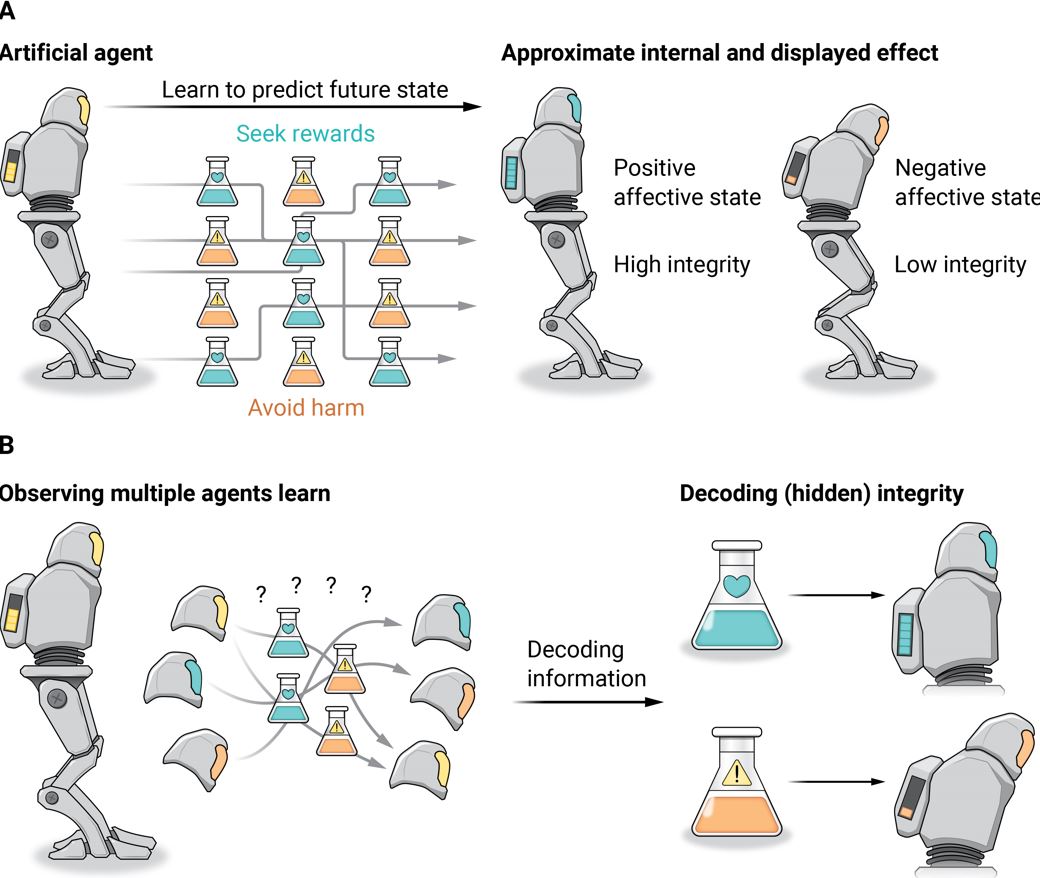
Artificially vulnerable, fully empathic #AI is required to prevent sociopathic robots.
Learn more in a recent @SciRobotics Viewpoint: https://t.co/mVO68Ld4bF
Artificially vulnerable, fully empathic #AI is required to prevent sociopathic robots.
Read the recent Viewpoint at Science #Robotics: https://t.co/LA20MZhJJM
Marc Tessier-Lavigne is stepping down as president of Stanford University following an investigation into practices in his laboratory.
The matter shows why running a lab is a full-time job, @hholdenthorp argues in a new Editor’s Blog post. https://t.co/667BjzmCnC
🚨✍️New IACS publication: A book chapter called "VR for Cognition and Memory". This chapter, to be featured in Current Topics in Behavioral Neurosciences, touches on the unparalleled verisimilitude of VR for veridical studies of cognition
https://t.co/PVEOehVZGF
Creating artificial empathy is the key to preventing robots and AI from turning malicious, apathetic, and/or antisocial, asserts a new @SciRobotics Viewpoint. https://t.co/dVc8XxTHQd
Urgent need for AI empathy! Fantastic paper by @ChristovMoore and @theIACS where the authors discuss that current approaches overlook the crucial affective aspect, promoting sociopathic behaviors. Let's embrace vulnerable, empathic AI to protect human welfare. #ArtificialEmpathy
Creating artificial empathy is the key to preventing robots and AI from turning malicious, apathetic, and/or antisocial, asserts a new Viewpoint. @ChristovMoore@USC@UCLA https://t.co/dKKmhOllPZ
In this week's #SciencePodcast🎙️, @boron110 and neuroscientist @ChristovMoore talk about the importance of feelings for future iterations of #AI.
🎧 Listen to this segment and more: https://t.co/rIBN6FCSsG
@magnabosco@Jonas_Kaplan@USCDornsife Yes, but we have to take into account the a model and flexible nature of suffering, which is far more integrative and creatively inferred than just the momentary impairment of function. Affect serves a sophisticated computational function - @CasperHesp thoughts?
Really interesting follow up from @gvillalobosm . Indeed, how do we leverage empathy in ensuring AI’s niche is complementary? What do we do about the faults and failures of human empathy? This will demand much of us as role models.
2. Must never be used to replace humans, but to help them to become better at what they are doing.
3. Must be used only to prevent humans from working on future positions in which computers and robots are better, like repetitive, boring, and difficult tasks.
2/3
I can't agree more. Just as Asimov's laws, we need to develop new "empathy" laws for AI. Some that have come to my mind:
1. AI must be developed and implemented only to boost human intelligence, creativity, and innovation.
1/3